
Hyundai pens another hit
By Gary S. Vasilash
When the model year 2020 Hyundai Palisade first rolled out, it pretty much changed the nature of three-row SUVs.
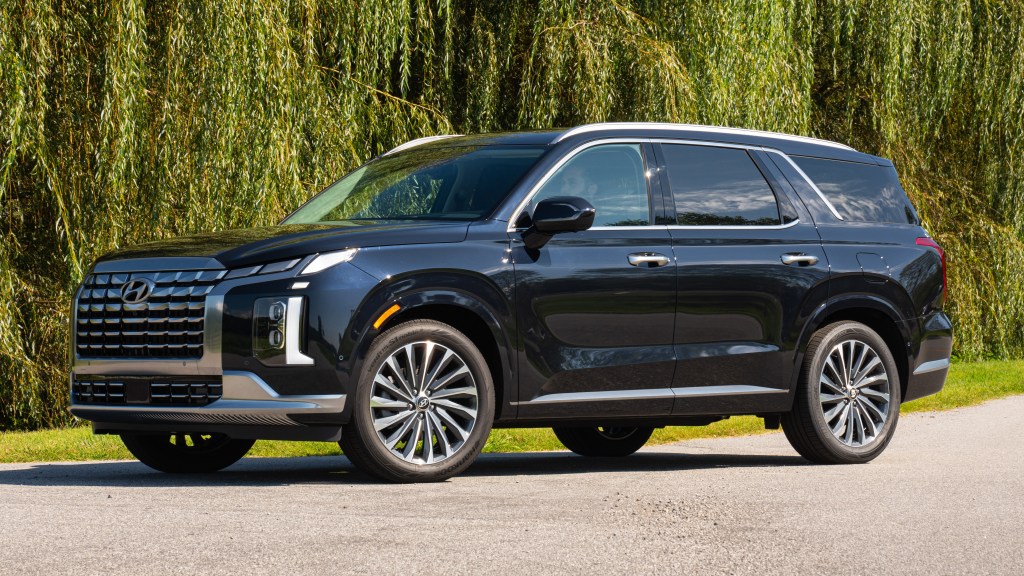
That is, whereas models in that category had tended to be more utilitarian in their styling (read: boxy and bland), with the Palisade it is almost as though Hyundai designers and engineers figured: “The others are solidly well established in this space, so if we’re going to wedge our way in, we’ve got to up the ante.”
And they did, inside and out.
Here is a vehicle that looks stylish while substantial, which is no mean feat. A vehicle that provides a sense of being in a comfortable environment (often, because vehicles are designed to transport people from A to B, the interior is executed as a waystation, something that’s temporarily engaged; here it is more like being in a room, and especially when taking long(er) road trips, that is highly desirable.)
Hyundai did a refresh of the vehicle for model year 2023 and as seems to be the case with this company, adjustments and improvements are made on a regular basis, not as some OEMs do, which is wait (sometimes too long).
Some Numbers
The Calligraphy trim is the second highest on offer, with a starting MSRP of $50,350—and given the level of amenities, the starting MSRP is probably going to end up being close to the finishing MSRP for many people. (Above Calligraphy? Calligraphy Night, for those who are looking for a blacked-out variant.)
The bigger choice that one needs to make is whether to opt for the front-drive version or the optional HTRAC AWD model, which is a price bump of $2,000.
Either way, there is a 3.8-liter V6 that produces 291 hp and 262 lb-ft of torque mated to an eight-speed automatic.
There is a 5,000-pound towing capacity.
It is 196.7 inches long, 77.8 inches wide, 68.9 inches high, and it has a 114.2-inch wheelbase.
Design Details
The Calligraphy has a unique front fascia that is largely predicated on a grille that consists of a pattern of individual metallic-appearing geometric elements, rectangular but with a create that results in three-dimensionality, that serve to accentuate the larger metallic pieces that frame the front end of the vehicle. It is a purposeful look.
Twenty-inch alloys are a key element for the body side design, as are a strong C-pillar and short front and rear overhangs.
The back has large vertical LED lamps and a wide horizontal skid plate that provide, in effect, a cubic solidity.
Pop that back hatch and there are 18 cubic feet of cargo capacity behind the third row and if you fold it and the second row down, there is 86.4 cubic feet for serious stuff.
Inside View
From the driver’s seat, the interior appears (because it is) large, but the execution of the instrument panel is more minimalist than exaggerated, than is the case in some other large vehicles. For example there is a long slot, going from just to the right of the steering wheel all the way to the passenger door panel that is the HVAC vent. Subtle, not fussy.
(Speaking of the door panel: it is quilted on the Calligraphy: again, something that is simply a nice touch.)
The seating—throughout—is comfortable and covered with Nappa leather.
Yes, there is a 12.3-inch navigation screen with a horizontal orientation. (And on the subject of navigation, it is integrated with the smart cruise control which allows curve control, as in adjusting the speed when going into a curve.) The gauge cluster is also 12.3 inches. While the vehicle facilitates digital control of features, there are knobs and buttons for things like adjusting the temperature and cranking the volume on the 630-Watt Harman Kardon 12-speaker audio system.
One thing worth noting about things of an audible nature: generally if you have something large—and the total interior volume is 173.3 cubic feet—that is rolling on 20-inch wheels, it can be noisy. The vehicle uses acoustic glass on the side windows and windshield, and I’m guessing a non-trivial amount of other materials used for noise countermeasures. And because sometimes those in the front want to clearly communicate with those in the back, there is an in-car intercom.
As this is a “family” vehicle, and as keeping members safe it a key consideration, there is a full suite of safety tech, including lane keeping assist, lane following assist, blind-spot avoidance assist, high-beam assist. . . you get it. Lots.
Final Thought
Hyundai has plenty of SUVs on offer. There are Venue and Tucson, Kona and Santa Fe, Ioniq 5 and Nexo.
The Palisade is its top-of-the-line. And there is no question that it is. On the Hyundai retail website there are comparisons made with vehicles including the Ford Explorer, VW Atlas, Honda Pilot, Nissan Pathfinder, and Dodge Durango.
While there are comparable elements to all of those, and while all of those are mainstream brands, arguably the Palisade can compete in a class above and hold its own.
 shinymetalboxes