
The cool pickup gets cooler. And more capable.
By Gary S. Vasilash
One of the most significant vehicles that Ford has launched during the past few years—arguably more significant than the Mustang Mach-E, which people seem to get excited about—is the Maverick, a midsize pickup truck that is smaller than the Ford Ranger, another midsize pickup truck, which has seemingly lost its mojo.
So let’s put some numbers to the “significant” claim.
Through the first half of 2024 the respective U.S. sales for the vehicles:
- Mustang Mach-E: 22,234
- Maverick: 77,113*
And for good measure:
- Ranger: 15,175
So why is the Maverick, which went on sale in late 2021 as a model year 2022 vehicle, so successful?
Because it is small, fun, funky, functional, and economical.
As for the last item: the starting MSRP for a 2024 Maverick XL with a 2.0-liter EcoBoost engine, is $23,920. For those interested in a 2.5-liter hybrid version, that’s $25,420.
The functional part is that it is a bona-fide truck. As in something with the ability to handle a 1,500-pound payload and tow up to 4,000 pounds (with the 2.0-liter).
And the really clever bit that Ford designers and engineers did was to embrace the fact that they were creating something that would have a low price point.
Typically there seems to be a tendency for them to pretend that whatever it is they’re putting on the road is more expensive than it is, which leads to faux execution inside (in particular) and out.
In the case of the Maverick, while the materials may not be the stuff of an F-150 King Ranch edition, those materials are treated with an honesty and an innovative spin such that they make the truck all the better because there is an authenticity to it.
Now, for model year 2025, the Maverick is getting a refresh.
And a new model.
“One of the first things you’re going to notice is a slimmer, more modern headlight profile,” says Josh Blundo of the design team.

The primary change for the Maverick trims across the board—and there is a new trim added, the Tremor—is in the front, not only in terms of the headlights, but the fascias, which are specifically designed for each trim (e.g., the Lariat trim has a grille featuring what Blundo refers to as “chicklets,” small metallic rectangles that pop on the black grille).
Inside the most obvious change is the 13.2-inch touchscreen—standard across the lineup—which Blundo says is as big as the screen in any Ford model. Yes, as big at one in an F-150.
Kirk Leonard from the engineering team—who has been with Maverick since just after the launch of the ’22 MY vehicle, and who came to it from Super Duty, which goes to show that this is a serious truck—points out, “Just because we’re a small truck doesn’t mean we get a pass on the capability, durability and toughness that customers expect from our vehicles.” So while the Maverick may be fun, it is not a poseur.
Leonard says “The number-one thing customers have been asking for is all-wheel drive for the hybrid.”
So the ’25 Maverick is available with a AWD system for the hybrid.
Leonard adds, “They wanted all-wheel drive but they didn’t want to give up on fuel economy.”
So, he says, they’re estimating that the AWD Maverick with the 2.5-liter hybrid system will deliver 191 hp, 155 lb-ft of torque, and 40 mpg city.
Those who are even more interested in fuel economy but not interested in all-wheel drive can get the front-drive version, which Leonard says will provide an estimated 42 mpg in the city, and a 500-mile range on a tank of gas.
The Maverick is also available with a 2.0-liter EcoBoost engine that provides 238 hp and 277 lb-ft of torque.
And There’s This. . .
Josh Blundo is one of those guys who is a quintessential “car guy.” While a teen in New Hampshire he was sketching cars, which really wasn’t a thing that his peers were doing. He went to the College for Creative Studies in Detroit and found that car culture was everywhere.
Which is evidently an environment he thrives in.
He says that when the Maverick was first launched he saw that it had a certain minimalism that he finds appealing. And something to use as a launch pad for creation.
Which lead to the design of the Maverick Lobo model.
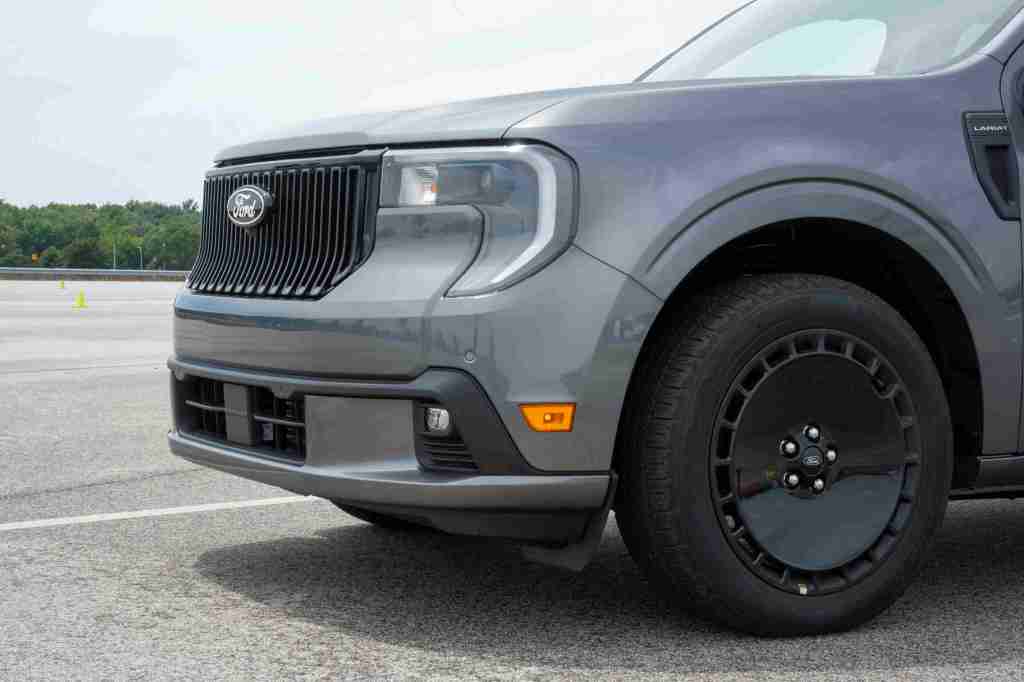
Although this fits within the “street truck” modified niche, Blundo says, “Street trucks really represent a broad culture. A lot of people think ‘muscle’ trucks—full-size trucks with V8s.”
Then, at the other end of the spectrum, he says, are tuner vehicles. In this case they’re mainly sedans and hatches—Civics and Golfs and the like.
“Maverick, because of where it sits in the truck space, unibody and more focused on handling than straight-line performance, sits in the middle ground,” Blundo says.
So for the Lobo aesthetic they lowered the truck ½ inch in the front and 1.12 inches in the rear, which results in a roof height that’s 0.8 inches lower. And that roof is painted black, as are the 19-inch wheels. (Speaking of the roof: there are two available configurations, Standard and High. High, among other things (e.g., heated steering wheel and seats; spray-in bedliner) includes a moon roof.)
There are a Lobo-specific front fascia and painted rear bumper.
Kristen Keenan and her colleagues in Color + Materials provided the Lobo with a unique interior execution. Keenan, who had worked designing performance footwear at Nike, says that that experience helped inform what they did inside the Lobo, such as using ActiveX, a high-end synthetic that looks good and wears well.
Because this truck is not just about show but also go, there are things like a twin-clutch rear drive unit that provides torque vectoring and an upgraded cooling system.
The truck offers the “Lobo mode,” a drive mode that essentially minimizes the intervention of the stability control system so that the truck can be thrown around on a track—a closed track, notes Keith Daugherty, an engineer who worked on the Lobo and deployed elements from the European and U.S. Ford parts bins (brakes from the Euro Focus ST; strut mounts from the Mach-E).
And, yes, as a daily driver the Lobo has available, like other Mavericks, things like Pro Trailer Hitch Assist, because at the end of the day, it’s a truck.
==
*While some may quibble that this is an unfair comparison, given that one is an EV and the other is a pickup truck, the Maverick is a pickup truck that is available as a hybrid, and according to James Gilpin, Maverick brand manager, about half of all Mavericks sold are hybrids. This means about 38,550 Mavericks sold are electrified, still greater than the 22,234 EVs.
 shinymetalboxes