
It isn’t often you can find a vehicle of this type that is (1) affordable and (2) actually fun to drive.
By Gary S. Vasilash
In 2024 Mazda North American Operations reported “record-breaking” sales. It sold 424,382 vehicles.
Of that total, 46,980 were cars. The remainder, 377,402 were crossovers.
The cars consisted mainly (as in 38,877) in the form of Mazda3s. The MX-5 Miata made up the balance in the car calculations.
But look at all of the crossovers.
The point is, Mazda has made a concerted shift away from the cars. Many driving enthusiasts who knew they needed to buy cars mainly for purposes of daily transportation would often opt for a Mazda because (1) it had sporty driving dynamics, (2) it was affordable and (3) it would do what needed to be done in terms of simply getting you to work or school in an appealing package.
Years ago at a press conference where an SUV was being introduced a writer for one of the buff books asked a company exec, “I get the utility part, but what about the sport?”
That must have been 20 years ago.
And in that time, while there has been an explosion of SUVs (or some would say “CUVs,” because most of them are based on car platforms so they are considered “crossovers,” but what isn’t taken into account is that many SUVs are based on truck platforms, so aren’t they crossovers, too?), the levels of stylistic sportiness, either in terms of the exterior sheet metal or the powertrain and chassis combination have been lacking.
Even the utility isn’t what one might think. People interested in carrying people and goods would be better off getting a minivan.
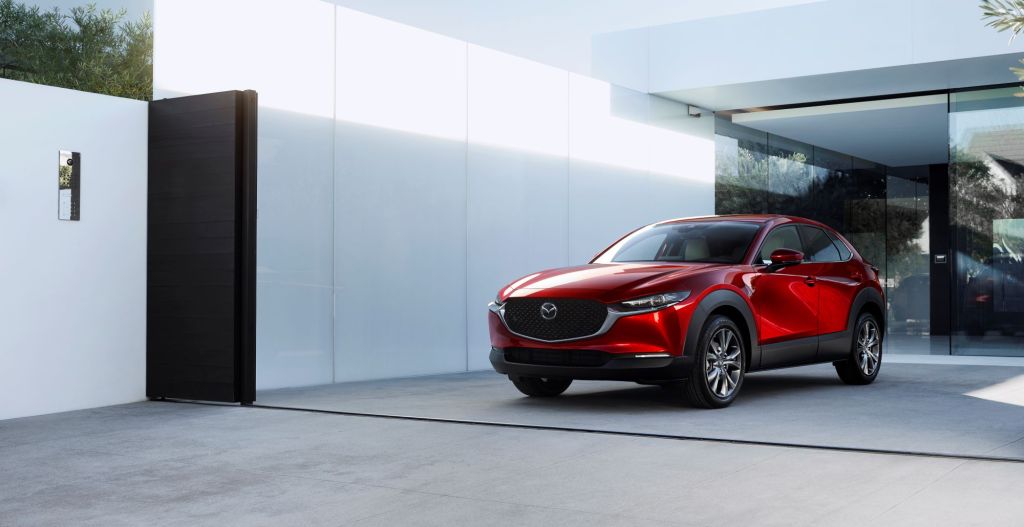
The Mazda CX-30 is sporty and it is comparatively affordable, with the trim driven here having an MSRP of $32,940, which is well under the average transaction price for a vehicle nowadays such that even though it is a bit so-so on the miles per gallon front—22 mpg city, 30 mpg highway, combined 25 mpg—you’d have cash left over for filling the tank quite readily, even if you opt to fill it with premium. Why would you do that? Because on premium the turbo-charged four produces 250 hp. On regular gas the output is 227 hp. So sportier is simply a bit more expensive.
The engine is mated to a six-speed automatic. There are paddles should you desire to shift-it-yourself, of course.
The vehicle features Mazda’s i-Activ AWD system, which monitors where the torque needs to go, and G-Vectoring Control Plus, which both adjusts torque and braking when cornering.
Chassis-wise, the front suspension is MacPherson strut with a stabilizer bar and in the rear a torsion-beam setup.
All of which goes to the point of this being sporty.
There is utility, too, given the configuration of the vehicle, offering 20.2 cubic feet with the rear seat in place (per EPA) and 45.2 cubic feet with the seat back folded (per SAE).
Given this is the S Carbon Turbo trim, there is an appropriate use of fitting materials, such as terracotta leatherette/suede seat coverings, as well as a suede material on the IP. The IP has a 10.25-inch infotainment touchscreen. There are, of course, wireless CarPlay and Android Auto, and even Alexa.
The bottom line: this is sport. And utility.
 shinymetalboxes