
Considering the execution of the Kona. . .
By Gary S. Vasilash
During the development of the 11th-generation Ford F-150 (2004-2008) J Mays was the vice president of Design at Ford.
One of the briefs that the design team had was to improve the interior design of the truck.
During a presentation at the Ford design facility in Dearborn Mays pointed out that while the exterior sheet metal gets people in a vehicle—they go to the showroom, see it, and if they like it get into it—but the interior design keeps them there.
If you think about it, vehicle interiors are far more important than exteriors.
Yes, it may be that seeing whatever in your driveway puts a smile on your face whenever you go out to get into it.
But that lasts a few moments and when you are in the vehicle there are a whole lot of moments spent behind the wheel.
According to autoinsurance.com the average time spent driving to work in 2024 was 26 minutes. So that would be a roundtrip time of 52 minutes. Five days a week, then that’s more than four hours.
Yes, the interior environment in a vehicle matters. A lot.
The Vehicle Then & Now
Which brings me to the Hyundai Kona.
I am a fan of the exterior of the first-generation (model years 2018-2023) Hyundai Kona. It added significant amounts of style to the small SUV category, a category that was (and pretty much continues to be) dominated by designs that are readily forgotten.
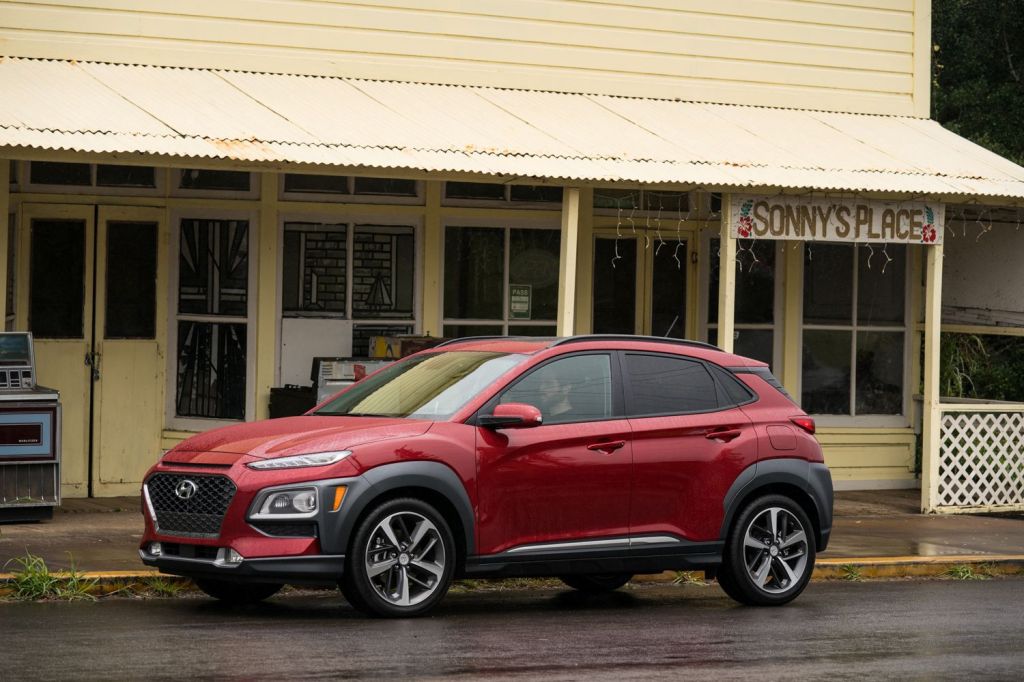
The exterior design is sporty. And at least in terms of cargo capacity, it is reasonably utile: 19.2 cubic feet of cargo space with the second row up and 45.8 cubic feet with the seat down.
But that was then and this is now.

The second-generation Kona was launched in model year 2024. Driven here is 2025.
And the exterior sheet metal is in my estimation less sporty and more, well, manhwa (i.e., the Korean term for “manga”).
Lots of Room
But the utility quotient is way up, with cargo capacity being 25.5 cubic feet behind the second row and 63.7 cubic feet with the seatback folded.
Similarly, the passenger volume is way up: it is 94.1 cubic feet (w/o sunroof) for the first-generation Kona; it is 101.2 cubic feet for gen two.
Lots of Tech
And the interior of the second-generation Kona is a nice place to be because it is exceedingly well done.
I just took a quick drive to the store in the Kona. While waiting behind a few cars to make a left turn, when the car ahead of the Kona moved and I didn’t immediately react, a “bing” and a message on the gauge screen pointed out that the car had moved way.
When I got home it pointed out that I should look in the rear seat as I had opened the rear door to put in groceries.
While that rear-seat notification is now common (according to the Alliance for Automotive Innovation, which organized voluntary commitments among its members in 2019 for rear-seat reminder systems, as of November 2024 there were 263 models available with the tech), the Leading Vehicle Departure Alert is rare.
And there’s Blind Spot View Monitor. Flick the turn signal to either direction and there is an appropriate live camera image of that side of the vehicle shown in the gauge cluster. While this is available only in the Limited trim, the Limited AWD driven here has an MSRP of $33,400.
“Smaht. Very Smaht.”
And for that you get a vehicle with that, remote smart parking assist (“Smaht Pahk” as the 2020 TV commercial with John Krasinski, Rachel Dratch and Chris Evans put it), a 12.3-inch digital instrument cluster, another 12.3-inch navigation screen, heated and ventilated front seats, a heated leather covered steering wheel (and on the subject of leather: the seating surfaces are H-Tex, a faux leather which is convincing), a proximity keyfob with pushbutton start (keep the key in your pocket or purse: the door unlocks and you can start the vehicle), and an overall look of clean, contemporary design on the inside of the vehicle.
The vehicle is powered by a 1.6-liter turbocharged engine that produces 190 hp and 195 lb-ft of torque. It is stickered at 24 mpg city, 20 mpg highway and 26 mpg combined, which is pretty much what I got while driving it.
Thoughtful
One of the striking things about the Kona is that it has what I consider a “deliberate design.”
Sure, all vehicles have a design brief and to the extent that’s executed, their designs are deliberate.
But it seems there is a considerably stronger level of consideration applied here, both inside and out.
What’s more, the technology that are part of the package tends to be the sort of things that other OEMs put in vehicles that are much higher in price.
 shinymetalboxes