
An accessible vehicle that happens to be a car. . .
By Gary S. Vasilash
The Ford Model T was in production from 1908 to 1927. During that time there was an array of variants. Touring cars and coupes. Four doors. Two doors. No doors. Sedans and convertibles and wagons.
In all, an impressive >15 million were sold.
The Volkswagen Beetle is another car that had an impressive run. Between 1938 and 2019 there were some 22 million Bugs of various types sold on a global basis.
But those cars pale in comparison to the Toyota Corolla.
The Corollas was introduced in 1966. Since then, more than 50 million have been sold globally.
Yes, add all the Model Ts and Beetles and it is still considerably less than the Corolla.
Last year in the U.S. there were 232,908 Corollas sold.
If you take the F-Series out of the picture, there was no Ford brand model that came close in terms of 2024 sales. There was the Explorer at 194,094, but that’s 17% fewer than the Corolla.
And it is a similar situation at GM. Again, absent the pickups, the best-selling model in 2024 was the Chevy Equinox, at 207,730 vehicles. Closer, but no cigar.
(If we want to go down the SUV road: there were 475,193 Toyota RAV4s sold in the U.S. in 2024. . . .)
So far, the Corolla continues to perform:
Through Q1 2025 there have been 55,456 sold.
The Explorer is inching closer at 47,314 and the Equinox exceeds it with 71,002, but again, both of those vehicles are SUVs, so that would bring us to the RAV4’s Q1 sales of 115,402.
If you combine the Explorer and Equinox sales, that’s 118,316, or 2,914 more than the RAV4, to put things into some sort of perspective.
Chevy, Ford and Toyota are all, essentially, bread-and-butter brands. They’re making vehicles for most of us.
But what is surprising, given the Corolla’s clear consistently large sales—globally and in the U.S. market—is that you can’t buy a car from Chevy and the only car that Ford has in its lineup is the Mustang. That’s not exactly a mainstream model. (And to put its sales into perspective: in 2024 there were 44,003 Mustangs sold, which means that in the first quarter of ‘25 Ford moved more Explorers than Mustangs in all of ’24.)
(Another thing to be noted about Toyota and cars: last year in the U.S. it sold 309,876 Camrys. It has sold 70,308 through Q1 of ’25. Yes, a lot of cars.)
The thing about the Corolla is that like the aforementioned Model T and Beetle, it is primarily an accessible vehicle.
About the FX
The vehicle driven here, the FX, is based on the Corolla SE grade, but has been amped up a bit for a sportier look.
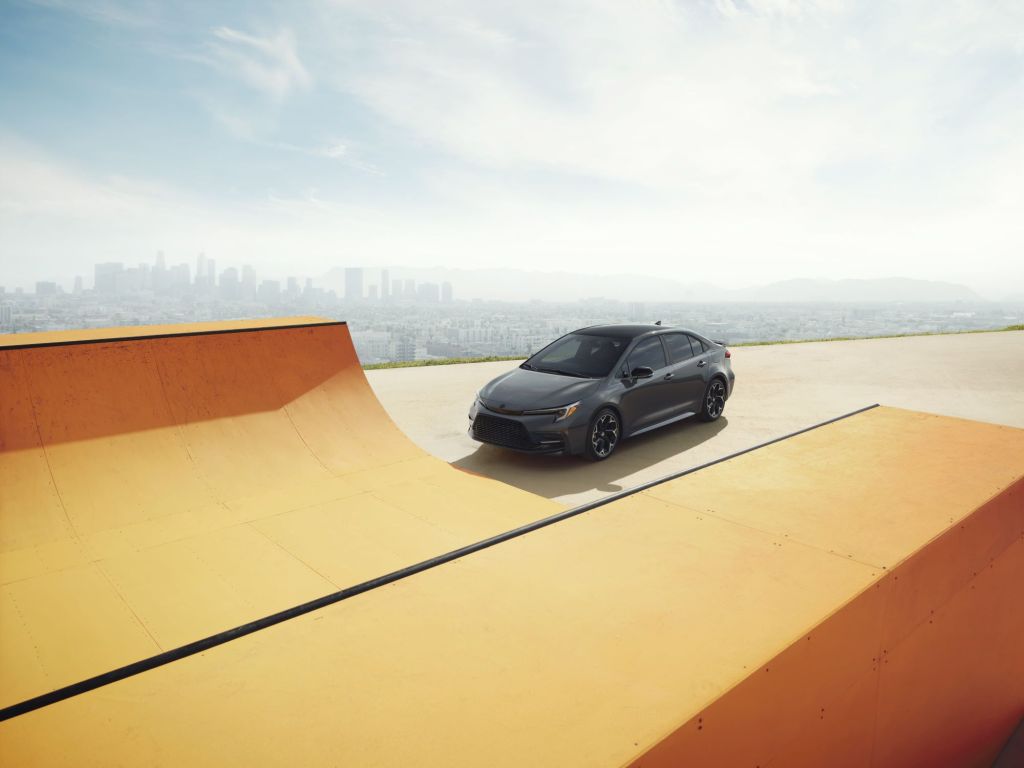
Achieving that look includes a sizeable spoiler, satin-black 18-inch alloy wheels with black lug nuts, and a blacked-out roof.
Powering the car is a 169-hp four-cylinder engine. There are three drive modes: Eco, Normal and Sport. This car isn’t going to win any races. But hundreds of thousands of people who have bought Corollas over the past few years likely don’t even know where a racetrack is located, and probably don’t have any points on their licenses for speeding.
On the inside things are, as they might say, “jazzed-up” a bit with the use of orange stitching on the seats and trim.
There is a 10.5-inch infotainment screen. Where there are knobs for HVAC settings, curiously no volume or tuning knobs for the audio system. You adjust the volume either with a steering wheel button or a diminutive rocker button just below the screen, which is a bit tricky to use unless you’re sitting at a light.

Affordability
One of the reasons—in addition to the reliability, durability and quality Toyota vehicles are known for—people buy Corollas is because they’re affordable.
The MSRP prices range from $22,325 for an LE to $28,190 for a Hybrid XLE. (These numbers are pre-Liberation Day, so who knows what anything will cost going forward.)
This FX Edition has a starting MSRP of $26,500. Throw in a few options ranging from a blind-spot monitor with rear cross-traffic alter to an LED trunk light, adding $1,644, put in the handling fee of $1,135, and it is out the door for under $30,000: $29,279.
And there aren’t a whole lot of other cars you can say that about—unless, of course, you’re talking about Corollas, and then there are a whole lot of them.
In Addition
A couple other things to know about the Corolla.
One is that it is based on the Toyota TNGA-C platform, which doesn’t mean much in and of itself. What is important to know is that it is a global platform. Which means that it is being used as the basis of vehicles all around the world. Consequently, because of economies of scale it can be engineered and built with more robustness than a platform with a more limited scale—well, that limited-scale platform can certainly be produced with desired characteristics but it will be a whole lot more costly.
The point about the platform is that it is solid, not tinny.
Second, the Corolla driven here was built. . .in Huntsville, Alabama, at the Mazda Toyota Manufacturing plant. Yes, a compact car built in the U.S.
 shinymetalboxes