
Built to take it. . . .
By Gary S. Vasilash
Consider these elements:
- Fox Racing QS3 internal-bypass shocks, front and rear, with rear piggyback-style remote reservoirs
- Independent double-wishbone front suspension with coil springs and stabilizer bar
- Multi-link rear suspension with coil springs and stabilizer bar
- 33-inch Toyo Open Country III tires
- 18-in. matte-black alloy wheels with 33-in. Toyo all-terrain tires
- Stabilizer Disconnect Mechanism (SDM)
- Multi-Terrain Select (MTS) and Crawl Control (CRAWL)
- Electronic locking rear differential
- TRD Pro aluminum front skid plate with underbody transfer case and fuel tank protection
- Part-time 4-Wheel Drive (4WD)
- Electronically controlled 2-speed transfer case (high/low range) and Active Traction Control (A-TRAC)
- Rigid Industries LED fog lights
If those things make you shrug, as in “I don’t exactly know why these things are of particular importance,” then the 4Runner TRD Pro is not for you.
Which is not exactly the sort of thing you ordinarily see this early in a description of a given vehicle.
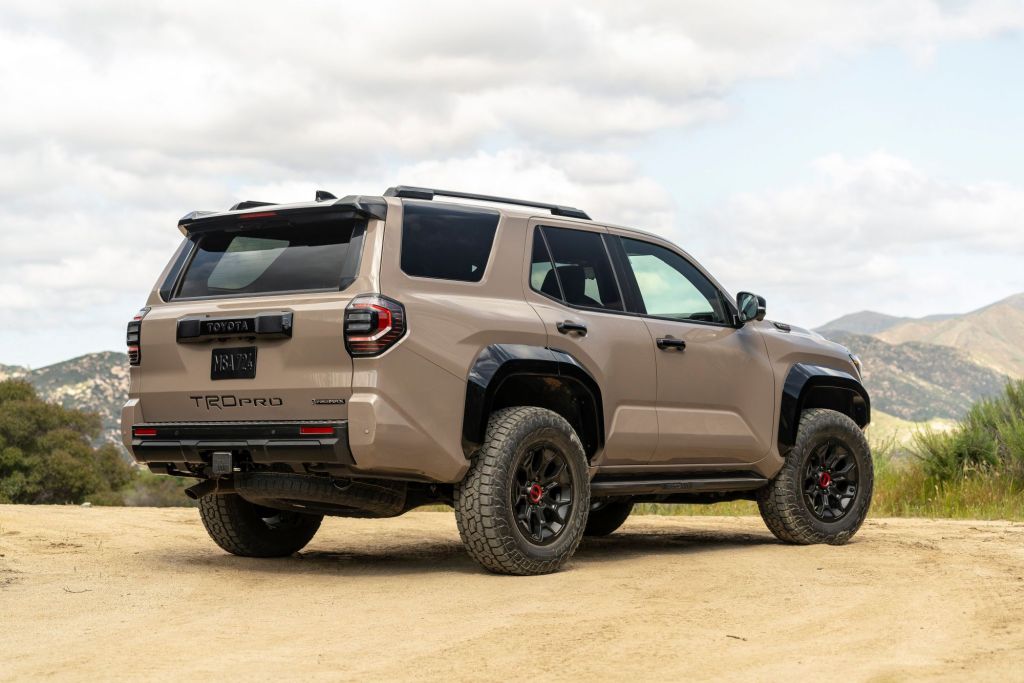
But the point is, the 2025 4Runner TRD Pro, a mid-size SUV, is engineered to drive on terrain and in ways that if you aren’t an enthusiast of the great outdoors you are likely never to appreciate.
Here’s another thing to know about this model—as well as the other 4Runner variants: It has body-on-frame construction.
Again, if you shrug, then maybe there should be the consideration of something like a Grand Highlander.
The TNGA-F platform the 4Runner is built on is also used for things like the Toyota Tundra and Tacoma—both pickup trucks. (It is also found on the Toyota Land Cruiser.)
This is a fully boxed ladder frame that is constructed to provide high levels of torsional rigidity. Another thing Toyota has done is use tailor welded blanks, which means there is additional strength in areas that need it so the structure is ready to handle the hard stuff, like when crawling over rocks.
The vehicle is powered by an i-FORCE MAX 2.4-liter, turbocharged (twin-scroll turbocharger) 4 cylinder hybrid engine.
Yes, that’s right: this is a hybrid, a parallel hybrid system with a permanent magnet synchronous motor/generator. The system—as in the combustion engine and the electric motor—produces 326 hp @ 6,000 rpm and 465 lb-ft of torque @ 1,700 rpm.
There is an eight-speed automatic.
And if you’re curious: it is rated at 23 mpg city, 24 mpg highway, 23 mpg combined.
The TRD Pro offers seating for five on SofTex-covered seats: this is material that resembles leather, but which is formulated to be able to handle serious wear and tear. It also cleans up nicely, because if you’re going to have a vehicle that you may take literally off-the-grid on weekends (which goes back to the point of the TRD Pro), odds are you’re going to want to get rid of the mud and muck that may be brought unintentionally back into the cabin. (Leather is used for the heated steering wheel and on the shift knob.)
The 4Runner offers beefy knobs, dials and buttons that make making adjustments far easier than is the case of vehicles that have switched to digital interfaces for changing things. But this is not to say that the vehicle is in any way behind when it comes to tech, as there are a 12.3-inch digital gauge cluster and a 14-inch infotainment screen. There is a 14-speaker JBL audio system. The 4Runner has wireless Apple CarPlay and Android Auto.
The interior is so good that it is a winner in the 2025 Wards 10 Best Interiors & UX competition.
But let’s go back to the list that started this and the claim that if you aren’t impressed, the 4Runner TRD Pro is probably not the one for you.
It is worth knowing there are eight other 4Runner trims. And while there is something of a bias toward the rough and ready (e.g., TRD Off-Road Premium; Trailhunter), there are configurations that are better for those who are unlikely to beat the stuffings out of their vehicle on a somewhat regular basis.
 shinymetalboxes