2026 Volkswagen Tiguan SEL R-Line Turbo

This is where things become interesting for this oft-overlooked crossover. . . .

By Gary S. Vasilash

Volkswagen has had a Tiguan on offer in the U.S. market since model year 2009. It is now on its third generation of the compact crossover.

The first two generations—model years 2009 to 2017 then 2018 to 2024—were OK vehicles in a segment where the likes of the Toyota RAV4 and the Honda CR-V reside. That means OK is, well, not enough. The second gen vehicle was built all over the place—from Germany to Indonesia, from Algeria to India, yet in the U.S. it was something of a shrug.

That is, if we look at the total sales in the U.S. for the Tiguan for 2024 (gen two), it is 94,372 (and that made it the best-selling VW model overall in the U.S. for that year). Meanwhile, over at Toyota, there were 475,193 RAV4s sold.

And if it seems unfair to compare it with the top-seller in the segment (although it should be noted that on a global basis, Volkswagen is just a smidge behind Toyota in production volume, so it is actually fair; in addition to which, the third-largest global player is Hyundai, and in the U.S. market in 2024 its Tucson had sales of 206,126), that’s the segment in which it competes, so it is up against seriously stiff competition.

And Now This. . .

And with the third gen, and the R-Line Turbo model in particular, VW has a Tiguan that people who are looking for a compact crossover simply need to consider.

I won’t predict huge sales for the Tiguan (an unfortunate circumstance is that the models sold in the U.S. are built in the VW plant in Puebla, Mexico, and as such are hit with a 25% tariff), but it is, unlike its predecessors, a more serious player and if you’re going to be offering something in this highly competitive segment, it needs to be serious because otherwise it will be merely interesting.

When I mentioned to a friend that I was driving a Tiguan, he immediately responded, “The turbocharged one with 268 hp?!?”

Yes, that one.

That is a surprising level of awareness, and if it goes out to the general public, it should do good things.

A word about that performance: the standard engine provides 201 horsepower, which is a bit below the 2025 RAV4, which delivers 203 hp, but a considerable amount more than the 187 hp for the Tucson.

Improved Engine

The Tiguan is powered by the company’s venerable (it was originally launched in 2006) EA888 2.0-liter engine that has, to borrow a Toyota term, been the object of “continuous improvement” over the years. Now it is the Evo5, which brings with it plenty of improvements, notably the variable geometry turbo and a 500-bar fuel pressure system. The turbo, of course, handles the exhaust while the higher fuel pressure system (they are typically 350 bar) helps with the fuel injection into the combustion chamber (it provides smaller droplets of fuel that facilitate a better air-fuel mixture which means better combustion for both performance and fuel efficiency).

The VW Tiguan SEL R-Line Turbo: improved exterior and exterior styling and performance that is notable. (Image: Volkswagen of America)

An addition word about the turbo. Chances are the sticker on the fuel door of a vehicle with a turbocharged engine will say that premium fuel is “Recommended.” Sometimes it is “Required.” Premium generally runs about $1 per gallon more than regular. While that might not be a big deal for someone who is driving, say, an Audi or a Lexus, for many people that buy vehicles in this category it is.

Regular fuel is Recommended for the Tiguan. Yes, even the turbocharged version. Often putting regular into a turbocharged engine results in reduced output. That’s not the case with the EA888 Evo5: that 268 hp is what you get with regular unleaded.

And while of the subject of gasoline, the vehicle is stickered at 22 mpg city/29 mpg highway/25 mpg combined, with the combined number being accurate during my time with the vehicle.

There is an eight-speed automatic and VW’s 4Motion all-wheel drive system.

(Here’s something clever–and surprising: that combined mpg number for the turbo AWD Tiguan is the same as the 25 mpg combined number for the standard version with AWD. No fuel sacrifice for improved performance.)

Size and Screens

A few more numbers: it has a passenger volume of 101 cubic feet—so it can seat five—and a cargo volume behind the second row of 27 cubic feet; with the seat folded, 59 cubic feet—so you can transport stuff.

There are a 15-inch infotainment screen and a 10.25-inch reconfigurable gauge cluster. A word about that infotainment screen. The graphics have a fresh, clean look.

On the subject of fresh and clean, the vehicle as driven has a “Mistral” leather interior package that is light colored and even has American walnut trim. Often interiors of German cars seem as though the inspiration came from the Black Forest. Not this one, which is a definitive plus.

Solid Offering

But then there’s that issue of being a “German” vehicle.

It has long seemed to me that the characteristic that is most prevalent in German products—vehicular or otherwise—is that they have a lot of serious mechanical engineering behind them. Robust. Solid. (One could argue that this is not merely a stereotype given VW’s contract with Rivian to source Rivian’s electrical architecture and software stack.)

One of the things that I discerned in this third-generation Tiguan that I would comparatively lacking in even recent iterations of gen two is that this solidity is back, that when you shut the door there is a “thunk” indicating substance.

There are lots of things to like about this Tiguan, from its quickness to the puddle lamp and front light illumination when you near the vehicle at night.

But that solidity. That’s something that sets it apart from that array of other compact crossovers.

This makes a big difference.

Mickey on the Grid

By Gary S. Vasilash

When you think “Formula 1 racing,” you think. . .Mickey Mouse.

When you think “Las Vegas,” you think. . .Donald Duck.

Well, you evidently will at the Las Vegas Grand Prix as Disney and Formula 1 have a “highly anticipated collaboration” that is going to kickoff at the event.

(Image: Disney)

Prior to the qualifying race Mickey and his colleagues will do a pitlane walk.

The mouse will be busy, as he is also going to be performing as a conductor in front of the Fountains of Bellagio.

The Disneyland Band will perform the national anthem on race day.

And these are just a few of the events that will include Mickey Mouse, Minnie Mouse, Donald Duck, Daisy Duck, Goofy, and Pluto.

And, of course, there will be merch.

On November 8 there will be Disney x Formula 1 gear available at the, deep breath, “F1® Las Vegas Hub Presented by American Express inside the Venetian Resort Las Vegas.”

As there are those who can’t make it, there will be “select items” on the DisneyStore.com site in North America.

The race isn’t going to occur until November 22, so people have a solid opportunity to get plenty of Disney stuff before the event.

Presumably, part of this emphasis on behalf of Disney is because it owns ESPN, the broadcaster for this season. Apple will start streaming F1 races next year and it has a partnership with F1 that runs five years.

But Disney isn’t going away from F1.

Emily Prazer, Chief Commercial Officer of Formula 1 and President and CEO of Las Vegas Grand Prix, Inc.:

“As we look ahead to the global Disney’s Mickey & Friends and Formula 1® launch in 2026, the Fuel the Magic program will bring two iconic brands together to give fans of all ages a race weekend filled with creativity, entertainment and a touch of magic.”

Somehow both F1 and Las Vegas seem more Jessica Rabbit than Minnie Mouse.

2025 Mazda CX-5 Turbo Signature

By Gary S. Vasilash

Nomenclature in the auto business is a trickier thing than it ought to be for consumers trying to figure out what it is that they might like to buy.

One example of this is the situation that exists between the Mazda CX-5 and the Mazda CX-50.

The CX-5 is an established moniker, having been around since model year 2013.

The CX-50 is far fresher, having been introduced in model year 2023.

Both are compact SUVs.

The addition of the “0” does indicate that the CX-50 is bigger (e.g., 185.8 inches long vs. 180.1 inches for the CX-5; a 110-inch wheelbase vs. a 106.2-inch wheelbase).

The point is, if you go into a Mazda dealership and are looking for what can be considered the “zippier” of the two, go for the CX-5, especially given that both vehicles come with a 2.5-liter engine that, at the top of the line trims (like the one here), produces 256 hp and 320 lb-ft of torque, so because the CX-5 is slightly smaller, it provides better maneuverability. (Of course, both vehicles are not particularly large in the context of many SUVs/crossovers out there, so this is a relative thing.)

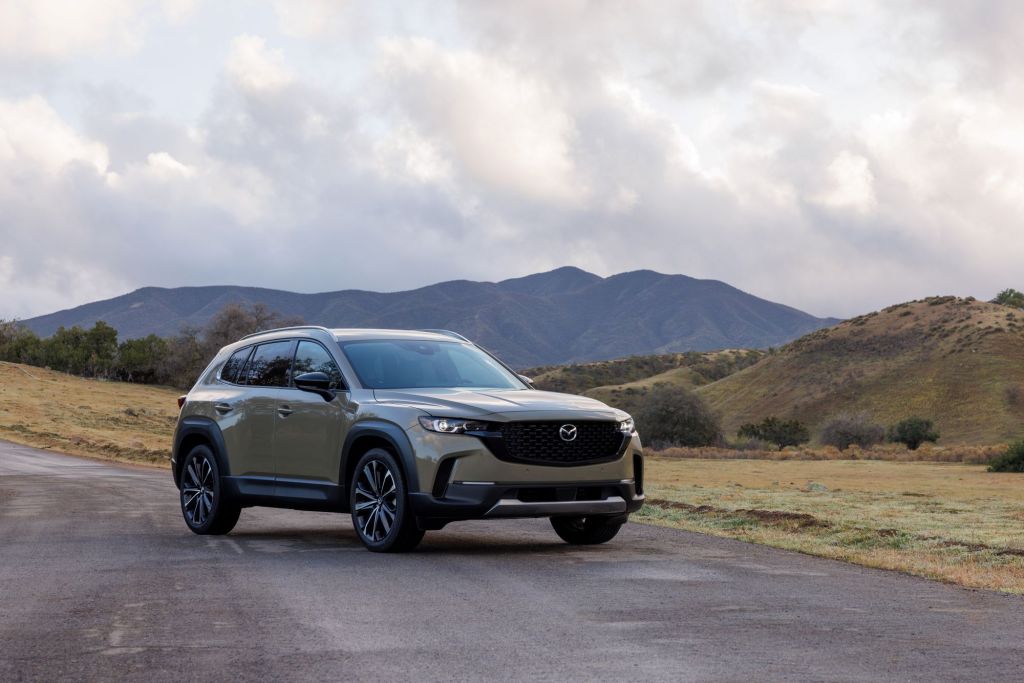
2025 Mazda CX-5: the sort of presence other compact SUVs probably wish they had. (Image: Mazda)

Like all Mazdas—and this is no mean feat—the CX-5 looks great. There has been a consistency in styling for the past few years that Mazda hasn’t deviated from. The exterior sheet metal of the CX-5 is formed in a way that makes it distinctive in a category of vehicles that is becoming increasingly truck-like in appearance. (If people want trucks, don’t they simply buy trucks?)

The cabin is comfortable and the materials are what can be considered a “category-above” compared what are found in other compact crossovers. It is something of a mystery as to how a company that doesn’t sell a whole lot of vehicles vis-à-vis the competitors can have Nappa leather and leather-wrapped steering wheels and shifter, to say nothing of a solid 10-speaker Bose audio system.

The CX-5—as in all trims—is an all-wheel-drive vehicle. In this trim level there is the Mazda Intelligent Drive that allows selection of Normal, Off-Road, Sport. Somehow that central choice doesn’t seem all that relevant for a vehicle that will undoubtedly be driven normally 95% of the time and quickly 5%.

And there is a full suite of the Mazda i-Activsense safety features, including Smart Brake Support (you close too quickly on a vehicle in front of you and the vehicle will let you know it) to Adaptive Front Lighting (which is both cool and functional: when you are turning the headlights appropriately pivot to show you where you are going). When moving through sluggish traffic, there’s Traffic Jam Assist, which uses radar cruise control that can bring the vehicle to a complete stop as well as a steering function that helps keep the vehicle centered.

The EPA Passenger and Cargo volumes are 103.6 cubic feet and 30 cubic feet, respectively, so while not giant in either case, certainly reasonable.

The 2025 CX-5 starts at $29,050 and goes to $41,080 (sans delivery fees).

One option I strongly recommend: the Soul Red Crystal Metallic paint. It shows off the form in a wonderful way.

2025 Toyota Crown Nightshade

It isn’t just the dark color scheme that makes this stealthy. . .

By Gary S. Vasilash

Quick: what is the top-of-the-line car model offered by Toyota?

As you’ve probably read the headline, you made a correct guess.

And I’m guessing that it was a guess because the Toyota Crown is something that is not as well known as it ought to be in the lineup.

The Crown was introduced in the U.S. as a model year 2023 vehicle. It replaced a vehicle that also didn’t have the visibility it deserved, the Avalon.

(Arguably in the case of the Avalon there was reduced promotion because it was so well executed that the owners of Lexus dealerships probably wouldn’t have liked that the Avalon would give the Lexus ES a run for the consumers’ money.)

While you might think that this is a bit of an exaggeration to talk about the relative invisibility of the Crown, consider this:

Through the first three quarters of 2025, there were 8,669 Crowns sold in the U.S. (The Crown Signa, which, in effect, replaced the Venza, a crossover, had nearly double the sales of the sedan: 16,277.)

The GR86 sports car—even available with a manual transmission, so this is not designed and engineered to take the kids to school or to shop at Costco—nearly had as many sales at the Crown: 8,107.

And the Crown is the kind of vehicle that you can take the kids to school in and to shop at Costco (it is a hatch that offers 15.2 cubic feet behind the second row, so there is space for stuff).

Toyota Crown: a stylish hybrid that, even if it wasn’t in the Nightshade trim, is still stealthy. (Image: Toyota)

The Crown has stylish sheet metal, which is certainly not unusual for Toyota models of late. It could be said that one of the reasons why Toyota still has cars on offer while Chevy and Ford have abandoned them (yes, yes, there is the Mustang, but it is hardly a “car” in the sense of the classic four-door architecture: the GR86 is a car, too, but the “sports” modifier separates it) is because it has freed up its designers.

For the Nightshade edition there is that “dark” theme, with Storm Cloud paint, 21-inch, 10-spoke wheels with a black finish, and dark door handles, mirror caps and rear badging.

Inside there’s a black leather interior and features and execution that may bring Lexus to mind, but not in the way the Avalon did (and if I had to think of a Lexus that might be Crown-like it would be the HS 250h, the brand’s first hybrid sedan, which had but a short (2010-12) run in the U.S.). The front seats are heated and cooled; the rear seat is heated. There is a 12.3-inch digital gauge cluster and a 12.3-inch infotainment screen (which has, just below it, a volume knob for those so inclined to take advantage of the JBL 11-speaker system).

The Crown is a hybrid that produces a system horsepower of 236. (For those who want more power, there is the Platinum trim providing 340 hp.) By and large the 236 hp is certainly sufficient for the aforementioned daily drives. This is an all-wheel drive vehicle.

 The vehicle EPA rated at 42 mpg city, 41 mpg highway and 41 mpg combined. Given that it has a 14.5-gallon tank that is filled with regular fuel, if you were to drive the Crown such that you’d leave one gallon in the tank just in case, you’d have a range of over 550 miles.

Which means Crowns are certainly not seen that often at gas stations.

The Market for Electric Trucks

Apparently there’s not much of one in the U.S.

By Gary S. Vasilash

While it is common knowledge that the Chinese electric vehicle market vastly outpaces that of the U.S. on a per capita basis, when people think about that it is likely to be in the context of passenger vehicles.

But here is a remarkable finding from BloombergNEF and Smart Freight Centre:

  • In the first half of 2025, there were some 89,000 electric trucks—as in medium-duty trucks and big rigs, not pickups—sold globally.
  • Of that total, nearly 80,000 were sold in China.

How many were sold in the U.S.?

According to Colin McKerracher, Head of Clean Transport, BloombergNEF, “just 200 units.”

200.

Or 0.25% of the Chinese total.

Given the U.S. population is about 24% that of China, one might think that number might be somewhat bigger.

Europe (Switzerland, Netherlands, Sweden, Norway, Greece, Denmark, Iceland, Germany, UK, France, Austria, Belgium) accounts for the remaining ~8,800 electric trucks sold in the first half.

Another stat from the BloombergNEF/Smart Freight Centre that is notable:

  • “nearly 100 to 1”

That’s the comparison of sales of electric medium and heavy trucks with those powered by fuel cells.

McKerracher: “The prospects for hydrogen in road transport look dim.”

Which leads to a question of whether commercial electric truck volumes—battery- and fuel cell-powered—in the U.S. are any brighter.

Calling It Something Doesn’t Make It So

You don’t get to decide. . . .

By Gary S. Vasilash

(Image: Mercedes-Benz)

“Inspired by the golden era of automotive design of the 1930s, this show car embodies the pure essence of Mercedes-Benz. With its hood giving it a majestic presence, sculptural flowing lines and a touch of Art Deco, it rises to become a true icon of automotive beauty. The interior with its continuous bench seat and the elegant rear, evoking memories of the legendary 300 SL. Our Vision Iconic is more than just an automobile – it is a sculpture in motion, an homage to timeless elegance and a statement for the future. The symbiosis of traditional craftsmanship, state-of-the-art technology and an unmistakable design language makes it the ultimate expression of value, prestige and grace: the most beautiful, most prestigious kind of thing.”

–Gorden Wagener, Chief Design Officer Mercedes-Benz Group AG

Yes, this concept car may have all of those attributes from the hood to the flowing lines and so on.

But one thing it isn’t is “a true icon of automotive luxury.”

Something becoming an “icon” isn’t a matter of nomenclature (e.g., “Vision Iconic”).

It becomes an icon because there is cultural respect given to something over a period of time.

One could describe the Mercedes-Benz 300 SL, the gull-wing-door vehicle that came out in 1954, as “iconic.” That’s why Wagener is able to cite it as “evoking memories.”

The term “icon” is earned, not labeled.

BMW is eating Mercedes’ Mittagessen in a big way so far as sales are concerned. Perhaps a bit of humility and attention to getting more desirable product on the road now might help Mercedes even if those vehicles aren’t self-proclaimed icons.

Polestar 3: Dual Motor, Pilot, Plus, Performance

(That’s a lot of Ps in that name. . )

By Gary S. Vasilash

One of the things that interests me when I am in a vehicle is the extent to which people notice it.

You may be surprised at how few vehicles garner some comment from people. The last vehicle I had that drew lots of attention was the VW ID.Buzz. And as I think about that vehicle, I realize that I’ve not seen a lot of them since.

And while that van drew attention largely because of the nostalgia factor, the Polestar 3 has no such fond memories for anyone, as it has been available in the US market only since late summer 2024.

A friend I was meeting at a restaurant came in and pointed out a window to the Polestar 3 in the lot: “Are you driving that? What is it?” The waiter stopped and looked at it, too, while listening to my explanation of how it is a brand from a company headquartered in Gothenburg, Sweden, once a sub-brand of Volvo. (This gets into organizational complexity with the bottom line essentially being that there is Volvo, owned by Geely, and there is Polestar, owned by Geely. So while the two companies are separate, they have the same parent and there is a non-trivial amount of sharing between the two siblings.)

They were both unaware of the brand.

Which is not entirely surprising. Through the third quarter 2025 Polestar has delivered 44,482 vehicles. Globally.

To put that into context, Cadillac delivered 46,525 vehicles. Domestically. In the third quarter alone.

Polestar is still a stealth brand.

This is not particularly pricy when you realize this is a performance vehicle. (Images: Polestar)

A neighbor who was walking her dog past my house while I pulled into my driveway literally turned around and came back to talk to me about the Polestar 3, wondering what it was, saying that she liked the way it looks, both in terms of size and styling. (She is right about that.)

The not-so-good news for the folks at Polestar: She is in the market for a vehicle and is likely going to buy a Chevy Equinox. “EV?” I asked. “No. Gasoline.”

That is not-so-good on two levels.

First of all, the top trim level AWD Equinox has an MSRP, including destination, of $37,395.

The MSRP, including destination, for this AWD Polestar, which is at the top of the line, is $86,300.

Clearly, my neighbor has a good eye, even though she has a different kind of budget.

And second, of course, the Polestar 3 is an electric vehicle, not fueled with gas, which accounts for part of the difference.

And it is interesting to note that whereas that 2025 Equinox she is considering is built in the GM San Luis Potosí plant in Mexico, the Polestar 3 is assembled in Ridgeville, South Carolina (that is nominally a Volvo plant, which goes back to the previous comment about the sibs).

Without going too Volvo about this, it is worth noting that the Polestar 3 is based on the Scalable Product Architecture 2 platform, which underpins the Volvo EX90, that brand’s flagship electric vehicle.

And because it has Volvo DNA it is engineered with safety in mind, ranging from having a boron steel safety cage to an extensive list of sensor-based safety tech that facilitates accident-free driving (note: it helps; it is up to the driver and others to prevent accidents).

One interesting thing is that while model year 2025 vehicles have to have a rear seat reminder system to advise the driver to check the back seat to make sure that a child or pet is not being left behind, many of these systems are simply based on the vehicle being put in park and the alert showing up.

In the Polestar 3 there is actually interior radar that monitors the situation.

So what does one get for the not-minor amount of money.

Well, there are two electric motors that provide a combined output of 517-hp, which means this can be quick. They also provide AWD. But this power also means that the range is somewhat limited: an EPA estimate of 279 miles.

There is active air suspension. 22-inch wheels. A panoramic glass roof. Over-the-air-updates for life.

An example of the interior details that show considerable consideration was paid to the execution of the inside.

The infotainment is based on the Android Automotive OS, with Google built in. (There is wireless Apple CarPlay, too).

The interior is both comfortable and well designed, with details on things like the door trim that subtly make you know that someone spent time considering what they were doing.

A Better Battery Range Predictor

You’ve undoubtedly seen someone—or been that someone—walking along carrying a gas can having run out of fuel. What happens when an EV is out of energy? This project is working to keep that from being a question that needs an answer. . . .

Apparently, the battery management systems in EVs are little better than crap shoots when it comes to providing accurate information as to whether there is sufficient charge in a battery to get from point A to point B.

One reason is there are lots of parameters that need to be taken into account in order to make the assessment, ranging from the condition of the battery to its discharge rate, from the traffic between A and B and the ambient temperature.

To address this overall uncertainty, engineers at the University of California, Riverside (UCR), have developed a metric, State of Mission (SOM). Mihri Ozkan, a UCR engineering professor described it: “It’s a mission-aware measure that combines data and physics to predict whether the battery can complete a planned task under real-world conditions.”

Some models use physics equations that don’t deal with changing environments. Some use machine learning models that provide output but no information regarding how that output was achieved.

The SOM takes into account both information from the batteries’ performance over time as well as electrochemistry and thermodynamics.

Cengiz Ozkan (also a UCR engineering prof): “By combining them, we get the best of both worlds: a model that learns flexibly from data but always stays grounded in physical reality. This makes the predictions not only more accurate but also more trustworthy.”

But there is still a hurdle that the UCR team needs to get over as the SOM development continues.

“Right now,” Ozkan said, “the main limitation is computational complexity. The framework demands more processing power than today’s lightweight, embedded battery management systems typically provide.”

It always comes down to sufficient power, one form or another.

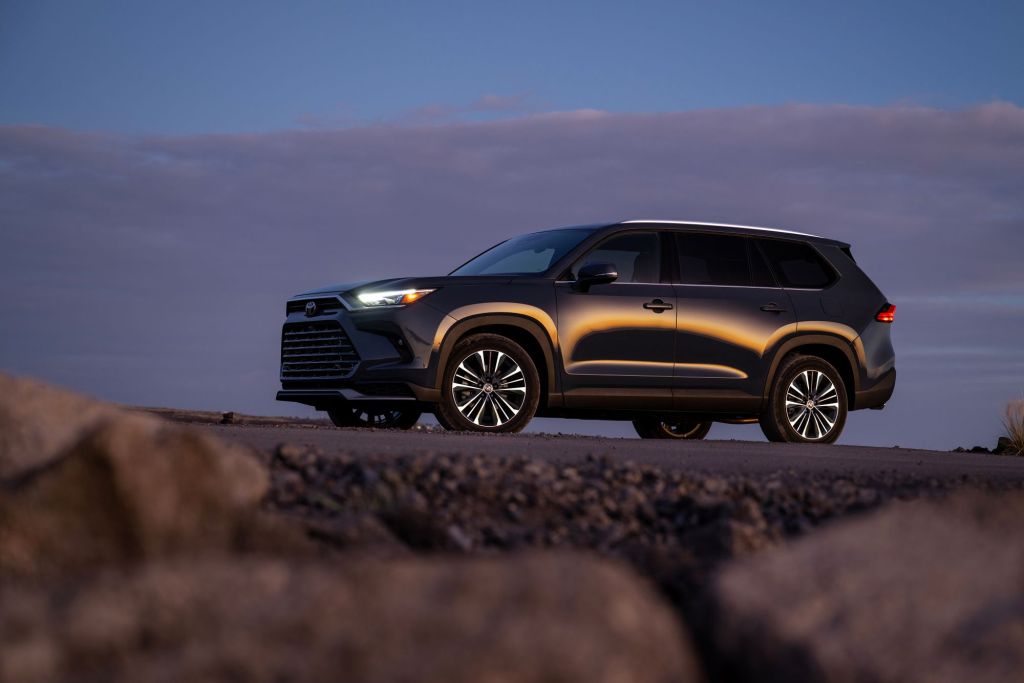
2025 Toyota Highlander 25th Edition AWD

The 25th anniversary is the Silver Anniversary. This anniversary Highlander is available in Heavy Metal. . .

By Gary S. Vasilash

One of the things Toyota did early on that caused many of those in Detroit to grumble was use the platform from one vehicle for another. This wasn’t a case of simply slapping new fascias on a car and using different seat fabrics and saying “Voila! something different!” but of creating something different.

This approach had several advantages. It spread engineering costs from one vehicle to another. It increased scale for a given platform. Both of these things led to better quality (focused engineering resources) and lower costs for consumers (economies of scale).

Case in point: the Toyota Highlander. The vehicle was introduced at the 2000 New York Auto Show as a model year 2001 vehicle.

It was based on the platform used for the Camry sedan, with slight modifications to accommodate things like a higher ride height.

Toyota Highlander 25th Edition. Celebrating a quarter century. (Image: Toyota)

This was not only clever, but arguably revolutionary, given that back then vehicles with that body architecture had frames, like pickup trucks. Cars like the Camry, with unibody construction, provided a more comfortable ride.

So one could say that the body-on-frame vehicles were sport utility vehicles (SUVs) and the first gen Highlander ushered in the midsize crossover utility vehicle (CUV). (The first-generation Toyota RAV4, introduced in the U.S. for the 1996 model year, was based on the Corolla platform, so it gave rise to the compact CUV segment.)

There was something else that happened with the Highlander that’s of some significance.

Model year 2006 was available with a hybrid powertrain. That made the Highlander the first Toyota after the Prius that had one. While it might have seemed that the Camry would get a hybrid after the Prius, that didn’t occur until model year 2007.

(The hybrid in the Highlander could have had something to do with the fact that also in model year 2006 the Lexus RX 400h was launched: the “h” is for “hybrid.”)

Currently, the Highlander is in its fourth generation. It is clearly a case of improvements all along the way.

For the 2025 model there is a special edition, the 25th Edition. Perhaps not the cleverest of names, but a well-appointed Highlander.

The celebration of the milestone is performed with a variety of touches, inside and out.

On the exterior view there are—yes, changes to the front and rear fascias (silver accents on the bumpers), 20-inch wheels, and side rockers.

Inside there are carpeted floor mats and an all-weather rear cargo liner. The seats have leather trim.

And in the space between inside and out there are illuminated door sills and puddle lamps (although they shine on the outside, they are meant to help you get to the inside, so we’ll put them in this intermediate space).

The powertrain (there is a 2.5-liter four-cylinder engine coupled with three permanent magnet motors (two front, one rear)) provides a combined output of 243 hp.

This results in EPA fuel efficiency numbers of 35 mpg city, 34 mpg highway and 35 mpg combined.

Which is most impressive for an AWD vehicle with a third row.

But about that third row. . . .

The legroom back there is 28 inches. No, not a whole lot of room.

The 25th Edition is based on the Highlander Limited Hybrid grade which provides things like a 12.3-inch infotainment touchscreen and 11-speaker JBL audio system. Yes, there is a small volume knob for those who prefer torquing a knob rather that using the steering wheel controls.

The base MSRP for the vehicle is $52,680, which is certainly reasonable for something that (1) is so well-appointed, (2) a hybrid and (3) is limited to 2,500 units.

2026 Hyundai Palisade Calligraphy AWD

It may be positioned as a mass-market three-row, but it is a whole lot more—arguably a segment above

By Gary S. Vasilash

In 2024 the auto industry spent some $29.5 billion on advertising. That’s about 9% of all of the ad spend from all categories and industries, making it one of the top categories.

One of the things the ads do is not only try to convince people to buy whatever, but to perceive whatever in the way that the advertiser wants us to.

Or put simply, if it is a truck the goal is to make sure the viewer understands that it is rugged and capable.

If it is a vehicle that is in the “luxury” category, then it must be presented in a way that makes the viewers realize there is something special about the vehicle that sets it apart from “mainstream” vehicles.

Of course, in the case of trucks they must be engineered to be rugged and capable.

And if it is a luxury vehicle, then there must be attributes—say top-notch materials used in the interior and an impressive infotainment system—that would make the implied purchase premium seem appropriate.

There are simply some things that are necessary to validate the positioning of the vehicle.

But one thing that this does is segments what people may look at.

Sure, someone who wants a truck may simply look at the overall architecture of the vehicle and determine that it is, indeed, a truck.

The lux part is what, at least in the context of the Hyundai Palisade Calligraphy, that has fuzzy borders.

A three-row crossver with massive exterior styling. (Images: Hyundai)

While people would correctly perceive Hyundai to be a mainstream brand—and even the people at the Hyundai Motor Group decided that it would have a separate higher-end brand, Genesis—the Palisade Calligraphy interior is every bit as nice as any Cadillac, Lincoln, Lexus, Mercedes, etc. I have been in of late. And lately I’ve been in a lot (I was one of the jurors for the 2025 Wards 10 Best Interiors & UX Awards, and if you scroll down on this page you’ll see we were in a lot of interiors, and while you won’t see the Palisade on the list, that’s because it wasn’t available during our testing; I’m confident it will be there next year).

The materials, the design, the technology, the comfort, the convenience, and the attention to detail are all first-rate.

Comfort, space, and technology in quantity–and with quality.

Now it should be pointed out the Calligraphy is the top trim for the Palisade, which is available in five other trims, with the SE that has a starting MSRP of $39,435.

The Calligraphy driven here has a MSRP of $56,060, and with one option($245)—and this speaks to the fact that the vehicle as trimmed is absolutely rife with things that would likely otherwise be options—and inland freight and handling ($1,495) the whole thing comes to $57,800. (What is the option?, you wonder. Absurdly enough, carpeted floor mats.)

Recognize this is a seven-passenger, three-row all-wheel drive crossover that has heated/cooled, power-adjusting and reclining front and second row seats, as well as third row seats that also recline. A vehicle with a 12.3-inch infotainment screen and Bose premium audio. A vehicle with a total interior volume of 181 cubic feet of which 161.9 are devoted to passengers. (Max cargo is 86.7 cubic feet—and the folding of the second and third rows are done with a snap, not effort; with all rows in place it is 19.1 cubic feet). A utility that, yes, can tow (up to 5,000 pounds).

This is a big vehicle: 119.2 inches long, 78 inches wide, and 69.5 inches wide, with a 116.9 wheelbase. (One thing that should be noted is that the fidelity of the cameras and the fast-acting dynamic lines shown on the infotainment screen allow maneuvering in parking lots a whole lot easier than you might think.)

While I had the Palisade I was asked whether I would prefer it or the three-row Hyundai Ioniq 9, an electric vehicle with an award-winning interior.

Without question, the Ioniq 9 is a whole lot quicker and responsive thanks to its dual motors (talking about the long-range AWD version here) that produce 303 hp and 446 lb-ft of torque, compared with the 3.5-liter V6 in the Palisade that produces 287 hp and 260 lb-ft of torque (you’ve got to take into account, however, the Palisade is about 1,400 pounds lighter than the Ioniq 9).

The long-range AWD Ioniq 9 provides an estimated range of 311 miles. The EPA numbers for the Palisade are 18 city/24 highway/20 miles per gallon combined. It has a 19-gallon fuel tank. So that means a range, based on the combined figure, of 380 miles,

While 79 miles may not seem like a big deal, imagine using the Palisade, coming home from a holiday weekend, with the second and third rows being occupied by kids who were antsy not long after you pulled away from the cottage. Then recognize that the 79 miles could represent an hour more driving and that even though the Ioniq 9 can be charged from 10 to 80% in 24 minutes (which means you’d get 249 miles of range at 80%), the Palisade can be fully refueled—for 380 miles—in about five minutes.

I’d opt for the Palisade.

And for those shopping for a three-row crossover: a luxury brand or this one? I’d have a hard time determining why this isn’t the better choice.