
Maybe they got their styles wrong. . .
By Gary S. Vasilash
Cadillac has announced the VISTIQ, a three-row electric SUV.
It has a dual-motor system, which means all-wheel drive is standard. The motors provide 615 hp and 650 lb-ft of torque, which, according to the company, will provide a 0 to 60 time of 3.7 seconds when the Velocity Max performance mode is engaged.
The 102-kWh battery is expected to provide a range of 300 miles.
As Jeff MacDonald, North American chief engineer, for the vehicle puts it:
“From the start, it was our team’s goal to deliver a three-row SUV that provides exhilarating performance and intuitive technology, wrapped in the brand’s iconic design language.”
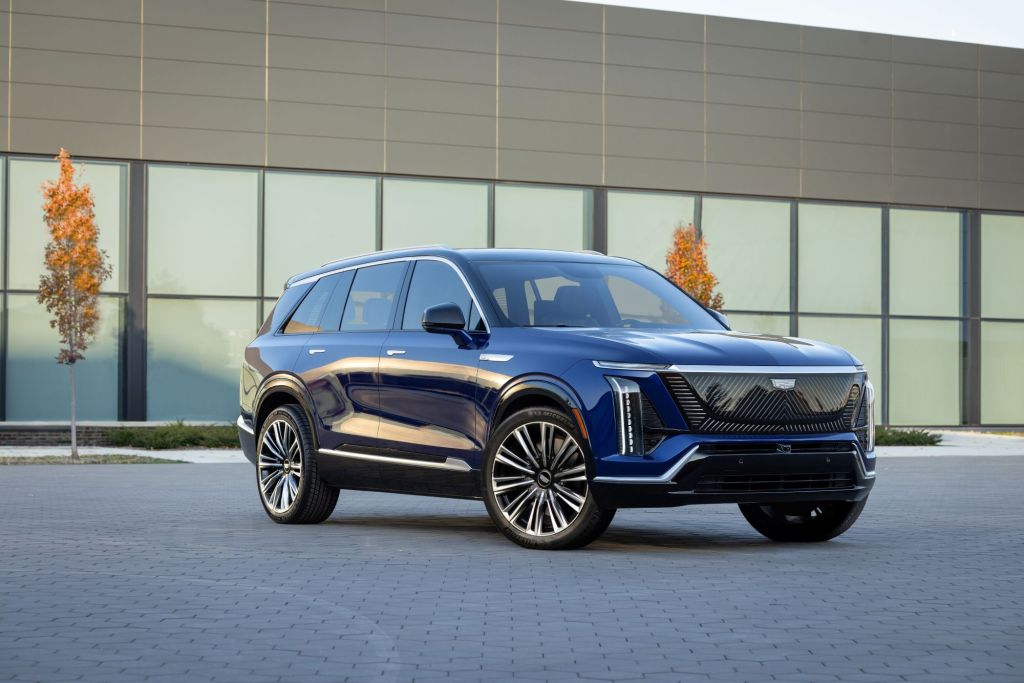
And of that design language, Brian Nesbitt, executive director, Global Cadillac Design, says:
“VISTIQ continues the Cadillac EV identity, including our signature vertical lamps front and rear, the illuminated pinstripe grille, a 33-inch diagonal high-resolution LED screen, and available 23-inch wheels, rendered in a proportionally stately and functional three-row SUV.”
But there is one odd thing in Cadillac’s announcement of the EV, which will have a starting MSRP of $78,790:
““The spacious interior seamlessly integrates with the elegant design, inspired by modern architectural contours and structure framework. The vertical banding is reflective of robust features in Brutalist architecture and helps frame elements in the interior, creating more refined lines and offering a balance of sophistication and practicality for modern luxury living.”

Brutalist?
Writing in Architectural Digest, a place where they know a thing or ten about architectural styles modern and otherwise, Katherine McLaughlin explains:
“The style is often associated with socialist utopian ideas, which were regularly promoted by the buildings’ architects. Many early Brutalist buildings were affordable housing projects that sought to reimagine architecture to address modern needs.”
Brutalism got its start in post-World War II Britain where, McLaughlin writes,
“Spinning off the heels of the modernist movement of the day, architects were presented with a new set of challenges, namely limited resources, when designing in the post-war era.”
So they had to design buildings that were concrete-intensive and decoratively absent.
McLaughlin quotes Geddes, Ulinskas, principal of Geddes Ulinskas Architects:
“If modernism is about architecture being honest, Brutalist design is about architecture being brutally honest.”
Ulinskas goes on:
“Forms are as simple as can be and materials are stripped to be as bare and raw as possible.”
There is something to be said for honesty in materials in vehicles—if you’re going to have something that looks like wood, it should be wood, not plastic or an applique; the same goes for metal and carbon fiber. And this is what they’re doing inside the VISTIQ.
Yes, the materials are authentic inside. But they are undoubtedly not “as bare and raw as possible.”
Somehow Brutalism just doesn’t seem particularly “Cadillac.”
 shinymetalboxes