
Bigger Isn’t Necessarily Better

For every action there is still an opposite reaction. . .

By Gary S. Vasilash

While it might seem that anyone riding in a large SUV would be safe, especially in relation to those who are not riding in a large SUV when said vehicle has a collision with the non-large vehicle—and, yes, according to IIHS president David Harkey, “The huge mass of these large SUVs provides some additional protection in crashes with smaller vehicles, though that also means they present more danger to other road users” (like those in smaller vehicles)—turns out not all is without risk.
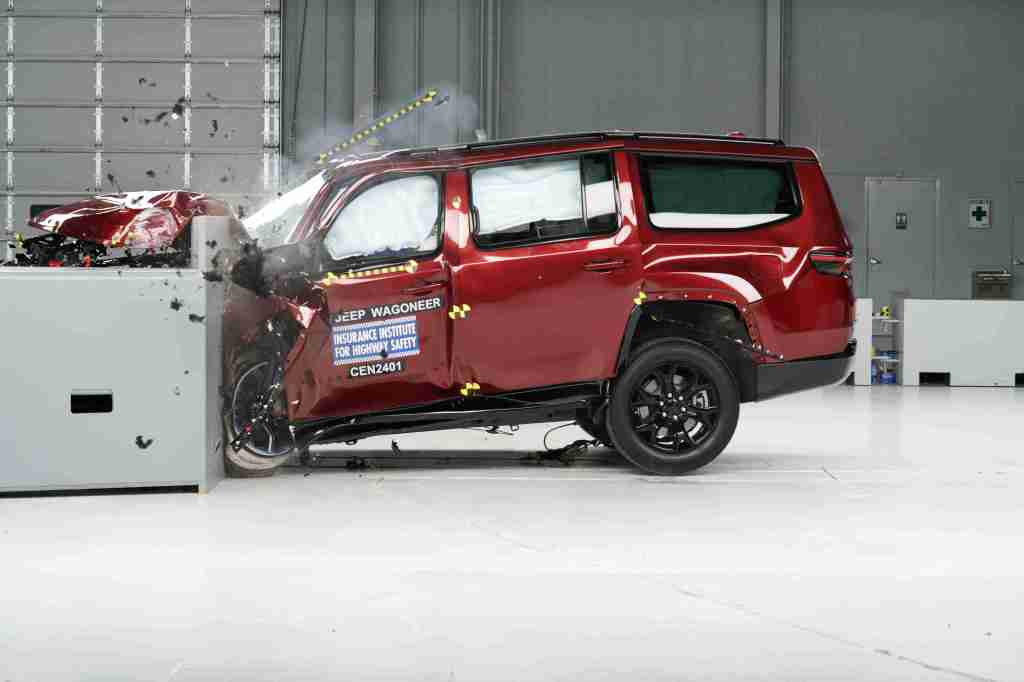
Wagoneer in the small overlap front test. (Image: IIHS)

Harkey: “The flip side of their large size is that there is a lot more force to manage when they crash into a fixed obstacle like a tree or bridge abutment or the barriers we use in our front crash tests.”

Yes, the Insurance Institute for Highway Safety (IIHS) has a tendency to crash all manner of vehicles into barriers of various sizes and orientations.

IIHS recently tested the Jeep Wagoneer, Chevrolet Tahoe and Ford Expedition.

And of the three, only the Wagoneer received the organization’s 2024 TOP SAFETY PICK award.

The reasons the Chevy and Ford didn’t get the pick are various, including “subpar performance in the small overlap front crash test.”

What is surprising about that is, as IIHS points out, “More than 90% of new models have sailed through this evaluation with good ratings since 2021.”

The small overlap front crash test is about “maintaining survival space for the driver and front passenger.”

Survival space.

Of the three, IIHS found the Expedition to be most troubled when rammed into barriers on either the driver or passenger sides.

Another troubling thing is that while big vehicles like these are typically people movers, all three were not particularly good when it came to the second-row passengers during the moderate overlap test.

All of which is to say: No matter how big your vehicle is, drive it carefully and safely. After all, your passengers depend on it. To say nothing of how things like footwell intrusion should you be driving can be more than merely problematic.

22 Ford Expedition: Of Course They Did

Ford full-size SUV flagship gets an update. A serious update

By Gary S. Vasilash

Jeff Marentic, Ford North American general manager for Passenger Vehicles, says that since they launched the then-all-new Ford Expedition for model year 2018, the large SUV (it is 210 inches long, a.k.a., 17.5 feet long–and this is the standard-size vehicle) saw its numbers triple.

So as the vehicle manufacturer has decided to pretty much go all-in on things that aren’t cars (yes, there is the Mustang hanging in there as a “car,” but it is worth noting that when they decided to develop the Mustang Mach-E, the electric vehicle, they opted for the crossover look, not a fastback coupe), it has done a refresh for the Expedition, one that isn’t a tweak here or there, but even including two new versions, the Stealth Edition Performance Package and the Timberline model.

2022 Ford Expedition Timberline. You never know when that road somewhat non-improved, so the vehicle is. (Image: Ford)

(There are also the XL and the Platinum versions.)

What “Performance” Means

As for the Stealth Edition Performance Edition—yes, yes, there is a lot of black all around the vehicle, from the grille to the 22-inch premium alloy wheels—what provides the performance is the 440-hp, 510 lb-ft of torque 3.5-liter twin-turbo V6.

They are not shy about pointing ouit that the performance of that engine leaves the Chevy Tahoe RST’s 5.3-liter V8 at quite a deficit: the Stealth offers 85 more horsepower and 106 more lb-ft of torque. Not trivial differences.

Sorry, Jeep

Then as for the Timberline, know that back when the ’18 model came out, Jeep dealers didn’t have a Jeep Wagoneer on their lots. So the ’22 Expedition Timberline has the same engine as used by the Stealth, but it this case, the comparison is with the 5.7-liter V8 in the Jeep Wagoneer: Ford brings 48 more horsepower and 106 more lb-ft of torque.

What’s more, the ground clearance—an important factor when the surface under the 33-inch Goodyear Wrangler AT tires isn’t paved—for the Timberline is a standard 10.6 inches. That bests the Wagoneer by 0.6 inches.

Mike Kipley, vehicle chief engineer, notes that they’ve deployed the same steel skid plate that’s used on the Ford Raptor and the same Trail Turn Assist that’s found on the Bronco (it tightens the turning ratio of the vehicle, very useful when negotiating tight turns off road): Clearly Ford is taking advantage of the developments made for a couple of its iconic vehicles.

Amenities, Too

Lest you begin to think that Expedition has become some sort of family vehicle that can either go very quickly or is for just going to trailheads, know that the Expedition Platinum offers Ford BlueCruise hands-free driving assist tech. A 22-speaker Bang & Olufsen audio system is on offer. And there is an available 15.5-inch high definition touch display available.

The customers of these large vehicles should be pleased.

And the people in Detroit and Auburn Hills are probably unhappy.

Of course Ford went big on the Expedition.