2025 Hyundai Santa Cruz Limited AWD

Don’t be misled by the box on the back. This is far more than just a pickup

By Gary S. Vasilash

The Ford Maverick pickup and the Hyundai Santa Cruz both came out in 2022 and there was an immediate comparison made between the two vehicles because they both have boxes behind the cabin.

But this is a convenient but false comparison.

The Maverick is first and foremost a truck, a truck in more of the classic sense of being utility-first and everything else gravy.

The Santa Cruz is described by its marketers as a “Sport Adventure Vehicle.” And while no one outside of a Hyundai dealership is likely to describe the Santa Cruz as such, in one regard that is more accurate than calling it a compact pickup truck.

You may recall that when BMW launched its X3 SUV it didn’t want to merely call it an “SUV” because it is, after all, a BMW. So it coined the term “Sports Activity Vehicle.” Which, of course, hasn’t had a whole lot of resonance.
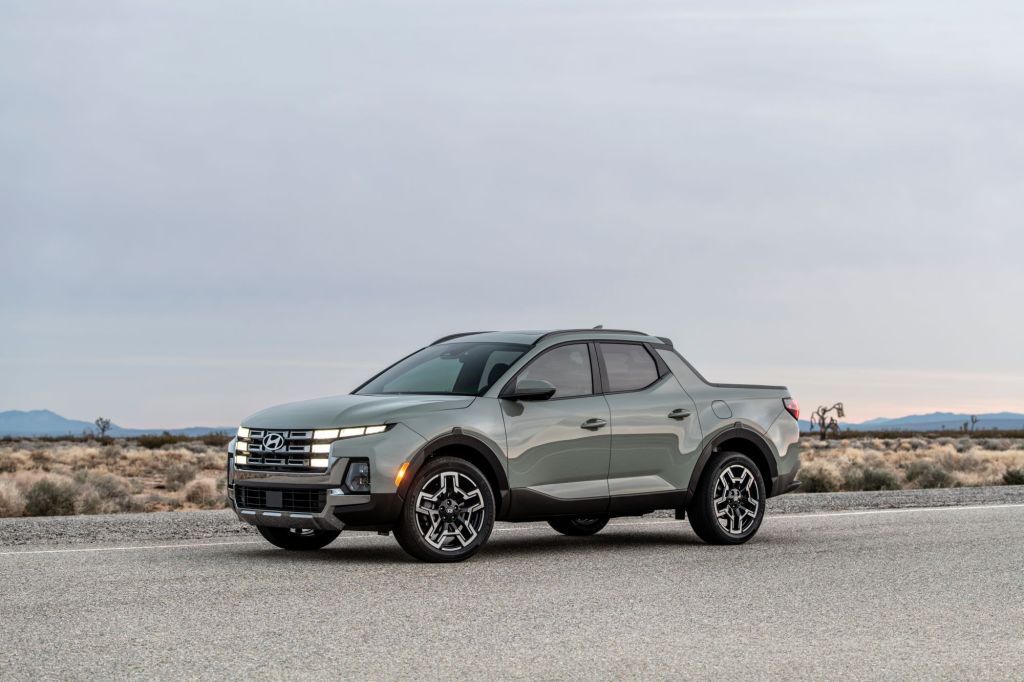
2025 Hyundai Santa Cruz Limited AWD: Style meets substance. (Images: Hyundai)

But the SAV that is the Santa Cruz is in someways closer to the SAV that is the X3 in that the Santa Cruz, certainly, is more like an SUV with a bed on the back than it is like the Maverick, which is like a “Honey, I Shrunk the F-150.”

The level of sophistication in the cabin of the Santa Cruz is simply in a completely different space than the DIY nature of the Maverick.

And while they both have beds, the Maverick’s is not only bigger (54.4 inches long vs. 52.1 inches; 20.3 inches deep versus 19.2 inches; 53.9 inches maximum width versus 53.3 inches; 33.3 cubic feet of volume versus 27 cubic feet), but it simply seems like the sort of thing you’d fill with landscaping material while the Santa Cruz would be more about mountain bikes.

It is a difference between utility and, well, weekend, low-impact adventure.

If there is any product in the Ford lineup that the Santa Cruz resembles, it is the Explorer Sport Trac, which had a run from 2000 to 2010: essentially a four-door Explorer with a box on the back. It was more Explorer than Ranger or F-150.

The Santa Cruz is like a Tucson with a box on the back.

When the refreshed Santa Cruz was revealed last year, José Muñoz, then-president and Global COO of Hyundai Motor Company and president and CEO of Hyundai Motor North America (he has since become president and CEO of Hyundai Motor Company), said, “The development goal for freshening Santa Cruz was to give it an even bolder, stronger design.”

While I agree with the “bolder,” I would quibble with the “stronger,” at least in the context of a vehicle with a box on the back. Usually when “stronger” is used in relation to truck-like vehicles, that means “boxier,” and the style of the front end of the Santa Cruz (or any Hyundai vehicle, for that matter, even the Class 8 Xcient tractor) doesn’t bring a T-square to mind. Rather, with it’s B-LED projector headlamps and LED daytime running lights it looks completely contemporary.

(There are also LED taillights, and LED cargo light on the rear edge of the roof, and LED bed lighting. This vehicle probably has more LEDs than most people have in their houses.)

The Limited is powered by a 281-hp 2.5L direct-injected turbocharged engine. There is an eight-speed wet dual-clutch automatic transmission (DCT). This vehicle can tow up to 5,000 pounds.

Inside there are such things as a powered 8-way driver seat and 6-way for the front passenger; both are heated and ventilated. There are leather surfaces on the seats. There is leather for the steering wheel and the shift knob.

That circle on the black rectagular surface is something you ordinarily don’t see in vehicles. It is a biometric interface: just like on smartphones, it is a fingerprint recognition system that allows the Santa Cruz to be started and it also loads the profile preferences for the person who is identified.

There is a 12.3-inch digital gauge cluster (i.e., what’s in front of the driver, with the speedometer, for example) and a 12.3-inch infotainment touch screen with the now-obligatory wireless Apple CarPlay and Android Auto.

Bose premium audio. Plenty of USB-C ports. Wireless charging.

There is Hyundai Digital Key 2 Touch, which allows a phone to be used in lieu of the fob.

There is even a fingerprint authentication system that allows a fingerprint to unlock the vehicle, start it, and load driver profiles.

There is BlueLink+ a connected vehicle service (remote start; lock-unlock; emergency assistance; etc.) that is. . .subscription free.

The point is, yes, the Santa Cruz may be truck-like because of the bed on the back, but it has contemporaneous amenities and style such that it really might make someone refer to it as a “Sport Adventure Vehicle.”

More Maverick

The cool pickup gets cooler. And more capable.

By Gary S. Vasilash

One of the most significant vehicles that Ford has launched during the past few years—arguably more significant than the Mustang Mach-E, which people seem to get excited about—is the Maverick, a midsize pickup truck that is smaller than the Ford Ranger, another midsize pickup truck, which has seemingly lost its mojo.

So let’s put some numbers to the “significant” claim.

Through the first half of 2024 the respective U.S. sales for the vehicles:

  • Mustang Mach-E:              22,234
  • Maverick:                          77,113*

And for good measure:

  • Ranger:                             15,175

So why is the Maverick, which went on sale in late 2021 as a model year 2022 vehicle, so successful?

Because it is small, fun, funky, functional, and economical.

As for the last item: the starting MSRP for a 2024 Maverick XL with a 2.0-liter EcoBoost engine, is $23,920. For those interested in a 2.5-liter hybrid version, that’s $25,420.

The functional part is that it is a bona-fide truck. As in something with the ability to handle a 1,500-pound payload and tow up to 4,000 pounds (with the 2.0-liter).

And the really clever bit that Ford designers and engineers did was to embrace the fact that they were creating something that would have a low price point.

Typically there seems to be a tendency for them to pretend that whatever it is they’re putting on the road is more expensive than it is, which leads to faux execution inside (in particular) and out.

In the case of the Maverick, while the materials may not be the stuff of an F-150 King Ranch edition, those materials are treated with an honesty and an innovative spin such that they make the truck all the better because there is an authenticity to it.

Now, for model year 2025, the Maverick is getting a refresh.

And a new model.

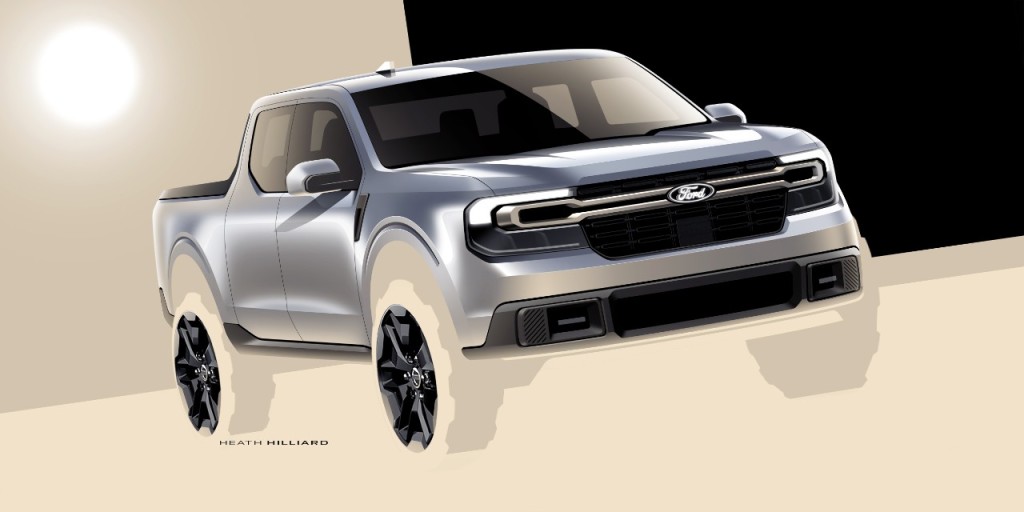
“One of the first things you’re going to notice is a slimmer, more modern headlight profile,” says Josh Blundo of the design team.

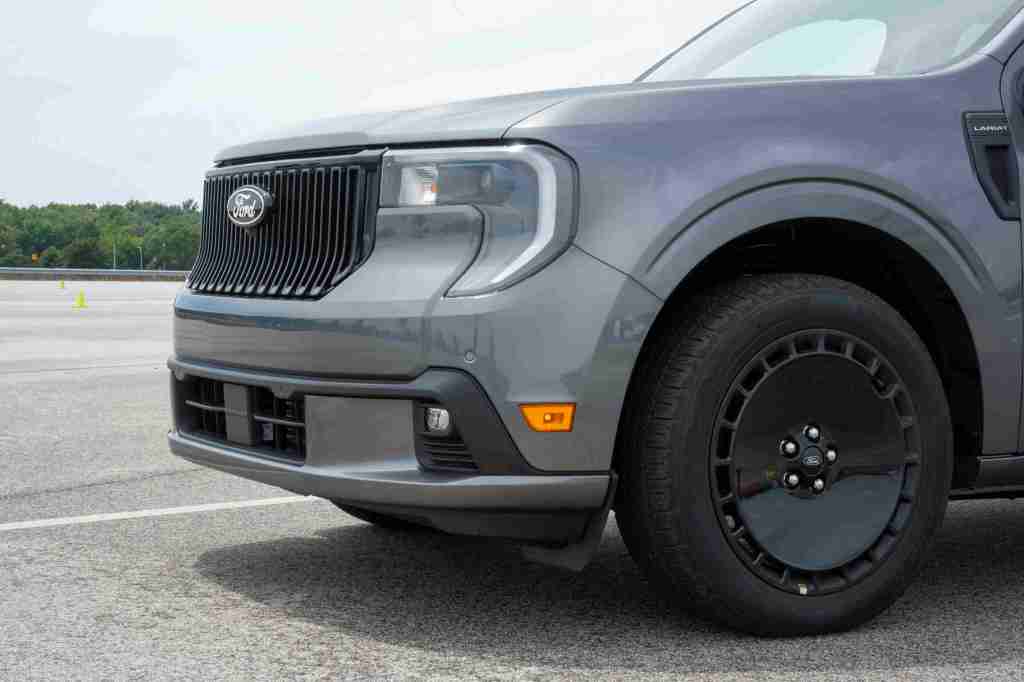
The front fascia for the ’25 Maverick Lariat features “chicklets” on the grille. The front ends of each of the available models—XL, XLT, Lariat, Tremor, and Lobo—has a differentiated look. (Images: Ford)

The primary change for the Maverick trims across the board—and there is a new trim added, the Tremor—is in the front, not only in terms of the headlights, but the fascias, which are specifically designed for each trim (e.g., the Lariat trim has a grille featuring what Blundo refers to as “chicklets,” small metallic rectangles that pop on the black grille).

Inside the most obvious change is the 13.2-inch touchscreen—standard across the lineup—which Blundo says is as big as the screen in any Ford model. Yes, as big at one in an F-150.

Kirk Leonard from the engineering team—who has been with Maverick since just after the launch of the ’22 MY vehicle, and who came to it from Super Duty, which goes to show that this is a serious truck—points out, “Just because we’re a small truck doesn’t mean we get a pass on the capability, durability and toughness that customers expect from our vehicles.” So while the Maverick may be fun, it is not a poseur.

Leonard says “The number-one thing customers have been asking for is all-wheel drive for the hybrid.”

So the ’25 Maverick is available with a AWD system for the hybrid.

Leonard adds, “They wanted all-wheel drive but they didn’t want to give up on fuel economy.”

So, he says, they’re estimating that the AWD Maverick with the 2.5-liter hybrid system will deliver 191 hp, 155 lb-ft of torque, and 40 mpg city.

Those who are even more interested in fuel economy but not interested in all-wheel drive can get the front-drive version, which Leonard says will provide an estimated 42 mpg in the city, and a 500-mile range on a tank of gas.

The Maverick is also available with a 2.0-liter EcoBoost engine that provides 238 hp and 277 lb-ft of torque.

And There’s This. . .

Josh Blundo is one of those guys who is a quintessential “car guy.” While a teen in New Hampshire he was sketching cars, which really wasn’t a thing that his peers were doing. He went to the College for Creative Studies in Detroit and found that car culture was everywhere.

Which is evidently an environment he thrives in.

He says that when the Maverick was first launched he saw that it had a certain minimalism that he finds appealing. And something to use as a launch pad for creation.

Which lead to the design of the Maverick Lobo model.

Lobo. Lowered and with a look that combines street truck and tuner cultures, says designer Josh Blundo.

Although this fits within the “street truck” modified niche, Blundo says, “Street trucks really represent a broad culture. A lot of people think ‘muscle’ trucks—full-size trucks with V8s.”

Then, at the other end of the spectrum, he says, are tuner vehicles. In this case they’re mainly sedans and hatches—Civics and Golfs and the like.

“Maverick, because of where it sits in the truck space, unibody and more focused on handling than straight-line performance, sits in the middle ground,” Blundo says.

So for the Lobo aesthetic they lowered the truck ½ inch in the front and 1.12 inches in the rear, which results in a roof height that’s 0.8 inches lower. And that roof is painted black, as are the 19-inch wheels. (Speaking of the roof: there are two available configurations, Standard and High. High, among other things (e.g., heated steering wheel and seats; spray-in bedliner) includes a moon roof.)

There are a Lobo-specific front fascia and painted rear bumper.

Kristen Keenan and her colleagues in Color + Materials provided the Lobo with a unique interior execution. Keenan, who had worked designing performance footwear at Nike, says that that experience helped inform what they did inside the Lobo, such as using ActiveX, a high-end synthetic that looks good and wears well.

Because this truck is not just about show but also go, there are things like a twin-clutch rear drive unit that provides torque vectoring and an upgraded cooling system.

The truck offers the “Lobo mode,” a drive mode that essentially minimizes the intervention of the stability control system so that the truck can be thrown around on a track—a closed track, notes Keith Daugherty, an engineer who worked on the Lobo and deployed elements from the European and U.S. Ford parts bins (brakes from the Euro Focus ST; strut mounts from the Mach-E).

And, yes, as a daily driver the Lobo has available, like other Mavericks, things like Pro Trailer Hitch Assist, because at the end of the day, it’s a truck.

==

*While some may quibble that this is an unfair comparison, given that one is an EV and the other is a pickup truck, the Maverick is a pickup truck that is available as a hybrid, and according to James Gilpin, Maverick brand manager, about half of all Mavericks sold are hybrids. This means about 38,550 Mavericks sold are electrified, still greater than the 22,234 EVs.

Designing the 2022 Ford Maverick–& About Electric Pickups

A wide-ranging discussion that’s concentrated on pickups

By Gary S. Vasilash

Although “essential courage” may sound a bit exaggerated when it comes to the design theme for a vehicle, Scott Anderson, design manager at Ford, explains how that term describes what the team did in developing the design of the 2022 Ford Maverick—the interior design, in particular.

The Maverick is a compact truck. Unibody, not body-on-frame, like its sibs, the Ranger and the F-150.

While those two vehicles are designed and engineered primarily for those who are focused on, primarily, vocational uses (OK: there are plenty of people who buy pickups and never use the beds for anything beyond groceries or Christmas trees), the Maverick is designed and engineered mainly for urban dwellers who like to do recreational things (the Maverick can tow 4,000 pounds: like a small trailer) and whose recreation may include making things, not only with sheet metal and 2x4s, but also 3D printers.

It is a different proposition.

One of the things to know about the Maverick is that in the base model, which has a starting MSRP of $19,995, has a hybrid powertrain.

And as has long been the argument by some OEMs that have not gone the hybrid route, the nature of that, which combines an internal combustion engine (in this case a 162-hp 2.5-liter four) and an electric motor and battery (all in for the Maverick: 191 hp), hybrid powertrains are more expensive than, say, a 162-hp 2.5-liter four all by itself.

But the base Maverick is a hybrid and the base Maverick starts at under $20K.

And because it is a truck and because Ford has a lot riding on its reputation of building trucks (i.e., “Built Ford Tough”), there could be no skimping on the engineering of the Maverick.

So no surprise they had to do some things differently on developing and executing the interior.

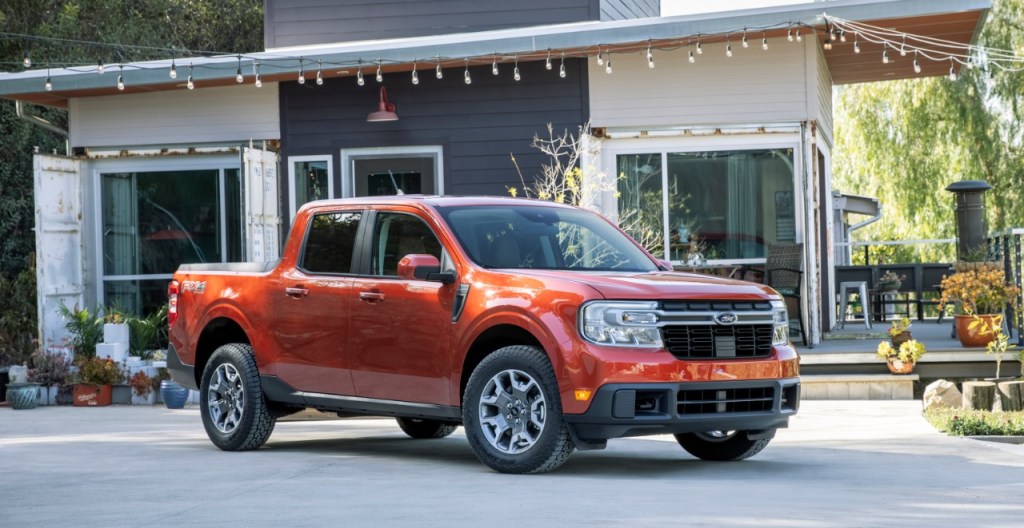
Functional design and clever use of materials in the ’22 Ford Maverick. (Image: Ford)

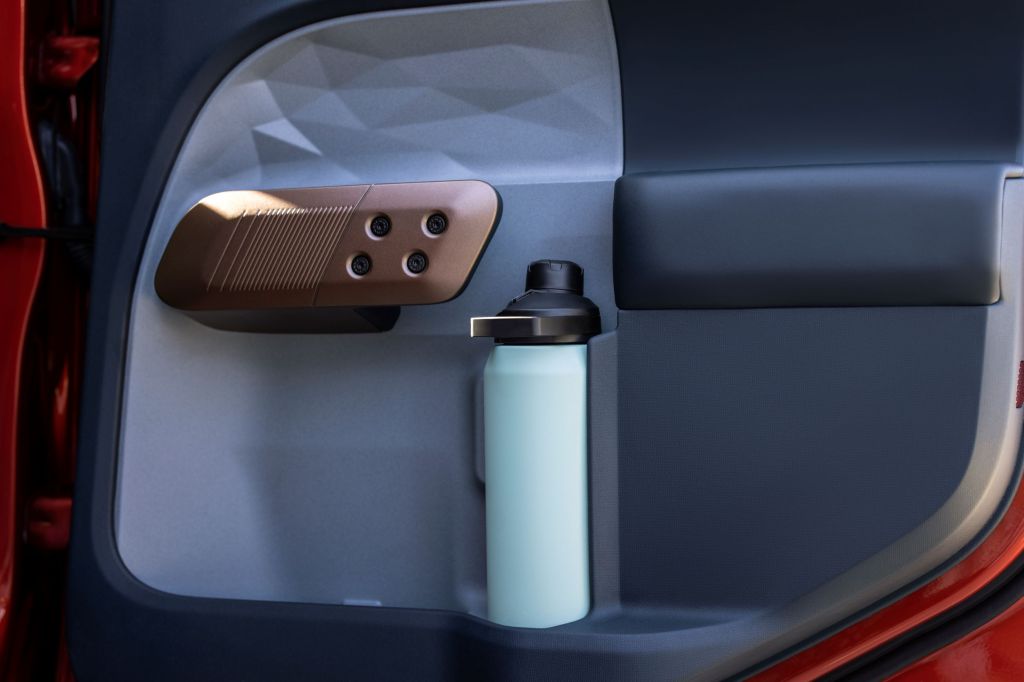
For one thing, Anderson says, they decided that they would be honest about the use of plastic. They wouldn’t make it appear as though the material is something that it isn’t—but at the same time, they made it appear, through color and texture choice, as something both interesting and fit-for-purpose.

In addition, they did lots of observation about how people use their interiors, including storing objects of various sizes and configurations and so make the means to accommodate them, even if it meant things, as in the case of the front arm rests, are not what is typical: the front arm rests are truncated so as to make it more convenient to have large water bottles in the map pocket below.

So there is the essential part. And the guts, because when you decide that fasteners, for example, are going to be part of the design, not something hidden (often in a half-assed manner), then you’ve got to stand up for it.

Anderson talks about all this and more on this edition of “Autoline After Hours” with Rain Noe of Core77, freelance writer Mark Williams and me.

In addition, Noe, Williams and I discuss the coming onslaught of electric trucks, including the F-150 Lightning, the Rivian R1T, the HUMMER EV pickup, the Bollinger B2, the Silverado electric, the Tesla Cybertruck, and the Lordstown Endurance.

And you can see the show here.

How the Ford Maverick Was Developed

An up-close look at bringing the clever small truck to the market

By Gary S. Vasilash

The Ford Maverick is what is being called a “white space” vehicle, a small—199.7-inch long—pickup truck with four doors and seating for five. As a point of reference, a Ford Ranger is 210.8 inches long and an F-150 is 231.7 inches long.

It will come standard with a hybrid powertrain that will provide an estimated combined fuel efficiency rating of 37 mpg. And the standard model has a payload capacity of 1,500 pounds and is capable of towing 2,000 pounds.

(Image: Ford)

The starting MSRP for the Maverick is $19,995.

And when asked whether this is some sort of artificially low price, both Chris Mazur, Maverick chief program engineer, and Trevor Scott, marketing manager for the Maverick (and Ranger), unambiguously maintain that this truck is the real deal.

It is, they say “Built Ford Tough.”

That claim is fairly bedrock for the Ford truck lineup so you can be confident that they’re not going to be using it unless there is confidence that they’re going to deliver with this pickup the same way that’s done for the other Ford trucks.

The interesting thing about the Maverick is how it was developed—done in a way unlike has been the case at Ford (as well as other companies that develop, well, anything). And this approach has not only led to the various innovations that are part of the Maverick, but also contributes to the cost-efficiency that the MSRP underscores.

One of the things about the truck is that the team, observing the way that real people use their trucks (not that the people on the team aren’t real people, too) is that many of them hack solutions, whether it is drilling holes in the sidewalls of the box to access electricity or jury-rigging the means to secure a mountain bike in the back. So Mazur says that they thought about that and have made power access simply available will provide CAD files that will allow owners to 3D print tooling for things like attachments.

It is almost that DIY ethos that is characteristic of the product development.

When the development started—pre-COVID—it was decided that there would be a cross-functional team consisting of representatives and participants from all functions that would be necessary to get the job done.

All of the participants wouldn’t just be in the same email group—they would be in the same room. Finance. Manufacturing engineering. Everyone was there. If there was a question to be answered, there was the person—right over there—who probably had the answer.

And they worked to be fast. Their “audacious goal” was to cut 25 months out of the development program.

They made quick models. They plastered the wall with documents and Post-It notes.

When it was time for the upper management reviews, it was there in the room, with the working documents and models and whatnot. Binders and PowerPoints were not on the schedule.

And when COVID hit and the people left the room for their own houses, they were still a team that knew one another, knew who to talk to to get answers, knew who was involved in what aspect of the development.

They were able to get things done.

They didn’t hit the 25-month goal, Mazur admits.

But they took 20 months out of the process.

Remarkable by any measure. And they had a pandemic to contend with.

Realize that as Ford has decided that things like trucks are important to its offering in a way that cars no longer are, the Maverick is a key vehicle in its product lineup.

Mazur and Scott are our special guests on this edition of “Autoline After Hours.”

John McElroy and I are joined by Mike Martinez of Automotive News, who covers Ford.

It is a full hour devoted to the Maverick.

If you have any interest in the truck or in an innovative approach to development, you’ve got to watch this show because you’re not likely to ever get a better sense of how the Maverick has been created.

You can see it all here.

A Thought About the Design of the Ford Maverick

Does an urban dweller want something that is Built Ford Tough or which smacks of fashion?

By Gary S. Vasilash

“One thing that’s non-negotiable is that Maverick is Built Ford Tough,” said Chris Mazur, chief engineer for the small pickup.

What seems a bit odd is that Ford says of the truck “The interior design is stylish and spacious, with thoughtful features and the versatility for city driving or escaping the urban life,” which seems to indicate that this is a vehicle for city dwellers.

Looks like a truck. Is a truck. (Image: Ford)

So this “Built Ford Tough” characteristic doesn’t seem to align with what would assume would be style-conscious urbanites—except for those who wear Carhartt.

As it starts under $20K and comes standard as a hybrid, there is a draw there.

But as Hyundai is coming with the Santa Cruz, a vehicle that is certainly more chic, it will be interesting to see which has greater appeal for those who want a “truck” but really don’t want a “truck.”