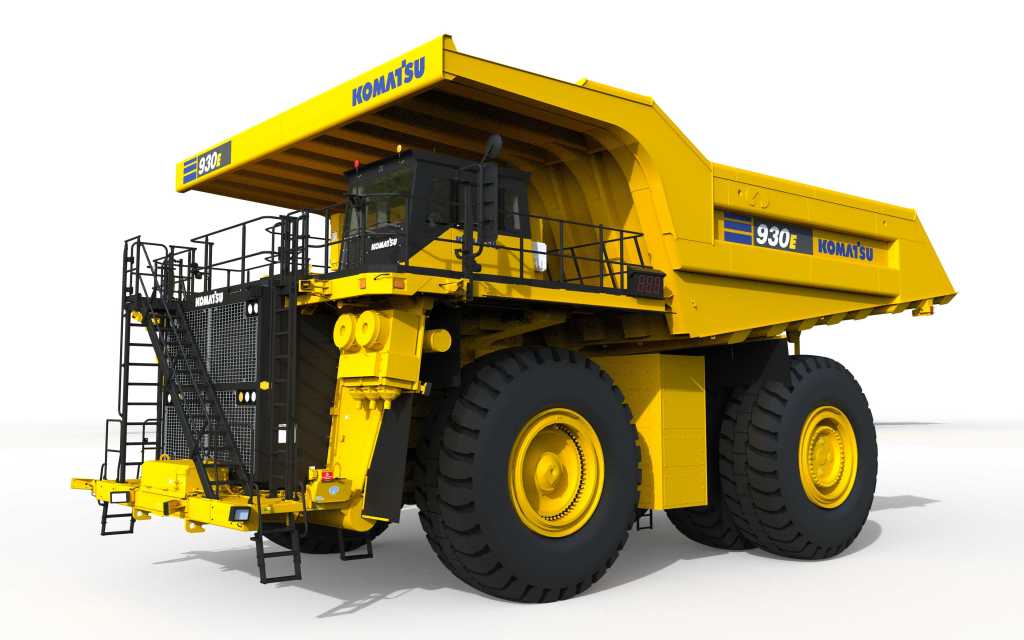
The nominal payload for a Komatsu 930E-5SE—an electric truck that is used in applications like mining—is 640,000 pounds.
Heavy-duty piece of mining gear going to GM fuel cell tech. (Image: Komatsu)
So when Charlie Freese, executive director of GM’s HYDROTEC business says that they believe that fuel cells “can play an integral role in a zero-emissions future, helping to electrify heavier-duty applications,” he’s talking about things like the 930E.
To that end, GM and Komatsu have entered into an agreement through which the companies will co-develop a hydrogen fuel cell power module—on the order of 2 megawatts—to power the 930E.
Dan Funcannon, Komatsu vp of North America Engineering and Development, says Komatsu has pledged to become carbon neutral by 2050.
Typically mining trucks and associated equipment aren’t powered by batteries, aren’t powered by fuel cells, but are powered by diesel fuel.
And diesel isn’t on the pathway to carbon neutrality.
GM HYDROTEC will develop the fuel cell modules, which they refer to as “power cells.” Komatsu will work on the mining truck.
The plan is to have the first prototype tested at the Komatsu Arizona Proving Ground with a few years.
While it may seem like a long time, as Komatsu has a truck and GM has a factory producing fuel cells, let’s face it: when you are on a mining site in the middle of nowhere, you want to make sure that the massive piece of equipment, approximately the size of a small building, works, day in, day out.
Although it seems as though GM execs can’t talk enough about the Ultium platform for battery electric vehicles (there seems to be an inverse relation, however, between talking about it and delivering vehicles based on it: through Q3 it delivered 5,334 Cadillac LYRIQs, 1,216 HUMMER EVs, and 18 Silverado EVs, for a cumulative 6,568 vehicles: you could park all of them at the Mall of America and still have 6,182 parking spaces left over), there is another electric vehicle technology that the company is pursuing that deserves more attention: HYDROTEC, its fuel cell technology.
It has developed what it calls “power cubes.” A cube contains >300 individual hydrogen fuel cells that combined produce 77 kW. (The cube also contains the necessary thermal and power management systems and controls.)
GM HYDROTEC fuel cell “power cube.” (Image: General Motors)
Today GM announced that it has signed a development agreement with Autocar Industries.
Autocar Industries doesn’t build cars. It builds trucks—although its tagline is:
“Some Build Trucks. We Build Tools.”
As in tools that are trucks that are used in vocational applications such as hauling trash or hauling trailers around freight yards.
Charlie Freese, GM executive director, Global HYDROTEC:
“EV propulsion systems like GM’s Ultium Platform are great solutions for electrifying passenger vehicles,* but larger vehicles like Autocar’s class 8 trucks, refuse trucks and terminal tractors require robust solutions that enable significant energy carrying capacity and fast refueling times.”
So they’re going to be developing, along with Triz Engineering, which specializes in commercial vehicle engineering, hydrogen fuel cell-powered vehicles that Autocar will manufacture in its plant in Birmingham, Alabama. The power cubes will be produced at a GM facility in Brownstown, Michigan.
The first vehicles to be built are cement mixers, roll-off trucks and dump trucks. The power cubes can be combined, so if 77 kW isn’t enough, then there can be 154 kW or 231 or. . .
If there is any question about the viability, capability and durability of fuel cells, applications like this one should put it to rest. Freese said that they put the systems through all manner of demanding tests—G-loads, temperature extremes, crashes—and the carbon fiber hydrogen tanks have been subjected to small-arms fire. (There are also military applications; the Autocar trucks aren’t likely to be taking fire.) These things are meant to get the job done.
(The thing about hydrogen for vehicles is that whereas people talk about the lack of infrastructure for electric vehicles, the infrastructure for hydrogen refueling is essentially non-existent except for some places in California. Consequently, building vehicles for the mass market doesn’t make a whole lot of sense now. Building vehicles for specfic applications–like what Autocar does–makes a whole lot of sense because users can create dedicated refueling without having to worry about pumps dotting a highway: they know where their equipment is going to be at the end of the day, so they can put the refueling equipment there. Still, perhaps when people start realizing that even fast-charging EVs will take about 20 minutes to get the battery charged 80% and hydrogen refueling is functionally and temporally the same as that at one’s local gas station (i.e., fill it up in <5 minutes), perhaps the demand for fuel cells for passenger vehicles will grow.)


 shinymetalboxes