
By Gary S. Vasilash
When the Honda Ridgeline was in its first year on the market, it received the 2006 North American Truck of the Year Award (it is worth noting that back then there wasn’t the Utility category, simply “Car” and “Truck,” and it was a good year for Honda, as the Civic took Car).
Then, when the second-generation Ridgeline, which is the basis for the current model, had its debut year, it took the 2017 North American Truck of the Year. The other two finalists were the Ford Super Duty (which won the NACTOY award in 2024) and the Nissan Titan (which is going out of production this summer).
The point of this is that the NACTOY jurors tend to be a picky lot (full disclosure: I am one of them), and for the Ridgeline to take its category the two times it has been eligible says a lot about the truck.
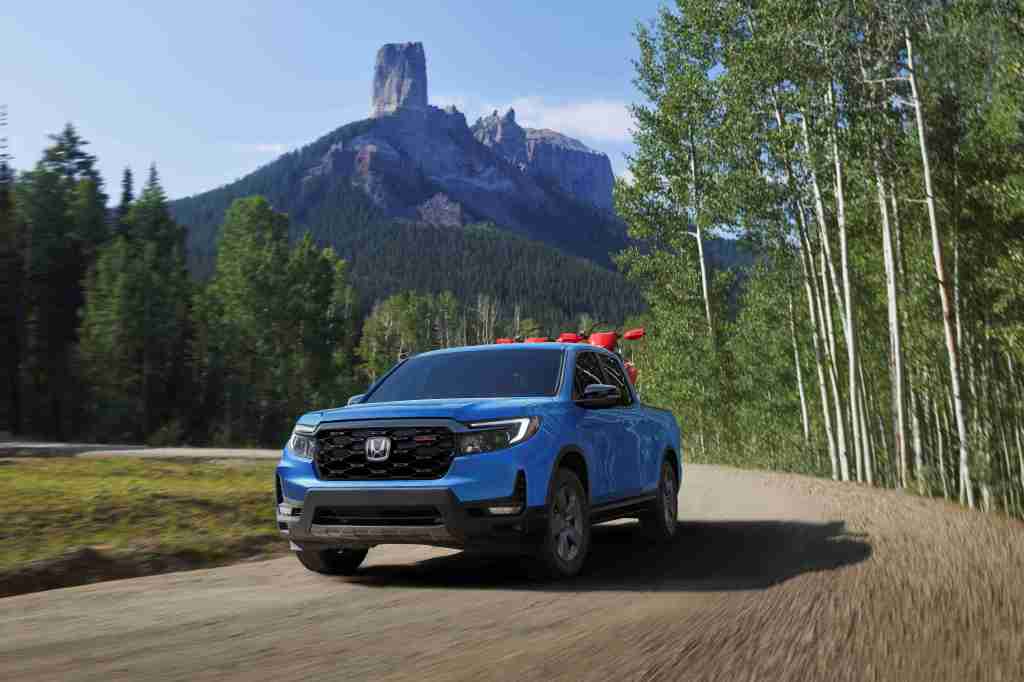
One of the things that made some people dismissive about the Ridgeline being a “truck” is that doesn’t feature body-on-frame construction but is a unibody.
How dare Honda!
Clearly it was on to something because the U.S. pickup truck leader, Ford, introduced the Maverick in 2021 and it, too, is a unibody. (It took the NACTOY Truck category in 2022.)
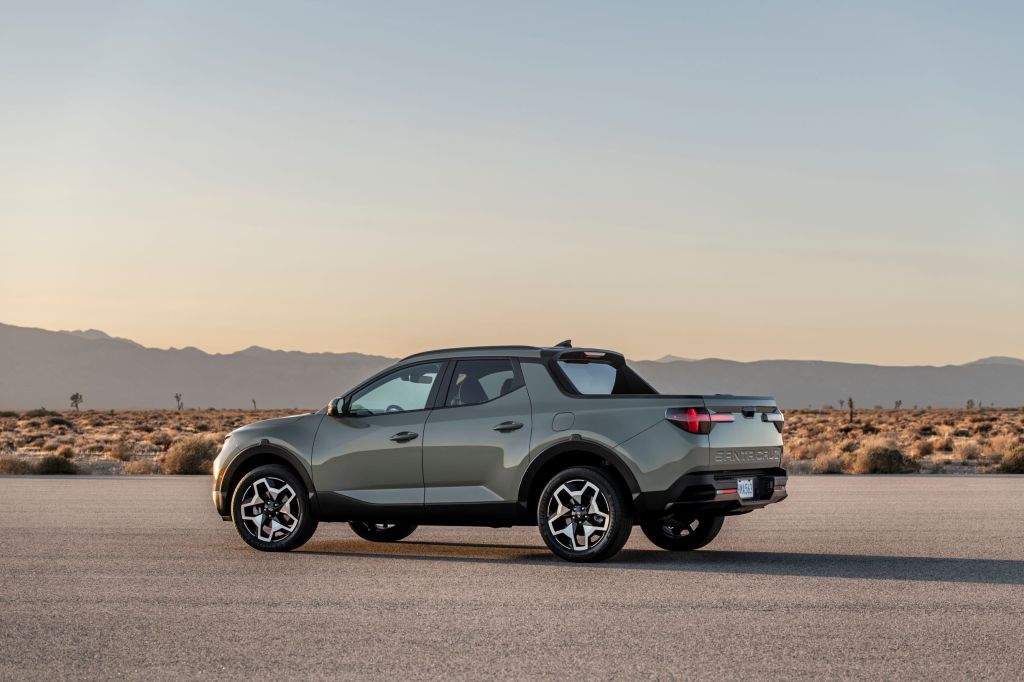
(The Hyundai Santa Cruz is also on that type of platform.)
The Ridgeline has a box on the back: 64 inches long; 50 inches wide at the wheel wells, 51 inches wide at the D-pillar, 60 inches wide at bed walls.
The Ridgeline can tow: up to 5,000 pounds.
The TrailSport version has a total payload capacity of 1,521 pounds.
When driving the Ridgeline a friend took a look at the box on the back.
“I need a truck a few times a year.”
And it occurs to me that that is precisely the sort of person who might be inclined to get a Ridgeline rather than the other midsize trucks that are available, all of which are body-on-frame vehicles.
This is because the Ridgeline truly rides and handles like an Accord.
Let’s say for the sake of argument that my friend’s “few times” adds up to a solid month. Let’s say that he goes for one of those other midsize trucks.
That means for 11 months out of the year he’s driving something that doesn’t have anywhere near the ride and handling of the Ridgeline.
Seems to be quite a price to pay for hauling gear or gravel or whatever on occasion.
The TrailSport trim package is new for 2024. It has such things as a suspension tuned for offroad conditions and General Grabber A/T Sport tires (245/60R18), the first deployment of all-terrain tires on a Ridgeline. (Although they are big and chunky, the sort of thing you might imagine would generate all manner of road noise when not driving on a trail (which one might do “a few times a year”), somehow there isn’t a heck of a lot of noise from the tires in the cabin.)
In addition to which the TrailSport has a steal underbody protector for the oil pan.
On the inside there is the use of orange thread for the stitching on the steering wheel, door panels and seats; the front-seat headrests have “TrailSport” embroidered on them.
Just as there is capable rubber on the outside, there are serious rubber floor mats standard: if you’re going to use the truck to play in the dirt you might get dirty, so. . . .
The truck is powered by a 280-hp, 3.5-liter V6 that’s mated to a nine-speed automatic.
There is Honda’s torque-vectoring all-wheel drive system and there is “Intelligent Traction Management” for that system that allows the driver to select for sand, snow, mud, or paved roads. (Here’s betting that depending on where one lives, the last is the normal selection and the second occasional, assuming there are winter conditions.)
There are the now-obligatory infotainment features in the Ridgeline (e.g., nine-inch color touchscreen; Apple CarPlay and Android Auto), and what’s interesting is that Honda says that it has deployed a faster processor in its head-unit which means less lag.
According to Merriam-Webster, a pickup truck is “a light truck having an enclosed cab and an open body with low sides and tailgate.”
The Ridgeline certainly is that. And even more.
One more thing: Cars.com generates an “American-Made Index” each year for vehicles, taking into account assembly location, parts content, engine origin, transmission origin and U.S. manufacturing workforce.
The Ridgeline was designed and engineered in the U.S. It is manufactured in a plant in Lincoln, Alabama.
Of all vehicles—sedans, SUVs, minivans, hatchbacks, coupes, pickup trucks—there is only one truck in the top 10 of the most recent index: the Ridgeline.
Yes, according to Cars.com it is the most American of pickups.
So there’s that, too.
 shinymetalboxes