The jurors of the North American Car, Truck and Utility of the Year (NACTOY) awards made their decisions of the vehicles that take each of those categories, and it is hard to imagine that anyone would be particularly surprised by the vehicles that won the 2026 awards:
Car: Dodge Charger
Truck: Ford Maverick Lobo
Utility: Hyundai Palisade
(Image: NACTOY)
The Charger arrived on the scene initially as a two-door muscle car powered by a 670-hp electric propulsion system. But the Dodge faithful like the smell of gasoline, so there is a 550-hp six-cylinder engine they can opt for. (There is also a 420-hp version, but c’mon.) And there is also a four-door variant.
The presentation of the awards was made at the Detroit Auto Show in downtown Detroit, just about 20 minutes away from Ford World Headquarters, which is a convenience for the truck team at Ford, because with the win for the Maverick Lobo, this means Ford trucks have taken the Ed Welburn-designed trophy for six years running. And it is the second win for the Maverick as the original version of the truck got the nod in 2022.
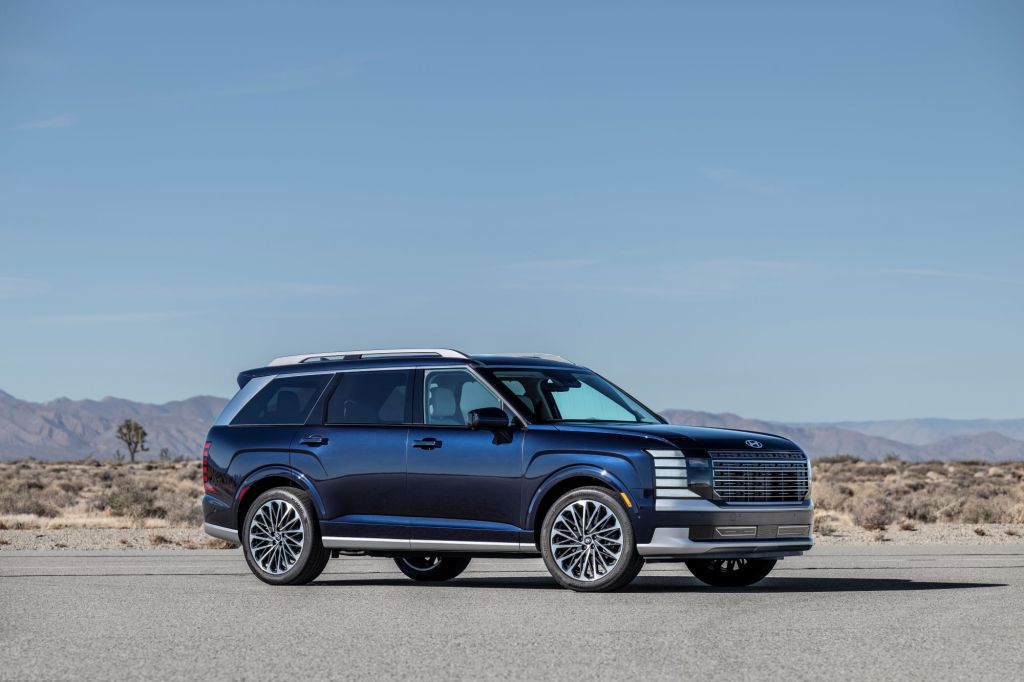
The second-generation Hyundai Palisade, a three-row SUV with an adult-usable third row, has striking exterior design that wraps an interior with a level of design execution and material-appropriateness that would be impressive in a vehicle with a much higher starting MSRP: $38,935. For those who are at the Detroit Auto Show and looking at the three-row SUVs: start with the Palisade. It is simply the benchmark.
It may be positioned as a mass-market three-row, but it is a whole lot more—arguably a segment above
By Gary S. Vasilash
In 2024 the auto industry spent some $29.5 billion on advertising. That’s about 9% of all of the ad spend from all categories and industries, making it one of the top categories.
One of the things the ads do is not only try to convince people to buy whatever, but to perceive whatever in the way that the advertiser wants us to.
Or put simply, if it is a truck the goal is to make sure the viewer understands that it is rugged and capable.
If it is a vehicle that is in the “luxury” category, then it must be presented in a way that makes the viewers realize there is something special about the vehicle that sets it apart from “mainstream” vehicles.
Of course, in the case of trucks they must be engineered to be rugged and capable.
And if it is a luxury vehicle, then there must be attributes—say top-notch materials used in the interior and an impressive infotainment system—that would make the implied purchase premium seem appropriate.
There are simply some things that are necessary to validate the positioning of the vehicle.
But one thing that this does is segments what people may look at.
Sure, someone who wants a truck may simply look at the overall architecture of the vehicle and determine that it is, indeed, a truck.
The lux part is what, at least in the context of the Hyundai Palisade Calligraphy, that has fuzzy borders.
A three-row crossver with massive exterior styling. (Images: Hyundai)
While people would correctly perceive Hyundai to be a mainstream brand—and even the people at the Hyundai Motor Group decided that it would have a separate higher-end brand, Genesis—the Palisade Calligraphy interior is every bit as nice as any Cadillac, Lincoln, Lexus, Mercedes, etc. I have been in of late. And lately I’ve been in a lot (I was one of the jurors for the 2025 Wards 10 Best Interiors & UX Awards, and if you scroll down on this page you’ll see we were in a lot of interiors, and while you won’t see the Palisade on the list, that’s because it wasn’t available during our testing; I’m confident it will be there next year).
The materials, the design, the technology, the comfort, the convenience, and the attention to detail are all first-rate.
Comfort, space, and technology in quantity–and with quality.
Now it should be pointed out the Calligraphy is the top trim for the Palisade, which is available in five other trims, with the SE that has a starting MSRP of $39,435.
The Calligraphy driven here has a MSRP of $56,060, and with one option($245)—and this speaks to the fact that the vehicle as trimmed is absolutely rife with things that would likely otherwise be options—and inland freight and handling ($1,495) the whole thing comes to $57,800. (What is the option?, you wonder. Absurdly enough, carpeted floor mats.)
Recognize this is a seven-passenger, three-row all-wheel drive crossover that has heated/cooled, power-adjusting and reclining front and second row seats, as well as third row seats that also recline. A vehicle with a 12.3-inch infotainment screen and Bose premium audio. A vehicle with a total interior volume of 181 cubic feet of which 161.9 are devoted to passengers. (Max cargo is 86.7 cubic feet—and the folding of the second and third rows are done with a snap, not effort; with all rows in place it is 19.1 cubic feet). A utility that, yes, can tow (up to 5,000 pounds).
This is a big vehicle: 119.2 inches long, 78 inches wide, and 69.5 inches wide, with a 116.9 wheelbase. (One thing that should be noted is that the fidelity of the cameras and the fast-acting dynamic lines shown on the infotainment screen allow maneuvering in parking lots a whole lot easier than you might think.)
While I had the Palisade I was asked whether I would prefer it or the three-row Hyundai Ioniq 9, an electric vehicle with an award-winning interior.
Without question, the Ioniq 9 is a whole lot quicker and responsive thanks to its dual motors (talking about the long-range AWD version here) that produce 303 hp and 446 lb-ft of torque, compared with the 3.5-liter V6 in the Palisade that produces 287 hp and 260 lb-ft of torque (you’ve got to take into account, however, the Palisade is about 1,400 pounds lighter than the Ioniq 9).
The long-range AWD Ioniq 9 provides an estimated range of 311 miles. The EPA numbers for the Palisade are 18 city/24 highway/20 miles per gallon combined. It has a 19-gallon fuel tank. So that means a range, based on the combined figure, of 380 miles,
While 79 miles may not seem like a big deal, imagine using the Palisade, coming home from a holiday weekend, with the second and third rows being occupied by kids who were antsy not long after you pulled away from the cottage. Then recognize that the 79 miles could represent an hour more driving and that even though the Ioniq 9 can be charged from 10 to 80% in 24 minutes (which means you’d get 249 miles of range at 80%), the Palisade can be fully refueled—for 380 miles—in about five minutes.
I’d opt for the Palisade.
And for those shopping for a three-row crossover: a luxury brand or this one? I’d have a hard time determining why this isn’t the better choice.
The next generation of the three-row SUV from Hyundai. . .
By Gary S. Vasilash
The Hyundai Palisade is now, with the 2026 model, in its second generation. The three-row SUV launched in the summer of 2019 as a 2020 model, and over the years has consistently gained plaudits and sales.
One notable thing about three-row SUVs is that they’re more popular than you might imagine.
According to Hyundai figures, for the first half of 2025 there were 1,394,000 compact SUVs sold, which puts that category head and shoulders above everything else in the mainstream segment.
But three-row SUVs are in second place, at 754,277 vehicles sold.
Entry SUVs come in third, at 717,117.
But in the three-row space that the Palisade competes in there is a variety of choices, whether it is the Ford Explorer or the Jeep Grand Cherokee L, the Honda Pilot or the Toyota Grand Highlander.
In other words, Hyundai designers and engineers had their work cut out for them when they developed the first generation, and arguably even more work for the 2026 model year Palisade.
Premium Approach
When Soomin Choe, Exterior Creative Design Manager, Hyundai Design North America, talks about the development of the new model he repeatedly uses the adjective “premium,” whether he’s referring to the execution of the exterior design or how the interior is architected and adorned.
Another word he uses is “furniture.”
Here’s the thing: the ’26 interior is capacious for those who are housed in it.
The Space
Its interior volume, 181 cubic feet (that’s 161.9 for passengers and 19.1 for cargo behind the third row), is bigger than that of its competitors from Chevy, Kia, Honda, VW, Toyota, Ford, Subaru, Nissan, and Mazda.
So like a modern room, the Palisade includes comfortable seating, storage capacity for the stuff that you have when seated, premium materials on surfaces, and an impressive sound system (14-speaker Bose—which is likely better than what most people who buy three-row SUVs have in their homes.)
Soothing
And speaking of what people have in their homes, often times there are TV commercials for furniture stores touting massaging chairs. The Palisade has got an “Ergo Motion” driver’s seat and the front passenger and the second-row passengers have “relaxation” seating, which means there are powered tilt and recline.
(The third row does have power adjustable seating, but it isn’t to the extent of the other places. It is notable that the third-row seats are heated, which is unusual given that space is often a penalty box in vehicles. They even increased the size of the rear side windows so those in the back have a better view of their surroundings.)
Go the Distance
A word about the powertrain offerings. There is a 287-hp, 3.5-liter V6 mated to an eight-speed automatic. Given the nature of this being a family hauler, which can translate every now and then as “vacation vehicle,” the Palisade can tow up to 5,000 pounds. It is also available with all-wheel drive.
Then there is a hybrid powertrain, consisting of a 258-hp four that is mated with two electric motors that are mounted in the six-speed transmission case that increase the overall propulsion system output to 329 hp. What is particularly interesting about this is that even though this is, as previously mentioned, a large vehicle—199.2 inches long, 78 inches wide, 69.5 inches high, with a 116.9-inch wheelbase—it is going to be providing on the order of 34 mpg. (Let’s say for the sake of argument that someone gets only 30 miles per gallon. It has an 18.2-gallon fuel tank. So let’s posit someone wants to end up with at least 0.2 gallons in the tank. 30 x 18 = 540. That’s a lot of miles on a single tank of fuel.)
The ’26 Palisade comes in seven trims, from the entry SE to the top-of-the-line Calligraphy.
Special Trim
But there is one trim that is particularly interesting.
While the Palisade is certainly a refined vehicle, the Hyundai product planners know that especially in the U.S. market there is a non-trivial number of people who want vehicles that not only look rugged but are capable of performing at levels that suburban sleds can’t.
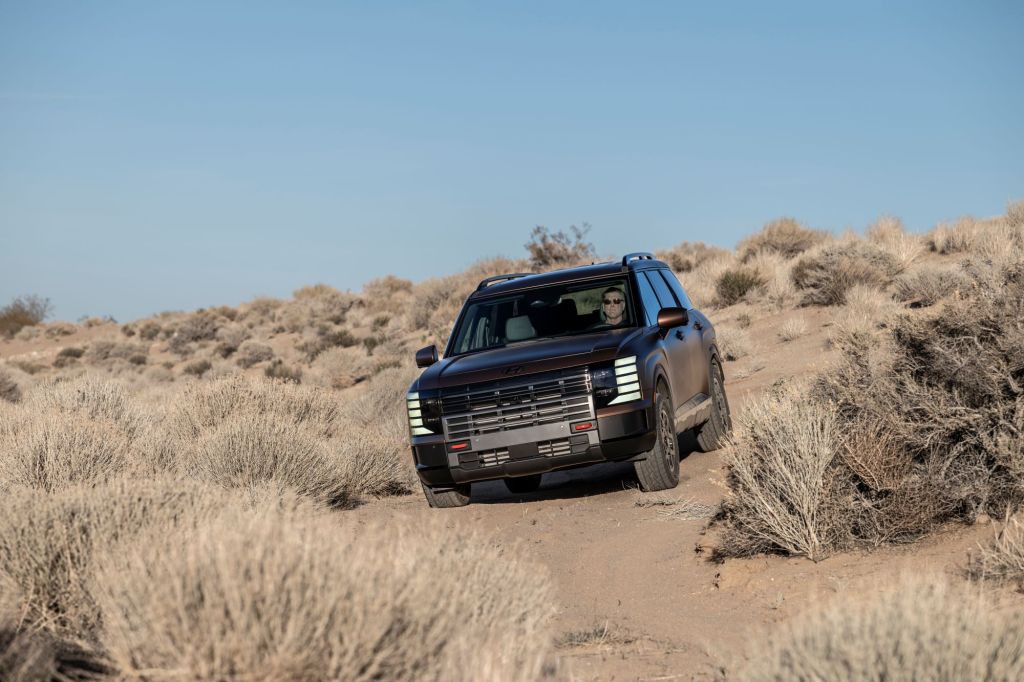
XRT PRO: Go play in the dirt. (Inside it is still well-appointed.)
So the designers and engineers came up with the XRT PRO model. It has thing like an electronic rear limited-slip differential. There is 8.4 inches of ground clearance as well approach (20.5°), departure (22.4°) and breakover (18.3°) angles that take the ground into account.
There are 18-inch dark-finish alloy wheels and the darkness theme carries through to the exterior trim.
Clearly, with the ’26 Palisade Hyundai is doing all it can to increase its share of the three-row SUV market.




 shinymetalboxes