
Some somewhat technical aspects of an immensely impressive three-row SUV. . .
By Gary S. Vasilash
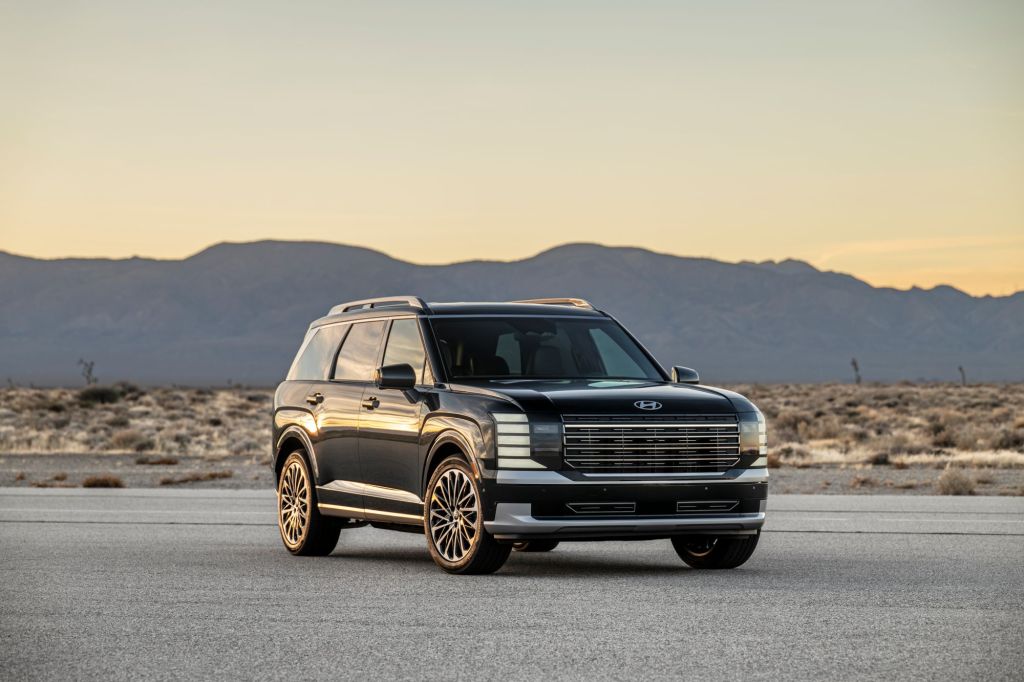
The 2026 Hyundai Palisade Hybrid is the first deployment of the Hyundai next-generation hybrid system. Which is important to know simply from the standpoint that it has been offering hybrids in the U.S. market since 2011. It hasn’t stopped. And as this indicates, it has continued to work on the technology.
The Palisade Hybrid features a 2.5-liter turbocharged four-cylinder engine. There are two electric motors, one that has the primary function of providing power to the wheels and the other, secondary, motor that supports starting and regenerative braking and power flow. All in, the result is system horsepower of 329 and 339 lb-ft of torque. The motors—know in the technical hybrid community as P1 (the starter motor, 17 hp) and P2 (the drive motor 72 hp) are integrated with the vehicle’s familiar—at least more familiar than Honda’s transmission-free two-motor hybrid system (there is a lock-up clutch deployed when needed) or the Toyota e-CVT—six-speed automatic transmission.
There are a couple things to keep in mind about what might seem to be an usual transmission choice.
One is that it provides a more natural driving “feel.” Odds are, even if you don’t think about it, you are used to discerning when a vehicle shifts gears when you accelerate (not so much when you decelerate). And it actually feels odd when you’re driving a vehicle with a CVT (now often with programmed steps to simulate a more natural, mechanical feel). (One reason why people driving an EV become surprised when they take it out for the first few times and look at their speedometer and see a high number is because there is linear acceleration: it just goes.)
Another is that they’re taking advantage of the mechanical advantage provide by the step-gear transmission. Know that the Palisade is a big vehicle. . .
- 116.9-inch wheelbase
- 199.2 inches long
- 78 inches wide
- 69.5 inches high
. . .that offers plenty of interior space. . .
- 159.6 cubic feet of passenger volume
- 19.1 cubic feet of cargo space behind the third row
. . .and provides the ability to tow 4,000 pounds.
As this is sort of techy with that P1 and P2, it is also worth knowing (even if it isn’t wholly understood) that the 2026 Palisade makes extensive use of third-generation steel (average strength 69.2 kgf-mm2). What this means is the structure of the vehicle is remarkably solid, which is helpful when it comes to minimizing any squeaks and rattles from the structure (they take care of things like road noise with an extensive use of sound-absorbing material and thicker glass on the windshield, front doors and tailgate).
Also, by using hot-stamped components (most stamping for vehicles is done at room temperatures, but some of the steels used in the Palisade have to be heated up to make them more ductile so they can be stamped—otherwise they might break the dies), the cage structure adds safety, which is an important thing for a people-mover.
The Palisade comes in a gas-only version. That has a 287-hp V6 and an eight-speed automatic. In the front-drive setup it provides 19/25/21 mpg city/highway/combined and 18/24/20 mpg for the AWD version.
The Palisade Hybrid provides 31/32/31 mpg in the FWD configuration and 29/30/29 mpg in AWD.
A significant difference. And a key reason why the Palisade Hybrid is a notable vehicle for today.
 shinymetalboxes