
Kevin Kang talks about how global designers looked beyond the world of COVID to the one that we’re experiencing today—when more people want to get out in the world. Which have rise to the fifth-generation of the Santa Fe SUV.

By Gary S. Vasilash
One of the things that COVID gave rise to is the design—inside and out—of the fifth-generation, 2024 Hyundai Santa Fe.
As Kevin Kang, Head of Department, Design, Hyundai Design North America, explains, the work on the project (code name: MX5) began in late 2019, and within a few months the design teams in the U.S., Korea and Europe were communicating with one another via digital means, including putting on virtual reality headsets (with individuals expressed as avatars) so the design-in-becoming could be viewed and manipulated.
Because they were all aware of the varying levels of lockdown that COVID was causing, the designers thought about the future, about what people would be interested in doing post-pandemic. And so research was conducted and it was determined, Kang recalls, that people would be more interested in getting out into the world.

In some instances this going out would be a visit to Costco to load up on things rather than waiting for the Amazon truck to deliver. In other cases it would be spending some time at a camp site.
So they decided that they would work to develop a three-row, midsize SUV that would blur the boundaries between the two activities, combining create comforts with capability.
This led them to start at the back.
Kang explains that what makes an SUV an SUV is not how it appears from the front or the side, but it is all about the back. About the tailgate.
They maximized the opening.
Whereas the opening in the previous generation is 44.5 inches wide and 30 inches high, the ’24 Santa Fe’s opening is 50.2 inches wide and 32 inches wide.

(One result of going so big and working to make it fully accessible: they had to lower the position of the brake lights.)
(One result of people working during COVID and using Clorox wipes with regularity on objects they’d have to hand: they put a UV sterilization tray above the glovebox: pop in your phone, close the lid and activate.)
The Best Box
To state the obvious, the ’24 Santa Fe is boxy. Both inside and out.
Kang: “We wanted to create the best-looking box ever.”
But this isn’t something that was done purely for reasons of styling.
Kang, again: “For me, a logical design is the superior one.”
(For those who might think that boxy on the outside rather than something sleek and swoopy means it is like trying to move a brick through the air, know that the drag coefficient for the new Santa Fe is 0.294. . .and the drag coefficient for the outgoing model is 0.33. And lower is better. However, it is worth noting that part of this aero efficiency is achieved through the use of something borrowed from the company’s IONIQ electric vehicles: active air flaps in the front fascia.)
Making Models
The designers who worked on the interior of the Santa Fe thought about things like what would be involved in going from home to a campsite. This would not necessarily be an A to B undertaking, but have intermediate stops that might be picking up kids from school, stopping at a supermarket, hitting a Starbucks. . .and then making it to the great out of doors.
All of which means acquiring things along the way and, in some instances, generating trash.
To figure this out in a logical manner the designers made one-fifth scale models of the interior of the vehicle as well as the stuff that would come along for the ride. This led them to creating spaces for things.
Like a large tray space in the center console that can be used to place things a fast-food to-go bag. (The shifter has been moved to the steering column and the cupholders moved back on the console.) And a drawer readily accessible to the second-row passengers (though it can be reached from the front) that could be used to toss trash.
And they addressed ergonomics, as well. For example, Kang says that they took a lesson from the cockpit of aircraft. In planes there are ledges around the screens for the instruments that the pilot can use to steady their hands during flight.
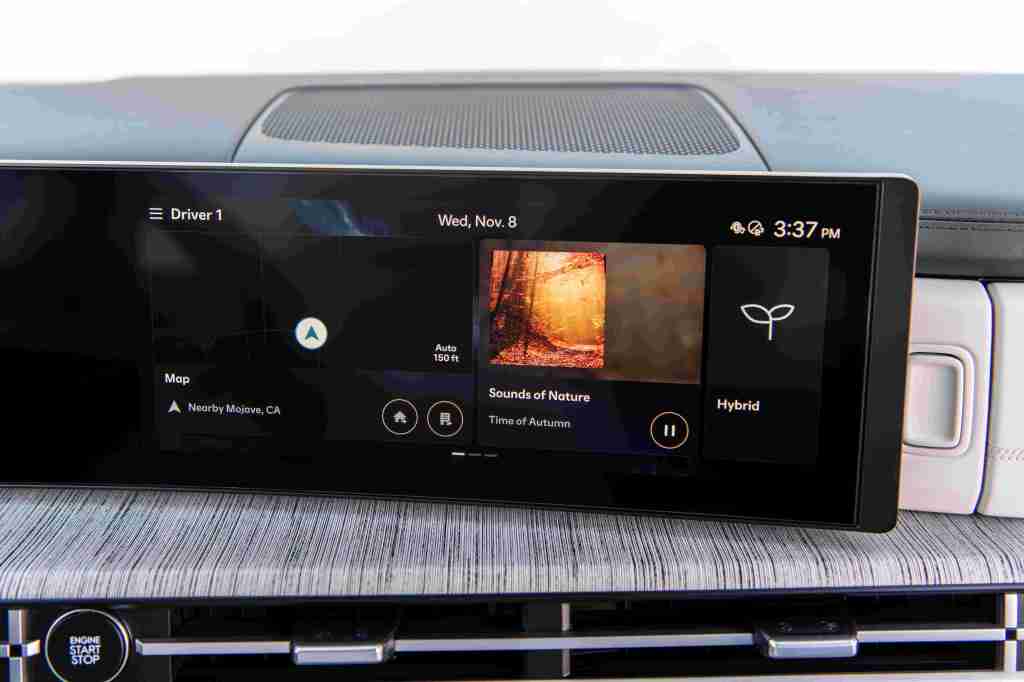
So they designed what they call a “palm rest,” a trim piece that runs across the middle of the instrument panel with a slightly bigger surface below the infotainment screen: this allows someone to have stability when making selections from the screen.
Meanwhile, on the Exterior. . .
Going back to the exterior, Kang says that they worked to keep the greenhouse surfaces as flat as possible (again, the surface of a box). Of course, to provide a sense of ruggedness, there are fender bulges, though these are done in an interesting way: around the outer area of the flair there is a chamfer that goes into the surface of the vehicle which results in a more massive appearance of the surround as it bulges outward.
The trim in the rocker area of the Santa Fe is piano black, which is surprising on a vehicle that does have some offroad capabilities (there is an XRT trim that has a higher ground clearance than the other models—8.3 inches rather than 7.0 inches—which provides greater approach, departure and breakover angles, so for those inclined to go to campgrounds that are well off the proverbially beaten path, it is the trim to take). Kang says that while matte finishes might be preferable, consumers find that to look not particularly upscale: remember that the Santa Fe is designed for the daily suburban driver, as well.
The front of the Santa Fe has a horizontal LED lamp that stretches across the top grille, terminating in the headlamps. This forms a double “H” shape: the “H” that is formed where the horizontal bar meets the vertical lights on either side and an “H” that is formed by the headlamps that each have a pair of vertical lights.

Then on the fascia above the lower grille there is still another “H” formed with the body-colored material surrounded by darker trim.
While this reads as though it would be gaudy, it is actually more subtlety executed.
No Russian Dolls
Is this use of the “H” something that may show up on subsequent Hyundai vehicles?
Kang thinks not.
“We have collectively decided not to do the Russian-doll approach to design,” he says.
In the SUV lineup, for example, there is the Tucson smaller than the Santa Fe and the Palisade larger. But all three vehicles exhibit their own stylings.
Each vehicle has a design onto itself.
And this makes absolute sense. Globally, Kang points out, Hyundai has more than 60 different models.
Trying to make a family look for dozens of vehicles would probably be nothing more than an exercise in frustration.
While the first read on the ’24 Santa Fe may bring to mind the Land Rover Defender (arguably not a bad thing, especially as that vehicle starts at a price well above the sticker for the Santa Fe AWD hybrid with the top-of-the-line Calligraphy trim package), that sense quickly disperses as it is clear that given the detail outside and in, this is a vehicle that is clearly its own thing.
 shinymetalboxes