
2026 Toyota Grand Highlander Hybrid MAX Platinum

Impressive, capable and even fuel-efficient. . .

By Gary S. Vasilash

The word “grand” isn’t used as much today as it once was.

Way back in the day, the Latin word was grandis, meaning “full-grown,” “big,” “great.”

Then that was picked up the French (grant, grand) and then moved over to Middle English, which added some meanings, including “important” and “magnificent.”

We use “grand” to designate $1,000.

We watch the Grand Prix races.

We sometimes eat a 1000 Grand candy bar.

The Jeep Grand Cherokee was launched in model year 1993.

The Pontiac Grand Prix went out of production with model year 2008.

The Dodge Grand Caravan—evidently the folks in Auburn Hills like the adjective—ended its decades-long run in 2020.

Toyota took up the mantle in model year 2024 with the Grand Highlander.

///

One of the things that some people were concerned about who liked the Jeep Grand Cherokee was that grandis notwithstanding, it was a two-row SUV from its beginning in 1993.

Toyota rolled out with its Highlander SUV in 2001 and offered a third-row as an option. It wasn’t much of a third row if a row is supposed to accommodate people above the age of 5. The Highlander offers 28 inches of legroom.

In model year 2021 Jeep put a third row into the Grand Cherokee, creating the Jeep Grand Cherokee L. That “L,” presumably indicating “long,” put a row back there with 30.3 inches of legroom.

For model year 2024 Toyota decided that it wanted to up its game, so it brought out the Grand Highlander.

And one of the most notably grand things about it is the third row. It is designed to accommodate people who are “full-grown,” thereby getting back to that Latin etymology.

The legroom is 33.5 inches.

Grand, indeed.

///

The name of this trim—one of 10 trims available—is certainly big: Grand Highlander Hybrid MAX Platinum.
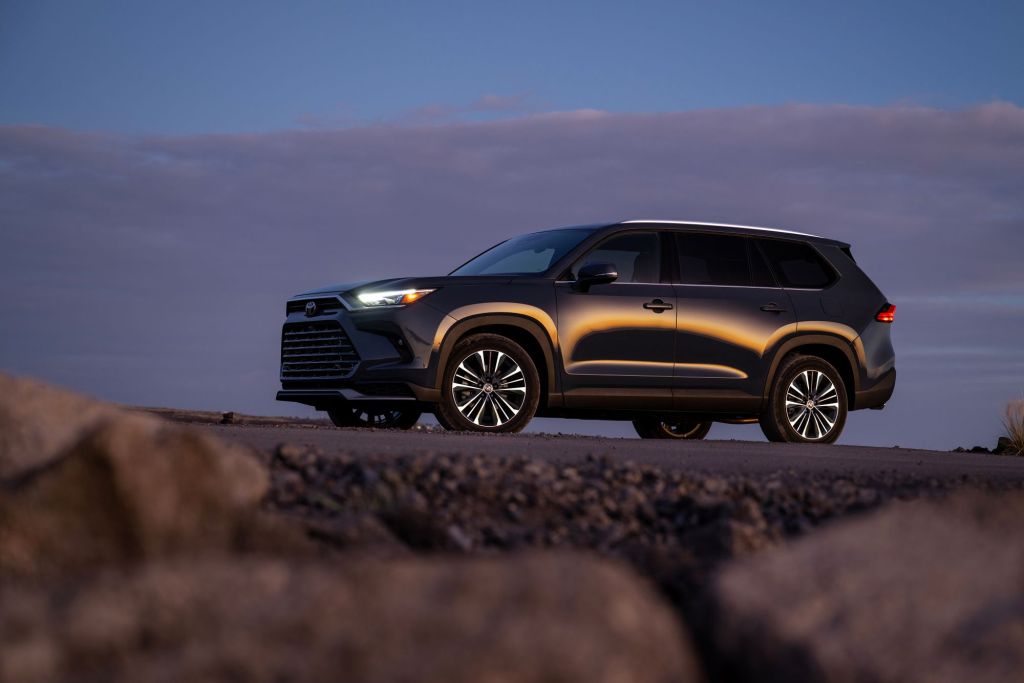
2026 Toyota Grand Highlander: yes, it truly is grand. (Image: Toyota)

To dissect that, the “hybrid” part goes to the 2.4-liter turbo-charged four cylinder engine that’s supplemented by a front-mounted hybrid motor and a rear-mounted eAxle electric motor, all of which means total systems output of 362-hp and 332 lb-ft of torque and full-time electronic AWD (you don’t have to do anything; the system will figure out the demand).

Now here’s an impressive thing to know, also to the point of the hybrid: even though this model has a curb weight of 4,905 pounds, the estimated fuel economy is 26 mpg city, 27 mpg highway, 27 mpg combined.

That in a vehicle that can accommodate seven people in—dare I say?—grand comfort.

And it takes regular fuel.

Consider: this is a vehicle that’s 201.4 inches long, 78.3 inches wide, 70.1 inches high, and features an 8-inch ground clearance. This is a large vehicle with lots of visual presence. A large vehicle that is accommodating of the aforementioned seven adults. A large vehicle with plenty of technical amenities. A large vehicle that features a well-appointed cabin that is both quiet and immensely comfortable.

Yet it gets a combined 27 mpg.

And let’s take that number a bit further.

The fuel tank on this Grand Highlander has a 17.17-gallon capacity.

So let’s say that you’re a bit heavy-footed and are getting 25 mpg. And let’s round that capacity to 17 gallons.

This means that there is a possible range of 425 miles. You could drive from Memphis to St. Louis and still have some gas in the tank.

Of course, if you’re towing that number is going to be reduced. But the tow capacity is a notable number, too: 5,000 pounds.

///

Inside, where it really matters, the Toyota Grand Highlander must make the product planners who work on the Lexus TX look over their cubicle walls. This Platinum trim is very nicely done.

The seats from front to rear are trimmed with leather. There are Ultrasuede insets. The front seats are heated and ventilated; the second row heated; the third row. . .well, they’re in the third row.

There is three-zone automatic climate control, so that’s a benefit throughout.

There is a 12.3-inch infotainment screen. There is an 11-speaker JBL audio system. There is a panoramic moonroof. There is a 10-inch color head-up display.

The color and material combinations in the cabin are absolutely well done.

///

The base MSRP is $59,575.

Certainly not humble, but certainly not grand.

Arguably for all that it provides, it very well may be a bargain, which is certainly not something that you’d expect for something so grand.
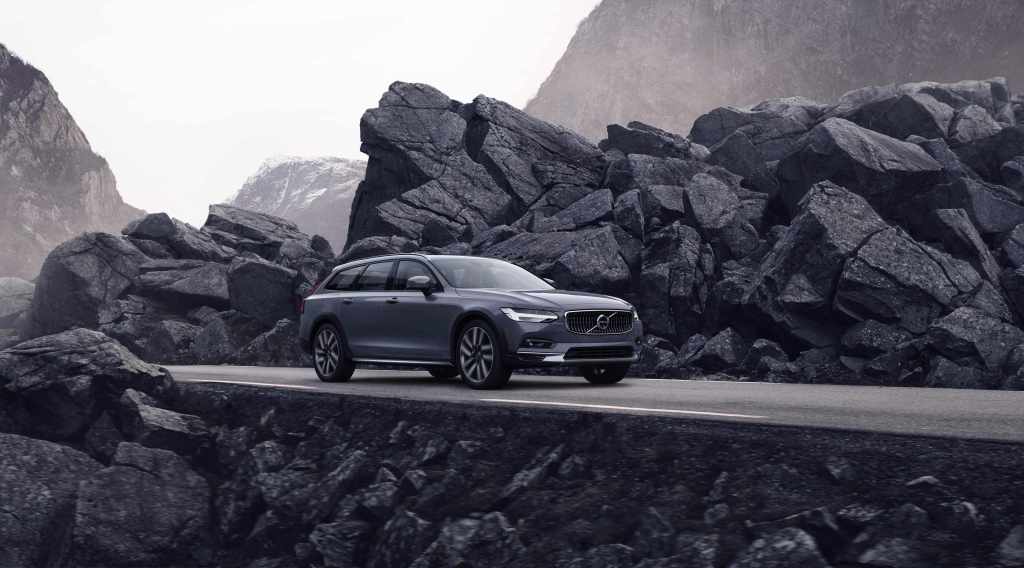
2024 Volvo V90 Cross Country B6 AWD

When you want something that few others have. . .

By Gary S. Vasilash

So my neighbor, a guy in is mid-20s said: “I really like that car a lot. I quite nearly bought one.”

He was talking about the 2024 Volvo V90 Cross Country B6 AWD.

Volvo V90 Cross Country. OK. Maybe this doesn’t look like your neighborhood. But it takes a good-looking vehicle to hold its own with that impressive setting. (Image: Volvo)

Which is surprising for two reasons:

  1. He is in his mid-20s
  2. The car in question is a station wagon

He said that not only does he like the styling of the Volvo, but he’d taken one for a spin and thought it drove well.

To fill out this little vignette, know that he bought an Alfa Romeo Giula sedan instead.

He had had another Giulia, a Quadrifoglio, that he’d leased. He purchased the one now in his driveway.

He said he bought the Alfa because he likes the way it handles.

It is worth noting that in the first quarter of 2024 Alfa sold 640 Giulas in the U.S., so perhaps my neighbor is something of an outlier.

Style vs. Utility

The station wagon body style—more puzzling referred to in other markets as a “shooting brake” (not that “station wagon” isn’t odd: the “wagon” bit makes sense because it can carry goods, but the “station” part seems to indicate that it is something that is static, like a train station—has gone out of favor for the sport utility vehicle.

In part, this goes to the notion that the sport utility vehicle configuration provides utility. Presumably that means the ability to contain a lot of stuff, whether it is golf clubs or hockey gear, suitcases or Costco-sized personal paper items.

The V90 Cross Country provides 25.2 cubic feet of cargo capacity with the second-row seat back up and 69 cubic feet if that is folded down.

So let’s say someone opts for a Jeep Grand Cherokee. Let’s face it: that vehicle is the absolute poster child for an SUV with comfort and style. The Jeep, of course, has four-wheel drive, which makes it incredibly capable when the pavement has given way to an undeveloped surface.

The Volvo has all-wheel drive, which means that it is configured to handle things like snow (after all, Volvo HQ is in Sweden, so they know more than a little something about that).

For what most people are likely to encounter in their driving, AWD is the ticket.

Anyway. . .the Grand Cherokee offers 37.7 cubic feet behind the second row, which is significantly greater than what the Volvo provides, but the Grand Cherokee has 70.8 cubic feet of space with the second row back folded, so it is pretty much a wash.

The V90 Cross Country is longer than the Grand Cherokee—195.2 inches vs. 193.5 inches—but with mirrors folded narrower—74 inches vs. 77.5 inches—and a lot lower: a height of 60.5 inches vs. 70.8 inches. All of which is to say that doing a bit of geometry explains the differences in capacity.

Looks Right. Drives Right.

But let’s get back to my neighbor.

He said he finds the styling of the Volvo appealing, which goes to show that the company has gone a long way from when it seemed as though the designers were kitted with a T-square and right-triangle. It could also go to the point that it very well may be that given the endless proliferation of SUVs and crossovers there may be a small-but-growing group of people who are looking for alternatives.

Yes, he didn’t buy the Volvo, but he did buy a sedan.

Also, he said that he thought the Cross Country handled well. Presumably this has something to do with the vehicle having a lower center of gravity than, say, an SUV.

The Volvo is a mild hybrid. Which means that there is, in addition to the regular 12-Volt battery, a 48-Volt battery that recovers some of the energy produced by braking and stores it until it is used when it works through an integrated starter-generator to provide assistance when starting from a stop.

The vehicle has a 2-liter turbocharged four-cylinder engine. It is mated to an eight-speed automatic. There are 295 hp and 310 lb-ft of torque. All of which is to say that it comports itself as you would expect something like a station wagon to. What’s more, it has a maximum towing capacity of 3,500 pounds. Combined fuel economy is 25 mpg.

Volvo has gone all-in with Google, so there are Google Maps, Google Assistant and Google Play. (Yes, it does support CarPlay.)

Will the Era End?

Swinging back to the Giulia, as previously mentioned, there weren’t a whole lot sold in the U.S. in Q1 2024.

But there were fewer V90 Cross Country models sold during that same period: 164.

At some point, perhaps, more people are going to want to get something that they don’t see in every other driveway on their block. On mine there is an array of F-150s.

And a Giulia.

But I suspect that car makers—Alfa and Volvo alike—are going to have to phase out things that are not gaining traction.

And add to the proliferation of SUVs.

A Jeep Cherokee By Any Other Name

Naming cars is hard

In light of the kerfuffle between Stellantis, owner of the Jeep brand, and the Cherokee Nation, whose chief, Chuck Hoskin, Jr., told Car and Driver that the Stellantis marque really ought to give up the name “Cherokee” for its Grand Cherokee and Cherokee vehicles as a matter of respect, we thought we would bring you names that poet Marianne Moore came up with for Ford in 1955 when it was searching for a name for what would become the Edsel.

Here are some of them, cited by Poetry Foundation (where else?):

Hurricane Accipter
The Impeccable
Symmechromatic
Thunderblender
The Resilient Bullet
Intelligent Bullet
Bullet Cloisoné
Bullet Lavolta
The Intelligent Whale
The Ford Fabergé
The Arc-en-Ciel
Arcenciel
Mongoose Civique
Anticipator
Regna Racer
Aeroterre
Fée Rapide

Moore’s final suggestion: Utopian Turtletop.

If you think about it, “Anticipator” would be a good name for a Level 2+ or higher autonomous vehicle.

Incidentally: Moore was no poetic slouch. Among her many writing awards are the National Book Award and the Pulitzer Prize.–gsv