
Bentley Joins Leather NGO

Sustainability is the name of the game. . .

By Gary S. Vasilash

One of the considerations that OEMs—especially in the higher end of the market—have to come to grips with is developing vehicles that are as environmentally sound as they can be. This isn’t simply an issue of sticking motors and batteries into propulsion systems. It also goes to the point of the types of materials that are used in the vehicles.

Let’s face it: while companies may use recycled steel and aluminum and plastic, odds are end consumers don’t pay a whole lot of attention to that.

What they do pay attention to is what’s on the inside of vehicles.

Which brings us back to the environmental aspects.

As in:

“Leather is a timeless, luxury material that has always epitomized the elegance, durability and quality of a hand-crafted Bentley interior. It has a rich history that dates back decades in our cars and has always stood the test of time.”

That’s Marc Stang, Technical Expert, Leather and Colour Development at Bentley Motors.

The problem is one of sustainability. Leather is generally iffy in that regard.

Somehow tanning leather with olive oil byproducts even seems like it would be nicer to touch than leathers treated with all manner of potentially hazardous things. (Image: Bentley Motors)

So Bentley Motors has become the first automotive member of Leather Naturally, an NGO that focuses (no surprise) on using certified, properly-sourced leather in a variety of industries.

One of the things that Bentley is doing regarding the leather it offers is to deploy a sustainable leather tanning process.

Rather than the heavy metals, minerals and aldehydes that are typically used in tanning, the Bentley Olive Mill Waste Water tanned Leather is produced using an organic byproduct of the olive oil industry (which goes to the point of that name).

Presumably this will allow leather to stand the test of time a little longer at the venerable motor car company.
Growing Seating Surfaces (Yes, “Growing”)

By Gary S. Vasilash

This sounds like something out of a movie where scientists in an isolated lab create something that is, well. . . .

Researchers at Imperial College London have created a way that self-dyeing, vegan, plastic-free “leather” can be grown.

They’ve modified the genes of a bacteria species that produces sheets of microbial cellulose with the modification also making the bacteria produce a dark black pigment know in the lab world as “eumelanin.”

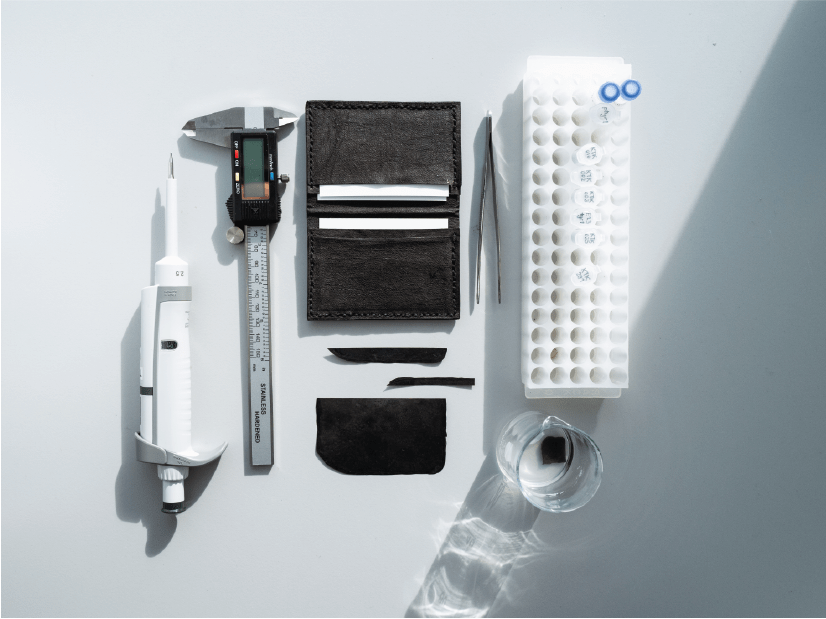
Among that scientific gear is the wallet that was grown from engineered bacteria to resemble the look and feel of leather. (Image: Imperial College London)

Beyond Black

But they’ve also found that using genes from other microbes they can produce colors. They shine blue light on the surface of the bacteria that respond by producing colored proteins. This allows the creation of logos and other patterns in the materials.

While they’ve produced a shoe and a wallet as examples, there are other applications for the material about which Professor Tom Ellis of Imperial College London’s Department of Bioengineering said:

 “Bacterial cellulose is inherently vegan, and its growth requires a tiny fraction of the carbon emissions, water, land use and time of farming cows for leather.

​”Unlike plastic-based leather alternatives, bacterial cellulose can also be made without petrochemicals, and will biodegrade safely and non-toxically in the environment.”

As automotive interiors become increasingly less plastic- and cow-intensive, presumably this could translate into seating surfaces and trim.

Seems at least somewhat creepy.