Most people are probably familiar with ammonia in its addition to household cleaning products—the ones that really smell, well, like something.
The biggest use on ammonia is not to help keep surfaces clean but in fertilizers, which accounts for about 90% of its use.
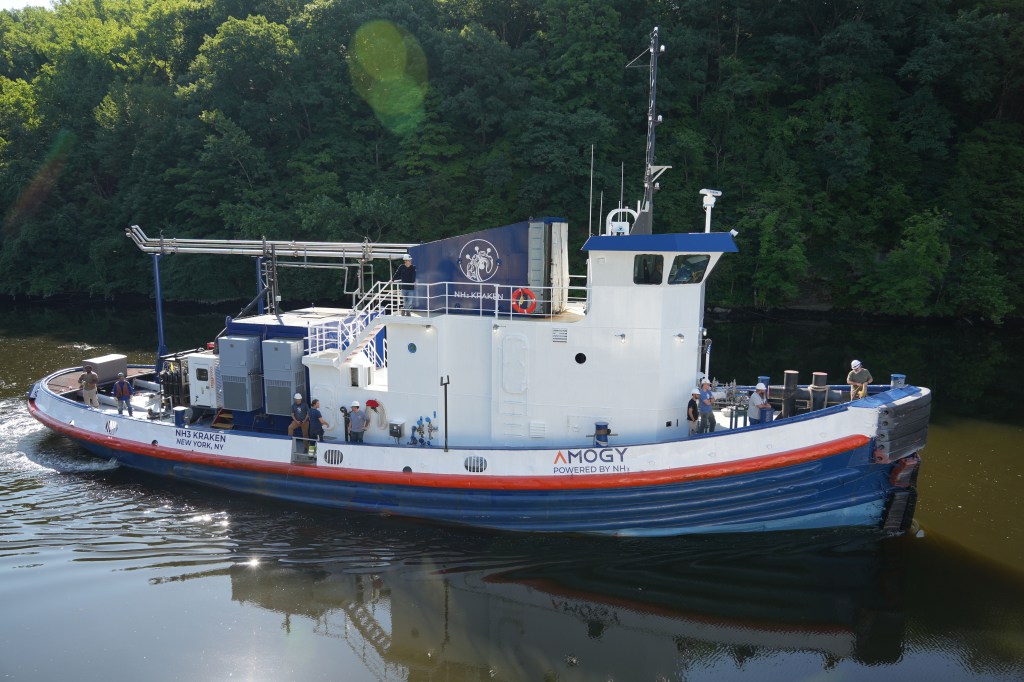
Tugboat powered by ammonia. (There is a little chemistry involved, of course.) (Image: Amogy)
But a company named Amogy, headquartered in Brooklyn, New York has another idea for where ammonia can be used: as a marine fuel.
But not as just any marine fuel, but one that is carbon-free.
To prove its viability Amogy retrofitted a tugboat built in 1957 with it ammonia-to-electrical power system.
The tugboat, renamed the NH3 Kraken, was then sent out on a voyage on a tributary of the Hudson River.
The name of the vessel, incidentally, is predicated on the chemical formula of ammonia.
The way its system works is that it cracks the nitrogen from the hydrogen, with the latter then being used in a fuel cell that generates electricity that powers the boat.
Further underscoring its environmental correctitude, green ammonia—made with renewable energy—was used on the NH3 Kraken.
According to Seonghoon Woo, CEO and co-founder of Amogy, “Ammonia is the world’s second most produced chemical, with around 20 million tons moving around the globe through 200 ports per year.”
Which sounds as though there is something of a nautical infrastructure, or at least one that could probably be brought up fairly quickly.
That said, the International Maritime Organization is targeting net-zero emissions by 2050, so there’s evidently some time.
One of the considerations that OEMs—especially in the higher end of the market—have to come to grips with is developing vehicles that are as environmentally sound as they can be. This isn’t simply an issue of sticking motors and batteries into propulsion systems. It also goes to the point of the types of materials that are used in the vehicles.
Let’s face it: while companies may use recycled steel and aluminum and plastic, odds are end consumers don’t pay a whole lot of attention to that.
What they do pay attention to is what’s on the inside of vehicles.
Which brings us back to the environmental aspects.
As in:
“Leather is a timeless, luxury material that has always epitomized the elegance, durability and quality of a hand-crafted Bentley interior. It has a rich history that dates back decades in our cars and has always stood the test of time.”
That’s Marc Stang, Technical Expert, Leather and Colour Development at Bentley Motors.
The problem is one of sustainability. Leather is generally iffy in that regard.
Somehow tanning leather with olive oil byproducts even seems like it would be nicer to touch than leathers treated with all manner of potentially hazardous things. (Image: Bentley Motors)
So Bentley Motors has become the first automotive member of Leather Naturally, an NGO that focuses (no surprise) on using certified, properly-sourced leather in a variety of industries.
One of the things that Bentley is doing regarding the leather it offers is to deploy a sustainable leather tanning process.
Rather than the heavy metals, minerals and aldehydes that are typically used in tanning, the Bentley Olive Mill Waste Water tanned Leather is produced using an organic byproduct of the olive oil industry (which goes to the point of that name).
Presumably this will allow leather to stand the test of time a little longer at the venerable motor car company.
You’d be surprised at what can be done with what might otherwise seem to be organic waste. Like using it to create car parts
By Gary S. Vasilash
Dr. Deborah Mielewski is a Technical Fellow at the Ford Motor Company.
Two things to know about that: (1) Ford employs about 87,000 people in the United States (more if the people from elsewhere are added, but she works in Dearborn, so we’ll use that number). (2) There are 16 Technical Fellows at Ford.
Yes, she is a rare individual.
She obtained her PhD in Chemical Engineering.
You might be thinking: “Technical Fellow. . .one of 16. . .chemical engineering. . .snooze.”
And were you to be, you’d be wrong.
Mielewski, whose focus is on sustainability, is one of the most enthusiastic and engaging individuals who talks about the environment and recycling and closed-loop processes who isn’t on the Discovery Channel or some outlet like that.
In fact, she probably ought to be.
But for the Earth Day episode of “Autoline After Hours” we have Debbie Mielewski talking about what she and her colleagues are doing in the lab to help make the crossovers, trucks and cars that Ford produces more environmentally sound—and doing so in ways that are not, well, what you might imagine.
One of her earlier undertakings was to develop seat foam using soybean oil. Unbeknownst to her at the time, Henry Ford had been a big proponent in using soybean oil for a number of applications, such as in paint and for body panels.
Ford was once so big on soybean that it built a processing plant on the grounds of the Rouge Complex in Dearborn. (Image: Ford)
The foam that they were creating in the lab took a while to come to a usable form (to say nothing of finding a way to attenuate the rather unpleasant fragrance emitted), but they worked at it and the material debuted on the 2008 Mustang.
Then they’ve had a variety of other atypical materials that they’re using.
She says—at least partially in jest—that while driving home from work one Friday night she thought about having a margarita when she got home. And that she would get in touch with Jose Cuervo on Monday to find out whether there might be some materials they could source (other than tequila, that is).
To obtain the juice that turns into the beverage the heart of the agave plant is roasted, ground and compressed. And then there is a whole lot of plant matter, fibrous, left over. While the Jose Cuervo company uses some of it, as do local artisans, there is still a large quantity left over.
The Ford scientists determined that the fibers are good for plastic reinforcement.
She says she likes coffee. Thinking about that led to the discovery that when coffee beans are roasted, their skin, chaff, comes off. Millions of pounds of the stuff. Ford and McDonald’s are working together to use the chaff as a composite reinforcement material instead of the traditional talc. It is lighter. Better. And is otherwise waste.
Wheat straw. Dandelions. Shredded paper currency. These and a whole lot more are being used and investigated by Mielewski and her team.
She tells a story about telling one of her colleagues to go collect some of the post-processed hemp at a Detroit medical marijuana distributor. (He was a bit reticent. . . .) Another fiber that may have application in automotive component production.
This is a fascinating look at a subject that will become only more important explained by someone who has spent more than 30 years of her career working on it.
Mielewski recalls that early on, when some of her other colleagues from the more traditional product engineering teams looked askance at her presentations, Bill Ford, known for his environmental leadership, had her back. Now the whole approach is becoming more pervasive. And not just on April 22.



 shinymetalboxes