
Tough Times for Porsche

China cooling on the cars. The U.S. imposing tariffs. Hard to see a silver lining.

By Gary S. Vasilash

Back in the good old days of 2024, the tariffs on vehicles exported to the U.S. from the E.U.—things like Porsches, for example—were 2.5%.

Today the tariff is 27.5%.

Friday (August 1) that is supposed to drop to 15%.

Still: 2.5% to 15%.

To put that in real numbers:

A 2.5% tariff on an $80,000 vehicle is $2,000.

A 15% tariff on an $80,000 vehicle is $12,000.

Even rich people would notice the difference.

Porsche reported that in the first half U.S. tariffs cost the company $400 million euros (~$459 million).

According to Oliver Blume, chairman of the Executive Board of Porsche AG, there are three factors affecting the company’s business:

“In China, demand in the premium and luxury segment has fallen sharply. In the U.S., import tariffs are also putting huge pressure on our business. Looking ahead, the movement of the dollar could also have an impact. In addition, the transformation to electric mobility is progressing more slowly than expected overall, with consequences for the supplier network.”

And not only the supplier network.

Porsche is undertaking what it calls a “strategic realignment.”

Part of that realignment means it is going to start negotiating with employees, with the objective, says Dr. Jochen Breckner, member of the Executive Board for Finance and IT, “to make Porsche fit for the future.”

Given the present, the future looks like it is going to be less robust than it would have been.

In the first half of 2024 it delivered 155,945 vehicles globally.

In the first half of 2025 it delivered 146,391 vehicles globally.

Roughly a 6% decline.

While Blume’s observation sounds somewhat bland, there is really a lot of sharp edges to it for Porsche (along with other premium German brands).

The China market is increasingly turning more of Chinese brands including BYD and Geely.

The U.S. 15% tariffs are certainly going to cut in the number of Porsches purchased in the U.S. (how many people are going to, say, delay the purchase, hoping that in a few years the number will be reduced?), and the decreased global value of the dollar means it will take more of them to buy something like a 911.

And the “electric mobility is progressing more slowly than expected overall” is something of an understatement.

While you might think that this is an issue only for people with Porsche money, when GM says it took a $1.1-billion hit in Q2 because of the tariffs, this goes throughout the types of consumers.

Toyota’s Templin Talks Tariffs

The long and short of it is this: affordability is challenging without the tariffs, so for consumers (and companies) they’re not going to be advantageous. . .

By Gary S. Vasilash

“First, let’s start with the ‘T’ word,” Mark Templin, executive vice president and chief operating officer, Toyota Motor North America (TMNA), began in a presentation to a couple hundred journalists at TMNA headquarters in Plano, Texas, today.

“No, not Toyota. I’m talking tariffs.”

And Templin began a measured explanation as to why tariffs are not going to be good for Toyota and other OEMs and will certainly not be good for the consumer.

“A 25% tariff on all imported vehicles is not sustainable longer term without significant price increases,” Templin said, adding, “And the industry already has an affordability problem.”

Affordability?

According to Kelley Blue Book, the new vehicle average transaction price in April was $48,699.

Were that 25% added to the average transaction price, that number would grow to $60,874.

Average.

Is anyone going to be getting a 25% raise anytime soon?

The Whole & the Parts

In addition to which, there are, Templin pointed out, tariffs on imported auto parts.

“It’s important to understand,” he said, “that supply chains are global, they’re complex, and they’re very fragile. Many of the suppliers”—which make things like parts that are used in shops and garages for purposes of repair—“are not capitalized for an abrupt tariff.”

Bottom line: the tariffs “will make servicing and repairing vehicles more expensive for customers.”

So for those who realize they’re not going to be able to afford a new vehicle and so will hold on to their existing one will discover that taking Old Reliable into the shop isn’t going to be an inexpensive operation.

Auto Is Really Important to the Economy

Templin pointed out that the auto industry added more than $1.2-trillion to the U.S. economy last year, nearly 5% of GDP.

Not only does the industry directly employ 10.1 million people in the U.S., there is a multiplier effect whereby each auto job creates nine more jobs.

Hobbling the industry with tariffs is probably not a good economic decision.

Templin pointed out that Toyota has 14 plants in North America, 11 of which are in the U.S.

“Nearly 80% of what we sell in the U.S. is built in North America, and over half is built here in the U.S.”

So, some might think, why not simply move more production into the U.S. and thereby avoid the tariffs?

Toyota Motor Manufacturing Kentucky—better known as the “Georgetown Plant”—has been in operation since May 1988. Since then they’ve produced more than 14 million vehicles. Last year alone the people at the plant manufactured 435,631 vehicles and 714,400 engines. The Camry, which was the best-selling sedan in the U.S. last year for 23 straight years running, is built at Georgetown. So far Toyota has invested more than $11-billion in the facility. Yes, they know more than a little something about domestic manufacturing. (Image: Toyota)

It Takes More Than a Moment

“Contrary to what some may think,” Templin said, “the auto industry has long product life cycles, and we can’t simply move production facilities overnight.”

And if a world-class manufacturer like Toyota can’t do it quickly, odds are those that are less adept are going to take a whole lot longer—assuming any companies are going to go down that road.

“Right now,” Templin said, “we are in a wait-and-see mode.”

Toyota execs are working to provide as much stability as they can for employees, dealers and suppliers.

“Our message to all of them continues to be: ‘Stay calm and stay focused on the customer.”

“At Toyota, we make decisions based on consumer and market needs rather than the policy direction of the moment. So our thinking is long-term,” Templin said.

The company has invested some $50 billion in the U.S. over the past 68 years. Yes, they think long-term about their operations here. Of that there can be no doubt.

Templin said that he’s met with policy makers in Washington and that he believes they understand the importance of the auto industry to the U.S. economy and the consequences of tariffs.

Let’s hope he’s right.

Tariff Time, Take Three

So now the tariffs on everything from Canada and Mexico that are covered by the USMCA agreement are pushed back to April 2.

This is really quite silly.

For supporters of the Administration, this is being characterized as a “deal-making” strategy.

Couldn’t it also be characterized as someone not knowing what the hell is going on and so can’t make up their mind?

Don’t serious people know what they’re going to do and follow through?

This on-again-off-again is nothing but waste for those who are trying to run businesses.

And that waste costs money for nothing. Think of all the people at OEM and supplier companies that are spending time figuring out how to handle things that are supposed to be happening–and then aren’t.

Sure, it is good that they are not happening, but given the competitive nature of the auto industry it would probably be better if these people weren’t busy trying to figure out how to deal with vehicles that are being produced in their own factories and concentrataing on how to compete with those being built by others.

In addition to which, if the objective is to prevent fentanyl from crossing the borders, as well as migrants, wouldn’t it be simpler and more straightforward to (1) address the issue with the leaders of Canada and Mexico (does anyone really imagine Trudeau and Sheinbaum are unwilling to sit down and talk about how these issues can be mitigated without having their economies put in some jeopardy?) and (2) increase the security at the borders to interdict this rather than to cause potential pain at the grocery store and dealership for American citizens?

Here’s hoping that something is resolved before there is a Take Four.

Tariff Time, Take Two

Let’s take a pause. For now.

By Gary S. Vasilash

So let’s see: on Tuesday (yesterday) the Trump administration imposed 25% tariffs on everything coming from Canada and Mexico, including automobiles.

This afternoon (Wednesday) the Trump administration, through White House press secretary Karoline Leavitt, announced that the automakers have a one-month reprieve.

Leavitt: “We spoke with the Big Three auto dealers. We are going to give a one-month exemption on any autos coming through USMCA.”

While it is possible that they talked to auto dealers—perhaps Leavitt is looking for some new wheels—odds are they talked with Big Three auto execs.

This may seem to be a quibble, but it goes to the point that if, indeed, Leavitt didn’t mean dealers—after all, dealers are probably not experts on the United-States-Mexico-Canada Agreement that was orchestrated by Trump during his first administration—the administration isn’t exactly hitting on all cylinders when it comes to understanding the auto industry and this isn’t an encouraging statement from the White House.

To be sure, a month extension is not a bad thing.

But anyone who knows even a little about the way businesses operate—especially incredibly complex businesses like the auto industry—there needs to be a horizon of planning that isn’t merely a month long.

As you may recall, on February 3 he pushed back the tariffs by a month, to yesterday.

So this month-by-month situation is not good for the auto industry.

And let’s keep in mind that so far, at least, there are still 25% tariffs coming to steel and aluminum imports, and these are supposed to take effect March 12.

While he rolled copper into the materials he said he is going to put a tariff on, on February 25 he signed an executive order that launches “an investigation into how copper imports threaten America’s national security and economic stability.”

This means that the Commerce Department is supposed to report on the copper supply chain conditions and then make recommendations before tariffs go into effect. Unless he simply says to hell with waiting and puts tariffs on copper.

Perhaps it is a good thing he is doing what he can to minimize electric vehicle sales because EVs use a lot of copper.

Tariff Time

The price of eggs still hasn’t come down and soon the prices of vehicles are going up. . .

By Gary S. Vasilash

If you were thinking about buying a new vehicle, you might hurry given the application of tariffs on vehicles imported from Canada and Mexico.

No, it won’t mean that the price will go up 25%. But they will go up sufficiently such that you’ll more than notice it on your loan payments.

Anderson Economic Group has figured that vehicle prices will rise on the order of $4,000 to $10,000.

Now, of course, this pass through of pricing isn’t going to be instantaneous.

But it is going to be significant.

According to Stephanie Brinley, analyst at S&P Global Mobility, the vehicle manufacturers are going to be building some 20,000 fewer vehicles per day.

Brinley, speaking to the Automotive Press Association, also pointed out that there is a whole lot of trade going back and forth across the borders, and this is not only parts being produced by suppliers.

Say you want to buy a Ford F-150. Those trucks are built at plants in Dearborn and Kansas City. No problem there.

But say you want a V8.

That’s built in Windsor, Ontario, Canada.

EV sales are already tough.

Chevy has a hit with the Equinox EV. A large part of that is undoubtedly that it is a 315-mile range EV that starts at $41,900. For now.

It is built at the GM plant in Ramos Arizpe, Mexico.

So are the Chevy Blazer EV and the Cadillac Optiq.

Let’s say you want to buy a Ford Mustang GT, which ranks highly in the 2024 Made in America Auto Index from Kogod School of Business.

What’s the likelihood that if the price of other things in the showroom go up (the Mustang Mach-E is built in Cuautitlan, Mexico) the price will be held on the Mustang GT with the gas engine?

Low, I suspect. After all, not only are there going to be fewer vehicles to sell, they’re going to want to make something, and there’s only one way that’s going to happen.

Sure, maybe the vehicle manufacturers will eat the costs. For a while.

But if the trade dispute carries on, there will be little appetite for that.

The Trouble with Tariffs Among Friends

It could cripple auto manufacturing in North America. . .

“Much international trade is the result of long-term planning. To create something like the modern North American auto industry, a deeply integrated system in which various components of a finished car may be manufactured in all three countries, with parts sometimes crossing the border seven or eight times, businesses needed to make a lot of cross-border investments and carefully restructure the geography of their production.

“They were only willing to make those investments and engage in that kind of long-term planning because NAFTA gave them confidence that more or less free trade in North America was a settled issue. Now, suddenly, it seems that this confidence was misplaced.”

Paul Krugman, “How to Damage U.S. Manufacturing”

Why the change in confidence?

Tariff threats.

Tariffs and Trucks

There could be a big problem for GM if there are 25% tariffs on vehicles coming into the U.S. from Mexico

By Gary S. Vasilash

There is, of course, a whole lot of unknowns regarding what the forthcoming Trump administration is going to do vis-à-vis the auto industry.

This is not just a question of the elimination of the tax credit for EVs, which would undoubtedly have a huge negative effect on EV sales in the U.S. in 2025, but more troubling, the possibility of 25% tariffs on products from Mexico and Canada.

John Murphy, senior North American automotive equity research analyst at Bank of America, thinks that the 25% may be something of a negotiating tactic, not a hard-and-fast decision.

In a recent interview with Yahoo Finance, Murphy said the 25% tariff on parts and products is “unlikely to come through.”

But “unlikely” isn’t a definitive “no.”

So there could be a problem, especially for General Motors.

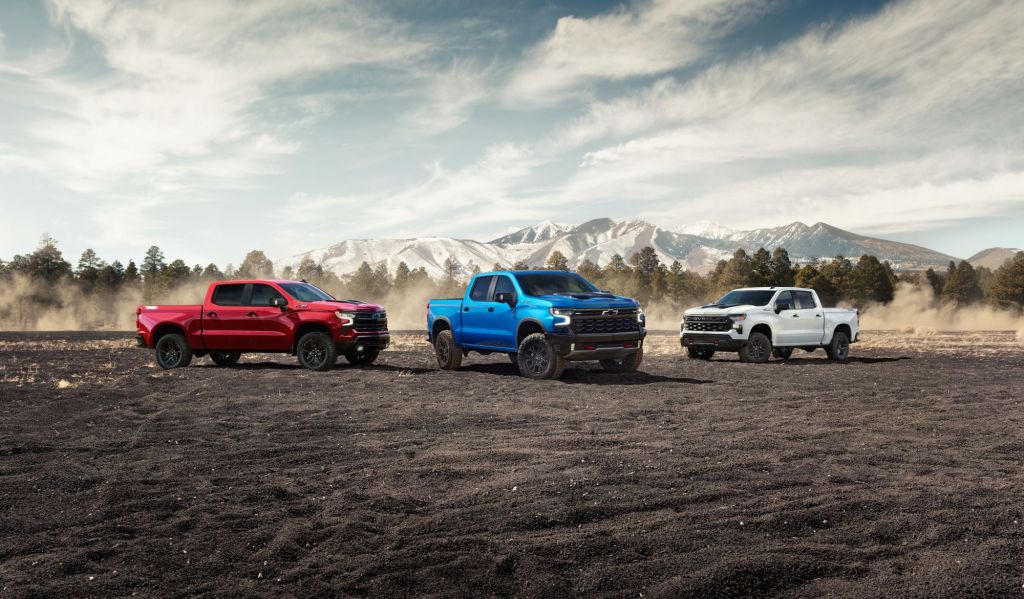
Mexcio is an important source of pickup trucks, including the Chevy Silverado, for General Motors. (Image: Chevrolet)

Murphy points out that nearly a third of GM products for sale in the U.S. come from outside the U.S., mainly Mexico.

Notably, there are Chevy Silverado and GMC Sierra pickups built south of the border.

“That creates real problems,” Murphy said.

“The question is how fast you”—or in this case, “GM”—“can react to that.”

After all, it is not as though there is some GM truck plant sitting idle in the U.S.

“They just can’t pick up and move.”

Which may be something that isn’t fully understood by politicians.

Murphy suggested that if the tariffs block the import of Chinese parts and vehicles into the U.S. that will be a “net positive” for the domestics, as well the Japanese and Korean manufacturers with an existing U.S. manufacturing footprint.

The Cost of Tariffs on Auto

“By means of glasses, hotbeds, and hotwalls, very good grapes can be raised in Scotland, and very good wine too can be made of them at about thirty times the expense for which at least equally good can be brought from foreign countries. Would it be a reasonable law to prohibit the importation of all foreign wines, merely to encourage the making of claret and burgundy in Scotland?”—Adam Smith, The Wealth of Nations

Here’s something to think about regarding the possibility of tariffs and how they will affect vehicle pricing and/or availability.


David Christ, group vice president, general manager-Toyota Division, Toyota Motor North America, pointed out yesterday (the day after the election) at a meeting of the Automotive Press Association, that Toyota has 10 manufacturing plants in the U.S. It is building its 11th in North Carolina that will open in 2025 for the production of batteries for electrified vehicles. A $13.9-billion plant.

Certainly a solid U.S. footprint. It employs some 49,000 in the U.S.


Christ said an issue with tariffs is that things not necessarily visible to the end consumer—like parts—can have a big effect.


He said, for example, that the Camry is about 90% U.S. by content. But that means 10% comes from out of the country.


That’s because Toyota, like other manufacturers, has a global supply chain.


OEMs don’t make everything that goes into their vehicles. And suppliers of components not only have to find the lowest-cost places to produce their products, but they need a sufficient number of customers for a given part to be produced in a given plant, so with those two factors they are likely to be located somewhere that isn’t necessarily the U.S.


So regardless of the high level of domestic content, that 10% will drive up the cost of the car.

Who benefits from that?


For customers, this makes the vehicle less affordable.


A costlier vehicle might mean fewer of them are purchased.


Fewer cars purchased means fewer cars built.


Fewer cars being built means fewer hours are necessary for people to work.


The trail of consequences continues. Makes you want to reach for a domestic claret or burgundy.


And while it might be thought that this is something that is not an issue for the traditional domestic manufacturers like Ford and General Motors, it is worth noting that in the 2024 Cars.com American-Made Index, which takes into account assembly location, parts content, engine origin, transmission origin and U.S. manufacturing workforce, the top-10 most-American vehicles are:

  1. Tesla Model Y
  2. Honda Passport
  3. VW ID.4
  4. Tesla Model S
  5. Honda Odyssey
  6. Honda Ridgeline
  7. Toyota Camry
  8. Jeep Gladiator
  9. Telsa Model X
  10. Lexus TX

What you don’t see is either Ford or General Motors. And as Jeep is owned by Stellantis and as Stellantis is headquartered in Hoofddorp, Netherlands, it can no longer be considered a “traditional domestic.” But the folks that build the Gladiator in Toledo, Ohio, still certainly are.


(In case you are wondering: the highest-ranking vehicle from GM is the Chevy Colorado, at #23. Ford makes it at #29 with the Lincoln Corsair. Which means the cost of tariffs would be higher for them.)


“Free and fair trade is the best way to go,” Christ said.


Adam Smith wrote The Wealth of Nations in 1776. That idea has been kicking around for quite some time.