It’s got nice looks and the fifth-generation Toyota hybrid system. A competent combo. . .
By Gary S. Vasilash
“What kind of car is that?” my brother-in-law asked as we arrived for Thanksgiving.
“A Toyota Corolla.”
“They sure have come a long way,” he responded, shaking his head with a bit of disbelief. “Corollas didn’t look like that before.”
Yes, that’s true. Previously, Corollas had a design that indifference could be an appropriate response to. Not bad. But not the sort of thing that would cause comment like that which took place in this instance.
Now the Corolla is sporty in its styling, which is remarkable for a vehicle that, in all manifestations, has an MSRP of under $30,000 (from the Hatchback SE at $24,180 to the Hybrid XLE at $28,940).
Some people may be surprised to learn that that’s a Toyota Corolla. The style is notable, as is the fact that this model is fitted with a hybrid system that makes stops at gas stations comparatively infrequent. (Image: Toyota)
///
And that there is a Corolla Hybrid makes the proposition for getting a highly fuel efficient vehicle that is sporty all the more interesting.
How efficient?
Well, here is the lineup and the EPA estimated fuel economy numbers for each:
LE/XLE: 53 / 46 / 50 city/highway/combined mpg
LE AWD: 51 / 44 / 48
SE: 50 / 43 / 47
SE AWD: 47 / 41 / 44
The Corolla Hybrid is powered by Toyota’s fifth-generation hybrid system. There is a 1.8-liter four-cylinder engine as the core element. With the attendant electrification the propulsion system produces 130 hp and 105 lb-ft of torque.
While the styling might make it seem as though the Corolla Hybrid is something that goes really, really fast and gets there really, really fast, the acceleration and overall performance is more conventional compact car.
But again, it allows you to quickly go past gas stations for a longer period of time than is the case of some even bigger vehicles from other OEMs who are still working out their hybrid strategies.
And the available all-wheel drive (there is a rear-mounted electric motor that kicks in when needed, not only when the sensors determine slippery conditions, but when starting from a stop and getting on the throttle) is certainly a good feature.
///
The vehicle as driven has the “SE Premium Package,” which means there is a 10.5-inch Toyota Audio Multimedia screen (the standard size is 8 inches), six audio speakers, a 12.3-inch digital gauge cluster, and a wireless charger.
While the steering wheel is wrapped with leather, the seats are “Sport Fabric-trimmed), a.k.a. cloth.
A helpful and useful standard feature is Blind Spot Monitor with Rear Cross-Traffic Alert, with the first part of that being helpful when driving and deciding whether to move from one lane to another and the latter when, say, backing out of a parking space at the grocery store, when you’re likely to have two full-size pickup trucks on either side of you.
After all, the overall height of the Corolla Hybrid is 56.5 inches, so you’re comparatively low.
That’s one of the sacrifices you make for sporty styling.
Although people who live in places like southeastern Michigan would probably answer the question “What is the best-selling automotive nameplate of all time?” with “Ford F-150” because there are so many of them evident on the roads and in the driveways (in fact, it almost seems as though the “most people” have one), that is not the right answer.
The right answer is “Toyota Corolla,” the compact car that can.
Even though the F-Series has been available since 1948 and the Corolla since 1966, the Corolla has about 20% more sales (~50 million v. ~40 million), even with the 18-year difference in availability.
That’s largely because whereas there is a huge concentration of F-150s (and yes, Chevy SIlverados and Ram 1500s) in places like southeastern Michigan, the Corolla is available on five continents. (There is yet to be a Toyota dealership in Antarctica.)
Even though many people maintain there is waning interest in cars—especially compact cars—because everyone wants trucks or crossovers, there is still immense interest in cars.
Consider: through Q3 2025 Toyota sold 179,983 Corollas. GM’s Buick Div., which offers only crossovers, had sales of 156,835.
But this is not to say that the folks at Toyota don’t recognize a couple of things, like the value of the Corolla badge and the interest in crossovers.
So it has on offer the Corolla Cross which, too, is doing well in the U.S. market. Through Q3 it outsold the F-150’s little brother, the Ranger: 73,341 to 48,278.
Now there’s another aspect to the Toyota approach to the market, which in its case is a global market. (Yes, the Corolla Cross is available around the world, too.)
Toyota has not only maintained its hybrid offerings, but it has expanded them throughout most of its lineup, including to things like the Corolla Cross. While there have been some people who were critical that the company wasn’t going “all-in” on electric vehicles in a way some of its competitors seemed to be, because Toyota does have more of a global view than some of its competitors, it recognizes that EV charging isn’t as everywhere convenient as gasoline, so hybrids are a sensible alternative.
2026 Corolla Cross Hybrid XSE. Note the available Cavalry Blue body color and Jet Black roof. Also the hexagonal pattern of the upper grille is specific to the hybrid trim. (Image: Toyota)
And the U.S. market is certainly interested in the hybrid powertrain offerings. Of the Corollas Crosses sold through the first quarter 24,594 are hybrids, which is more than the Chevy Blazer EV, at 20,825 or the F-150 Lightning, 23,034 (not that anyone is likely to cross-shop a pickup with a compact crossover).
The Corolla Cross is categorized as a crossover. Presumably that has a lot to do with ground clearance. That is, a Corolla sedan has 5.3 inches of ground clearance and the Corolla Cross 8 inches, which is just 0.1 inch less than that of a RAV4, which is clearly a crossover.
But the Corolla Cross and the Corolla sedan are both built on the same platform, TNGA-C, whereas the RAV4 is based on the TNGA-K, which goes to the point that the Corolla Cross really drives, well, like a car, albeit with a higher seating position for better visibility.
The Corolla Cross Hybrid (it is also offered with no electrification of the 2.0-liter engine) provides a system horsepower of 196 net, which is reasonably peppy for the vehicle. What is more to the point of it vs. the standard is its superior fuel economy: 46/39/42 city/highway/combined miles per gallon for the hybrid and 31/33/32 mpg for the standard engine.
It is also worth noting the Hybrid—available in three trim levels—are all all-wheel drive, using Toyota’s 5th Generation Hybrid System. (The whole Toyota “continuous improvement” approach is something it has been applying to its hybrid systems, which can certainly provide consumers with a sense of confidence.)
The 2026 Corolla Cross Hybrid XSE has a base MSRP of $33,330 and with the $1,450 delivery, processing and handling fee (which gets you out the door), it is up to $34,780.
Exterior-wise, the XSE trim brings things like 18-inch black-finished alloy wheels, and black rocker panels, over-fenders and badging. There is a special grille design that has intimations of electrification.
On the inside there are a 12.3-inch digital gauge cluster and a 10.5-inch infotainment setup. There’s a heated steering wheel and heated front seats (good for those in southeastern Michigan this time of year).
There is Toyota Safety Sense 3.0 (Pre-Collision System with Pedestrian Detection, Proactive Driving Assist, Full-Speed Range Dynamic Radar Cruise Control, Lane Departure Alert with Steering Assist, Automatic High Beams, Lane Tracing Assist, and Road Sign Assist)—again, going to the point of continuous improvement.
All in, it is a competent package that, because in large part of its global footprint, has the kind of build quality and amenities that are a consequence of this massive scale.
It isn’t just the dark color scheme that makes this stealthy. . .
By Gary S. Vasilash
Quick: what is the top-of-the-line car model offered by Toyota?
As you’ve probably read the headline, you made a correct guess.
And I’m guessing that it was a guess because the Toyota Crown is something that is not as well known as it ought to be in the lineup.
The Crown was introduced in the U.S. as a model year 2023 vehicle. It replaced a vehicle that also didn’t have the visibility it deserved, the Avalon.
(Arguably in the case of the Avalon there was reduced promotion because it was so well executed that the owners of Lexus dealerships probably wouldn’t have liked that the Avalon would give the Lexus ES a run for the consumers’ money.)
While you might think that this is a bit of an exaggeration to talk about the relative invisibility of the Crown, consider this:
Through the first three quarters of 2025, there were 8,669 Crowns sold in the U.S. (The Crown Signa, which, in effect, replaced the Venza, a crossover, had nearly double the sales of the sedan: 16,277.)
The GR86 sports car—even available with a manual transmission, so this is not designed and engineered to take the kids to school or to shop at Costco—nearly had as many sales at the Crown: 8,107.
And the Crown is the kind of vehicle that you can take the kids to school in and to shop at Costco (it is a hatch that offers 15.2 cubic feet behind the second row, so there is space for stuff).
Toyota Crown: a stylish hybrid that, even if it wasn’t in the Nightshade trim, is still stealthy. (Image: Toyota)
The Crown has stylish sheet metal, which is certainly not unusual for Toyota models of late. It could be said that one of the reasons why Toyota still has cars on offer while Chevy and Ford have abandoned them (yes, yes, there is the Mustang, but it is hardly a “car” in the sense of the classic four-door architecture: the GR86 is a car, too, but the “sports” modifier separates it) is because it has freed up its designers.
For the Nightshade edition there is that “dark” theme, with Storm Cloud paint, 21-inch, 10-spoke wheels with a black finish, and dark door handles, mirror caps and rear badging.
Inside there’s a black leather interior and features and execution that may bring Lexus to mind, but not in the way the Avalon did (and if I had to think of a Lexus that might be Crown-like it would be the HS 250h, the brand’s first hybrid sedan, which had but a short (2010-12) run in the U.S.). The front seats are heated and cooled; the rear seat is heated. There is a 12.3-inch digital gauge cluster and a 12.3-inch infotainment screen (which has, just below it, a volume knob for those so inclined to take advantage of the JBL 11-speaker system).
The Crown is a hybrid that produces a system horsepower of 236. (For those who want more power, there is the Platinum trim providing 340 hp.) By and large the 236 hp is certainly sufficient for the aforementioned daily drives. This is an all-wheel drive vehicle.
The vehicle EPA rated at 42 mpg city, 41 mpg highway and 41 mpg combined. Given that it has a 14.5-gallon tank that is filled with regular fuel, if you were to drive the Crown such that you’d leave one gallon in the tank just in case, you’d have a range of over 550 miles.
Which means Crowns are certainly not seen that often at gas stations.
The 25th anniversary is the Silver Anniversary. This anniversary Highlander is available in Heavy Metal. . .
By Gary S. Vasilash
One of the things Toyota did early on that caused many of those in Detroit to grumble was use the platform from one vehicle for another. This wasn’t a case of simply slapping new fascias on a car and using different seat fabrics and saying “Voila! something different!” but of creating something different.
This approach had several advantages. It spread engineering costs from one vehicle to another. It increased scale for a given platform. Both of these things led to better quality (focused engineering resources) and lower costs for consumers (economies of scale).
Case in point: the Toyota Highlander. The vehicle was introduced at the 2000 New York Auto Show as a model year 2001 vehicle.
It was based on the platform used for the Camry sedan, with slight modifications to accommodate things like a higher ride height.
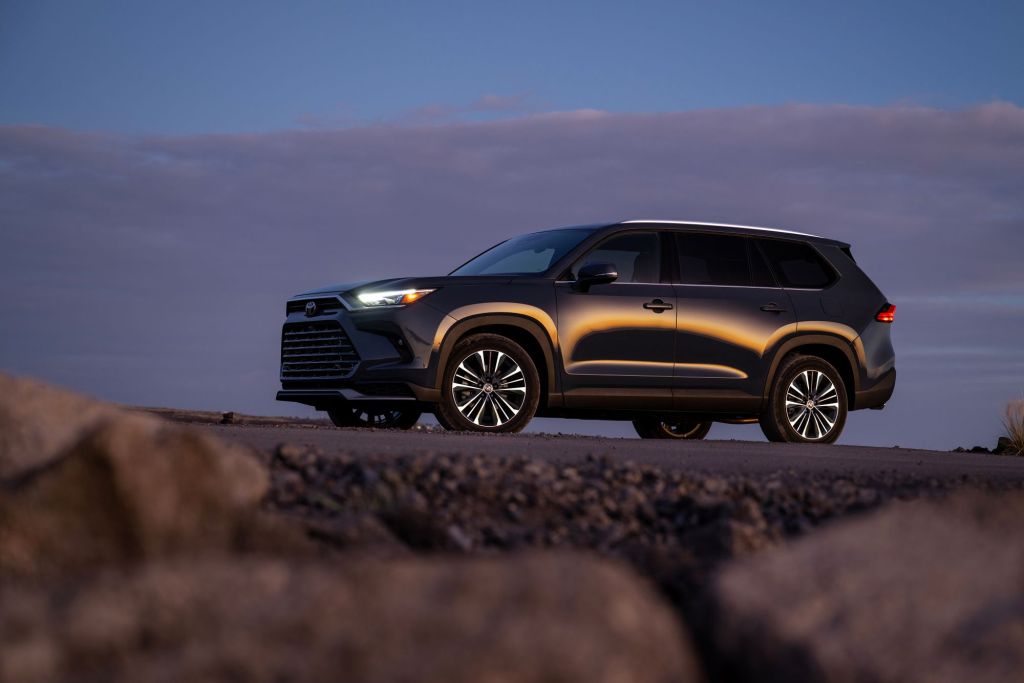
Toyota Highlander 25th Edition. Celebrating a quarter century. (Image: Toyota)
This was not only clever, but arguably revolutionary, given that back then vehicles with that body architecture had frames, like pickup trucks. Cars like the Camry, with unibody construction, provided a more comfortable ride.
So one could say that the body-on-frame vehicles were sport utility vehicles (SUVs) and the first gen Highlander ushered in the midsize crossover utility vehicle (CUV). (The first-generation Toyota RAV4, introduced in the U.S. for the 1996 model year, was based on the Corolla platform, so it gave rise to the compact CUV segment.)
There was something else that happened with the Highlander that’s of some significance.
Model year 2006 was available with a hybrid powertrain. That made the Highlander the first Toyota after the Prius that had one. While it might have seemed that the Camry would get a hybrid after the Prius, that didn’t occur until model year 2007.
(The hybrid in the Highlander could have had something to do with the fact that also in model year 2006 the Lexus RX 400h was launched: the “h” is for “hybrid.”)
Currently, the Highlander is in its fourth generation. It is clearly a case of improvements all along the way.
For the 2025 model there is a special edition, the 25th Edition. Perhaps not the cleverest of names, but a well-appointed Highlander.
The celebration of the milestone is performed with a variety of touches, inside and out.
On the exterior view there are—yes, changes to the front and rear fascias (silver accents on the bumpers), 20-inch wheels, and side rockers.
Inside there are carpeted floor mats and an all-weather rear cargo liner. The seats have leather trim.
And in the space between inside and out there are illuminated door sills and puddle lamps (although they shine on the outside, they are meant to help you get to the inside, so we’ll put them in this intermediate space).
The powertrain (there is a 2.5-liter four-cylinder engine coupled with three permanent magnet motors (two front, one rear)) provides a combined output of 243 hp.
This results in EPA fuel efficiency numbers of 35 mpg city, 34 mpg highway and 35 mpg combined.
Which is most impressive for an AWD vehicle with a third row.
But about that third row. . . .
The legroom back there is 28 inches. No, not a whole lot of room.
The 25th Edition is based on the Highlander Limited Hybrid grade which provides things like a 12.3-inch infotainment touchscreen and 11-speaker JBL audio system. Yes, there is a small volume knob for those who prefer torquing a knob rather that using the steering wheel controls.
The base MSRP for the vehicle is $52,680, which is certainly reasonable for something that (1) is so well-appointed, (2) a hybrid and (3) is limited to 2,500 units.
One of the vehicles you will not see coming and going is the Toyota GR86* Hakone Edition. This is not because the sports car, with its Ridge Green body color that is a visible tribute to spirted sporty driving, isn’t eye catching, nor because the coming-and-going can be done rather quickly, as it is powered by a 228-hp 2.4-liter boxer engine and is quick.
Rather, it is simply because this is a special-edition vehicle. There will be just 860 sold in the U.S., so this is a rather rare beast. (Given that in 2024 all trim levels of the GR86 combined had U.S. sales of just 11,426 vehicles, seeing any GR86 is a sight to behold.)
The GR86 Hakone Edition is based on the GR86 Premium model.
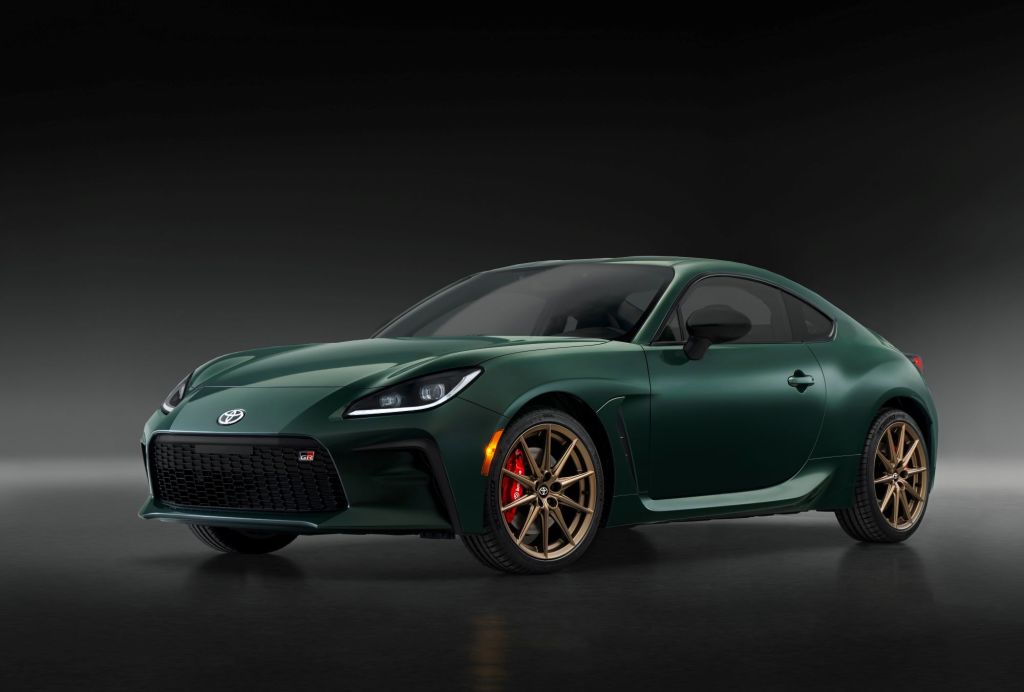
Toyota GR86 Hakone Edition: solid style. (Image: Toyota)
So they both have the same engine. They both are available with a six-speed manual transmission. They are both rear-wheel drive. They both have a Torsen limited-slip differential. They both have a top speed of 140 mph. They both are rated at 0 to 60 mph in 6.1 seconds. They are both fairly similar.
But then it is important to get to the Hakone aspect.
That comes from the Hakone Freeway in Japan, a two-lane toll road.
The road, which traverses mountains, is not designed like many freeways in the U.S. that seem to have been laid out by someone with a T-square. Rather, the Hakone Freeway has plenty of twists, turns and gradient changes.
So maneuverability is important to going fast.
While the GR86 and the Hakone both have MacPherson struts in the front, the Hakone has SACHS dampers, too. And while both have a multilink rear suspension, again Hakone goes SACHS.
Brembo two-piston rear brakes and four-piston front brakes are standard on the Hakone. Optional on the GR86.
The vehicle is structurally engineered with a specific selection of steels and aluminum, with high-strength fasteners and the addition of structural adhesives so that while the vehicle is light (2,811 pounds), it is solid.
Inside there are Ultrasuede sport seats that keeps one fairly planted. The shift knob for the manual has a special badge on top:
Although there is a backseat, let’s face it: this is essentially a two-seater. The truck has a volume of 6.26 cubic feet, so you’re not taking this to Costco.
But as it is rated providing 20/26/22 city/highway/combined mpg, you could conceivably use it as a daily driver. But as you’re pumping premium, you might reconsider that.
This is a car that is fun to drive. It may not be the most functional. But that isn’t the point. Toyota has plenty of models that can fulfill the function.
==
*A quick word about the name. The “GR”—which is used for other Toyota models, too—refers to “Gazoo Racing,” the motorsports division of Toyota. The GR badge indicates that the vehicle is engineered for performance. The “86” goes back to the AE86 Corolla GT coupe, which was available in Japan from 1983-87 and extremely popular among performance enthusiasts.
The question is: why wouldn’t you if you transport people and their stuff?
By Gary S. Vasilash
I once owned a Toyota Tercel. A subcompact. A vehicle that was as stylish as a pair of orthopedic shoes.
There were three reasons why I had the Tercel:
I needed a car to get to work
I could afford it
It was available
All of those reasons are fairly pragmatic, more about needs than desires.
On Maslow’s Hierarchy of Needs, the Tercel was at the base level. It was far from the Self-Actualization that many people imagine they achieve when buying a vehicle.
But is that the case? Really?
Sure, we all like to have something that reflects who we think we are, which explains why we buy particular shoes (ideally not orthopedic) or phone. Those objects send a message to those we encounter. But arguably, unless those objects are rather egregious—like wearing clown shoes or using a Jitterbug phone years before AARP membership kicks in—odds are there is less of a message being sent than we would like to imagine.
Which brings me to the Toyota Sienna XLE AWD minivan.
Suddenly the word “minivan” causes in some people a reflexive reaction like what happens when a doctor taps your knee with a little hammer: you can’t stop it.
But unlike that reflex, which physiologically occurs without involving the brain (the reaction goes straight through the spinal cord), the reaction to “minivan” is a social construct.
“I’m not a minivan person” or “I just wouldn’t feel right driving a minivan” or “What would it say about my sexuality if I was behind the wheel of a minivan?”
OK. No one says the last one out loud. But that’s what plenty of people are thinking.
For some reason, when people are buying a crossover or SUV, none of those things arise.
They do have to run some quick calculations like why I needed that Tercel. What’s more, they have to determine whether there is the sort of functionality that they will need. Toyota, for example, has 11 crossovers and SUVs to choose from, each with its own suite of specs. If you have multiple family members a Sequoia will work in a way that a RAV4 doesn’t. If there are just a few of you, the RAV4 works in a way that the Sequoia would be just overkill.
So there are at least a couple of proverbial back-of-the-envelope decisions that need to be made in terms of what the vehicle can do to meet your needs: how many people might you want to bring along with you; how much stuff do you generally carry of a nature that a pickup truck wouldn’t be right for?
So let’s take the stuff part of the equation.
The Toyota Sienna minivan offers 33.5 cubic feet of cargo space behind the third row, 75.2 cubic feet with the third folded, and 101 cubic feet with the second and third rows folded.
While those numbers may not mean a whole lot, know that they translate into Big, Bigger, Biggest.
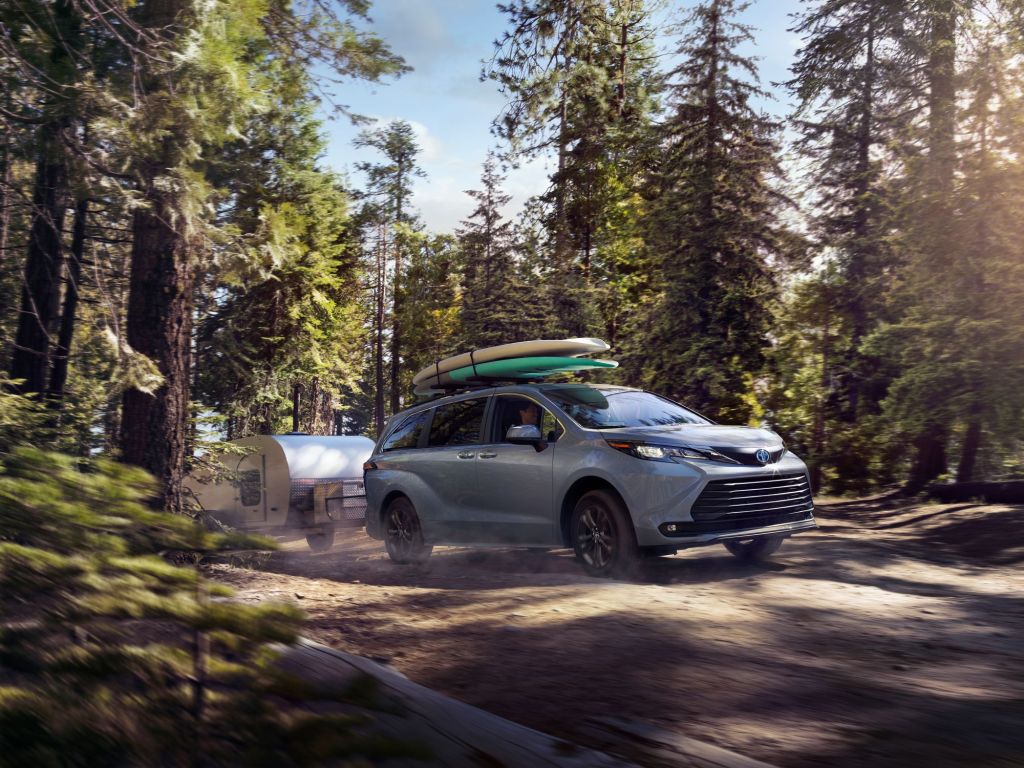
Toyota Sienna Woodland: yes, you don’t need an SUV to do things like this. (Image: Toyota)
And if that isn’t enough and you need to pack a U-Haul trailer, the Sienna offers 3,500 pounds of towing capacity.
Or what about people?
Depending on the seating configuration selected, it is either seven or eight people.
And the thing to know about that is that these people are all going to feel comfortable, not as though they are occupants of the proverbial sardine can.
The functionality of the configuration of the minivan’s architecture is simply more package-efficient than an SUV (or sedan, for that matter).
“Oh, but a minivan isn’t stylish,” comes the knee-jerk reaction.
It’s not like the people at Toyota’s Calty design studio in Newport Beach aren’t aware of that objection, so they’ve added style to the substance of the vehicle.
One of the notable characteristics of the Sienna is that it is now, in all trim levels and packages, a hybrid. There is a 189-hp four-cylinder engine. There is an electric motor up front. And in the AWD version (yes, AWD—just like in some SUVs!), another in the rear.
All told the propulsion system provides 245 hp.
But the impressive part of this is that on the AWD model, like the one driven here, the combined city/highway fuel economy is 35 mpg.
And the beauty of that is that with the 18-gallon tank you can achieve a theoretical 630 miles before you need a fill up, but even if you use 17 gallons to be on the safe side, it is still 595 miles.
If the average American drives 37 miles per day, then the Sienna can be driven for more than two weeks without visiting a gas station. And once there, only regular gas is required.
I drove the Sienna from Detroit to Traverse City (255 miles) and back, putting on freeway miles as well as slow city miles (Traverse City is increasingly popular). And I got the 35 mpg without a problem and it was in the Normal mode throughout (there are also Eco, Sport and EV modes, with the first eking out all the energy it can, so this is a bit on the slow side; Sport amps things up, but let’s face it: this is a minivan; EV is a short spurt of low-speed all-electric driving: this isn’t a plug-in hybrid).
The Woodland trim driven here includes a smidge more ground clearance (it is 6.9 inches rather than the 6.3 inches of other trims). There are 18-inch six-spoke dark wheels and black roof rails on the outside. There are themed floor mats and things like a 12-speaker JBL audio system on the inside.
And there is an abundance of the types of things one would expect on a vehicle that you’re going to be spending plenty of time in (from the 12.3-inch screen to wireless Apple CarPlay and Android Auto; four-zone climate control), as well as things that add to the overall utility (e.g., being able to open the sliding doors by putting your foot beneath it is a nice function). Of course, there is an array of safety tech bundled into Toyota Safety Sense 2.0 (pre-collision system with pedestrian detection, lane departure alert with steering assist, lane tracing assist, etc.).
If there is any stigma associated with the Sienna minivan it is one of simply being smart. Which isn’t a bad thing.
The Tercel did the job for me. The Sienna could certainly do it for those who are looking for efficiency, capability, capacity, and, yes, soupçon of style.
Fox Racing QS3 internal-bypass shocks, front and rear, with rear piggyback-style remote reservoirs
Independent double-wishbone front suspension with coil springs and stabilizer bar
Multi-link rear suspension with coil springs and stabilizer bar
33-inch Toyo Open Country III tires
18-in. matte-black alloy wheels with 33-in. Toyo all-terrain tires
Stabilizer Disconnect Mechanism (SDM)
Multi-Terrain Select (MTS) and Crawl Control (CRAWL)
Electronic locking rear differential
TRD Pro aluminum front skid plate with underbody transfer case and fuel tank protection
Part-time 4-Wheel Drive (4WD)
Electronically controlled 2-speed transfer case (high/low range) and Active Traction Control (A-TRAC)
Rigid Industries LED fog lights
If those things make you shrug, as in “I don’t exactly know why these things are of particular importance,” then the 4Runner TRD Pro is not for you.
Which is not exactly the sort of thing you ordinarily see this early in a description of a given vehicle.
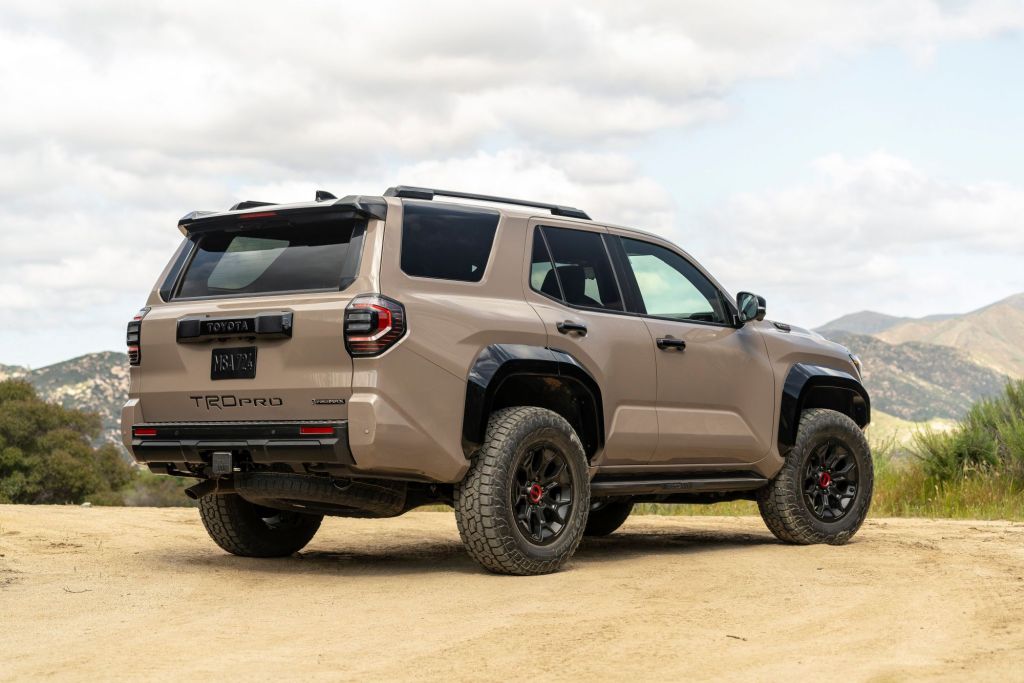
2025 Toyota 4Runner TRD Pro: Who needs pavement? (Image: Toyota)
But the point is, the 2025 4Runner TRD Pro, a mid-size SUV, is engineered to drive on terrain and in ways that if you aren’t an enthusiast of the great outdoors you are likely never to appreciate.
Here’s another thing to know about this model—as well as the other 4Runner variants: It has body-on-frame construction.
Again, if you shrug, then maybe there should be the consideration of something like a Grand Highlander.
The TNGA-F platform the 4Runner is built on is also used for things like the Toyota Tundra and Tacoma—both pickup trucks. (It is also found on the Toyota Land Cruiser.)
This is a fully boxed ladder frame that is constructed to provide high levels of torsional rigidity. Another thing Toyota has done is use tailor welded blanks, which means there is additional strength in areas that need it so the structure is ready to handle the hard stuff, like when crawling over rocks.
The vehicle is powered by an i-FORCE MAX 2.4-liter, turbocharged (twin-scroll turbocharger) 4 cylinder hybrid engine.
Yes, that’s right: this is a hybrid, a parallel hybrid system with a permanent magnet synchronous motor/generator. The system—as in the combustion engine and the electric motor—produces 326 hp @ 6,000 rpm and 465 lb-ft of torque @ 1,700 rpm.
There is an eight-speed automatic.
And if you’re curious: it is rated at 23 mpg city, 24 mpg highway, 23 mpg combined.
The TRD Pro offers seating for five on SofTex-covered seats: this is material that resembles leather, but which is formulated to be able to handle serious wear and tear. It also cleans up nicely, because if you’re going to have a vehicle that you may take literally off-the-grid on weekends (which goes back to the point of the TRD Pro), odds are you’re going to want to get rid of the mud and muck that may be brought unintentionally back into the cabin. (Leather is used for the heated steering wheel and on the shift knob.)
The 4Runner offers beefy knobs, dials and buttons that make making adjustments far easier than is the case of vehicles that have switched to digital interfaces for changing things. But this is not to say that the vehicle is in any way behind when it comes to tech, as there are a 12.3-inch digital gauge cluster and a 14-inch infotainment screen. There is a 14-speaker JBL audio system. The 4Runner has wireless Apple CarPlay and Android Auto.
But let’s go back to the list that started this and the claim that if you aren’t impressed, the 4Runner TRD Pro is probably not the one for you.
It is worth knowing there are eight other 4Runner trims. And while there is something of a bias toward the rough and ready (e.g., TRD Off-Road Premium; Trailhunter), there are configurations that are better for those who are unlikely to beat the stuffings out of their vehicle on a somewhat regular basis.
Since its establishment in 2011, the Toyota Collaborative Safety Research Center has been working with an array of North American intuitions on making things better for drivers and pedestrians. And it has just completed its 100th project
By Gary S. Vasilash
Toyota has a suite of driver-assistance systems and alerts—based on hardware and software—that it calls “Toyota Safety Sense” (TSS). Elements of the system include a pre-collision system, lane departure alert with steering assist, dynamic radar cruise control, and more.
Other OEMs have their TSS-like systems.
But what other OEMs don’t have is the Toyota Collaborative Safety Research Center (CSRC), established in 2011 by Akio Toyoda and funded (through 2026) to the tune of $115 million.
CSRC has collaborated with a number of organizations, from the Children’s Hospital of Philadelphia to Virginia Tech, from The Ohio State University Biomechanics Research Center to the Texas A&M Transportation Institute.
CSRC has announced the competition of its 100th research project, a study with the Massachusetts Institute of Technology AgeLab on the “Non-Driving Related Tasks” (NDRTs) performed by drivers while, ostensibly, driving.
Things like interacting with steering wheel controls, center stack interaction, using a phone (known in the research world as a “PED”: Personal Electronic Device), eating or drinking, interacting with passengers, fixing hair, singing to self. . . .
A whole lot of things that are not directly related to the task at hand (i.e., driving).
The researchers had some 450 hours of driving data—video and digital information—and in it they annotated more than 145 hours of NDRT behavior.
Dr. Bryan Reimer, research scientist at the MIT AgeLab and founder and co-director of the Advanced Vehicle Technology Consortium (of which Toyota is a founding member), explained that an objective is to determine the impact of SAE Level 2 driver assistance technologies on driver behavior when it comes to engaging in NDRTs.
Dr. Bryan Reimer of the MIT AgeLab says he has worked with dozens of OEMs on projects and is impressed with Toyota’s commitment to safety research. (Image: gsv)
Although every driver knows that they are not to do many of the things that are within the NRDT sphere, Reimer says there’s what he calls “the Cheeseburger Equation.”
You are hungry. You stop at a fast-food place and buy a cheeseburger. If you don’t eat inside the restaurant, you take the cheeseburger into your vehicle. And if you don’t remain parked, you drive your vehicle. And eat the cheeseburger.
That’s just going to happen, Reimer says.
Now the objective isn’t to create cheeseburger-facilitating vehicular automation.
Rather, it is to determine the methods to discourage drivers from performing NDRTs, thereby enhancing vehicular safety.
(Reimer says that positive suggestions can help reinforce correct behaviors in a way that telling people what not to do doesn’t do.)
In addition to announcing the completion of the 100th, CSRC announced 10 new projects:
“Analysis of Speed Assist Implementations and Context-Aware Improvements.” with Touchstone Evaluations
“Driver behavior adaptation to L2 automation,” with MIT AgeLab
“Evaluating driving performance and behavior across varying vehicle specifications and driving contexts,” with Virginia Tech Transportation Institute
“Safety benefits of in-vehicle alerts and notifications,” with Oregon State University
“User Acceptance Factors for In-Vehicle Safety Systems Targeting Impared Driving,” with Impact Research
“Comparing applicability of global ADAS testing scenarios in the U.S. context,” with University of Michigan Transportation Research Institute
“Skeletal data for anthropometry and posture,” with University of Michigan Transportation Research Institute
“Biological sex in ankle bone material properties,” with The Ohio State University Injury Biomechanics Research Center and University of Waterloo
“Interacting While Driving: Evaluating Attentional Demands of In-Vehicle Interfaces,” with Auburn University
Much of the information developed has been and is shared with other interested parties throughout the vehicle environment and some have contributed to the development of standards.
At a time when budgets are being not merely cut but chopped, it is laudable that Toyota continues to do safety research.
It doesn’t simply result in better vehicles, but there have been more than 400 students, postdocs, and researchers from collaborating institutions that have worked on CSRC programs, and that experience is proliferated throughout industry for the betterment of all involved parties.
Yes, Toyota has been, continues to be, and will be all about getting things better. . . .
By Gary S. Vasilash
When the model year Toyota bZ4X was launched in the U.S. it was roundly reviled for its range and its name. The range ranged from a low of 222 miles for a Limited AWD to a high of 252 for an XLE with FWD. And those, of course, are the EPA estimated numbers, so in the real world they vary—often going in the wrong direction.
And the horsepower wasn’t any great shakes, either: 201 hp for FWD and 214 for AWD.
Guffaws Galore
People scoffed at Toyota for putting out the vehicle. They dusted off the term “compliance car” for the midsize SUV, claiming that Toyota put out what they considered a pathetic attempt at an electric vehicle.
As for the other aspect of low dudgeon: What kind of name is “bZ4X”? It sounds like the name of a ‘droid in a knock-off Star Wars movie.
The explanation was:
bZ: Toyota’s “Beyond Zero” initiative for zero-emissions vehicles. (Why it isn’t “BZ” isn’t clear, nor is the whole notion of “beyond zero”: given that positive integers beyond zero are things like 1, 2, 3, etc., might that not indicate positive emissions?)
4: This is reportedly meant to indicate that it is approximately the same size as a RAV4 (although the bZ4X is longer (184.6 in. vs. 180.9 in.), wider (at 73.2 in., up by 0.2 in.), but lower (65 in. vs. 67 in.)).
X: Crossover.
When you have to explain something at several levels it is more like hermeneutical analysis than something you’re going to do at your local dealership.
This Is How They Do It
But anyone who knows approximately anything about Toyota knows that the company is all about “continuous improvement,” a philosophy and methodology that is still highly important even though people sometimes claim that Tesla’s nonlinear improvement (i.e., “great leaps forward”) is the name of the game.
2025 Toyota bZ: second time is a charm. (Images: Toyota)
Toyota has introduced the 2026 bZ. Yes, half the nomenclature has been eliminated. Given that the Lexus side of the house has used two letters for names since its start, two is good for the name of this model.
Long(er) Run
But then there’s the ranges offered by the new model.
The least range is 235 miles for the XLE FWD. The top end is 314 miles for the XLE FWD Plus model.
There are horsepower improvements, too: the Limited AWD and XLE AWD are both at 338 miles. On the low end there’s the XLE FWD, with a curiously low 168 miles. The XLE FWD has a 57.7-kWh lithium-ion battery, while the other models have a 74.7-kWh battery, which explains the low range.
While pricing hasn’t been announced yet, I wouldn’t bet against that XLE FWD having an exceedingly economic MSRP. (The vehicle becomes available later this year.)
The Stuff
The 2026 bZ comes with a NACS charging port that allows high-speed charging (e.g., at Tesla Super Chargers). The company estimates that with DC fast charging the battery can go from 10% to 80% in about 30 minutes.
In terms of overall dimensions, there is no change.
While there are some exterior mods—mainly to the fascias—compared to the bZ4X, the major changes are found in the interior.
Inside amenities are improved. All models get that 14-inch screen.
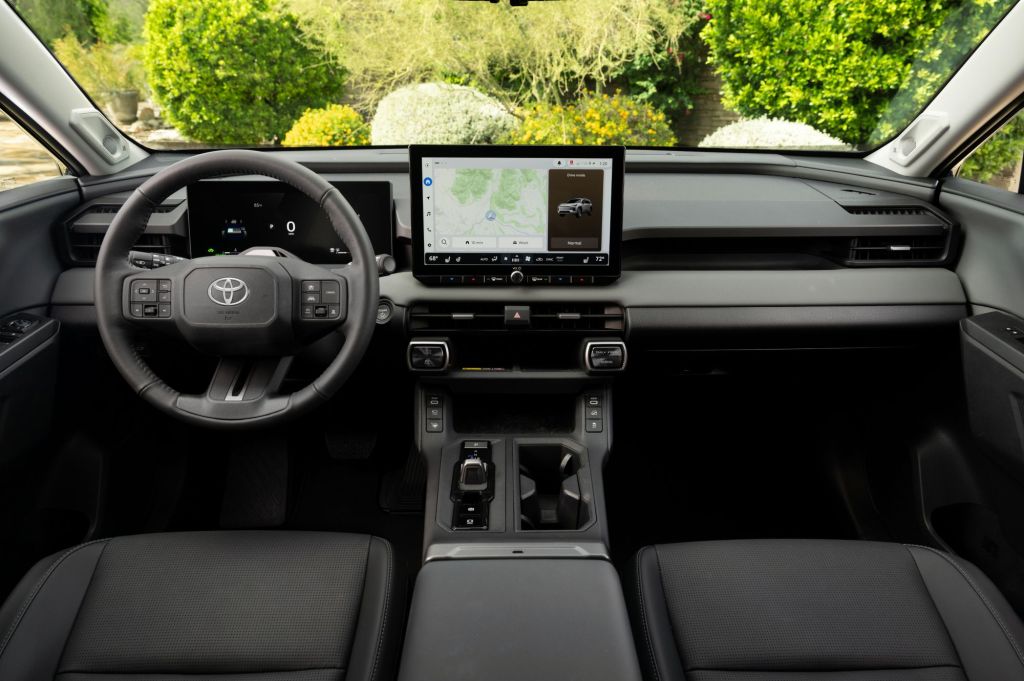
The dashboard is redesigned—which is no trivial change from an engineering perspective. All trims have a 14-in. touchscreen for infotainment. It runs the Toyota Audio Multimedia system, developed by Toyota in Texas, so its functionality is what Americans have come to expect (“Hey Toyota take me home”).
Because this is an “environmental” vehicle, the seating surfaces are either cloth or Toyota’s synthetic leather, SoftTex, which is made with thermoplastic polyurethane, which is actually a good facsimile or the real thing.
Driven
As for driving the bZ: quite honestly, the bZ4X drives well. After all, this is a vehicle that is primarily meant to be appropriate transportation for those who are inclined to reduce their carbon footprint, not a hot vehicle that one is going to put one’s foot to the floor in.
And the bZ, albeit quicker, also drives well. Generally, it drives for a longer period and you’re in more comfort while doing that driving.
Bottom Line
Now the real question comes down to the price. At present the Toyota shopping site has the MSRP for an 2025 XLE $37,070. That model has an estimated range of 252 miles. The company is going to have to meet or beat that with the 2026 models.
The market leader gets a wider suite of offerings. And hybrids across the board. . . .
By Gary S. Vasilash
A thing about the Toyota RAV4 is that when the company accurately describes it as “America’s best-selling compact SUV” it isn’t entirely clear just how much of a best selling compact SUV it is.
In 2024 Toyota delivered 475,193 RAV4s in the U.S. market
In the same period, the combined number of Chevy Equinoxes (207,730) and Ford Escapes (146,859) is 359,589. Well below the RAV4 number.
So Toyota really has something going for it, and for the sixth generation of the RAV4 it is, on the one hand, doing something expected, but on the other, somewhat unexpected.
As for the expected part, it is expanding the offerings within the marque.
That is, there are three styles:
Core
Rugged
Sport
Then within the styles it is offering things like the Woodland trim (Rugged) and GR Sport (Sport).
The unexpected part—well, maybe not entirely unexpected as this is, after all, Toyota, the company that offers a model that is still synonymous with “hybrid”: Prius—it is offering the 2026 RAV4 as a hybrid-only vehicle.
But there are two variants of that, two, either a straight-up hybrid or a plug-in.
And, of course, front-wheel or all-wheel drive (AWD) variants are available.
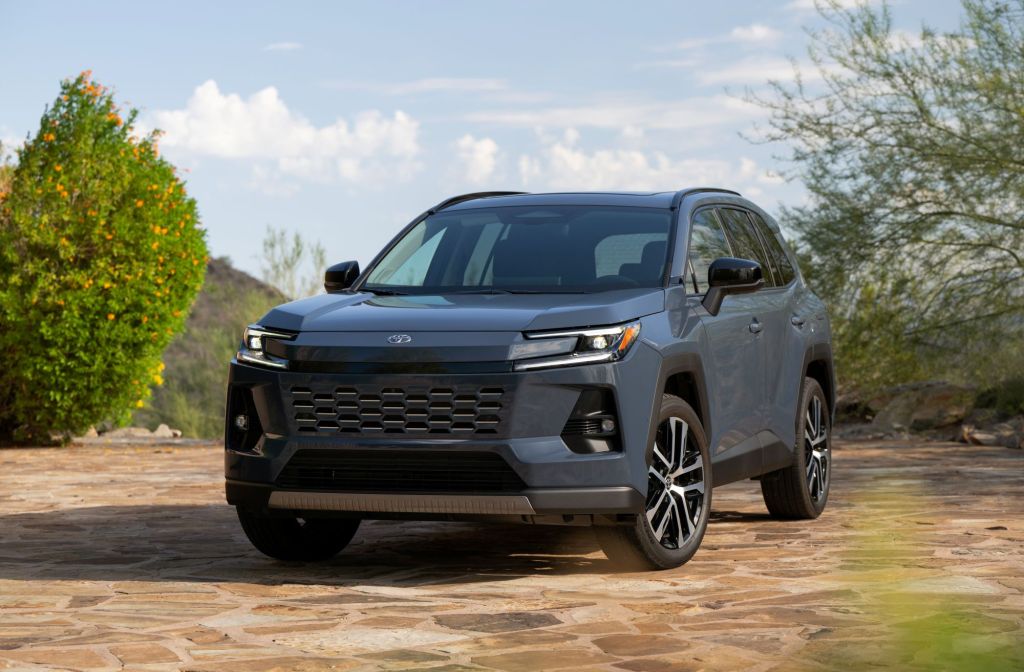
The new RAV4 trio–Sport (the red one), Rugged (the left) and Core (in the rear—for 2026. (Image: Toyota)
Some Numbers
The hybrid versions produce 236 hp for the AWD models (up from 219 hp in the current generation system). There hadn’t been a front-drive RAV4 hybrid previously available so the comparison has to be with the ICE-only model: the hybrid produces 226 hp, whereas the current gen gas-only model produces 203 hp.
The plug-in version, AWD only, has an output of 320 hp. That’s up from the current 302 hp.
The all-electric driving range is 50 miles, up from the current 42 miles.
The PHEV system in the XSE trim and the Woodland feature DC fast charging: from 10 to 80% in ~30 minutes.
Both hybrid systems include a 2.5-liter four-cylinder engine.
Some Platform Mates
The first-gen RAV4 in the U.S.—model year 1996—shared a platform with the Corolla.
This sixth-gen RAV4 has literally gone up in the world, as it is based on the TNGA-K platform, which also underpins vehicles including the Camry, Highlander, and Crown.
David Christ, group vp and general manager, Toyota Div., TMNA—a virtual one at the Cosm Dallas—introducing the 2026 RAV4. As you can see, they’ve sold a lot of the vehicles over the years. (Image: gsv)
Woven
Toyota has a company named Woven by Toyota.
Woven is undertaking some huge projects, like the creation of Woven City, a municipal testbed in Japan for things ranging from autonomous mobility to advanced logistics for goods and services.
No less notable but certainly on a smaller scale, Woven personnel have developed “Arene,” a software development program for vehicles. It facilitates things like advanced safety, connectivity and multimedia features. It allows Toyota and its suppliers to develop software that can be readily integrated into vehicles.
As the company describes it:
“Arene is built on the concept of kaizen, or continuous improvement. Rather than traditional linear development, the Arene platform is designed to make use of the latest iterative development methodologies. And Arene’s vehicle data capabilities allow these improvements to continue after-market based on in-market insights, extending the value of the vehicle.”
So it is not one-and-done.
There is the wherewithal for additions.
The 2026 RAV4 is the first vehicle deploying Arene.
A Thought
Now there will be a set of RAV4s for varying tastes: straightforward, utile and sporty.
One could argue that the Ford Escape sales numbers in 2024 were as low as they were because some customers opted for the Ford Bronco Sport, which is based on the Escape platform. That would add 124,701 units to the 146,859, which is a solid 271,560, but still far south of the 475,193 of the RAV4. . .and now there is something like the RAV4 Woodland.
And what other company is offering—in the mainstream market—a sporty crossover like the GR SPORT?
Although there are certainly externalities—like the tariffs—that could completely distort things, but odds are that the RAV4 is going to stay at the top of shopping lists in U.S. households with this sixth generation.