
2026 Toyota Corolla Hybrid SE

It’s got nice looks and the fifth-generation Toyota hybrid system. A competent combo. . .

By Gary S. Vasilash

“What kind of car is that?” my brother-in-law asked as we arrived for Thanksgiving.

“A Toyota Corolla.”

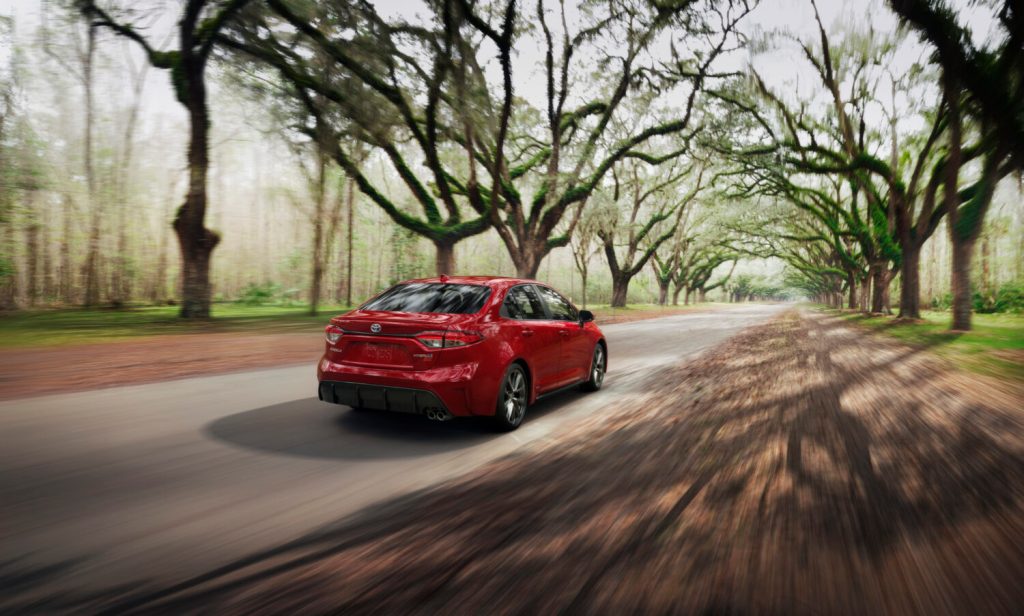
“They sure have come a long way,” he responded, shaking his head with a bit of disbelief. “Corollas didn’t look like that before.”

Yes, that’s true. Previously, Corollas had a design that indifference could be an appropriate response to. Not bad. But not the sort of thing that would cause comment like that which took place in this instance.

Now the Corolla is sporty in its styling, which is remarkable for a vehicle that, in all manifestations, has an MSRP of under $30,000 (from the Hatchback SE at $24,180 to the Hybrid XLE at $28,940).

Some people may be surprised to learn that that’s a Toyota Corolla. The style is notable, as is the fact that this model is fitted with a hybrid system that makes stops at gas stations comparatively infrequent. (Image: Toyota)

///

And that there is a Corolla Hybrid makes the proposition for getting a highly fuel efficient vehicle that is sporty all the more interesting.

How efficient?

Well, here is the lineup and the EPA estimated fuel economy numbers for each:

  • LE/XLE: 53 / 46 / 50 city/highway/combined mpg
  • LE AWD: 51 / 44 / 48
  • SE: 50 / 43 / 47
  • SE AWD: 47 / 41 / 44

The Corolla Hybrid is powered by Toyota’s fifth-generation hybrid system. There is a 1.8-liter four-cylinder engine as the core element. With the attendant electrification the propulsion system produces 130 hp and 105 lb-ft of torque.

While the styling might make it seem as though the Corolla Hybrid is something that goes really, really fast and gets there really, really fast, the acceleration and overall performance is more conventional compact car.

But again, it allows you to quickly go past gas stations for a longer period of time than is the case of some even bigger vehicles from other OEMs who are still working out their hybrid strategies.

And the available all-wheel drive (there is a rear-mounted electric motor that kicks in when needed, not only when the sensors determine slippery conditions, but when starting from a stop and getting on the throttle) is certainly a good feature.

///

The vehicle as driven has the “SE Premium Package,” which means there is a 10.5-inch Toyota Audio Multimedia screen (the standard size is 8 inches), six audio speakers, a 12.3-inch digital gauge cluster, and a wireless charger.

While the steering wheel is wrapped with leather, the seats are “Sport Fabric-trimmed), a.k.a. cloth.

A helpful and useful standard feature is Blind Spot Monitor with Rear Cross-Traffic Alert, with the first part of that being helpful when driving and deciding whether to move from one lane to another and the latter when, say, backing out of a parking space at the grocery store, when you’re likely to have two full-size pickup trucks on either side of you.

After all, the overall height of the Corolla Hybrid is 56.5 inches, so you’re comparatively low.

That’s one of the sacrifices you make for sporty styling.
2024 Toyota Corolla Hybrid XLE

Capability counts. . .

By Gary S. Vasilash

There are two things that someone who is buying a compact car wants, even though these two things aren’t written about a great deal.

One is size.

The second is performance.

Now admittedly, when someone is interested in a compact car, they want something, well, compact.

Not small.

Not tiny.

But not medium.

Not large.

This may be a financial consideration.

Or it simply may be that it makes sense.

A metric that I consider when behind the wheel of a compact car is whether I feel comfortable in it vis-à-vis the other vehicles on the road. And where I drive there is a high proportion of light-duty pickups and full-size SUVs.

There are few things worse that driving in congested traffic surrounded by giant vehicles—a Chevy Suburban is more than 18 feet long, 6.5 feet wide and over 6 feet high; an F-150 is 17 feet long, 8 feet wide and 6 feet high—and wondering whether you’re going to be seen.

Toyota Corolla Hybrid: competent and capable. (Image: Toyota)

The Corolla Hybrid is 182.3 inches long (about 15 feet), 70.1 inches wide (just under 6 feet) and 56.5 inches high (under 5 feet).

And it seems as though it has the size to allow one to drive with confidence.

Then there is the issue of performance.

This is something that has to be considered in the classic “horses for courses” sense.

Meaning that the Corolla Hybrid is meant to drive people in their daily activities not the Nürburgring.

The Corolla Hybrid has a system horsepower (which means what it gets from the engine and the motor) of 138. Which is pretty much a meaningless number.

The “performance” characteristic is: Can the vehicle drive on a freeway and have enough oomph to be able to deal with everything from full-size sedans and semis—and do so at speed?

And so having spent time on I-75 with it, I found the answer to that question is “yes.”

No, I didn’t blow the doors off of anything.

But I was able to maneuver with sufficient alacrity such that I was able to keep moving at a brisk pace.

And then, of course, there is the fact that this is a high fuel-efficient vehicle.

The sticker has it at 53 mpg city, 46 mpg highway and 50 mpg combined.

My combined was 49 mpg (most of the miles were accumulated on the highway).

This means that I could have driven approximately 550 miles before having to stop for a tank of gas (it has an 11.3-gallon tank).

So while that is comparatively thrifty (with the national average of a gallon of regular being $3.50, that means 550 miles for under $40), there is nothing about the way the Corolla Hybrid operates, nor about its interior execution and amenities, that makes you think “econo-box.”

A good thing.