
An increasingly popular vehicle. . .
By Gary S. Vasilash
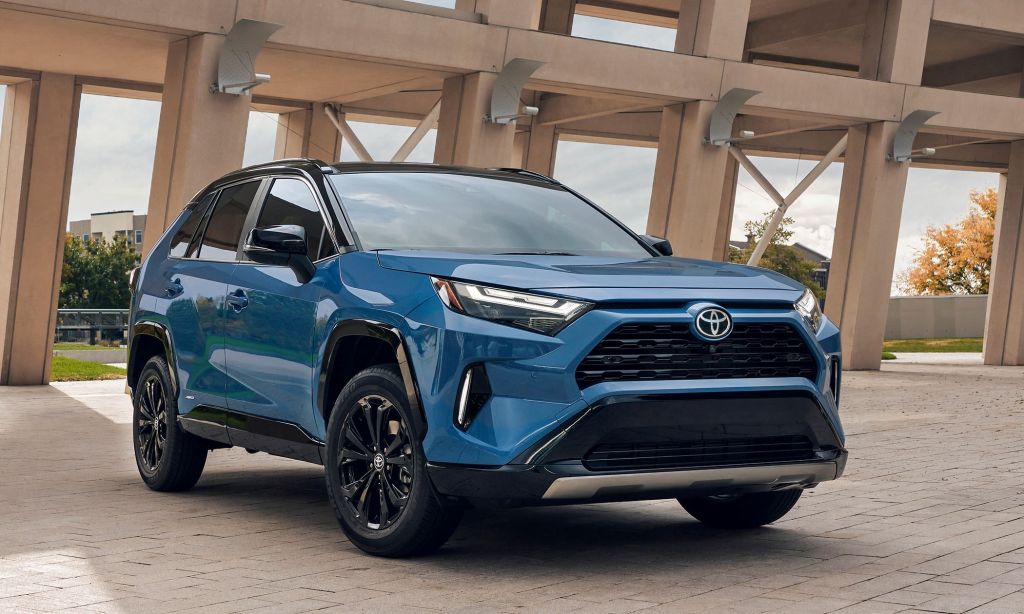
When it comes to compact crossovers, the Toyota RAV4 is a pioneer, having made its way to U.S. showrooms in January 1996.
The acronymic designator is said to stand for “Recreation Active Vehicle with 4-wheel drive.”
That “4” bit has morphed somewhat as (1) you can get a RAV4 with “all-drive,” not four-wheel drive (a primary difference being a transfer case, which the ute doesn’t have) and (2) the vehicle is available with front-wheel drive (though all-wheel is an option).
The vehicle is now in its fifth generation.
What is somewhat astonishing is the vehicle’s market performance in the U.S. in 2024. It became the best-selling vehicle in the U.S. To get to the top it had to supplant the Ford F-150 pickup, which had been #1 for so long that were someone to have an oversized foam finger with the Ford logo on it from when the F-150 got there it would now be crumbly.
Who would have thought that a compact SUV would supplant a full-size pickup in the U.S. market? Not me.
Through the years the exterior design of the vehicle has gone from boxy and functional (presumably as in “utility”) to softer to sharper to where it is now, which is fairly truck-influenced.
Maybe this is why it is doing so well in the market against trucks.
Even on the inside there are things like rubber-wrapped knobs that allow good grip and there are even buttons that are used, for example, to activate the heated steering wheel (this is an upper grade XSE model, incidentally). It has a wonderful simplicity compared to so many vehicles in this category (and others) that are focusing on doing things through screens and capacitive interfaces rather than, well, knobs and buttons.

(“But wait!” you say. “There aren’t any knobs or buttons on my phone, and that works just fine, thank you very much.” Yes, that is true, but consider this: you are holding your phone and staring at it in order to do something. A vehicle that weighs nearly two tons (in this case 3,775 pounds) and is traveling at, say, 70 mph is not the same thing: you’re eyes need to be on the road not trying to get to the right position on a surface to adjust the temperature.)
Oh, there is a 10.5 inch screen for infotainment. Toyota offers “Connected Services Drive Connect” that includes an “Intelligent Assistant” that is accessed via a “Hey Toyota.” Using that you don’t need to use any knobs or buttons or screens or surfaces. Just your voice.
The vehicle driven here is powered by a 2.5-liter four-cylinder engine that is orchestrated with two motor generators and a continuously variable transmission. There is one motor in the front and one in the rear which provides the all-wheel drive capability. The rear motor operates as needed and without a torque distribution system. Otherwise, the vehicle operates as a front-wheel drive vehicle, thereby helping optimize fuel economy.
And on that subject, the estimated fuel economy is 41/38/39 mpg (city, highway, combined). So with a 14.5-gallon fuel tank, you’ve got a considerable range.
The vehicle isn’t going to throw you back into your seat when you mash the accelerator—but then why would you? This is not engineered for that.
As for the “utility” aspect, there’s 37.5 cubic feet of cargo volume with the second row in position and 69.8 cubic feet when that seat is folded.
Seems like people who don’t haul things like gravel or equipment on a regular basis and so need a pickup have figured that that is enough volume to make that Costco run with a RAV4.
 shinymetalboxes