
This Tacoma variant is one bad-ass machine. . .
By Gary S. Vasilash
With the 2024 Tacoma, the reengineering of what has long been the most popular—by a lot—truck in its midsize segment* Toyota product planners decided to make the market for the pickup as broad as possible by providing versions of the truck that cover the terrain in terms of price point and in terms of the way the truck is fitted out, be it someone who is looking for something they can drive to the supermarket or someone whose drive to the supermarket takes them over the valley and through the woods.
There are 11 variants, six with a 2.4-liter, four-cylinder turbocharged engine and five with the 2.4-liter supplemented with a hybrid system. The non-hybrid versions have either up to 228 hp and 243 lb-ft of torque or 278 hp and 317 lb-ft of torque. The hybrid version adds a 48-hp electric motor so that the combined horsepower in 326 and 465 lb-ft of torque. There are models with an eight-speed automatic transmission and models with a six-speed manual.
There are the SR, SR5, TRD PreRunner, TRD Sport, TRD Off-Road, Limited, TRD Sport i-FORCE MAX, TRD Off-Road i-FORCE MAX, Limited i-FORCE MAX, Trailhunter, and TRD Pro.
Sheldon Brown, Tacoma chief engineer, on these variants: “Each one has a distinct focus on the core purpose of the grade and uses hardware-, spec- and performance-based turning to deliver that unique experience more so than in the past.”
Common Elements
Having visited the Toyota Technical Center in Michigan during the development of the vehicle I can testify to the extent to which the development team did benchmarking and performed careful consideration of making each of the variants more than some trim modifications here and there.
What is consistent across the board is that the truck uses a boxed, steel-ladder frame. The Tacoma is based on the Toyota TNGA-F global truck platform, which means that it has the same underpinnings as the Land Cruiser, Sequoia, and Tundra, and forthcoming 4Runner.
Styled at the Toyota CALTY Design Research studio in California, Kevin Hunter, who heads that facility, said the design theme for the truck is “badass adventure machine.”
Again, yes, you can use it to pick up some cereal, yes, you can use it to traverse some rocks and logs, and either way, regardless of what model you pick, this is still something that looks like a truck, not something styled to be soft and silky.
The Trailhunter
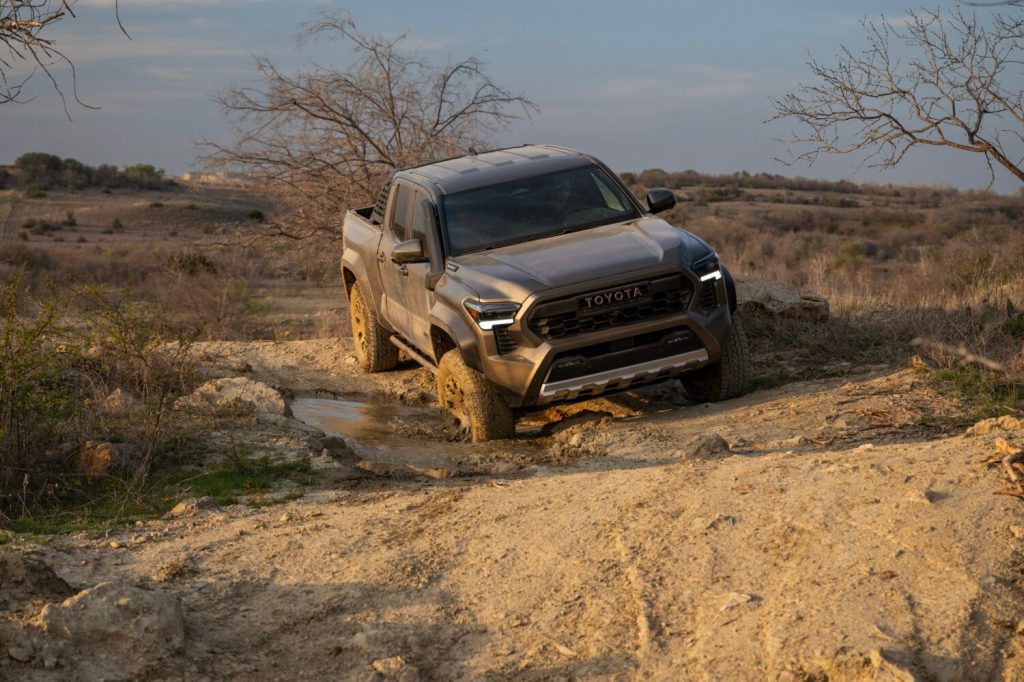
Of the lineup, the Trailhunter is certainly one that not only has the style but the stuff for, well, trail hunting, assuming that that activity requires driving places that are otherwise places were people don’t usually find themselves.
This model is a double cab configuration with a five-foot, aluminum reinforced composite bed.
ARB & Toyota
The vehicle comes with ARB high-performance Old Man Emu 2.5-inch forged monotube shocks. (Evidently the shocks are named after the large, flightless, Australian bird that can traverse difficult terrain at considerable speed. No, I don’t get it.)
Those shocks aren’t the only thing that ARB and Toyota collaborated on for the Trailhunter. The rear bumper is another, constructed with 2.5-mm thick steel that’s powder coated for durability. There are two red recovery points, two jack points for an off-road jack, and non-slip step pads.
Also, there are MOLLE sail panels that are attached to the truck so that there can be a variety of overlanding gear can be attached to them.
There are 33-inch Goodyear Territory Rugged Terrain tires wrapped around 18-inch bronze-finished alloy wheels. The bronze theme is also picked up on the heritage-style grille, although the integrated LED light bar is certainly not vintage, nor are the RIGID Industries LED fog lamps.
Also on the exterior are rock rails and, should you look under the truck, high-strength steel skid plates.
Selectable Settings
The Trailhunter has a push-button Stabilizer Disconnect Mechanism that increases the suspension articulation front and back.
There is also Multi-Terrain Selection which operates in 4WD High and 4WD Low. Depending on terrain selection (mud, dirt, sand) the system helps control wheel spin. There is an electronically activated locking read differential.
The Trailhunter also offers CRAWL Control: set a (slow) speed and it works as a cruise control system so you can concentrate of maneuvering the vehicle. And on the subject of maneuvering, there is the Multi-Terrain Monitor that shows what’s ahead of the truck on a 14-inch touchscreen.
One of the most-striking things about the interior design of the Trailhunter is found on the dashboard and center console. Yes, this is a completely technologically up-to-date vehicle.
But rather than having the driver needing to select things on the screen or via what seem to be rather paltry buttons, the knobs, switches and buttons in the Trailhunter are rugged and robust: You know that you are in a highly capable machine.
Which, presumably, is the point.
One More Thing
The Trailhunter is a hybrid. And only a hybrid. Toyota knows it can get the job done.
==
*In 2023 in the U.S. Ford sold 39,364 Rangers, Chevy 45,562 Colorados, GMC 14,831 Canyons, and Toyota 234,768 Tacomas.

 shinymetalboxes