
2027 Volkswagen Atlas Announced

Will this be the one that really makes VW a contender in the US market?

By Gary S. Vasilash

Some thoughts about its While many people may associate Volkswagen, still, with the Beetle*, in the US, at least, the Volkswagen brand is predicated largely on, well, with one of the more-popular categories in the market: midsize SUVs.

The VW Atlas, and its sibling the Atlas Cross Sport, both of which roll out of the company’s plant in Chattanooga, Tennessee, had combined sales in the US last year of 102,608 units.

The Atlas alone had sales of 71,044, putting it just behind the Tiguan, which had sales of 78,621, and the Tiguan is in the compact SUV category, which is even more popular than the midsize.
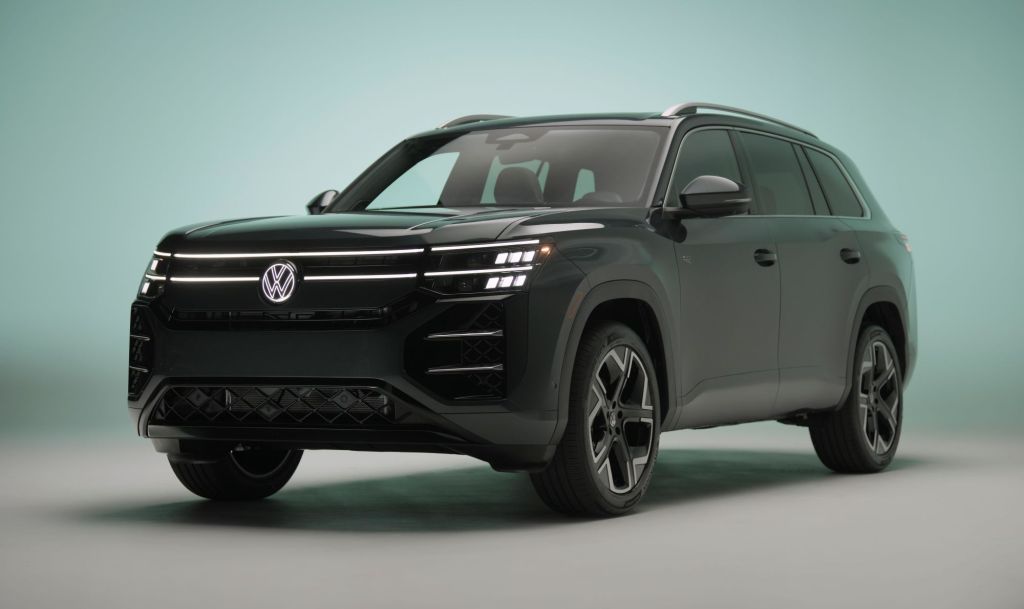
2027 VW Atlas. A serious midsize SUV. (Images: Volkswagen of America)

And now VW is upping its game with the second-generation, seven-passenger Atlas.

As Kjell Gruner, president and CEO, Volkswagen of America, put it when announcing the next Atlas, “When we first launched Atlas in 2017, we delivered the space and style the SUV market was missing: practical, well‑designed, and unmistakably Volkswagen.”

Which, of course, is a bit of an exaggeration, as there was an array of three-row SUVs (e.g., Ford Explorer, Honda Pilot, Hyundai Santa Fe, Chevrolet Traverse) that are “practical, well-designed,” but not VW. Of course.

The 2027 has a more aggressive and futuristic front-end appearance than the current model. There are double-stacked LED headlights set in a slab-like surface that projects a sense of solidity.
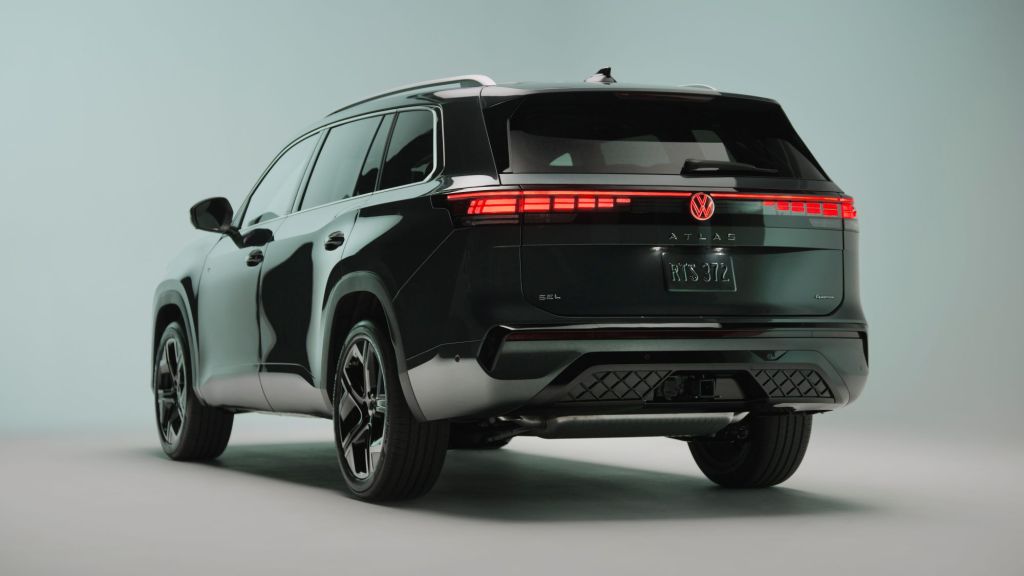
Note the stylish execution of the rear lamps. A detail that shows there was consideration given to all aspects of the design.

The body side is sleeker, so the notion that this is something created by designers who were deeply influenced by the Brutalist school of architecture doesn’t hold either there, on the side, or when moving around to the back, where there is a more-pronounced spoiler, although it should be noted there is a lower diamond-mesh pattern that echoes the one in the front, so again, some serious elements.
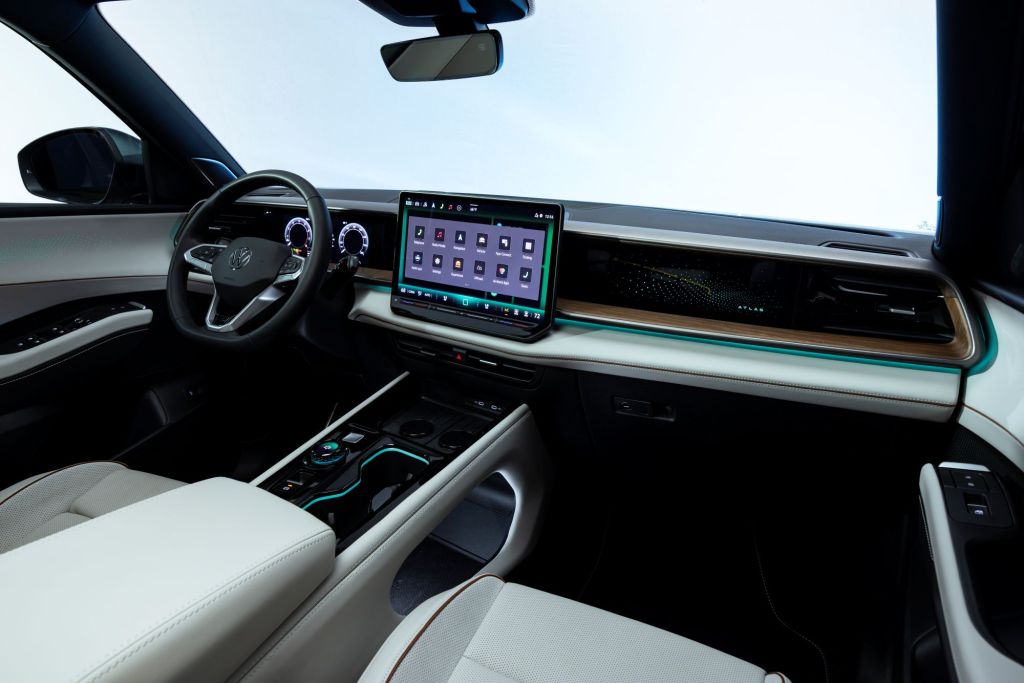
While some German interiors may make you feel like you’re in the Black Forest in the dark, the VW Atlas is open, light and fresh.

Inside, there is a clean, open look. Whereas one may think of the interiors of vehicles from German brands being a bit too Teutonic, that is far from the case with the new Atlas. Its interior design combines the fresh with the functional.

In the 10 years since the Atlas was introduced the competitive offerings have gotten all the more competitive, particularly in their exterior designs. Although there have been refreshes for the Atlas, including a major one in 2024, which included new front and rear fascias, the 2027 has an appearance that is seriously appealing.

//

*That there is such close association with a vehicle that hasn’t been available new in the US since 2019 is most impressive. There are few auto brands that have established such an icon directly associated with their past and present offerings. VW also has the Microbus in its portfolio, another unmistakable design, which was updated to the ID.Buzz, which, unfortunately, being an electric vehicle, is not doing well in the US market and, as it has limited range (<240 miles), is doing less well than its design might make one think. But ask yourself what is the iconic Chevy or Chrysler? Odds are, ask five people and get five answers.
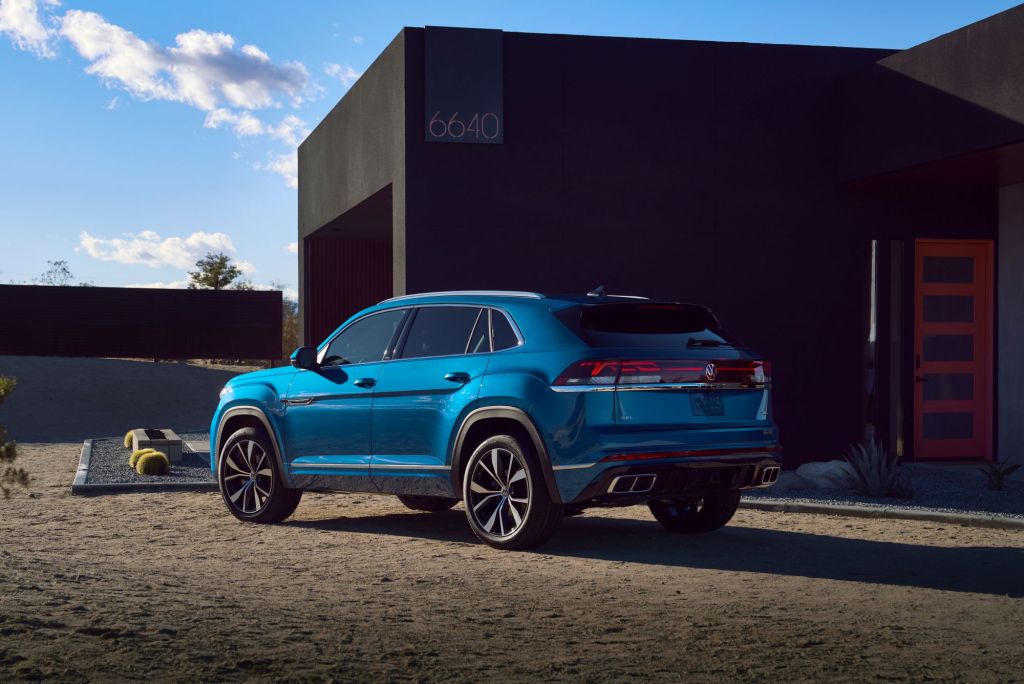
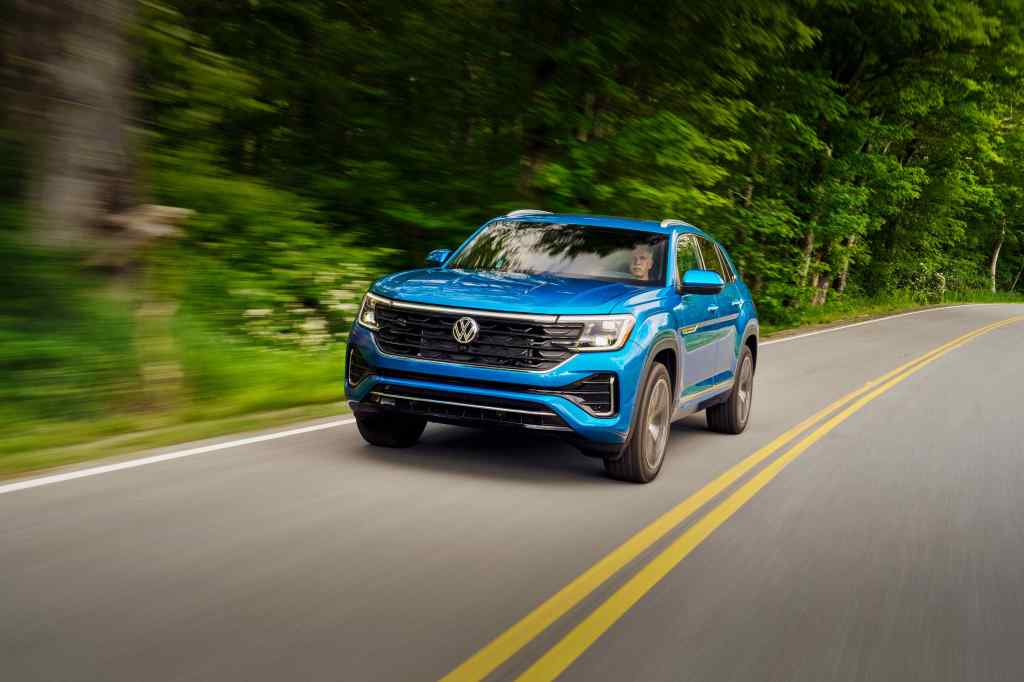
2025 Volkswagen Atlas Cross Sport SEL Premium R-Line

Who knew this is being built in Tennessee?

By Gary S. Vasilash

“This vehicle will be a real American – large, attractive and with many high-tech features on board. Above all, the midsize SUV will be made by real Americans.

“From 2016, this vehicle will roll off production line at the Chattanooga plant – as second core model in addition to the Passat.

“This major decision was taken by the Board of Directors of Volkswagen Group of America last Friday.

“So: Our midsize SUV will be a car “made in Chattanooga”!

“A car ‘made in the US’!”

While that might sound like something you’d hear someone say nowadays as the tariff situation (there is a 25% tariff on imported vehicles that is based on Section 232 of the Trade Expansion Act of 1962; Section 232 deals with national defense: who knew that things like a midsize SUV would have military implications?), that was actually from July 14, 2014, in a speech by Dr. Martin Winterkorn, who, at the time, was CEO of Volkswagen. (He resigned the following year as a result of the Dieselgate scandal.)

The vehicle he was talking about is the VW Atlas, a seven-seat SUV that went into production late 2016 as a model year 2018 vehicle.

Yes, it was, and is, built in Chattanooga. (The Passat, however, ended production there in 2021.)

The Atlas gave rise to the model year 2020 Atlas Cross Sport. It is a five-passenger vehicle.

And the plant has been cranking out Atlases of both configurations ever since. (In addition to the electric ID.4.)

VW Atlas Cross Sport: A sporty utility vehicle. (Image: VW)

A faster roofline and more generous cargo capacity (40.3 cubic feet in the present version with the rear seat ready to accommodate people; in the standard Atlas, with the rear seatback up the cargo is 20.6 cubic feet*, but it should be noted that the Atlas version of the Atlas has a third row, so that explains the delta in space for stuff) are key differences, as are an overall, well, sportier appearance. Like a diffuser on the rear hatch that isn’t found on the Atlas.

Under the Hood

The vehicle is powered by a turbocharged, direct-injected four-cylinder engine, the “Evo4” TSI EA888, mated to an eight-speed automatic. The engine produces 269 hp and 273 lb-ft of torque, which is good for a vehicle that is 195.5 inches long, 78.3 inches wide, 67.8 inches high, has a wheelbase of 117.3 inches and a curb weight of 4,171 pounds. Merging onto a freeway and then driving on it are no problem with the vehicle.

There are sporty stainless-steel pedal caps—but one need not get too carried away thinking that this is a vehicle that will allow you to crush it on a gymkhana course.

The vehicle is EPA rated at 19 mpg city, 26 mpg highway and 21 mpg combined. Helping that is a feature of the 4Moiton with Active Control all-wheel-drive system (not all Cross Sports have this; there is a front-drive version, too).

Inside

On the inside, as this is the top-of-the-line there is good leather seating surfaces. (Lower trims offer leatherette.) The overall execution provides a sense of substance, as one would hope to get from a German car, even if it is one built some 4,600 miles away from Wolfsburg.

There is a 12-inch infotainment display. The Atlas has VW’s App-Connect system, though which things like CarPlay and Android Auto are accessible.

And there is what VW calls the “Digital Cockpit Pro,” a 10.25-inch screen that stands in for the gauge cluster. One advantage of this is that it provides things that are actually useful, like navigation information so the driver can keep eyes forward.

From the points of view of styling, content and powertrain, this is midsize that can hold its own against others in the category.

While there is a bit of a sacrifice to get that style, unless your needs are all about utility (which would then shift a look to the Atlas version of the Atlas), it is worth it.

///

*It is interesting to note that while the seats-in-position cargo capacity of the Cross Sport is about twice that of the regular Atlas, through Q1 2025 the sales of the regular Atlas were about twice that of the Cross Sport: 16,902 to 8,689. Guess people either have more than five passengers on a regular basis or they anticipate that they will so they give up some sportier style for potential utility.

2024 Volkswagen Atlas Cross Sport SEL Premium R-Line

Style meets substance. . . .

By Gary S. Vasilash

The Volkswagen Touareg was first available in the U.S. and pulled from the market in 2018. The rather, um, exotic name refers to a Berber tribe that inhabits the Sahara. It was, after all, a midsize luxury SUV, so this whole nomadic adventuring what presumably descriptive in the naming.

It probably had more than a little something for the vehicle not being as successful as had been hoped in the burgeoning SUV-crazy U.S. market.

Many people probably didn’t know how to say it (phonetically: “two-are-egg”), so rather than embarrass themselves at a VW dealership they went and bought a Ford Edge.

But one of the characteristics of the Touareg—which continues to exist in other markets—that I recall with respect is that it was substantive. This was a solid SUV, not something that was fundamentally a car in SUV’s clothing.

It was the sort of vehicle that you could imagine rolling across the Sahara.

Not that you would, of course, but in the event that you suddenly found yourself in North Africa you’d be good to go.

VW Atlas Cross Sport: looks good. Drives well. Carries stuff. (Image: Volkswagen)

While l am not 100% confident that the Atlas Cross Sport could go trekking though sand dunes, one of the things that struck me about it is that compared to some other SUVs I’ve been in of late, this really feels well-built. . .and it so happens to be built by Volkswagen in Chattanooga, Tennessee.

When you shut the door you think “vault” not “vague.” When you drive the Atlas Sport you think “capable” not “cheap.”

It is, simply, the real deal.

What’s more, in a category where there is such proliferation of models that there is a stultifying sameness, there is another word that comes to mind, which is “style.”

I don’t want to go completely overboard on this, but the Atlas Cross Sport is an SUV that deserves more consideration that it evidently gets.

I say “evidently” because it is a, well, sportier variant of the Atlas. And in Q2 2024 the Atlas outsold what the Atlas Cross Sport did for Q1 and Q2 combined:

  • Atlas Q2: 19,293
  • Atlas Cross Sport first half: 18,835

And I suspect that the difference has to do with these numbers:

  • Atlas: three rows
  • Atlas Cross Sport: two rows

and:

  • Atlas: 96.8 cubic feet of cargo with seats folded
  • Atlas Cross Sport: 78 cubic feet of cargo with seats folded

I guess you could sort of say it is the difference between a pair of Timberlands and Louboutins (of course, the Cross Sport styling isn’t quite that exotic, but you get the analogy).

The Cross Sport is powered by a turbocharged 2.0-liter engine that produces 269 hp and 273 lb-ft of torque. It is mated to an eight-speed automatic. This model has AWD.

The stickered fuel economy numbers are 19 mpg city, 26 mpg highway and 22 mpg combined.

An important characteristic for a vehicle in this class: it has 5,000 pounds of towing capacity.

While the interior is well adorned with serious-seeming-but-attractive materials and there are metal-clad pedals that signify that you’re in R-Line trim, the interface for the 12-inch touchscreen is too fussy for purpose. (Funny thing: many OEMs seem to think that they know how create the digital interfaces for their vehicles, yet compared to companies in that field they just don’t: consider that while Waymo’s first vehicle, the Firefly, was purpose-built, that quickly gave way to vehicles from the likes of Stellantis and Jaguar because Waymo understands what its competencies are.)

There is a vast array of midsize SUVs out there. Lots to consider. Probably too many to reasonably consider.

But while things like Beetles still remain in the consciousness of many Americans and while Golfs are out there in number, these smaller vehicles should not make one not checkout something larger, the Atlas Cross Sport.