
2025 Toyota Corolla FX: Who Knew There Are So Many Corollas Out There?

An accessible vehicle that happens to be a car. . .

By Gary S. Vasilash

The Ford Model T was in production from 1908 to 1927. During that time there was an array of variants. Touring cars and coupes. Four doors. Two doors. No doors. Sedans and convertibles and wagons.

In all, an impressive >15 million were sold.

The Volkswagen Beetle is another car that had an impressive run. Between 1938 and 2019 there were some 22 million Bugs of various types sold on a global basis.

But those cars pale in comparison to the Toyota Corolla.

The Corollas was introduced in 1966. Since then, more than 50 million have been sold globally.

Yes, add all the Model Ts and Beetles and it is still considerably less than the Corolla.

Last year in the U.S. there were 232,908 Corollas sold.

If you take the F-Series out of the picture, there was no Ford brand model that came close in terms of 2024 sales. There was the Explorer at 194,094, but that’s 17% fewer than the Corolla.

And it is a similar situation at GM. Again, absent the pickups, the best-selling model in 2024 was the Chevy Equinox, at 207,730 vehicles. Closer, but no cigar.

(If we want to go down the SUV road: there were 475,193 Toyota RAV4s sold in the U.S. in 2024. . . .)

So far, the Corolla continues to perform:

Through Q1 2025 there have been 55,456 sold.

The Explorer is inching closer at 47,314 and the Equinox exceeds it with 71,002, but again, both of those vehicles are SUVs, so that would bring us to the RAV4’s Q1 sales of 115,402.

If you combine the Explorer and Equinox sales, that’s 118,316, or 2,914 more than the RAV4, to put things into some sort of perspective.

Chevy, Ford and Toyota are all, essentially, bread-and-butter brands. They’re making vehicles for most of us.

But what is surprising, given the Corolla’s clear consistently large sales—globally and in the U.S. market—is that you can’t buy a car from Chevy and the only car that Ford has in its lineup is the Mustang. That’s not exactly a mainstream model. (And to put its sales into perspective: in 2024 there were 44,003 Mustangs sold, which means that in the first quarter of ‘25 Ford moved more Explorers than Mustangs in all of ’24.)

(Another thing to be noted about Toyota and cars: last year in the U.S. it sold 309,876 Camrys. It has sold 70,308 through Q1 of ’25. Yes, a lot of cars.)

The thing about the Corolla is that like the aforementioned Model T and Beetle, it is primarily an accessible vehicle.

About the FX

The vehicle driven here, the FX, is based on the Corolla SE grade, but has been amped up a bit for a sportier look.
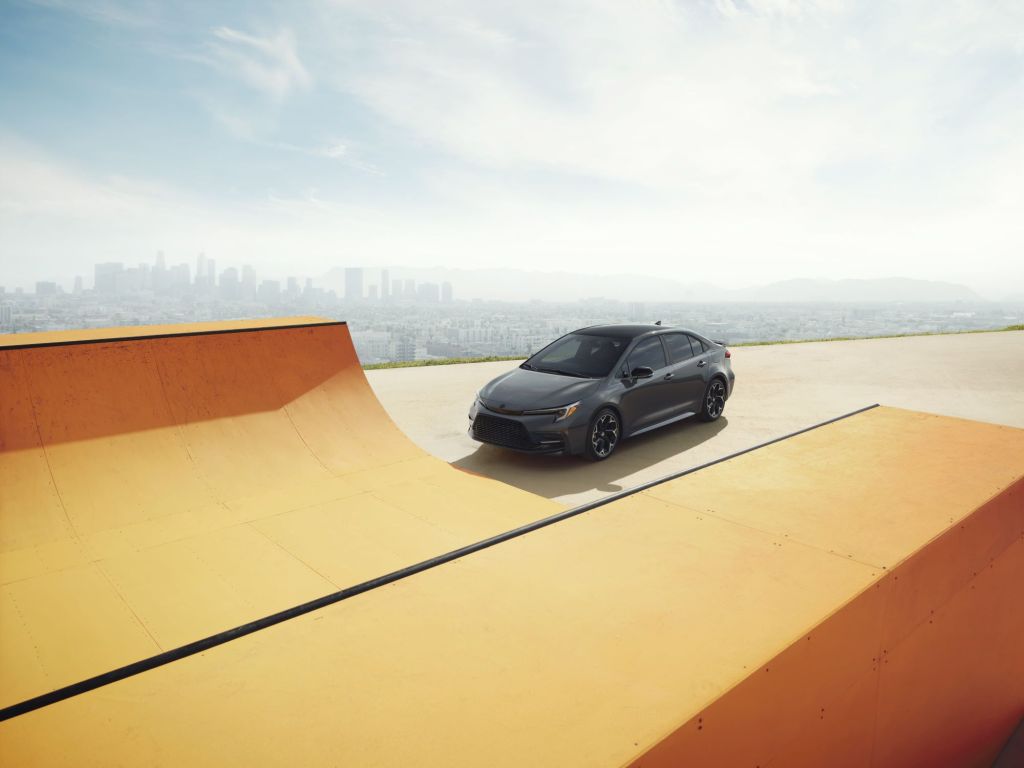
Corolla FX: Accessible style. (Images: Toyota)

Achieving that look includes a sizeable spoiler, satin-black 18-inch alloy wheels with black lug nuts, and a blacked-out roof.

Powering the car is a 169-hp four-cylinder engine. There are three drive modes: Eco, Normal and Sport. This car isn’t going to win any races. But hundreds of thousands of people who have bought Corollas over the past few years likely don’t even know where a racetrack is located, and probably don’t have any points on their licenses for speeding.

On the inside things are, as they might say, “jazzed-up” a bit with the use of orange stitching on the seats and trim.

There is a 10.5-inch infotainment screen. Where there are knobs for HVAC settings, curiously no volume or tuning knobs for the audio system. You adjust the volume either with a steering wheel button or a diminutive rocker button just below the screen, which is a bit tricky to use unless you’re sitting at a light.

It’s got the goods on the inside. (But if only one of those knobs on the IP was Volume for the audio.)

Affordability

One of the reasons—in addition to the reliability, durability and quality Toyota vehicles are known for—people buy Corollas is because they’re affordable.

The MSRP prices range from $22,325 for an LE to $28,190 for a Hybrid XLE. (These numbers are pre-Liberation Day, so who knows what anything will cost going forward.)

This FX Edition has a starting MSRP of $26,500. Throw in a few options ranging from a blind-spot monitor with rear cross-traffic alter to an LED trunk light, adding $1,644, put in the handling fee of $1,135, and it is out the door for under $30,000: $29,279.

And there aren’t a whole lot of other cars you can say that about—unless, of course, you’re talking about Corollas, and then there are a whole lot of them.

In Addition

A couple other things to know about the Corolla.

One is that it is based on the Toyota TNGA-C platform, which doesn’t mean much in and of itself. What is important to know is that it is a global platform. Which means that it is being used as the basis of vehicles all around the world. Consequently, because of economies of scale it can be engineered and built with more robustness than a platform with a more limited scale—well, that limited-scale platform can certainly be produced with desired characteristics but it will be a whole lot more costly.

The point about the platform is that it is solid, not tinny.

Second, the Corolla driven here was built. . .in Huntsville, Alabama, at the Mazda Toyota Manufacturing plant. Yes, a compact car built in the U.S.
2024 Volkswagen Tiguan S

By Gary S. Vasilash

The verb whelm means to roll over something so that it is submerged.

Which gives rise to the terms overwhelm and underwhelm, with the former being a sense of being overcome by something and the other, well, provoking a shrug.

However, it doesn’t seems as though whelm on its own has the sense of being in the middle of those two conditions, one being, in effect, excited and the other indifferent.

If you are submerged, then there’s a bit of overwhelming going on.

This exercise in the state of whelmedness is provoked by the VW Tiguan S, which left me feeling in a neutral zone between like and dislike.

It is just sort of there.

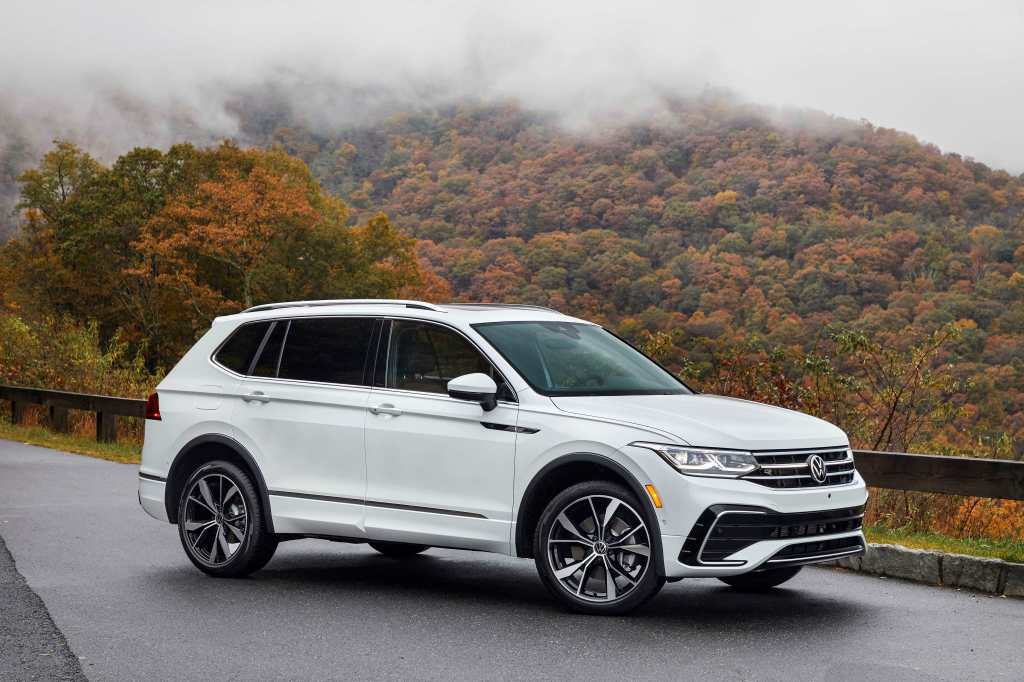
Some people give the compact crossover high marks for styling which resembles the midsize VW Atlas. While the Atlas is a handsome vehicle, somehow the scaling down the lines for the Tiguan doesn’t seem to be an distinct advantage for a vehicle that is competing in one of the most fierce of all, the compact crossover.*

VW Tiguan: Credible compact crossover. (Images: Volkswagen of America)

There are nice touches, such as the LED lighting fore and aft.

But inside—and recognize that we’re talking about the S, the base model, so that needs to be taken into account here—things are a little iffy.**

Like the 6.5-inch infotainment display that resembles what one found on a Game Boy—which has been out production since 2003. The backup camera display lacks the sharpness that is now common in vehicles in this category.

There is an 8-inch digital instrument display that, like displays when there were physical gauges, with needles that moved around a spindle, is nonconfigurable.

For years, German interior design was by far best-in-class. The fit, finish and particularly materials were top-notch, and it seemed as though this was not only an Audi thing, where it began, but was manifest just as well in Volkswagen products, too.

While there is still the appearance of this execution, the plastics are a bit, well, plasticly, which is not a good thing unless you are a fan of plastics. (Lest it be thought that I am being a bit persnickety about this, a friend, who is not in the auto business, climbed in the Tiguan and immediately commented about the “hard plastics.” Admittedly I wouldn’t have likely used his observation if it didn’t tally with mine, but that’s why you should take impressionistic reviews with a boulder-sized grain of salt, no matter what the source.)

Staying on the inside, as this is a front-drive version of the Tiguan (there are also AWDs), there are three rows of seats (the AWD version gets the more reasonable two): the first row with 40.2 inches of leg room, the second row with 36.6 inches of leg room and the third, with 27.7 inches of legroom—which really isn’t much in the way of legroom at all.

Cargo capacity, however, when you fold that third row flat is a good 33 cubic feet; with that seat up it is 12. If the second and third are folded it goes to 65.3 cubic feet, which means a lot of stuff can be swallowed.

Where German engineering comes to the fore in the Tiguan is under the hood. The 184-hp turbocharged four (mated to an eight-speed automatic) responds to right-foot input with remarkable alacrity. You want to merge: no problem. This was my favorite aspect of the Tiguan.

If there was a pleasant surprise, that is it.

Look: as stated, this is a tough category. But it is worth noting that the third-generation Tiguan will be introduced later this year, so. . . .

==

*This “familial resemblance” is something that many vehicle manufacturers pursue with their products, presumably thinking that if someone likes X but can’t afford it or X is the wrong size, then having W and Y that look like X is good. To be sure there can be cues from one to the other, but shouldn’t something have its own visual characteristics that make it special? The Beetle became the icon it did because it looked like nothing else, not something else.

Icons don’t look like something else.

**Car and Driver recently did a comparison of The Dodge Hornet, Ford Escape, Honda CR-V, Kia Sportage, Mazda CX-50, Nissan Rogue, Toyota RAV4, and VW Tiguan and the Tiguan came in number two. . .but it was the upper trim SEL R-Line model, so that needs to be considered.

Is the Volkswagen Beetle British?

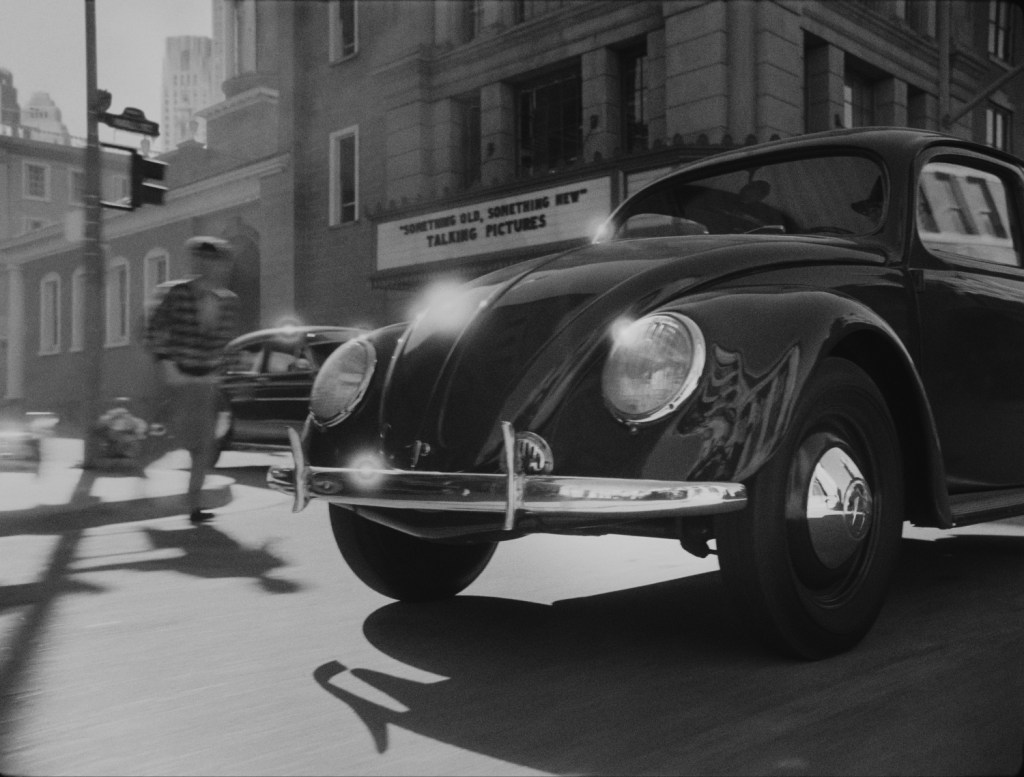
On December 27, 1945, the vehicle known as the Volkswagen Limousine went into production at the VW plant in Wolfsburg, Germany. The vehicle was internally known—and better known—as the “Type 1.”

(Images: Volkswagen)

But here’s an interesting aspect about the production of the vehicle that had been originally developed for the National Socialists (a.k.a., Nazis). The car, then known as the “KdF-Wagen,” wasn’t exactly built in quantity: By the end of World War II, only 630 had been manufactured. The Wolfsburg factory was used to build bombs, not Beetles.

While there had been plans to demolish the Volkwagenwerk GmbH following the end of hostilities, a factory that had been badly damaged but not destroyed, the British, which had trusteeship, decided that they could put the plant to work.

Under the direction of Senior Resident Officer Major Ivan Hirst, the factory was retooled to build the car. The British Military Government put in an order for 20,000 vehicles in August 1945.

Building Beetles (Type 1) in Wolfsburg

By the end of the year, 55 cars were built.

Starting in 1946 the production rate was approximately 1,000 per month. By 1947 the vehicles were being exported.

By the time the VW Beetle went out of production in 2003, 21,529,464 vehicles had been produced (15.8-million in Germany).

Were it not for British major Ivan Hirst, it could have been an entirely different story.