
Style meets substance. . . .
By Gary S. Vasilash
The Volkswagen Touareg was first available in the U.S. and pulled from the market in 2018. The rather, um, exotic name refers to a Berber tribe that inhabits the Sahara. It was, after all, a midsize luxury SUV, so this whole nomadic adventuring what presumably descriptive in the naming.
It probably had more than a little something for the vehicle not being as successful as had been hoped in the burgeoning SUV-crazy U.S. market.
Many people probably didn’t know how to say it (phonetically: “two-are-egg”), so rather than embarrass themselves at a VW dealership they went and bought a Ford Edge.
But one of the characteristics of the Touareg—which continues to exist in other markets—that I recall with respect is that it was substantive. This was a solid SUV, not something that was fundamentally a car in SUV’s clothing.
It was the sort of vehicle that you could imagine rolling across the Sahara.
Not that you would, of course, but in the event that you suddenly found yourself in North Africa you’d be good to go.
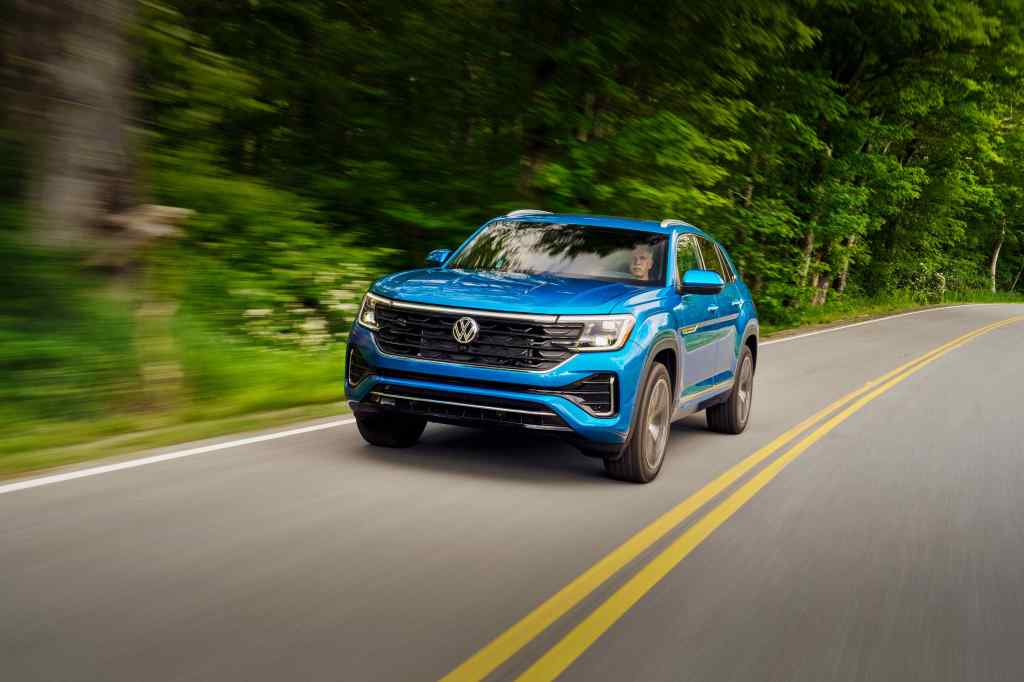
While l am not 100% confident that the Atlas Cross Sport could go trekking though sand dunes, one of the things that struck me about it is that compared to some other SUVs I’ve been in of late, this really feels well-built. . .and it so happens to be built by Volkswagen in Chattanooga, Tennessee.
When you shut the door you think “vault” not “vague.” When you drive the Atlas Sport you think “capable” not “cheap.”
It is, simply, the real deal.
What’s more, in a category where there is such proliferation of models that there is a stultifying sameness, there is another word that comes to mind, which is “style.”
I don’t want to go completely overboard on this, but the Atlas Cross Sport is an SUV that deserves more consideration that it evidently gets.
I say “evidently” because it is a, well, sportier variant of the Atlas. And in Q2 2024 the Atlas outsold what the Atlas Cross Sport did for Q1 and Q2 combined:
- Atlas Q2: 19,293
- Atlas Cross Sport first half: 18,835
And I suspect that the difference has to do with these numbers:
- Atlas: three rows
- Atlas Cross Sport: two rows
and:
- Atlas: 96.8 cubic feet of cargo with seats folded
- Atlas Cross Sport: 78 cubic feet of cargo with seats folded
I guess you could sort of say it is the difference between a pair of Timberlands and Louboutins (of course, the Cross Sport styling isn’t quite that exotic, but you get the analogy).
The Cross Sport is powered by a turbocharged 2.0-liter engine that produces 269 hp and 273 lb-ft of torque. It is mated to an eight-speed automatic. This model has AWD.
The stickered fuel economy numbers are 19 mpg city, 26 mpg highway and 22 mpg combined.
An important characteristic for a vehicle in this class: it has 5,000 pounds of towing capacity.
While the interior is well adorned with serious-seeming-but-attractive materials and there are metal-clad pedals that signify that you’re in R-Line trim, the interface for the 12-inch touchscreen is too fussy for purpose. (Funny thing: many OEMs seem to think that they know how create the digital interfaces for their vehicles, yet compared to companies in that field they just don’t: consider that while Waymo’s first vehicle, the Firefly, was purpose-built, that quickly gave way to vehicles from the likes of Stellantis and Jaguar because Waymo understands what its competencies are.)
There is a vast array of midsize SUVs out there. Lots to consider. Probably too many to reasonably consider.
But while things like Beetles still remain in the consciousness of many Americans and while Golfs are out there in number, these smaller vehicles should not make one not checkout something larger, the Atlas Cross Sport.
 shinymetalboxes