Another Change in the Supplier Landscape

It isn’t easy—or inexpensive—to be an automotive supplier

By Gary S. Vasilash

One of the things that doesn’t get a whole lot of attention but should is how there is a slow but certain transition of the automotive supply base.

On the one hand there are companies that seemed as though they were fixtures that shifted. Like Continental Automotive being spun out of Continental last April and becoming Aumovio.

Previously Continental spun off its Powertrain division. It became Vitesco. Vitesco was acquired in the fall of 2024 by Schaeffler and that name is now gone.

Today ZF announced it sold its advanced driver assistance systems (ADAS) business to Harman International.

In the case of Vitesco to Schaeffler, it is a fairly understandable shift, as Schaeffler has a Powertrain & Chassis Div., as well as others that are in that sphere (E-Mobility, Vehicle Lifetime Solutions (a fancy way of saying “aftermarket”), and Bearings and Industrial Solutions).

At first blush the ZF sale of its ADAS business to a company that may be more well known for its automotive audio brands—Harman Kardon, Infinity, JBL, Lexicon, Mark Levinson, etc.–Harman International.

But Harman, which was acquired by Samsung in 2017, has been more deeply involved in automotive tech than might be expected. It has been developing various systems that provide a wide array of driver information, taking advantage of its screens, software, and connectivity.

All of those are nicely complimented by the ZF ADAS acquisition.

But ZF?

This brings up something else that doesn’t get a whole lot of attention.

Given things ranging from the tariffs to the consumer demand for electric vehicles that didn’t grow as anticipated, automotive suppliers are under significant economic pressure.

In making the announcement, Mathias Miedreich, CEO of ZF, said, in part, “the transaction will help to significantly reduce ZF’s financial liabilities. The sale enables us to focus our resources on those core ZF technologies such as chassis, powertrain, commercial vehicles, and industrial applications in which we are global leaders.“

It wasn’t that long ago that ADAS was one of “those core ZF technologies.”

Realize that there will be more demand for ADAS going forward, not less.

But there is an on-going need to advance capabilities in that space, and that takes large, consistent investment.

Evidently the ZF board recognizes that for the good of the company at large those investments are not something that it can sustain. So the sale.

As for Harman, this is a great opportunity.

And let’s face it: with a corporate parent like Samsung, which has a market cap on the order of $499 billion, access to development funds is probably not going to be a significant issue.

How Often Do You Think About Your Chassis?

Probably—unless there is something amiss—never. . . .

By Gary S. Vasilash

Odds are, unless there is a problem with your suspension system like one corner of the vehicle sagging to a surprising degree or continued bouncing long after the pothole has been hit, you probably don’t think much about it.

So it is probably a good thing that there are companies like ZF that do. Otherwise there could be serious problems—dare I say?—down the road.

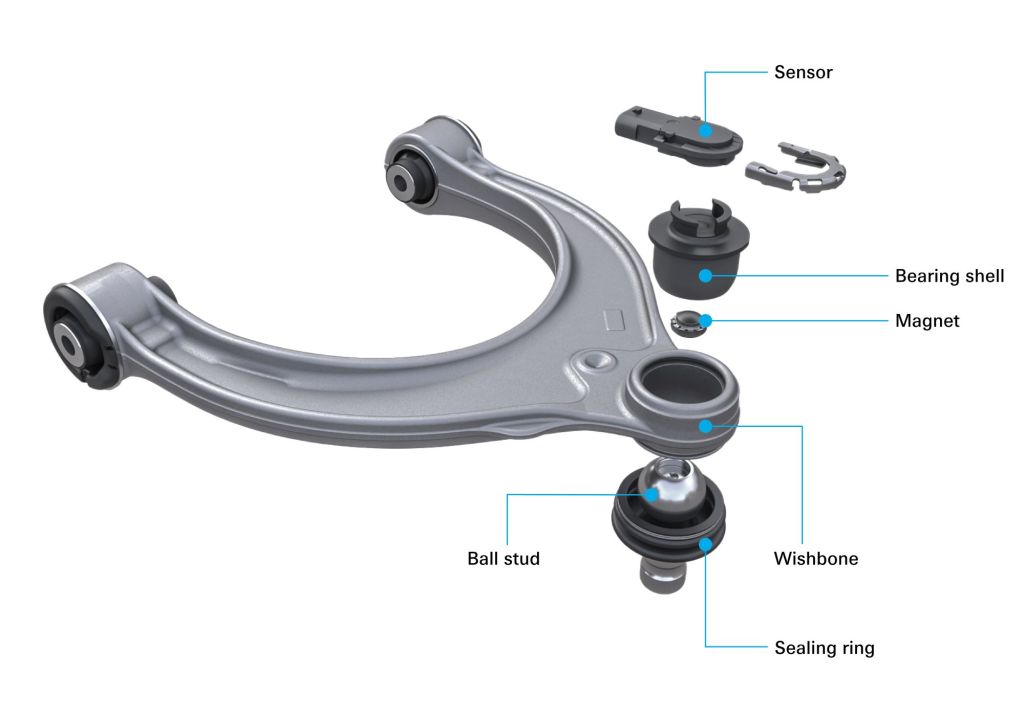
ZF has developed what it calls its “next-generation* Smart Chassis Sensor.”

This unit fits into a ball joint in the control arm.

“Next Generation Smart Chassis Sensor”: seems like a straightforward integration that results in useful information. (Image: ZF)

Consequently, it is able to measure a number of factors related to the vehicle, some to help ensure the ride as is as smooth as it can be, some that are unexpected.

For example, if a tire has been changed and the lug nuts aren’t sufficiently tight, it can detect that and send an alert to the driver.

Or if the vehicle is at the local landscaping supply store and being loaded with those decorative rocks, it can determine whether the vehicle is being overloaded.

(Apparently this load-detection capability is good for electric vehicle drivers in that it can provide more accuracy regarding when it is going to be necessary to get a recharge.)

ZF says the sensor system can even provide an assessment of “Chassis Health,” providing alerts when maintenance or repair is required.

Of course, this is the sort of thing that must be specified in a vehicle during development, not the sort of thing you have your local repair shop integrate into your vehicle.

Here’s hoping some chassis engineers look at the functionality and capabilities of this unit.

==

*A few weeks ago ZF introduced the Smart Chassis Sensor. Already there’s another, this enhanced with the integration of an accelerometer. Certainly not the rate of development more common in automotive, which tends to be measured in months, not weeks.

How the Celestiq Can Help Address the Problem of Potholes

Smart sensors can lead to smoother roads. . . .

By Gary S. Vasilash

The Cadillac Celestiq—the hand-built electric vehicle that has a price in the $340,000 vicinity—is a lot of things, but one that’s surprising is, in effect, a test-bed for road maintenance personnel.

That is, the Celestiq is fitted with Smart Chassis Sensor technology developed by ZF.

Sensors—two in the front wishbones and two in the rear—are permanently mounted into the ball joints of the suspension system.

An important part you cant see are the algorithms. (Image: ZF)

These sensors and associated algorithms are used to do a variety of things, like control damping and provide headlight leveling.

Steffen Reichelt, Head of the Chassis Components Product Line at ZF, says, “With the help of evaluation algorithms, our sensor not only replaces conventional height sensors, it also significantly outperforms them in terms of the quantity and reliability of the data collected.”

It is that last bit—the data collected—that is germane to the beyond-Celestiq applications.

Reichelt: “The data collected by the sensor allows additional conclusions to be drawn about the vehicle, its surroundings and the road surface. These findings are particularly attractive for commercial vehicle users and fleet owners, but also for the maintenance of road infrastructure.”

So while most of us will never experience the smooth ride that is undoubtedly offered by the Celestiq, conceivably those who do could benefit the rest of us with the data that their vehicles can collect about the road surfaces.

How’s Your Brake Fluid?

ZF is supplying a system that uses hydraulic-fluid-free braking

By Gary S. Vasilash

One of the things (among many) that most drivers probably don’t think much about is brake fluid, a glycol- or silicone-based hydraulic fluid that is pressurized when the brake pedal is depressed (roughly: the pedal initiates a vacuum booster that activates the master cylinder which pushes brake fluid through the brake lines so that it goes to the wheel caliper and then forces a set of pistons that apply the brake pads so the vehicle will slow or stop).

Which is probably something most don’t think about, either.

Or that it is generally recommended that brake fluid be changed every two years or 30,000 miles.

Who knew?

Some lucky drivers of vehicles produced by an unnamed “global manufacturer” will be getting vehicles that at least have a reduced amount of brake fluid on board, as those vehicles will be equipped with an electro-mechanical braking system (EMB) from supplier ZF.

Rather than brake fluid, this ZF system uses electric motors for brake actuation. (Image: ZF)

The EMB is a “dry brake-by-wire” system.

That is, when pressure is applied to the brake pedal a signal travels to electric motors that generate the pressure needed to provide braking.

No fluids are involved.

However, in this particular application the EMB is being used for the rear brakes with hydraulics at the front, so the entire braking system isn’t entirely dry.

According to ZF the EMB system is a contributor to software-defined vehicles.

That is, there can be adjustments made to the performance parameters EMB made via code, something that is not going to happen on a purely hydraulic setup (which would require adjustments with a wrench).

Of course, drivers are still going to have to be aware of that need to replace brake fluid in those vehicles. . . .

ZF & Remanufacturing

Everything old isn’t precisely new again—but an increasing number of products are being remanufactured for the good of the environment. . .

By Gary S. Vasilash

One of the ways that the environment can benefit without much in the way of sacrifice for consumers is through the use of remanufactured products rather than new.

While some might thinks that “remanufactured” is simply a euphemism for “used,” and that “used” is typically substandard compared with “new,” a “remanufactured” product doesn’t mean “second-hand,” with all of the questions that go along with that, but reprocessed in a factory so that it is like-“new,” even though it isn’t.

In other words, this isn’t the classic case of “buying someone else’s problem.”

Drivetrain modules being remanufactured at the Bielefeld plant. (Image: ZF)

Auto supplier ZF, which is best known for making new things, like transmissions and chassis systems, is also an evident leader in performing remanufacturing.

It recently received the German Sustainability Award from the Germany Sustainability Award Foundation (obviously a case of the award name being a reuse of the words in the title of the organization).

The award was given in the context of its activities in the “transformation field of resources.”

Or remanufacturing.

ZF operates 25 remanufacturing sites worldwide.

One, in Bielefeld, Germany, has been in operation since 1963.

There products come in and are disassembled, cleaned, tested, refurbished and reassembled.

According to ZF, compared to a new part, the remanufactured part means

  • On average a reduction in material use of up to 95%
  • Energy and CO2 savings up to 90%

At the plant there are some 180,000 clutch pressure plates and disks, 10,000 torque converters, and 55,000 clutch release systems that come in used and go out remanufactured.

Presently, up to 35% of the products that were originally manufactured at Bielefeld return to the plant for remanufacturing. An objective is to increase that to 90% over the next five years.

ZF Improves Hydrogen Systems

Putting unused hydrogen back into the system. . .

By Gary S. Vasilash

Although there is a concern regarding fuel efficiency when it comes to petroleum-powered vehicles, when using alternative forms of “fuel,” like hydrogen, making sure that the most is made of it is arguably even more important—after all, the price of hydrogen in the U.S. is over $30 per kilogram, with a kilogram being approximately equivalent to a gallon of gasoline.

To that end, ZF has developed a hydrogen recirculation blower.

ZF Hydrogen Recirculation Blower improves hydrogen consumption in FCEV commercial vehicles. (Image: ZF)

Essentially, it recirculates unused hydrogen back into the fuel cell by using a an electric motor that can operate at speeds up to 100,000 rpm to essentially blow the hydrogen back into the stack.

Because at the outgoing side of the fuel cell stack there is water (that’s the emissions from a hydrogen fuel cell: air contains oxygen, and as you recall from high school chemistry, hydrogen + oxygen form H2O) there is a water separator that not only keeps things from getting all wet, but serves as a coolant.

The recirculator has been engineered for use in commercial vehicles and will undoubtedly find application in Europe, where more fuel cell electric trucks are being introduced.

The price of hydrogen in Europe is competitive with the cost of fuels for thermal engines, and the amount of time it takes to refuel a hydrogen vehicle is approximately that of a liquid-fueled truck (compared to the l-o-n-g time to recharge a battery electric truck), so it makes sense that fleet operators would be interested in hydrogen as they lower their carbon emissions.

Just imagine how important this would be in places where hydrogen is exceedingly expensive compared to other fuels.

The Transformation at ZF

By Gary S. Vasilash

One of the aspects of the industry’s transition to electric vehicles that doesn’t get a whole lot of attention is that suppliers are responsible for large portions of a vehicle, so as there is the move from internal combustion engines to electric motors, as there is an increase in the importance of software, suppliers need to undergo a transition. . .or they will find themselves under water in short order.

However, making the switch isn’t like throwing a switch.

There are existing competencies within an organization—the things that allowed it to be selected as a supplier in the first place.

But now those competencies, while not completely irrelevant—let’s not lose sight of the fact that internal combustion engines aren’t going away for several more years—are less important within a supplier’s portfolio.

And there is the abiding issue of having the financial wherewithal to make the change, both from the standpoints of people and installed base of capital equipment.

Regardless of what list of the top suppliers you consult, you’ll find ZF right up there.

(Image: ZF)

Going Mobility

Martin Fischer heads up ZF’s operations in North America.

He describes what ZF is now as “a technology supplier to the mobility industry.”

Were you to ask someone in the industry about what ZF is just a few years ago, they’d probably answer, “The company that makes those impressive eight-speed automatic transmissions.”

While the company continues to produce those eight-speeds, Fischer says on this edition of “Autoline After Hours” that they’re not going to be making more investments in eight-speeds.

There are other things on the agenda.

Fischer says the focus today is on technologies related to autonomous driving, electric drive systems and components, and integrated safety, technologies that are both physical and digital.

To help the company move to new places, Fischer says they first started out with small teams that developed products, then integrated those people into the larger company so that everyone becomes involved.

The classic portfolio that ZF has had is undergoing a significant change, with everything from controllers that it is collaborating with NVIDIA on to electric motors to steer-by-wire systems and more. Not the sort of things that one might imagine a “classic” supplier would have the wherewithal to do–at automotive scale and quality.

What ZF is doing is essentially a masterclass in maintaining relevance in a changing industry.

Talking to Fischer are “Autoline’s” John McElroy, Lindsay Brooke of Automotive Engineering, and me.

You can see the show here.

How the Automotive Supply Base Is Being Transformed

Yes, there is still a need for some of yesterday’s tech in the auto industry today. But there is a greater need for tomorrow’s tech right now. And here’s what suppliers are doing to realize that

By Gary S. Vasilash

When people say that the auto industry is “undergoing the biggest transformation since its very beginnings,” they generally mean that the OEMs are having to vigorously change the product offerings that they are producing, putting plugs where they once had fuel filler ports, putting in drive motors where they once had engines, putting batteries in a place where there were once fuel tanks.

And that is just for the electric vehicle part of the change.

There are a variety of other factors that are driving change in automotive, such as the addition of automated driving capabilities and the need to address heightened expectations on the interiors of vehicles, whether this takes the form of things like comfort or infotainment.

By and large, the changes seem to be challenges for the OEMs.

Which is not entirely the case.

Let’s face it: most of what is assembled into a given vehicle is not produced by the OEM. It comes from suppliers.

So the transformation of the auto industry is having arguably a greater impact on the supply base as not only must it provide OEMs with what they want now, but what they will want in the future.

ZF ProAI automotive-grade supercomputer. (Image: ZF)

On this special edition of “Autoline After Hours” my colleague John McElroy and I talk with Martin Fischer, member of the Board of Management of ZF and president of ZF North America, and Phil Eyler, president and CEO of Gentherm.

ZF is one of the world’s largest automotive suppliers, and while historically—and currently—known for such products as its nine-speed transmissions, the company is undergoing a change as it focuses on domains including autonomous driving, electromobility, integrated safety, motion control, and digitalization and software.

Yes, the company has even developed an automotive supercomputer, the ProAI.

Then there’s Gentherm, which is a specialist in thermal electric devices. In 1996 the company launched its first heated and cooled car seat and in the subsequent years has taken a strong position in that market area.

Yet recently it has invested in technology for thermal management of electric vehicle batteries.

McElroy and I talk with Fischer and Eyler about how their companies are working through—and ahead of—demands—today’s and tomorrow’s—they are addressing as automotive suppliers.

Their approaches range from organizing skunkworks to create new products to taking existing technologies from other market segments, like medical, to apply to automotive applications.

You can see it all here.

ZF Investing Big in Truck Transmissions

One of the consequences of the pandemic is the increase in the number of commercial vehicles on the roads—as in, for example, all of those FedEx, UPS and Amazon Prime trucks crowding in suburban neighborhoods like a street in New York City pre-pandemic.

Who knew there was such a demand for home deliveries?

So to meet the demands for medium-duty commercial trucks (as well as buses and heavy-duty pickups), ZF has announced that it is investing $200-million in its plant in Gray Court, South Carolina, to produce its ZF PowerLine 8-speed automatic transmission.

This is a new transmission, as it went into production at the ZF HQ production facility in Friedrichshafen, Germany, at the end of 2020; the factory in South Carolina is scheduled to start exclusively supplying the North American market in 2023.

ZF PowerLine 8-speed transmission for truck applications. (Image: ZF)

A couple points about the transmission:

  • Although it is an 8-speed, Christian Feldhaus, Director Commercial Vehicle Driveline Technology North America, ZF, says, “ZF PowerLine proves equal, but in most cases, higher performance and efficiency than other transmissions with 9 and 10 speeds.” Or more gears are not necessarily better.
  • In addition to which, although there is increased attention to electric commercial vehicles—such as those Amazon will be getting from Rivian and General Motors’ new BrightDrop—one might wonder about a transmission ostensibly for ICE applications. Feldhaus: “With its modular design, PowerLine is prepared for mild hybrid and plug-in hybrid variants, making it a true technology bridge to future mobility.”

Arguably, post-pandemic there may be a falling off of home-delivery demands. But odds are people who have found it to be a convenient way to get things may stay with it.

So there’s going to be a need for a lot of transmissions.–gsv