
By Gary S. Vasilash
“Ford has shifted its electric vehicle strategy so it concentrates on smaller, lower priced EVs and electric work vehicles such as pickup trucks and full-size vans, Farley said. Any EV larger than a Ford Escape small SUV ‘better be really functional or a work vehicle.’”
That is from an AP story by Tom Krisher about a presentation Ford CEO Jim Farley gave to the Wolfe Research Global Auto Conference in New York on February 15.
Farley also talked about the relationship between Ford and the UAW in light of last fall’s strike.
Farley said, “Our reliance on the UAW”—it has more UAW members that either GM or Stellantis—“turned out to be we were the first truck plant to be shut down.”
He was referring to the Kentucky Truck Plant, Ford’s largest plant and where the highly profitable F-Series Super Duty, Ford Expedition and Lincoln Navigator are produced.
Ford has pretty much placed its production bets in North America on things like the F-Series.
The only car the company has on offer in the U.S. is the Mustang, not exactly what one would describe as a “family vehicle,” so arguably it is something of a niche at most. Trucks and utes are where it is at, it seems, for the Blue Oval.
In the smallish category there are the Escape and the Bronco Sport, which are both based on the same platform. And the Maverick pickup truck, which is also based on the same C2 platform. This extremely popular pickup is built at a Ford plant in Hermosillo,Mexico, so some of Farley’s USA! USA! USA! chest thumping needs to be adjusted a bit.
But his comment about where the sweet spot for EVs is going to be is somewhat puzzling.
Right now Ford has three EVs, two for consumers and one for vocational use: the F-150 Lightning, Mustang Mach-E and E-Transit.
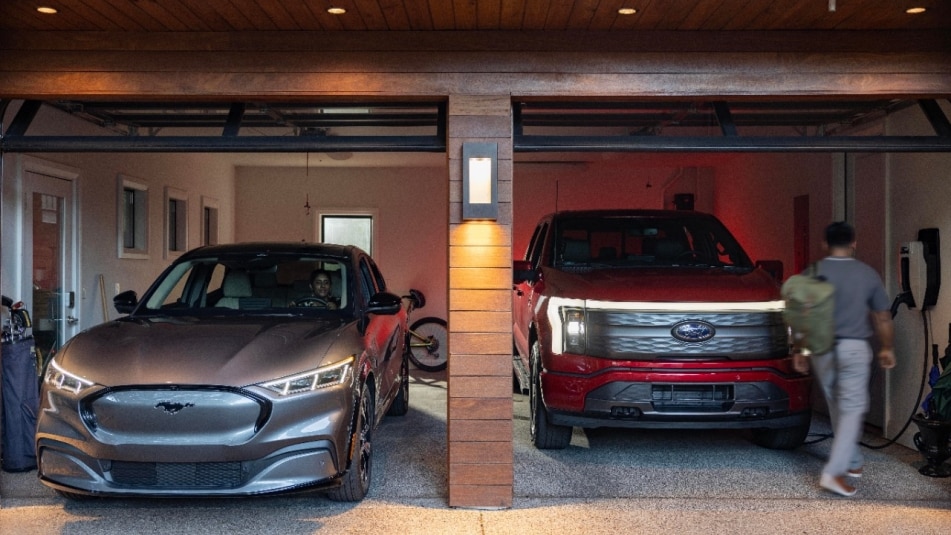
The first is, of course, a full-size pickup truck. The second trades on the muscle car performance of the Mustang. And the third is a vehicle for contractors.
Ford has been championing larger vehicles for the past few years for the simple reason that it is where it makes more money, so when it went EV it went big with the Lightning (and for power with the Mach-E).
It used to have the Focus to go up against the likes of the Honda Civic and Toyota Corolla, both of which still exist and do quite well in the market. Presumably neither Honda nor Toyota build those vehicles out of charitable impulses.
Ford used to have the Fusion to go up against the likes to the Honda Accord and the Toyota Camry, both of which. . . . Yes, same thing.
Ford—and it isn’t the only company in southeastern Michigan that has done this—has been messaging consumers that Bigger Is Better.
Suddenly Farley is talking about small vehicles.
Don’t get me wrong: small EVs, assuming that they can be made so that they are actually affordable for consumers and that provide a return to the OEMs, are undoubtedly a good idea to increase the number out on the roads.
Regardless of the size of the currently available EV (with the exception of Teslas) need to be sold to a still-skeptical public.
So there is that challenge.
And now Farley is doing a 180 and planning to go to the market with things that are small.
Which means he is going to need to convince people that on roadways populated with large F-150s and Explorers small Ford EVs are a good thing.
To which I say: Good luck.
 shinymetalboxes