Well, maybe it is more like a static electricity spark than a full-on lightning bolt. . .
By Gary S. Vasilash
A recent piece in Bloomberg about the Ford F-150 Lightning is about how the vehicle has become increasingly popular on the used market. It wasn’t popular on the new market.
Edmunds currently lists four new 2025 models of the electric truck with MSRPs ranging from $65,940 for an XLT to $87,590 for a Platinum.
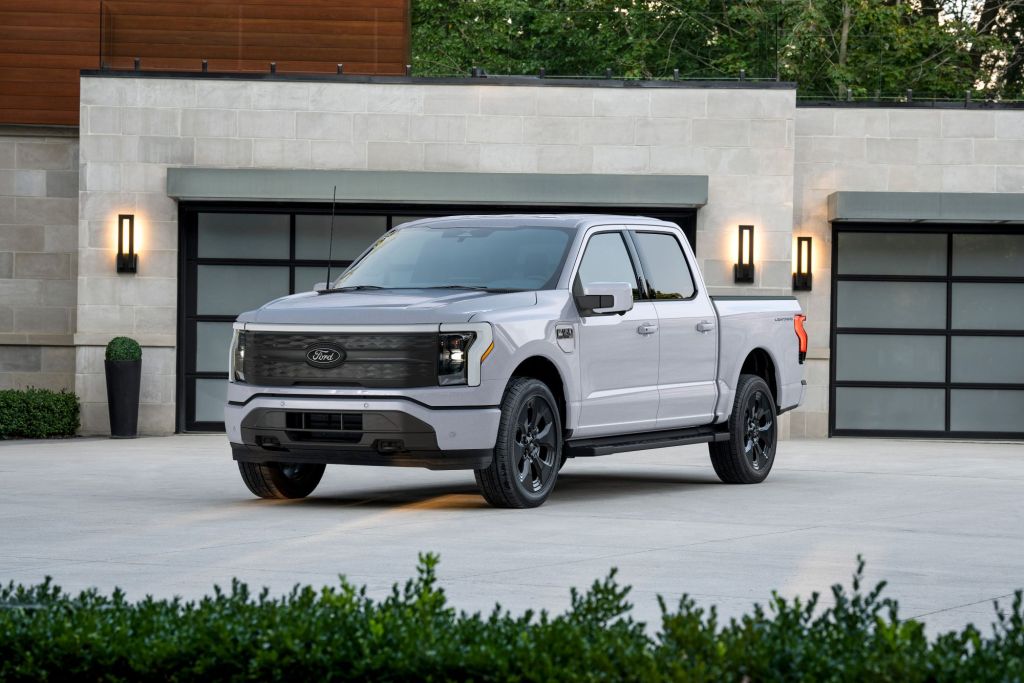
2025 Ford F-150 Lightning Dark Elements Package. (Image: Ford)
The Bloomberg piece quotes Jimmy Douglas, CEO of Plug, which wholesales EVs: “When Ford was selling it brand new, the math was complicated. But used, the Lightning is 50% to 60% of the sticker price and that is really a sweet spot; it’s an incredible truck for the money.”
Pretty much everything that is 50% to 60% below sticker is probably popular, too.
From 2022 to 2025 Ford produced some 100,600 Lightnings.
In May 2021 Ford started taking reservations for the truck. In the first 12 hours there were 20,000 people who made a $100 (refundable) reservation.
By December 2021, when there were nearly 200,000 reservations, Ford wisely decided to stop building the list. As it turned out in 2022 there were 15,617 Lightnings delivered, so if all of those 20,000 reservation holders for the first 12 hours hung on to those reservations, there would have been some people still waiting until 2023.
While it is interesting that people are buying used Lightnings, the numbers should evoke not much more than a shrug.
According to the Manheim Used Vehicle Value Index for Q3 2026:
“Used retail EV sales totaled approximately 124,000 units in the third quarter, the highest level on record, up 11.4% year over year, but still only about 2.8% of all used retail sales.”
Which means 97.2% of the vehicle sales in the third quarter weren’t EVs.
The Toyota C-HR was first available in the US in early 2018, imported from a place that you probably don’t associate with vehicles, be they subcompact crossovers or anything else for that matter: Turkey. But Toyota Motor Manufacturing Türkiye built the C-HR for the US. (And a completely unrelated vehicle had been built for the US market prior to the C-HR: the Ford Transit connect was produced in the Ford Otosan plant from 2010 to 2013.)
The first-gen C-HR was a quirky-looking model that was in the US market until late 2022. It went away for three years. The first-gen is powered by a 2-liter four-cylinder engine that produces 144 hp and 139 lb-ft of torque. It is mated to a continuously variable transmission.
But Toyota added the Corolla Cross to its lineup, which proved to be more popular. That is, in 2021 the company sold 35,707 C-HRs in the US and 7,203 Corolla Crosses (as it was its launch year). In 2022 C-HR sales were down to 12,141 units and the Corolla Cross was up to 56,666.
So rather than hanging on (something that seems to be the case when it comes to many OEMs that have a vehicle that is starting its slide: they tart it up with some unfunctional bits, such as embossed headrests, and ride it out), they removed the C-HR from the US market (it continued in other global markets) until model year 2026.
And Now This
But this time, the quirky style has given way to a look that says, “Yes, we are more than a quarter of the way through the 21st century” and replaced the rather underwhelming engine/transmission combo with an electric propulsion system that produces 338 hp.
Arguably more for performance in terms of quickness (0 to 60 in 4.9 seconds) than in terms of “Hey, let’s go climb some rocks,” the C-HR comes standard with all-wheel drive.
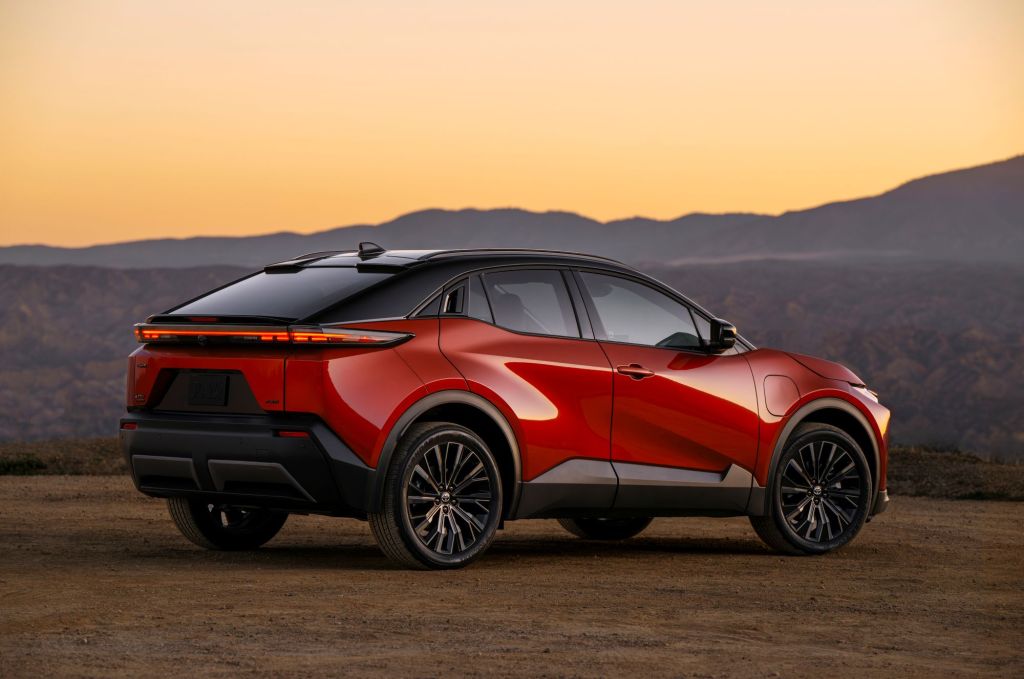
Toyota C-HR: an exotic exterior, not quirky. (Image: Toyota)
It is still a compact SUV, having an overall length of 177.9-inches, an overall width of 73.6-inches, a wheelbase of 108.3-inches, and an overall height of 63.8-inches. Ground clearance is 8 inches, just 0.1-inch less than a RAV4. It’s not that ground clearance is much of an issue for either vehicle, but this goes to the point of the C-HR’s “SUV-like appearance.”
Inside Space
There have been many interpretations of what the “C-HR” means. One of them is that the “HR” signifies “High Roof,” which the C-HR certainly has, but in a way that helps provide the interior volume (98.9 cubic feet), not making it appear from the front or rear view as though it will tip over. It also helps with the cargo capacity, which is 37.8 cubic feet with the rear seatback in the upright and locked position and 70.4 cubic feet when folded.
The interior has a minimalist and clean look—and actually is physically minimalist in that there is no glove compartment. Yes, people only wear gloves in the winter and are unlikely to store them there during the other seasons.
But whether it is the proliferation of self-storage facilities or the use of garages for stuff, not vehicles, one thing is certain, which is that people have a tendency to need places to put various and sundry objects in their vehicles, and the center console container—which is cleverly hinged so that the driver can open it so the top goes to the right or the front passenger can open it and the lid goes to the left—simply isn’t sufficient.
Maybe Marie Kondo consulted with the C-HR interior designers.
About the Electrics
In terms of the electric bit, it has a 74.7-kWh lithium-ion battery and a NACS charging port. On a fast charger the battery is said to go from 10% to 80% in about 30 minutes.
It features the SAE-Electric Vehicle Public Key Infrastructure Consortium-developed “Plug & Charge” system, a protocol that means there is no need for multiple charging network apps at most major charging networks (e.g., Electrify America, Tesla Supercharger, IONNA, IONITY, BP Plus, Shell Recharge).
What I would argue is almost-there-but-not-quite is the estimated range of the XSE trim: 273 miles. It is better for the SE trim with 18-inch wheels rather than the XSE’s 20s: 287 miles. I think that 300 miles is the number to offer. According to the J D Power 2026 U.S. Electric Vehicle Consideration Study, 73% of vehicle shoppers won’t consider an EV unless it provides “at least 500 miles of range.”
But for the first half of 2026 Toyota delivered 3,748 C-HRs, which is better than the number of Chevrolet Blazer EVs sold during the same period (3,166).
In December 2025 Polestar began deliveries of its striking Polestar 4 in the US. As an indication of just how global the auto industry is, know that the Polestar 4 comes from a company headquartered in Sweden that is owned by a company based in China and the vehicle available in the US is made in a plant in South Korea.
Polestar, it must be acknowledged, isn’t particularly well known in the United States. Outside enthusiasts—and they might have to be electric vehicle enthusiasts, because that’s what Polestar has on offer in its showrooms—it is pretty much a stealth brand. But the Polestar 4 is anything but a stealth vehicle because it is gorgeous inside and out.
It is considered to be a an “SUV coupe,” and the SUV part of it is probably a label given to it by the Polestar Marketing Department because the global vehicle market is increasingly interested in SUVs, so given that there is the Polestar 3 that is SUVish, the company needs more SUV product to proffer.
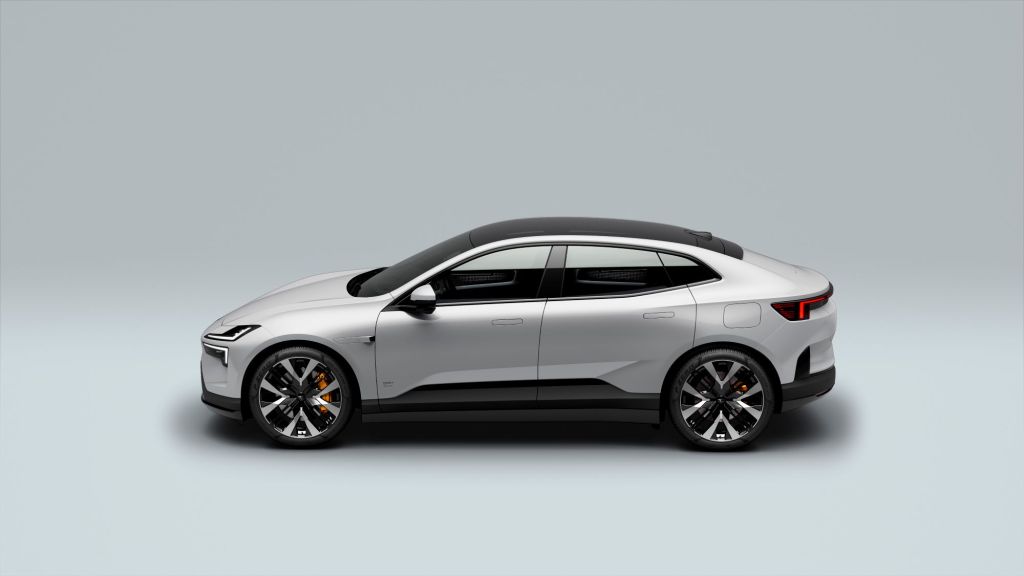
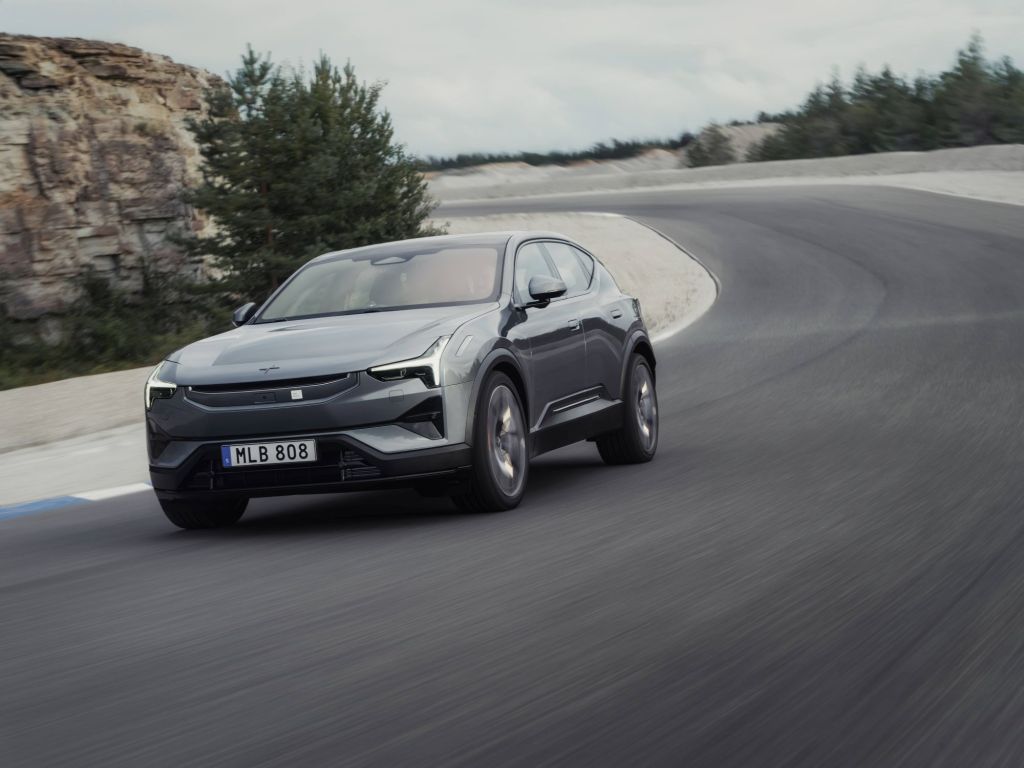
Does this look like an SUV? (Images: Polestar)
But the thing: the ground clearance of the Polestar 4 is 6.5 inches in the front and 7.3 inches in the back* (a clue that this vehicle dives toward the front). An SUV like a Honda Passport has a ground clearance of 8.3 inches. Or a Subaru Outback at 8.7 inches. Or a Jeep Grand Cherokee at 10.9 inches (with air suspension).
That’s not what people think of when they think “SUV.”
What’s more, just look at that roofline: coupe-like, yes; SUV, no.
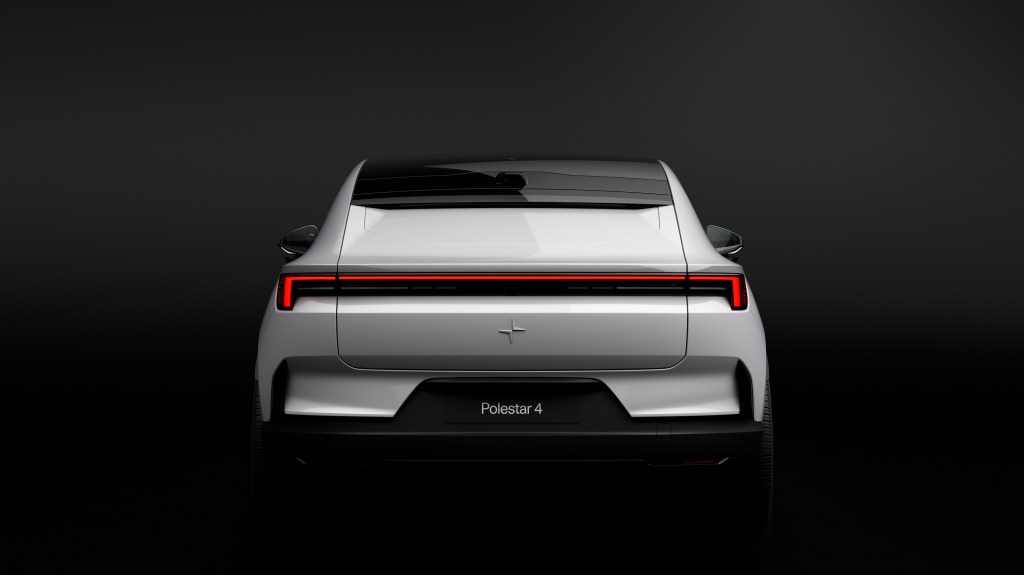
And that roofline leads to an unusual feature of the Polestar 4: There is no rear window. None.
It is worth noting that the roof is full-length glass, so it isn’t like one is in some sort of cocoon.
And it is said that because of that panoramic glass roof (no headliner), a low floor due to the EV powertrain, and the elimination of that back glass there is more rear headroom than would otherwise be the case: 37.8 inches for those in the back (a possibility of three back there, but more likely two). (For those in the front, 40.2 inches.)
So how do you see what’s behind you?
There is a video image appearing in the rearview mirror.
The Polestar 4 is nothing if not camera-centric: 4 short-range cameras, providing a 360º view; 1 rearview HD camera;2 forward-facing HD cameras behind windshield; 4 side-view HD cameras; 1 driver-monitoring camera in A-pillar.
While I am not going to get all huffy about the inability to look over one’s shoulder while backing up (there is a horizontally oriented 15.4-inch infotainment screen that provides real-time views of what’s what while in reverse), I will acknowledge that there were a few instances when driving west in the morning there was a less-than-sharp image in the mirror because the sun was shining on the lens.
There’s no rear window back there.
While this probably wouldn’t be a deal-breaker for a well-appointed EV that has a starting MSRP of $72,900 (for the dual-motor, Pilot Plus and Performance packages**) that has a zero to 60 time of 3.7 seconds.
But it is something to consider.
==
*As for the rest of the specs:
Wheelbase: 118 inches
Length: 190.5 inches
Height: 60.4 inches
Width: 79.1 inches
**The Pilot package adds things like Pilot assist, which combines adaptive cruise control with lane centering. The Performance package brings Brembo four-piston calipers, active dampers, and exceedingly nice touches including gold valve stem caps that are sizeable enough to be noticed poking out of the 22-inch forged alloy wheels.
Some people spend a lot of time searching out stats before buying a vehicle, which is certainly a good thing to do because there is that very big stat, which is the MSRP, which then comes along with plenty of additions that make what might have started out as a reasonable number a whole lot higher.
When it comes to electric vehicles, one of the stats that is highly significant is range: how many miles the vehicle is expected to go on a full charge of its battery.
(It has occurred to me that there are few vehicles powered by gasoline that ever even talked about range. Miles per gallon, which is more about efficiency than anything else, yes, but range? The only ad I can remember touting range was in the mid-teens, pre-Dieselgate, when two guys were driving a VW Golf TDI across country and refueling wasn’t an issue because the vehicle had a combined range of nearly 500 miles.)
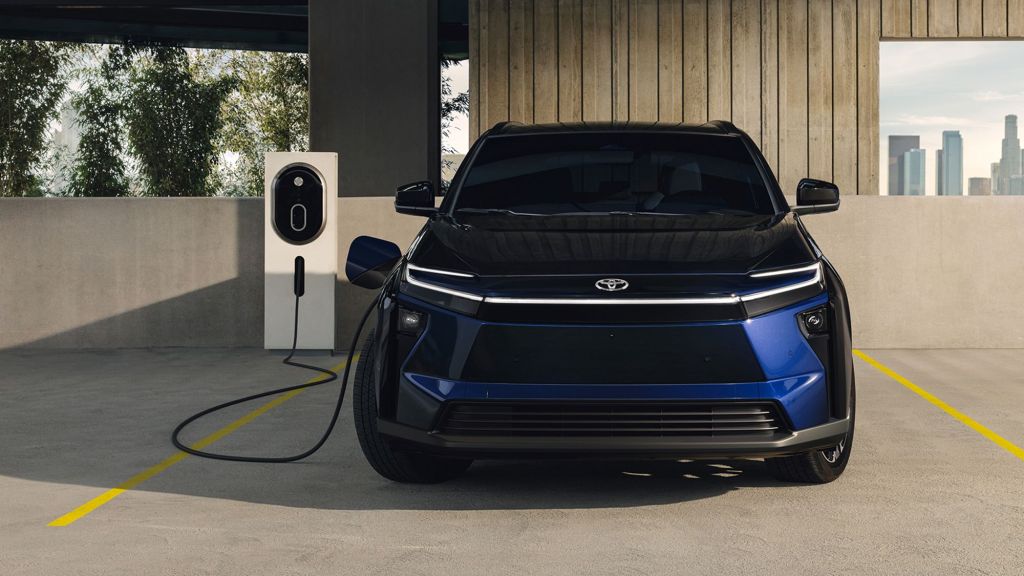
So if someone looks at the range stat for a 2023 Toyota bZ4X XLE FWD they’re going to see a range of 252 miles. Since that 2023 model Toyota has dropped the last two alphanumerics on the name and made some other changes.
Like the range of the 2026 bZ XLE FWD being 235 miles.
Toyota bZ. Charged up. (Images: Toyota)
Clearly a move in the wrong direction, right?
What’s more (or less) is that the power output of the 2023 model is 201 hp. It is 168 hp in the 2026 model.
But then we get to the really important number, the base MSRP for each of the vehicles.
For the 2023 XLE FWD it was $42,000.
For the 2026 XLE FWD it is $34,600.
Toyota did something else for the 2026 model.
It added the XLE FWD Plus model.
It provides 314 miles of range. It generates 221 hp. And it has a starting price of $39,100.
And it—and the other bZ trims—has the NACS charging port (a.k.a., the Tesla port) so the bZ can use Tesla Superchargers. (It also comes with an adapter so it can use the non-Tesla CCS stations, too.).
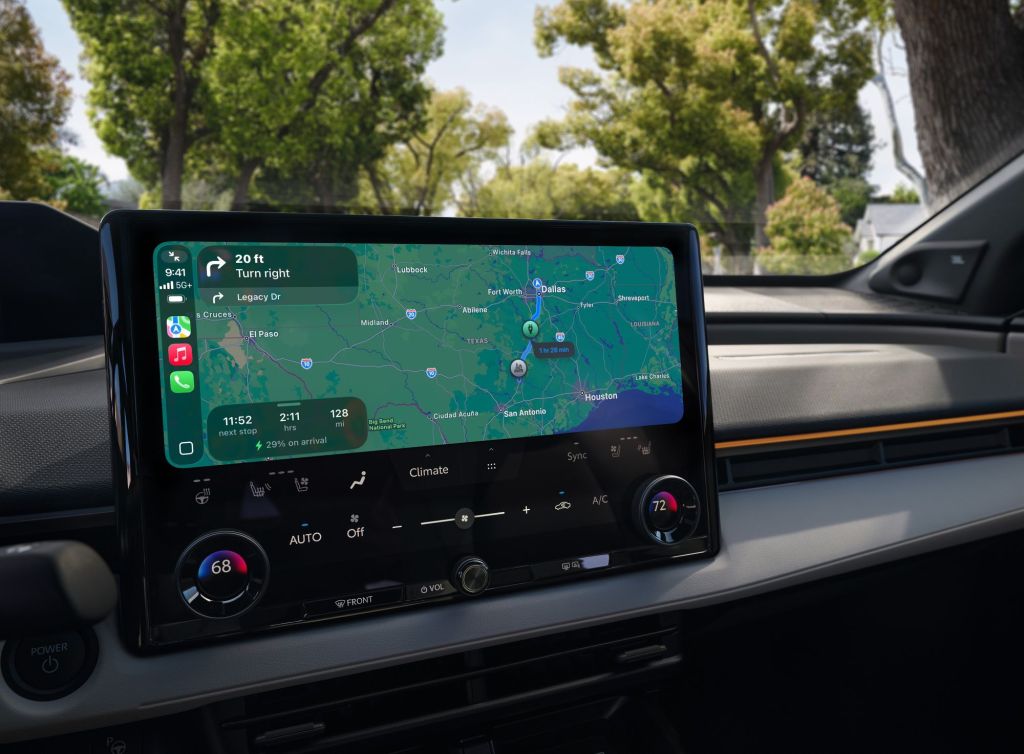
A most interesting feature of the bZ is it offers support for Apple Maps EV Routing via Apple CarPlay. What this means is that Apple Maps has access to real-time vehicle information so that drivers can get routed to chargers on their way to wherever they’re going. Not only does it take into account the battery performance and charge, but any elevation changes along the way (which, again, is something that drivers of ICE vehicles pay little attention to unless they are traversing the Alps or something). This is displayed on the bZ’s 14-inch multimedia screen.
Know that Toyota has developed its own operating system (Arene) so it is not wholly relying on third parties like Apple.
Apple Maps connect to the system to help drivers find charging stations along their routes.
But it clearly recognizes lots of customers—including customers of EVs—are part of the Apple ecosystem and want to use it, something that General Motors thinks isn’t particularly important.
The 2026 bZ is a competent car crossover. (It looks like an enlarged hatch, not like any of the other Toyota crossovers, with the exception of the Crown, which also seems very car-like to me.)
Going back to the spreadsheet, there are a total five variants of the bZ, the two mentioned, as well as the XLE AWD (288 miles; 338 hp), Limited FWD (299 miles; 221 hp), and Limited AWD (278 miles, 338 hp).
Looks go a long way even if the vehicle doesn’t. . . .
By Gary S. Vasilash
The Volvo EX30 received a “Best of the Best” design award in the RedDot 2024 design competition. While the small electric SUV has won other awards—like the World Urban Car from the World Car of the Year jury and the Eco Warrior of the Year award from Top Gear—arguably this design award is something that is more significant, for the simple reason that when you walk up to a vehicle you’re looking at the exterior styling, and, of course, when you get in it, the interior cues make a tremendous difference.
The RedDot jurors said of the EX30:
“Typical design elements have been convincingly reinterpreted and integrated into the EX30 – both on the exterior and in the interior. This vehicle is clearly recognisable as a Volvo, even without resorting to too many quotes. It is a product as if cast from a single mould with a consistent, very high design quality that convinced us across the board.”
So from the outside is a stylish small hatch (while it might be in the subcompact SUV category, that probably has a lot more vis-à-vis market positioning than anything else, and whereas “SUV” is acceptable, hatches have a growing but limited acceptance), measuring 166.7 inches long, 72.3 inches wide, 61.2 inches high, and with a 104.3-inch wheelbase. Sometimes designing a small vehicle can be tough to pull off, but this is clearly a contemporary Volvo, which means (were this something designed with tools of a long-gone era) the T-square has been replaced by the French curve. Well, comparatively speaking.
Volvo EX30: An award-winning design. (Image: Volvo)
And the real design win is on the interior of the vehicle.
One of the things that seems to be forgotten about electric vehicles, as everyone talks about 0 to 60 times, is that they are more environmental than ICE vehicles.
Even some OEMs seem to have forgotten that when developing their EVs (except when they were concerned about meeting regulations, which led to attention on the propulsion system primarily).
But the designers, engineers and materials specialists at Volvo worked to develop an interior that is far more sustainable than the common approach. So there are recycled and renewable materials used throughout the cabin. There are fibers used for seats that come from the leftovers from producing denim or a wool blend with some 70% recycled polyester. There’s trim that uses flax fibers (fun fact: that material is used to produce high-quality paper, some of which is used to print banknotes, so, and now we get to the point of a bad pun: the EX30 interior is money).
While you might think, “An interior that uses lots of recycled materials: this must be as comfortable and as attractive as a pile of wood shavings.” And you would be wrong. This is really well executed and provides a contemporary appearance, one that underlines the overall minimalism of the cabin.
One place where there is a bit too much minimalism is on the IP, where the gauges that you are familiar with is not where you are familiar with seeing them.
Rather, looking forward the only thing in that area is an infrared eye tracking sensor that will cause a “look at the road” warning if your eyes are wandering.
All of the information is available on a 12.3-inch touchscreen centered on the IP. Which means if you want to know how fast you are going you have to move your eyes to the right. If you want to know what time it is you have to read a small font on a screen with lots of other information.
The reduction in instrumentation is not a good thing.
Another thing that seems rather minimal is the range, with the EPA number 261 miles. Maybe the Michigan winter had something to do with it, but that number was cut by about 20%.
Now Volvo undoubtedly wanted to make sure that it was able to give the EX30 a starting MSRP around $40K (it is $40,345), and batteries are the most expensive part of an EV, so it is using a 69-kWh NMC battery in the vehicle. Although a somewhat bigger vehicle, the Chevy Equinox EV has an 85-kWh battery for an estimated 319 miles of range. That’s more reasonable. Even if the EX30 achieved the full 261 miles, it really seems that 300 miles is the number a competitive EV needs to reach.
But one might give that a pass, given the award-winning design it brings.
General Motors is a legacy auto manufacturer that positioned itself as an EV champion. Back in 2021 corporate execs, including Mary Barra, chairman and CEO, said they intended to be all-electric by 2035.
Plans change, of course.
“We have to meet customers where they are,” Barra said yesterday at a meeting of the Automotive Press Association in Detroit.
She didn’t mean in a dealership.
GM, like other OEMs, discovered in 2025 that (a) customers were not buying EVs at a rate that had been anticipated and (b) there is still a keen interest in the customer base for vehicles powered by internal combustion engines.
Still, Barra is confident that EVs are the end game so the company is going to keep offering and developing EVs.
She claimed that 80% of EV customers say their next vehicle will be an EV.
She probably wishes, however, there were more of them.
In 2025 GM delivered 169,764 EVs in the US, so if every one of them went into a GM store only 135,811 would come out with an EV.
Barra said that based on what GM analysts have determined it takes about six months to have a good sense of what the real market impact is when something significant happens to the EV market, like the elimination of the $7,500 tax credit at the end of September 2025. So when Q1 2026 wraps up, there will be a better idea of where EVs are going.
She said there are a few things that will make customers more inclined to get an EV. Yes, there is the instant torque provided by the electric motors, which is always something EV enthusiasts cite.
But she said there needs to be (1) more affordable EVs (the average transaction price for an EV in December 2025 was in excess of $58,000 according to Kelley Blue Book, which is certainly not the defintion of “affordable”) and (2) there needs to be a more robust charging infrastructure.
The way things are looking, even if EVs gain great ground there will still be a place for vehicles with engines under their hoods, a place that in non-trivial. Barra pointed out that even if EVs were to take 50% of the market at some point, that still means 50% for gasoline-powered vehicles.
Add in the market share of hybrids and plug-in hybrids and the market share goes up to 50.8%.
All of which indicates there isn’t exactly a burgeoning future demand for electrified vehicles in the UK given the results of the Kwik Fit survey (although that demand would be awfully appealing to US OEMs).
Dan Joyce, operations director at Kwik Fit, said of the findings: “The overall proportion of drivers planning to switch to low emissions for their next car has remained the same since last year. However, our study shows that younger drivers are much more open to moving to EVs – and new car brands – than many older drivers.”
(Which leads to a question of whether younger or older buyers are actually likely to buy a new vehicle, and my money is on the latter.)
The reference to “new car brands” in the quote goes to Chinese vehicles. According to Kwik Fix BYD had a year-over-year sales increase in September of 880%.
An EV that let’s you play in the dirt. But you can’t get too carried away. . .
By Gary S. Vasilash
The stylists who created the Hyundai IONIQ 5 pulled off a feat that is not at all easy to accomplish.
They devised a design that looks absolutely futuristic but—and here’s the tricky bit—doesn’t make one think that it is too advanced to be on the road with other vehicles that, well, don’t have appearances that would make them relevant in, say, 2030.
Realize that the IONIQ 5 was launched as a model year 2022 electric vehicle and is still striking.
So for MY 2025 they made a bit of a swerve with the IONIQ 5, a swerve that takes the vehicle off road.
Now we’re not talking Jeep Trail Rated terrain here.
Hyundai IONIQ % XRT. Yes, take it to the dirt. (Images: Hyundai)
But the XRT trim is more capable than the SE, SEL or Limited models.
For example, there is modified suspension tuning and the suspension is lifted by 0.9 inches—but lest one gets carried away, realize that this brings it to 7 inches. (The ground clearance for a Jeep Cherokee is 8 inches.)
There are off-the-beaten-path approach and departure angles: 19.8 degrees and 30 degrees, respectively.
There are red-painted recovery hooks on the front fascia that are said to be functional. (Those are something that you’re not likely to utilize in your daily commute unless your commute takes you through some tough territory.)
There is a composite cladding on the fascias, around the wheel arches and on the door panels that has a subtle pixelated camo pattern to provide a more-capable appearance. (The XRT wouldn’t look out of place driving on Mars thanks to this addition.) There are XRT black 18-inch wheels wrapped with 235 / 60 R 18 all-terrain tires.
As mentioned, the IONIQ 5 XRT is an electric vehicle. One of the aspects of this 2025 model (and the other trims) is that it comes equipped with the NACS port, standard, which means it can be used at the Tesla Supercharger network, adapter-free. (Which ought to annoy owners of the Tesla Model Y, given the aforementioned still-fresh design of the Hyundai and the aging Tesla exterior, Juniper update tweaks notwithstanding.)
It is worth noting that for those who aren’t using a Supercharger there is a CCS adapter that comes along for the ride.
And while this doesn’t matter as much as it did before the tax credits for EVs were pulled but is still non-trivial: the 2025 IONIQ 5 is built at the Hyundai Motor Group Metaplant America in Ellabell, Georgia.
Clever pixilation on the cladding.
The vehicle is, of course, all-wheel drive.
There is a 99-hp permanent magnet synchronous AC motor in the front. A 221-hp motor of the same type in the rear.
The system output is 320 hp and 446 lb-ft of torque.
It has a liquid-cooled 84-kWh battery pack. The peak DC fast charge rate is 250 kW, which means that the battery, on a DC fast charger, can be charged from 10 to 80% in 20 minutes. The EPA estimated range is 259 miles.
On the inside there are H-Tex seating surfaces (a synthetic leather that offers easy clean-up, because let’s face it: this trim wants to get dirty) featuring XRT-unique pattern and logo. And there are XRT badged all-weather floor mats (because you’re going to take this out in, well, all types of weather that you’re likely to bring into the vehicle with you when you go out in it).
Hyundai has some of the best screens in the business, with a 12.3-inch screen for the driver’s info and a 12.3-inch screen for infotainment. There are wireless Apple CarPlay and Android Auto and wireless charging. There is BlueLink+, the connected vehicle service that provides capabilities from remote starting to receiving diagnostic alerts to performing automatic collision notification and more.
And the BlueLink+ services are free, not for a trial period, but for as long as you own the vehicle.
While on the subject of costs, the MSRP for the 2025 IONIQ 5 XRT is $55,400. The one I drove had an optional paint color (Atlas White Matte) that added $1,000; carpeted floor mats for $210; and $1,475 for inland freight and handling, to a total sticker of $58,085, which is in keeping with average transaction prices for EVs.
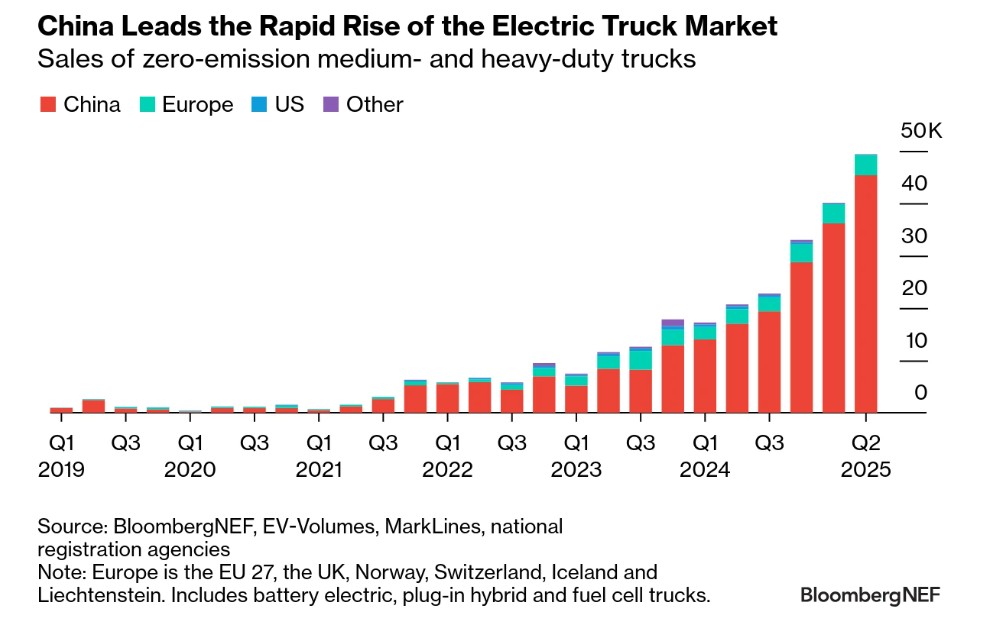
While it is common knowledge that the Chinese electric vehicle market vastly outpaces that of the U.S. on a per capita basis, when people think about that it is likely to be in the context of passenger vehicles.
In the first half of 2025, there were some 89,000 electric trucks—as in medium-duty trucks and big rigs, not pickups—sold globally.
Of that total, nearly 80,000 were sold in China.
How many were sold in the U.S.?
According to Colin McKerracher, Head of Clean Transport, BloombergNEF, “just 200 units.”
200.
Or 0.25% of the Chinese total.
Given the U.S. population is about 24% that of China, one might think that number might be somewhat bigger.
Europe (Switzerland, Netherlands, Sweden, Norway, Greece, Denmark, Iceland, Germany, UK, France, Austria, Belgium) accounts for the remaining ~8,800 electric trucks sold in the first half.
Another stat from the BloombergNEF/Smart Freight Centre that is notable:
“nearly 100 to 1”
That’s the comparison of sales of electric medium and heavy trucks with those powered by fuel cells.
McKerracher: “The prospects for hydrogen in road transport look dim.”
Which leads to a question of whether commercial electric truck volumes—battery- and fuel cell-powered—in the U.S. are any brighter.
One of the things that interests me when I am in a vehicle is the extent to which people notice it.
You may be surprised at how few vehicles garner some comment from people. The last vehicle I had that drew lots of attention was the VW ID.Buzz. And as I think about that vehicle, I realize that I’ve not seen a lot of them since.
And while that van drew attention largely because of the nostalgia factor, the Polestar 3 has no such fond memories for anyone, as it has been available in the US market only since late summer 2024.
A friend I was meeting at a restaurant came in and pointed out a window to the Polestar 3 in the lot: “Are you driving that? What is it?” The waiter stopped and looked at it, too, while listening to my explanation of how it is a brand from a company headquartered in Gothenburg, Sweden, once a sub-brand of Volvo. (This gets into organizational complexity with the bottom line essentially being that there is Volvo, owned by Geely, and there is Polestar, owned by Geely. So while the two companies are separate, they have the same parent and there is a non-trivial amount of sharing between the two siblings.)
They were both unaware of the brand.
Which is not entirely surprising. Through the third quarter 2025 Polestar has delivered 44,482 vehicles. Globally.
To put that into context, Cadillac delivered 46,525 vehicles. Domestically. In the third quarter alone.
Polestar is still a stealth brand.
This is not particularly pricy when you realize this is a performance vehicle. (Images: Polestar)
A neighbor who was walking her dog past my house while I pulled into my driveway literally turned around and came back to talk to me about the Polestar 3, wondering what it was, saying that she liked the way it looks, both in terms of size and styling. (She is right about that.)
The not-so-good news for the folks at Polestar: She is in the market for a vehicle and is likely going to buy a Chevy Equinox. “EV?” I asked. “No. Gasoline.”
That is not-so-good on two levels.
First of all, the top trim level AWD Equinox has an MSRP, including destination, of $37,395.
The MSRP, including destination, for this AWD Polestar, which is at the top of the line, is $86,300.
Clearly, my neighbor has a good eye, even though she has a different kind of budget.
And second, of course, the Polestar 3 is an electric vehicle, not fueled with gas, which accounts for part of the difference.
And it is interesting to note that whereas that 2025 Equinox she is considering is built in the GM San Luis Potosí plant in Mexico, the Polestar 3 is assembled in Ridgeville, South Carolina (that is nominally a Volvo plant, which goes back to the previous comment about the sibs).
Without going too Volvo about this, it is worth noting that the Polestar 3 is based on the Scalable Product Architecture 2 platform, which underpins the Volvo EX90, that brand’s flagship electric vehicle.
And because it has Volvo DNA it is engineered with safety in mind, ranging from having a boron steel safety cage to an extensive list of sensor-based safety tech that facilitates accident-free driving (note: it helps; it is up to the driver and others to prevent accidents).
One interesting thing is that while model year 2025 vehicles have to have a rear seat reminder system to advise the driver to check the back seat to make sure that a child or pet is not being left behind, many of these systems are simply based on the vehicle being put in park and the alert showing up.
In the Polestar 3 there is actually interior radar that monitors the situation.
So what does one get for the not-minor amount of money.
Well, there are two electric motors that provide a combined output of 517-hp, which means this can be quick. They also provide AWD. But this power also means that the range is somewhat limited: an EPA estimate of 279 miles.
There is active air suspension. 22-inch wheels. A panoramic glass roof. Over-the-air-updates for life.
An example of the interior details that show considerable consideration was paid to the execution of the inside.
The infotainment is based on the Android Automotive OS, with Google built in. (There is wireless Apple CarPlay, too).
The interior is both comfortable and well designed, with details on things like the door trim that subtly make you know that someone spent time considering what they were doing.