
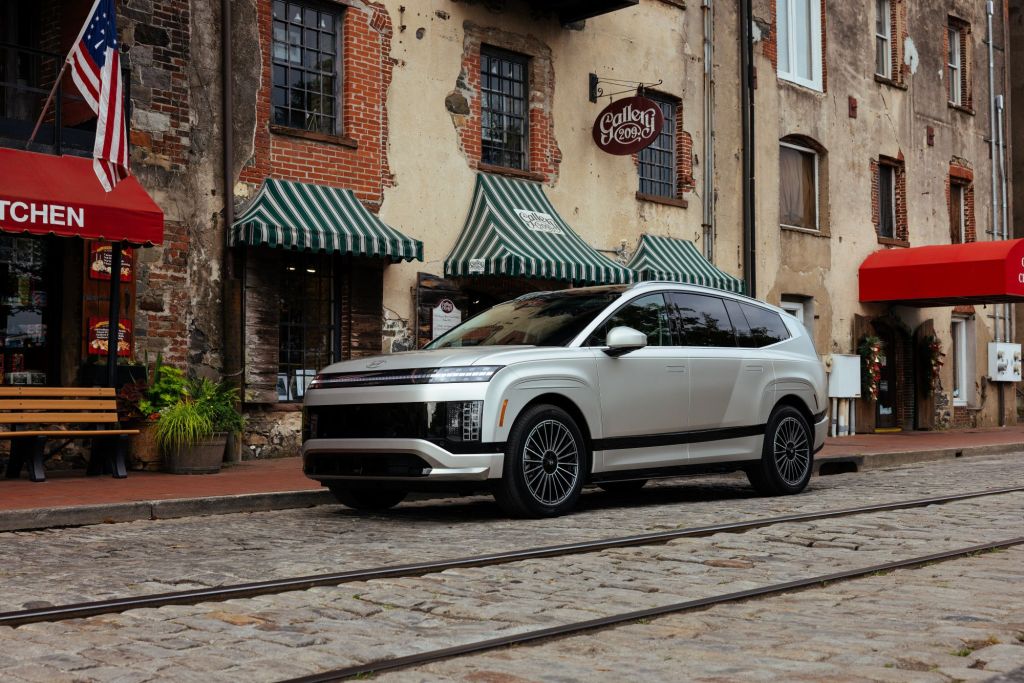
Even if it wasn’t an electric vehicle it would be a most-impressive three-row vehicle. . . .
By Gary S. Vasilash
Roomy for Folks
The IONIQ 9 seats ether six or seven people in its three rows. And any way you configure it it is roomy: as in having passenger interior volume of 163.54 cu. ft. in the seven-passenger configuration. But like any vehicle, the third row is not as roomy as it is in the front or second row, but the IONIQ 9 has sufficient roominess in that third row such that the people who are back there won’t feel as though they are being punished, as is the case more often than not.
The seats are comfortable and that interior volume is such that occupants have a sense of space, as though they are in a room, not an SUV.
In fact, Hyundai interior designer Gary Lin uses a neologism to describe the cabin: “Aerosthetic Lounge.”
Speaking of Seats
What Hyundai calls “Relaxation Seats” are available for the first and second rows in the six-seat setup. These are seats that resemble those found in the First Class cabin of a transoceanic aircraft: They offer full recline—including leg rests.
Now here’s the clever part of the Relaxation Seats: People talk about how to kill time when having to recharge their EVs. But let’s face it: there are only so many nonperishable items you’re going to be buying in that Walmart that has a charging area.
So Hyundai is cleverly allowing people in the IONIQ 9 to get a comfortable place to wait it out.
Not a Long Wait
The IONIQ 9 has a 110.3-kWh lithium-ion battery.
According to Hyundai, using a CCS adapter and a 350-kW DC fast charger, the battery can go from 10% of charge to 80% in 24 minutes. If you go to a Tesla Supercharger, the same can be done in 41 minutes. At a 50-kW DC fast charger it is up to 109 minutes.
Presumably the choice might be predicated on how much you want to lounge.
When You’d Need to Recharge/Relax
There are three powertrain setups for the IONIQ 9.
The Long-Range RWD model features a 160-kW motor in the rear.
The Long-Range AWD model adds a 66.1-kW motor in the front. (This is something that EVs do that gasoline-powered vehicles can’t: want AWD, just add a motor. In gas-powered vehicle there are driveshafts and transfer cases or center differentials involved. Much simpler in an EV.)
Finally, there is the Performance AWD model, which has a pair of 157.3-kW motors.
So in that order the ranges are an estimated:
- 335 miles
- 320 miles
- 311 miles
All of which is to say that the driver may not get to enjoy the full recline for a while.
The Utility Factor
Not only do people get big sport utility vehicles (and this vehicle is certainly sizable, measuring 199.2 in. long, 78 in. wide, 70.5 in. high, and having a 123.2-in. wheelbase) to move people, but also to move stuff.
So if all the seats are folded it can swallow 86.9 cu. ft. of stuff. 46.7 cu. ft. if the second row is in use. 21.9 cu. ft. behind the third row. (To provide some perspective: the trunk of a Sonata sedan measures 15.6 cu. ft., and it isn’t stingy on space.)
Yes, there is a frunk. For RWD models it measures 3.1 cu. ft. For AWD it is a diminutive 1.84 cu. ft.
Slippery, Too
One of the surprising things about the IONIQ 9 is that because it is large, you might think of it like pushing a large box through the air.
But, again, design and engineering have achieved a coefficient of drag that is nothing short of incredible.
That is, the coefficient of drag for a 2025 Corvette ZR1—the “fastest, most powerful Corvette ever,” according to Chevy—is widely reported to be 0.279.
The coefficient of drag for the IONIQ 9: 0.269.
Lower is more slippery.
In an Uncrowded Space
Back in 2023 Ford, which knows more than a little about such configurations, announced it planned to build a three-row electric SUV. A year later Ford announced that the vehicle planned to be launched in 2025 would be delayed. 2027, perhaps.
There aren’t a whole lot of EVs in this space.
Hyundai compares the IONIQ 9 to the Rivian R1S, which is reasonable. Except that the starting price for the Hyundai is $58,955 and the Rivian at $75,900. Not a trivial difference.
Hyundai also compares it with the Tesla Model X. Odds are Hyundai intends to sell more than the ~21,000 Model X’s that Tesla sold in the U.S. last year.
There is the Mercedes EQB that can carry seven, assuming that those who are relegated to row three are on the diminutive side.
And then there’s the Kia EV9. It is on the Electric Global Modular Platform (E-GMP). Just like the IONIQ 9.
Hush
Compared with vehicles powered by internal combustion engines, EVs tend to be quiet.
After all, there isn’t that series of explosions that occur as gasoline combusts in the cylinders because there are no cylinders, no gasoline in an EV.
But in some EVs there is a noticeable sound of whirring. And what’s more the case, there are noises from the outside of the vehicle, whether it is caused by the wind or the tires on the tarmac.
Hyundai engineers have addressed those noises in an impressive manner.
For one thing, there is acoustic glass used not only for the front side windows, but for the second row, as well. Many companies just opt for using the acoustic glass (which consists of a sandwich: glass/acoustic film/glass) in the front.
There are pads on the insides of the tires to absorb sound.
There is an array of foams and pads and insulation to mitigate unwanted sounds.
And if that’s not enough there is an active noise control system that uses the audio system to cancel out what you don’t want to hear.
Attainable
Let’s face it: electric vehicles are more expensive than vehicles that have gasoline engines.
According to recent numbers from Kelley Blue Book, the average transaction price for an EV was just shy of $60,000 while it was below $50K for a gas-powered vehicle.
Now make no mistake: the IONIQ 9 is—even if you look at it from the perspectives of size and amenities alone—an above-average vehicle.
Yet the starting MSRP for a RWD model is $58,955. (The vehicle is built at the amazing Metaplant outside of Savannah, Georgia, so it can qualify for the $7,500 tax credit.)
For all that it is and offers—nothing short of impressive.
 shinymetalboxes