
Efficiency without compromise
By Gary S. Vasilash
“Hybrids’ appeal is simple, and that is one of their greatest strengths. They dramatically improve fuel economy, extend driving range, and reduce fuel spending without fundamentally changing how the vehicle fits into a consumer’s life.”—The Hybrid Resurgence: A Structural Layer in the U.S. Powertrain Transition, Paul Waati, director of Industry Analysis, AutoPacific
And there you have it in a nutshell.
Hybrids, done right, are essentially transparent to owners until they realize that compared with their non-hybrid vehicle (assuming that isn’t a full-electric one) they are spending a heck of a lot less time at a gas station watching the numbers on that digital display run up to levels rarely seen.
And a word about time.
One of the things about electric vehicles. Unless we’re talking about a BYD Han L or a Denza Z9 GT (which, of course, aren’t available around these parts), it is going to take a lot longer to fully charge an electric vehicle than it will to fill the tank of a hybrid.
“Oh, go shopping while you’re waiting at the adjacent Walmart or get a cup of coffee at the nearby Starbucks,” the rationale for EV charging has it.
Well, you could you to the Shell station, fill up, then go to the nearby Target because you like that better or go Dunkin’ for a beverage and a cruller.
Odds are, up to this point in your life you didn’t spend much of your life considering a refueling (i.e., charging) “strategy.”
And with a hybrid, the same holds, except for the fact that you’ll be visiting the gas station a lot less.
Now some argue about the environmental correctitude of an EV, which is undisputed. Well, there could be some dispute depending on where it is that the EV is being recharged given that some 15% of the electricity generated in the US comes from coal.
And depending on the type of coal, compared to combusting gasoline, there is an increase in carbon emissions of from 30% to 45%. However, research has found that if an EV is charged purely in a coal-heavy grid, they are still cleaner than gas-powered vehicles, just not as clean as they might be if the source of juice is natural gas or nuclear.
Lest you think coal is becoming less of a source, keep in mind President Trump’s Executive Order 14241, signed on April 8, 2025.
“The what?” you think.
Well, the title tells it all:
“Reinvigorate America’s Beautiful Clean Coal Industry.”
So depending on where that EV is being charged. . . .
But this is about the Camry.
Toyota has been offering a hybrid powertrain for Camry since model year 2007.
Since model year 2025 all Camrys are hybrids.
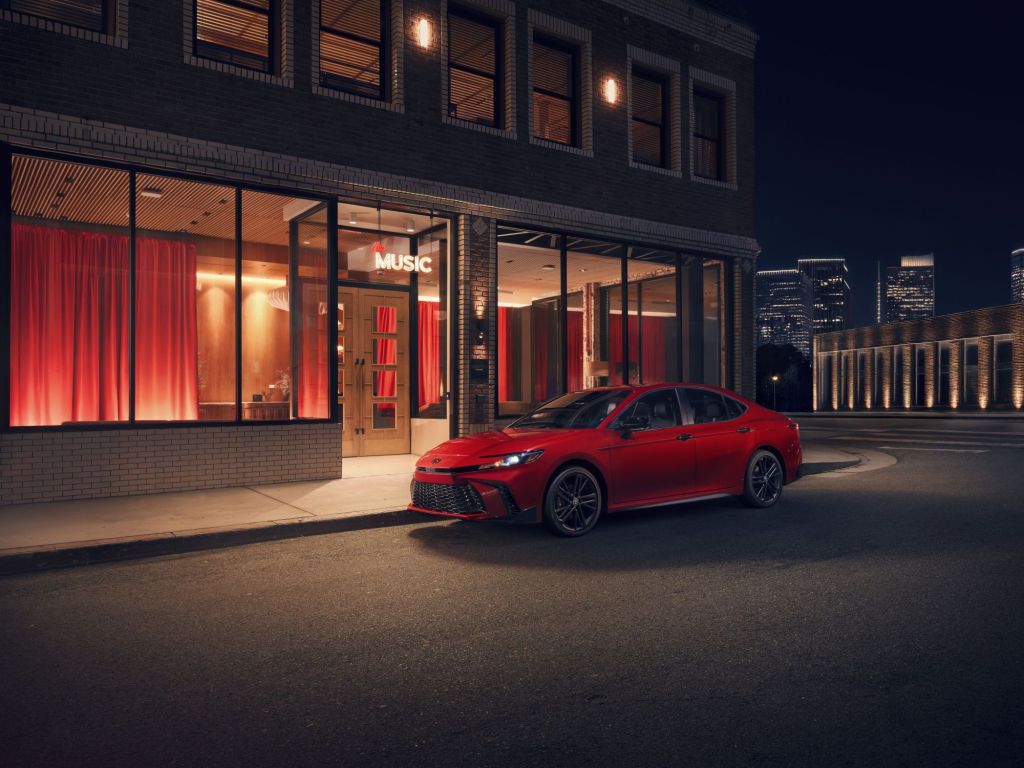
Arguably, rather than describing a Camry as a hybrid it could be described as “a car that drives nicely and is highly fuel efficient.” That, of course, is too many words for a headline.
But that’s what it is.
And another thing notable about it is that it isn’t going to kick you in the pocketbook.
The base LE trim starts at $29,700. It is a front-drive sedan that returns 52 mpg city, 49 mpg highway, and 51 mpg combined. This is a midsize car.
The Nightshade edition driven here starts at $33,200. It is an all-wheel drive car that provides 46 mpg across the board.
And the top-of-the-line XSE starts at $36,100 and returns 43 mpg across the board.
All models have the same powertrain, based on a 2.5-liter four-cylinder engine supplemented by electric motors. For those opting for a front-drive setup, the output is 225 hp. For AWD it is 232 hp.
The Nightshade edition provides sporty appearance elements like 19-inch satin-black alloy wheels, a gloss-black mesh front grille, black spoiler, black door handles, black outside mirrors. . . . You get it.
And it has the array of tech features—both for entertainment and safety—that are to be expected in a vehicle today.
One thing that may cause a bit of trepidation among people who haven’t had a hybrid is about the hybrid battery or the hybrid system overall. So it is worth know the hybrid system warranty is 96 months/100,000 miles and the hybrid battery warranty is 120 months/150,000 miles.
All of which is to say “the appeal is simple.”

