Going Rare Earth-Free for Magnets

By Gary S. Vasilash

The rare earth elements—of which there are 17, and since there are 118 elements on the Periodic Table, that number of rare earth elements is certainly not rare—are of increasing interest with the growth of electric vehicles.

EV motors use permanent magnets and permanent magnets are made with elements including neodymium and dysprosium.

There are at least a couple issues related to rare earths:

  1. They may be mined in places that are socially and politically unstable
  2. While there are things like neodymium found in the U.S., much of the processing capacity for the rare earths is located in China, so for OEMs to be able to get the full federal tax credit for EVs, sourcing from China is a no-go
(Image: Niron Magnetics)

Niron Magnetics, based in Minnesota, has developed what it claims are “the world’s first high-performance, rare earth-free permanent magnets” is drawing investments from automotive companies like, well, magnets draw iron filings.

It has obtained investments from GM Ventures, Stellantis Ventures, Volvo Cars Tech Fund, and most recently Allison Ventures (the venture capital arm of Allison Transmission) and automotive supplier Magna.

To produce its “Clean Earth Magnet,” which is based on iron nitride—a combination of iron and nitrogen, of which there is an abundance in the world—it uses nanomaterial engineering to carefully manipulate the crystals in the iron nitride.

According to Niron, the magnets provide such high magnetization that it is possible to design EV motors that use 15 to 30% less magnetic material, which can mean smaller, more efficient motors.

Smaller, lighter motors can then have a knock-on effect of reducing the size and mass of other elements in the EV.

So this is a win on many fronts, from economic to performance.

Euro Auto Sales Fun Fact

In 2023 Nissan sold 343,891 vehicles in Europe, a 20.1% increase over its sales there in 2022, according to Inovev.

In 2023 Chinese brands sold 353,276 vehicles—“mainly based on BEVs”—in Europe, more than double their sales there in 2022.

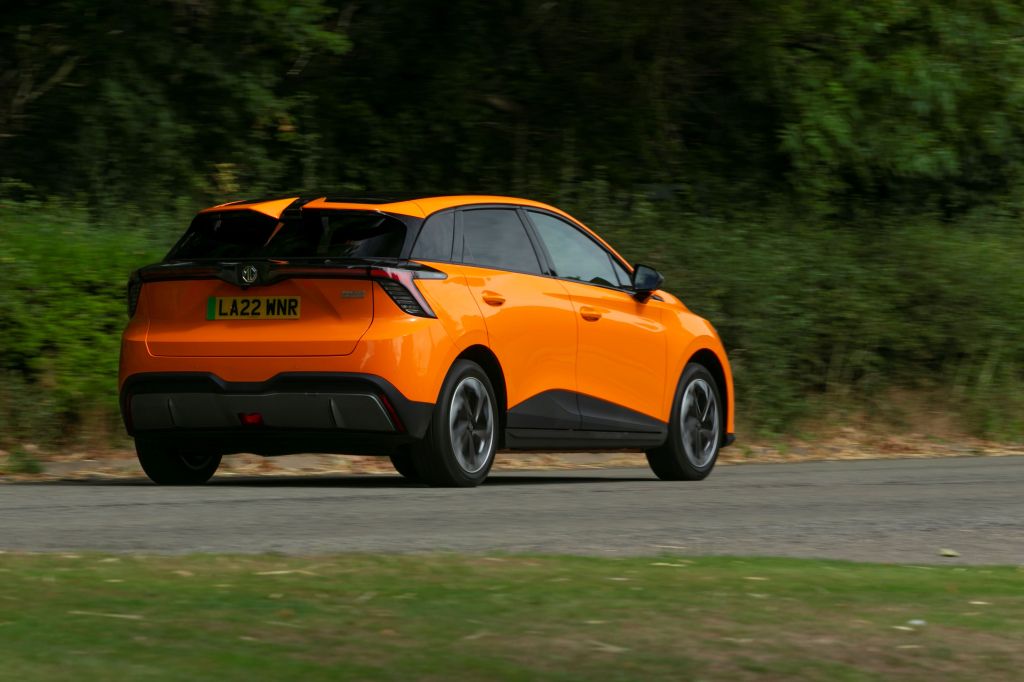
The MG MG4 EV: second only to the Tesla Model Y in U.K. 2023 sales. MG is owned by Shanghai-based SAIC Motor. (Image: MG)

Nissan, which has been around in the European market for a while (and had been affiliated with Renault until last year), is already surpassed by a phalanx of Chinese OEMs. (Yes, this is one company vs. several, but looked at from the point of view of sheet metal moved, it is still worth pondering.)

Maybe if you’re Stellantis or Renault or Volkswagen this isn’t a particularly fun fact.

And maybe this will portend things happening at some point in the U.S., as well.

GM Super Cruise: To the Moon!

By Gary S. Vasilash

As you’ve probably noticed, when you look at the Moon overhead, it generally appears to be about the size of a dime. When you look at it near the horizon, it appears massive. Which might lead you to believe that the Moon radically changes its distance with the Earth.

It doesn’t.

The Moon is 238,855 miles from the Earth whether it appears so close that you think you could drive to it or not.

Walking on the Moon. (Image: NASA)

This astronomical moment leads to General Motors’ announcement that it has increased the capability of its Super Cruise advanced driver assistance system that permits hands-free driving to 750,000 miles of roadways in the U.S. and Canada.

It claims that it is nearly six times the capability of any other hands-free driver assistance system available in North America.

It also says, “750,000 miles is like traveling one way from Earth to the Moon three times” [emphasis not added, its GM’s].

GM is adding the capability to handle the new roads via over-the-air updates to Super Cruise vehicles that are currently roaming the road except for three: the Cadillac CT6, Chevrolet Bolt EUV and Cadillac XT6.

Why are those three left out?

A GM spokesperson tells us that it is because those three vehicles have an older electrical system that’s incapable of handling the update.

Still, they are capable of providing some 400,000 miles of roads, so that’s a trip to the Moon and about 70% of the way back.

Not bad at all.

Fisker Faces NYSE Issue

By Gary S. Vasilash

On February 17, 2023, Fisker’s stock closed at $6.98. (For unrealistic comparison purposes, Tesla, that day: $208.31.)

On February 16, 2024, Fisker’s stock closed at $0.73. (Tesla: $199.95. Certainly not the halcyon number of days of yore, but still pretty damn good.)

On February 15, 2024, Fisker received a notice from the New York Stock Exchange.

In it, the NYSE pointed out that because Fisker’s common stock had traded at less than $1.00 per share for a consecutive 30 trading-day period, it is out of compliance with the rules of the exchange and could be delisted as a result.

This doesn’t mean that that is going to happen.

Fisker will tell the NYSE within 10 business days what its plan is is to get back into compliance.

There is a six-month “cure period” that the company has to get things in order (a.k.a., getting its stock price to at least an average of $1.00 per share for 30 consecutive trading days).

According to Fisker:

“The Company intends to remain listed on the NYSE and is considering all available options to regain compliance with the NYSE’s continued listing standards, including, but not limited to, a reverse stock split, subject to stockholder approval no later than at the Company’s next annual meeting of stockholders.”

It didn’t seem all that long ago that EVs were going to be a market—as in both the consumer and financial variants—winner for those involved.

Things are clearly not what they seemed.

Good News on the Fuel Cell Front

By Gary S. Vasilash

Although hydrogen fuel cell enthusiasts are probably saddened by Shell’s announcement that it is shutting off the valves at its hydrogen refueling stations in California, there was some good news this week—albeit not exactly for those who are driving Toyota Mirais or Honda Claritys in SoCal.

Extreme E, the off-road FIA-sanctioned racing series in which electric vehicles are run, is transitioning to Extreme H, which will swap out battery power for fuel cells next year.

So Extreme E becomes Extreme H.

Racing with hydrogen. (Image: Extreme E. Soon to be Extreme H)

But the good news is that the series and Symbio have announced that the latter will become the “Official Hydrogen Fuel Cell” provider to Extreme H.

Symbio?

It is a Europe-based company established by Michelin, Stellantis and Forvia (each company owns a third) that is dedicated to fuel cell systems.

In December 2023 Symbio opened SymphonHy, a gigafactory in France that currently has the production capacity to produce 16,000 fuel cells. It expects to expand that number to 50,000 by 2026.

Notably, Symbio partner company Stellantis has announced that it is developing hydrogen tech for Ram brand pickups. It already offers hydrogen versions of Peugeot, Citroen and Opel commercial vehicles in Europe.

Using hydrogen for Ram could be a proverbial game-changer.

And speaking of games (OK, a sport): If nothing else, the affiliation with the Extreme H racing series will provide attention to the tech.

Extreme E is having a race in Phoenix this year, so assuming that goes well, the U.S. will be part of the series.

Perhaps Extreme H will make more people in the U.S. interested in the possibility of fuel cells in place of battery electrics.

And maybe those Shell hydrogen stations will be reopened or replaced.

The Ford 180

By Gary S. Vasilash

“Ford has shifted its electric vehicle strategy so it concentrates on smaller, lower priced EVs and electric work vehicles such as pickup trucks and full-size vans, Farley said. Any EV larger than a Ford Escape small SUV ‘better be really functional or a work vehicle.’”

That is from an AP story by Tom Krisher about a presentation Ford CEO Jim Farley gave to the Wolfe Research Global Auto Conference in New York on February 15.

Farley also talked about the relationship between Ford and the UAW in light of last fall’s strike.

Farley said, “Our reliance on the UAW”—it has more UAW members that either GM or Stellantis—“turned out to be we were the first truck plant to be shut down.”

He was referring to the Kentucky Truck Plant, Ford’s largest plant and where the highly profitable F-Series Super Duty, Ford Expedition and Lincoln Navigator are produced.

Ford has pretty much placed its production bets in North America on things like the F-Series.

The only car the company has on offer in the U.S. is the Mustang, not exactly what one would describe as a “family vehicle,” so arguably it is something of a niche at most. Trucks and utes are where it is at, it seems, for the Blue Oval.

In the smallish category there are the Escape and the Bronco Sport, which are both based on the same platform. And the Maverick pickup truck, which is also based on the same C2 platform. This extremely popular pickup is built at a Ford plant in Hermosillo,Mexico, so some of Farley’s USA! USA! USA! chest thumping needs to be adjusted a bit.

But his comment about where the sweet spot for EVs is going to be is somewhat puzzling.

Right now Ford has three EVs, two for consumers and one for vocational use: the F-150 Lightning, Mustang Mach-E and E-Transit.

The Ford EVs for consumers: the Mustang Mach-E and the F-150 Lightning. (Image: Ford)

The first is, of course, a full-size pickup truck. The second trades on the muscle car performance of the Mustang. And the third is a vehicle for contractors.

Ford has been championing larger vehicles for the past few years for the simple reason that it is where it makes more money, so when it went EV it went big with the Lightning (and for power with the Mach-E).

It used to have the Focus to go up against the likes of the Honda Civic and Toyota Corolla, both of which still exist and do quite well in the market. Presumably neither Honda nor Toyota build those vehicles out of charitable impulses.

Ford used to have the Fusion to go up against the likes to the Honda Accord and the Toyota Camry, both of which. . . . Yes, same thing.

Ford—and it isn’t the only company in southeastern Michigan that has done this—has been messaging consumers that Bigger Is Better.

Suddenly Farley is talking about small vehicles.

Don’t get me wrong: small EVs, assuming that they can be made so that they are actually affordable for consumers and that provide a return to the OEMs, are undoubtedly a good idea to increase the number out on the roads.

Regardless of the size of the currently available EV (with the exception of Teslas) need to be sold to a still-skeptical public.

So there is that challenge.

And now Farley is doing a 180 and planning to go to the market with things that are small.

Which means he is going to need to convince people that on roadways populated with large F-150s and Explorers small Ford EVs are a good thing.

To which I say: Good luck.

Gotta Keep Truckin’

By Gary S. Vasilash

This is the classic “damned if you do, damned if you don’t” scenario:

The American Transportation Research Institute (ATRI) has come out with its annual list of the most-congested locations on the national highway system for trucks.

About this situation, Chris Spear, American Trucking Association president and CEO, said: 

“Traffic congestion on our National Highway System inflicts an enormous cost on the supply chain and environment, adding $95 billion to the cost of freight transportation and generating 69 million metric tons of excess carbon emissions every year.”

None of which is good.

Freightliner eCascadia: One benefit of electric trucks like this is that when they are in a traffic jam there won’t be emissions. (Image: Freightliner)

However, according to ATRI analysis, “traffic conditions continue to deteriorate from recent years, in some instances due to work zones resulting from increased infrastructure investment.”

That’s right: building roadways results in construction zones and construction zones lead to congestion.

So damned if they build, damned if they let it crumble.

Spear went on to say:

“The freight bottlenecks identified in this report provide an actionable blueprint for state and federal transportation officials on where to invest infrastructure funding most cost-effectively. Increasing freight efficiency should be a top priority for the U.S. DOT, and alleviating these bottlenecks would improve highway safety, protect the environment and support interstate commerce.”

Presumably the infrastructure projects–at least not all of them, because sometimes this seems to be the case–weren’t predicated on someone throwing darts at a map.

And again, while the bottlenecks will eventually be improved via infrastructure improvements, getting from here to there will not be without additional disruptions.

Where Driving Is Slow

Overall the ATRI, based on measurements from 325 locations, determined that during rush hour average truck speeds were 34.4 mph.

For the top 10 locales, the average speed was 28.5 mph.

The largest molasses zone?

The intersection of I-95 and SR 4 in Fort Lee, New Jersey.

It has topped the ATRI list for six years running, an accomplishment that the Fort Lee Chamber of Commerce probably doesn’t promote.

And as for the remaining nine:

2. Chicago: I-294 at I-290/I-88

3. Chicago: I-55

4. Houston: I-45 at I-69/US 59

5. Atlanta: I-285 at I-85 (North)

6. Atlanta: I-20 at I-285 (West)

7. Los Angeles: SR 60 at SR 57

8. Houston: I-10 at I-45

9. Atlanta: I-285 at SR 400

10. Nashville: I-24/I-40 at I-440 (East)

Clearly this is a top-10 list that some city leaders—particularly in Chicago and Atlanta—probably wish they weren’t on.

Western Europe, China and EVs

Although there was a seeming step-by-step, vehicle-by-vehicle increase in the under of Chinese battery electric vehicles registered in Western Europe last year, there was a bit of a stumble at the end, and Schmidt Automotive Research wonders whether there will be a cap of under 10% of the EV market in Western Europe for the Sino mobiles.

(Image: Schmidt Automotive Research)

As the chart shows, there was a noticeable decline in registrations in Q4. . .but then there are some reasons why this could be the case, including the increase in the amount of time it takes to ship vehicles from China to Europe while avoiding the Red Sea.

But the Schmidt study also points out some brands are offering discounts of up to €12,000, so you’d imagine that European consumers would be most interested in savings like that. . .especially as there may be higher import tariffs applied to Chinese vehicles coming into Europe this year.

Still, the fact that the Chinese OEMs have managed to gain that much of the European market in a comparatively short period of time says something about the appeal of their products.

Ford: Hybrids Should Be the Story

By Gary S. Vasilash

Much of the attention given to Ford’s Q4 2023 earnings call last week has been focused on CEO Jim Farley’s comment:

“[W]e made a bet in silence two years ago. We developed a super-talented skunk works team to create a low-cost EV platform. It was a small group, small team, some of the best EV engineers in the world, and it was separate from the Ford mothership. It was a start-up.

“And they’ve developed a flexible platform that will not only deploy to several types of vehicles but will be a large installed base for software and services that we’re now seeing at Pro.”

Somehow the inherent mystery of a “skunk works” has gotten people all excited.

Would they be so excited to know that the skunkworks methodology goes back to 1943 in the aircraft industry?

Yes, an 80-year-old approach.

Well, You’ve Got to Build It. . .

The other thing about this is that it is one thing for an R&D team operating independently to develop something and a whole other thing for that development to be engineered for and launched in production.

Launches have been something that Ford has been finding a bit troubling, so there’s that.

And it should be noted that the company also announced last week that its Ford e operation—as in the electric vehicles—lost $4.7 billion last year and the company anticipates losing $5 to 5.5 billion this year on Ford e.

The excitement of the skunk works project was certainly helpful from diverting some attention to that red ink.

What About This?

But what was largely overlooked was Farley’s comments on hybrids.

As in,

“Our global hybrid sales were up 20% last year, and we expect them to be up 40% this year.”

And:

“We now have the No. 1 and No. 2 best-selling hybrid trucks in the U.S. Maverick is No. 1. And we’re the No. 3 hybrid brand in the U.S. behind Toyota and Honda. But unlike them, our hybrids really sell best on trucks for our side.”

Given that Farley said “And margins on hybrids are closer to ICE, much higher than EV margins,” you’d think hybrids would be the headline going forward if for no other reason than the company can make money on them, something that it is not going to see on the EV side of the business until. . . . Well, that remains to be seen.

Maverick hybrid: Fuel efficiency and the energy to bust out the beats. (Image: Ford)

Not Exactly a Strong Third

While it is nice that Farley is so bullish about the company’s hybrid performance, it is worth really putting that into context.

Of course its hybrids “really sell best on trucks” because with the only hybrid Ford has without a box on the back is the Escape.

And as for it being number three, know that these are the number of hybrid sales for the three companies in 2023:

  1. Toyota:         523,664
  2. Honda:         293,640
  3. Ford:            133,748

In other words, it sold less than half of what Honda did and about a quarter of what Toyota did.*

So while the claim is factually true, one should perhaps not be too chuffed about the Ford hybrid performance.

About a quarter of Toyota and Honda sales are hybrids.

About 7% of Ford’s sales are hybrids.

Did I mention the skunk works. . .?

==

*It is worth noting that until recently Toyota was treated like some technological troglodyte for its continued support of hybrids and its not all-in approach to EVs. Not only do we see that Ford is reconsidering its positioning vis-à-vis hybrids and full EVs, but General Motors, which doesn’t have much of a record in the hybrid space, has announced that it, too, is going to bring hybrids to the U.S. market. Farley pointed out on the earnings call that consumers can quickly do the math on the fuel efficiency benefits of hybrids and, perhaps the most important factor: “they don’t have to change their behaviors.” It is surprising that there seems to be so many auto execs who ignore the long public charging time required for EVs compared with pumping gas: perhaps this is a case that when they get behind the wheel of their company vehicles someone else has done the charging.

Fuel Cell Market to Expand, But. . .

Fuel cells are having their moment again for various vehicle applications, from light-duty to big rigs.

How big a moment?

Seems not trivial according to a report by MarketsandMarkets, which products the automotive fuel cell market will grow from $200 million this year to $2.1 billion by 2030. It will have a compound annual growth rate of 48%.

Where will the largest market be?

Asia Oceana.

Given that the geographies covered in the firm’s report also includes Europe, North America and Rest of the World, presumably that Asia Oceana includes China, which could explain the biggest market.

(Image: Toyota)

That said, with companies including Toyota, Honda and Hyundai continuing their hydrogen fuel cell development efforts, Japan and South Korea can’t be counted out as players, and consumers, in this field.

However. . .the global battery electric vehicle market size right now is on the order of $500 billion and it is estimated to be about $1.5 trillion by 2030, so even with the impressive growth of fuel cells, they’re still approximately the size of a dandelion in a redwood forest.