
The Return of the Minivan?

By Gary S. Vasilash

Since the start of the contemporary minivan with the Chrysler Voyager, Dodge Caravan and the Plymouth Voyager in November 1983, that type of vehicle has had its ups and downs in the market. Mainly downs after the notion that it was a vehicle for “soccer moms.” One can imagine that when that meme was established Landon Donovan’s or Mia Hamm’s mothers probably didn’t want to be seen in one.

But from a packaging point of view, it is hard to think of anything better than the configuration of the minivan.

Perhaps the forthcoming VW ID.Buzz electric minivan will change the perceptions of what a minivan is.

In other parts of the world, there is nothing diminutive (i.e., “mini”) about the boxy vehicles (no matter what aero effects are deployed, let’s admit it: these are shaped more like shoeboxes than Stingrays).

Elsewhere they are called “MPVs,” or “multi-purpose vehicles.”

The purposes seem to be carrying people and stuff, so there isn’t a whole lot of multi about them.
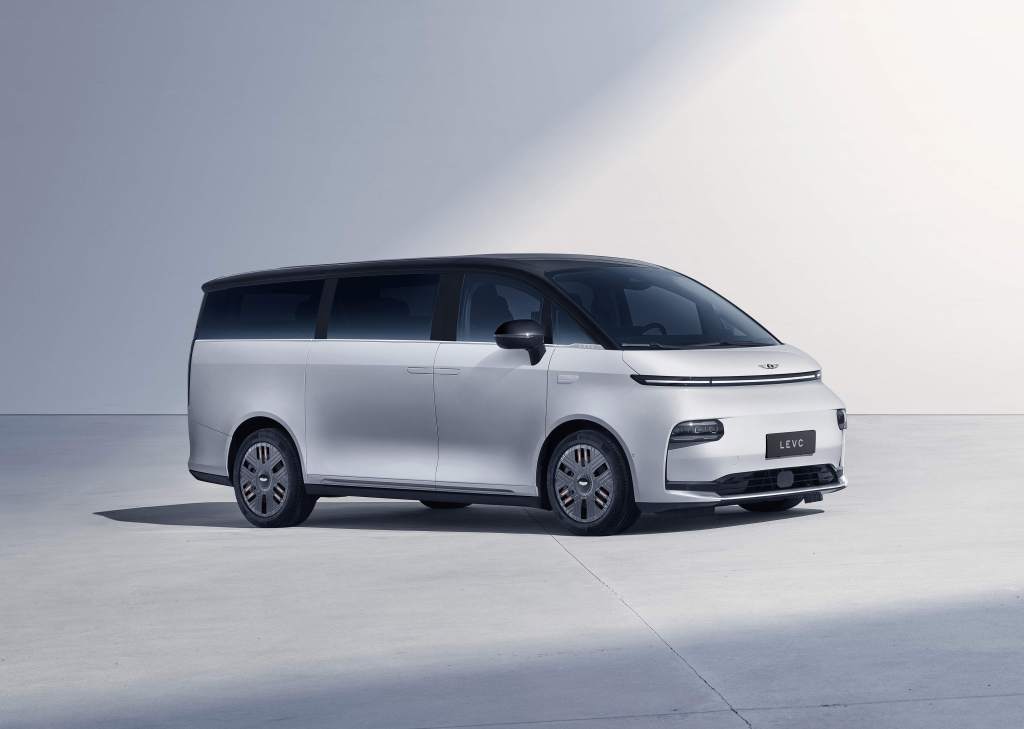
The L380, electric MPV. (Image: LEVC)

LEVC—the London Electric Vehicle Company, the firm that produces the TX, the hybrid-electric (it has a range extender) black cab that is rolling through the streets of London and elsewhere—is extending its transport offerings by putting into pilot production in a plant in Yiwu, China, the L380, a fully electric MPV.

Alex Nan, LEVC CEO, described the vehicle as “the next step forward in the company’s globalization strategy, as we rapidly accelerate our transition from manufacturing the world’s most advanced and iconic taxi, to becoming a leading e-mobility technology company.”

LEVC is a Geely Holding Group company. Which means it is related to Volvo and Polestar, Lotus and Lynk & Co., and others.

The L380 is based on the Geely Space Oriented Architecture (SOA), which is an underpinning that can be deployed for lots of vehicles, including those that aren’t vans.

The L380 will initially launch in China and then is expected to be delivered into the U.K. in about two years.

After that. . . ?

What’s the Real EV Demand?

(A Look at Western Europe)

By Gary S. Vasilash

Although Western European vehicle buyers have consistently been more bullish on buying electric vehicles, even there things are beginning to shift according to analysis by Schmidt Automotive Research.

According to its “European Electric Car Study,” there were 1.96 million battery electric vehicles sold in the West Europe region in 2023, a 28% year-over-year improvement, which means 16.9% of the total automotive market.

But it could it have better, as there was a 25% decline in December 2023 compared with the final month of 2022, which resulted in a decline for 5% for Q4 ’23 compared with ’22.

One of the reasons for the decline: “various purchase subsidies and lower tax incentives being stripped away.”

Looking ahead into 2024, Schmidt Automotive predicts:

“Auto executives will need to wrap up and buckle up as the market begins to see a chill easterly wind arrive, with discounting expected to be the keyword of the year, accompanied by protectionism to defend against an increasingly aggressive attack from Chinese manufacturers, as states hope to buy some time for key regional employers giving them space to restructure their business and become more competitive in the new e-mobility age.”

So let’s break this down:

  1. EV demand fell as consumer subsidies and tax incentives declined
  2. Discounting will be the condition this year, which means an advantage for the consumer and bad news for the manufacturers

The Chinese manufacturers are providing inexpensive products. Yes, they happen to be EVs, but would low-cost ICE vehicles be any less appealing?

At some point the “free money” for EVs is no longer going to be available.

Which leads to a question of what the real demand for the vehicles is.

Perhaps not as much as some OEM execs would like to think.

Useful Info for Those Going Fast

By Gary S. Vasilash

Cadillac, undoubtedly having a cadre of people on staff who know that there is still a whole lot of interest in the market for luxury sport sedans with internal combustion engines (even if there aren’t necessarily a whole lot of buyers), have given the CT5-V and CT5-V Blackwing a bit of refreshing, although keeping the 360-hp 3-liter twin-turbo under the hood of the CT5-V and the 668-hp 6.2-liter V8 in the Blackwing.

One of the primary mods is the deployment of a 33-inch diagonal LED color touchscreen.

2025 Cadillac CT5-V Blackwing showing its 33-inch-diagonal LED color touchscreen display can provide some useful information for those who are driving their car on the track really, really fast. (Image: Cadillac)

Some implementations of large screens seem rather gratuitous, as though there isn’t certainty of what ought to be on the screens (e.g., does there really need to be pictures of things like album covers?), but seeming absolute certainty that the screen needs to be there, as large as possible.

But in the case of the CT-5 Vs, they are offering a Performance Data Recorder that provides a wealth of info for those who take their cars racing, with everything from a Lap Analyzer tool—which Cadillac claims is something that heretofore was the sort of thing that one would need a laptop to process—to a live data screen in the center stack, which isn’t so much for the driver, but for the passenger who can provide real-time coaching for the driver.

Clever, those folks at Cadillac.

Skip the May Pole. Grab a Banner Instead. (Really?)

By Gary S. Vasilash

A country’s GDP—gross domestic product—is a measure of the value of goods and services produced for sale. A higher GDP is generally a reflection of comparatively higher economic health for a given country compared with others.

According to the United Nations, the top 10 countries measured on GDP per capita are:

  1. Luxemburg
  2. Ireland
  3. Norway
  4. Switzerland
  5. United States
  6. Demark
  7. Netherlands
  8. Sweden
  9. San Marino
  10. Belgium

What do all of these countries have in common?

They are not generally associated with wide-spread labor actions (a.k.a., massive strikes).

The U.S. Bureau of Labor Statistics has released information about union membership rage in the U.S.: 10%, or 14.4 million workers. That 10% is flat compared with 2022.

The BLS started tracking these numbers in 1983. Back then there were 17.7 million union workers. That represented 20.1% of the workforce.

And while many people (likely you, as you are reading something about the auto industry) might think that the auto industry is where there is the greatest number of represented workers, turns out that in the private sector the number-one industry for union workers is utilities, at 19.9%. Then the BLS buckets transportation and warehousing at 15.9%, followed by educational services (12.9%) and motion picture and sound recording (12.9%).

If people are interested in money first and foremost, then union membership is certainly a positive, as the median weekly earnings for a union worker in 2023 was $1,263 compared with $1,090 for a non-union worker.

Which brings us back to the list.

On Monday, speaking at the UAW national political conference in Washington, DC, UAW president Sean Fain said that he wants an organized strike, a general strike, a mass strike across the board, to occur on May 1, 2028.

“We want everybody walking out just like they do in other countries.”

If GDP is important, then one wonders about the wisdom of emulating the labor practices or activities of other countries where it isn’t particularly high.

People deserve good pay, benefits and working conditions. But somehow a scheduled across-the-board strike doesn’t seem to articulate the needs of a utility worker, which are probably different than those of a barista, which are coincidental at most with a university teaching assistant, which are undoubtedly not the same as someone working the line in a Chevy plant.

Buick: Wouldn’t You Rather Have One?

By Gary S. Vasilash

If there is someone who is quintessentially American, that person has to be Dale Earnhart, Jr. It is hard to imagine how difficult it would be to live up to the legend that his father was, but Dale Jr. was able to make his own way into the annals that is NASCAR.

Like many former drivers, Earnhart owns car dealerships. One of them is Dale Earnhardt Jr. Buick GMC in Tallahassee, Florida.

Like many dealer websites, there is an array of vehicles for sale presented and an immediate pop-up that shows they are willing to engage pronto with prospective customers.

But there is something that is different than is the case on many dealer websites, which is a Q&A section.

And one of the questions that is presented and answered is:

“Is Buick American?

And the answer begins:

“If you’re considering a new Buick vehicle as your next Thomasville, GA car or SUV, you may be wondering, is Buick American? The answer is yes.”

And it laudably goes on to acknowledge that the brand builds vehicles in places that aren’t within the U.S., like Bupyeong, South Korea (Encore GX), and Shanghai, China (Envision).

Yes, you read that right: the Buick Envision is built in China. Which is something to think about when the rhetorical question is raised: “Will Americans buy Chinese vehicles?,” as though this is some sort of question about the future. It isn’t. And the answer is yes.

The Buick Envista is also made in South Korea.

This leaves the Buick Enclave, which is made in the U.S., at the Lansing Delta Township plant in Michigan.

GM has been building vehicles in Lansing for a long time. Ransom E. Olds built a plant there in 1901. (Olds, unfortunately, ceased to exist in 2004.)

While some people wondered about the viability of Buick, here’s Duncan Aldred, vice president, Buick and GMC:

“As the fastest growing mainstream brand in the industry in the U.S.last year, 2024 promises more big things for Buick, spearheaded by the launch of the next-generation Enclave.”

Sketch of the 2025 Buick Enclave. No, it won’t have square wheels. (Image: Buick)

Last year Enclave sales, 39,411 units, were up 29.1% compared to 2022.

But Envision sales, 44,281 units, were up 71.2% and Encore GX, 64,149 units, were up 92.4%.

Which seems to indicate that at least so far as 2023 goes, they were busier in Bupyeong and Shanghai than they were in Lansing.

Perhaps the forthcoming version of the stylish Enclave will help boost things in Lansing.

And probably at Dale Jr.’s dealership in Florida, too.

Pininfarina’s Digital Approach to Documentation

By Gary S. Vasilash

OEMs today are hoping like they’ve never hoped before that with all of the money that they’re not making on electric vehicles (yes, yes, there are the exceptions like Tesla and BYD) that they’ll be able to more than make up it for by selling services, digital services, not mechanical ones.

The plan is that people will forego Google Pay or Apple Pay and use the interface in the vehicle.

While this may not be as great a leap as thinking that people will forego Waze or iTunes, it is still a bit of a stretch.

Legendary design consultancy Pininfarina has decided to increase its potential revenues through the creation of “Pininfarina Classiche.”

This is something for those who have a classic car and are interested in obtaining as much provenance as they can.

The Pininfarina archive has been digitized and the company has been working with the Historical Studies department at the University of Turin.

The archive includes production and serial numbers for >700,000 cars that is supplemented by >20,000 related documents, sketches, photos, and related items.

Most of the information is related to vehicles produced between the 1950s and 1990s.

For now, those who own a:

  • Alfa Romeo Spider (Duetto) from 1966 to 1993
  • Fiat 124 Spider from 1966 to 1982
  • Pininfarina Spider Europa and Volumex from 1982 to 1985

can get in touch with Pininfarina Classiche about their specific vehicle.

As for what Pininfarina will get, the fees are:

  • €400.00 VAT included for cars produced before 1980
  • €300.00 VAT included for those from 1980 onwards

Although this will not be a continuing stream of revenue as the OEMs with the digital dreams expect, odds are that collectors are going to be far more willing and interesting to get the documentation from the company.

Ocean Issue

By Gary S. Vasilash

Although there aren’t a heck of a lot of them out there (globally 4,700), so it is not something with big numbers. . .but if you happen to own one of them, that’s a big number in and of itself, the National Highway Traffic Safety Administration Office of Defects Investigation is looking into the braking performance of the Fisker Ocean electric crossover.

(Image: Fisker)

Reportedly there is a problem as described by NHTSA as a “partial loss of braking over low traction surfaces without alerting the driver”—and it would seem that the partial loss is more problematic than an alert—but this “result in a sudden increase in stopping distance”—which probably goes to the point of the partial loss.

According to Fisker, it issued and over-the-air update in December to help resolve the issue.

Apparently the complaints preceded this probable fix.

But it needs to be checked.

This should be particularly concerning to Ocean owners in places where there is snow and/or ice on the pavement (a.k.a., “low traction surfaces”).

Fisker’s official statement:

“Fisker is fully cooperating with NHTSA on this matter.”

Which goes without saying, except that companies are expected to say something.

GMC Going More Global

By Gary S. Vasilash

GMC sells its vehicles in three non-U.S. markets at present:

  • Canada, where its sales were up 10% in 2023 and where it has a market share of 5.5%
  • The Middle East, where its sales were up 15% compared with 2022
  • Mexico, where its sales were up 14.4%
  • South Korea, where it launched the Sierra LD pickup in 2023

How, you might be wondering, did it do in the U.S. in 2023?

Its retail sales were up 6.5% compared with 2022 and its total sales were up 8.9%, for a total 563,677 units.

GMC Yukon AT4. Presumably a nice vehicle on a snowy day. (Image: GMC)

(Which vehicle in its lineup were up 279.9% in ’23 compared with ’22? The HUMMER EV. It delivered 3,244. That vehicle has the distinction of being—with the exceptions of the Chevy Blazer EV and Chevy Silverado EV, both of which launched near the end of ’23, so these exceptions are not really comparative, especially as the HUMMER went into production in November 2021—the lowest-selling vehicle of all GM products.)

Feeling bullish about the global demand for vehicles of a large dimension, GMC announced that it will be rolling out the Yukon full-size SUV in Australia, New Zealand and China, with the last-named getting the vehicles in 2024 and the first two in 2025.

GMC sold 82,271 Yukons in the U.S. last year, essentially flat in the context of the 82,304 sold in 2022. While flat isn’t as good as the 279.9% of the HUMMER EV, it is better than the -19.3% of the Canyon, -14.8% of the Savana, or 17% of the Terrain.

Hybridized CUVs Matter

By Gary S. Vasilash

Here’s a fun fact: the Honda CR-V hybrid was the best-selling hybrid vehicle, bar none, in the U.S. market in 2023.

197,317 were delivered.

Honda CR-V Hybrid under its skin. (Image: Honda)

Meanwhile, over at Toyota, 161,125 RAV4 Hybrids were sold and an additional 26,073 RAV4 Primes, the plug-in hybrid, for a total of 187,198 hybrids.

GM has zero hybrids.

Ford has hybrid versions of the Escape, Maverick, Explorer, and F-150.

Combined, it delivered 133,743 hybrids.*

Ford sold 140,986 Escapes in 2023. That’s with all powertrain options.

Fewer than the Honda and Toyota hybrids.

Chevy sold 212,701 Equinoxes—none of which are electrified, and not all that many more than the CR-V hybrid (15,384, non-trivial, but when you take into account that Honda sold 361,457 CR-Vs in 2023, well. . . ).

Clearly, compact CUV hybrids are appealing.

Surprising GM is ignoring the market and Ford probably needs to ramp up its output.

Dodge has a hybrid version of the Hornet available, a crossover that launched last Spring, so its efforts are still nacent in this space. It sold a total 9,314 Hornets in 2023, of which 3,591 were the hybrid version, so there’s evidently some traction.

(Jeep has the Wrangler 4xe plug-in and the Grand Cherokee 4xe plug-in, of which it sold 67,429 and 45,684, respectively. Neither, of course, is likely cross-shopped with a CR-V or RAV4, but still nice numbers.)

*Here’s a big number–the electrified Toyotas sold in 2023: 565,800. With the exceptions of 2,737 Mirai fuel cell electric vehicles and 9,329 bZ4X BEVs, all hybrids.

Cheap EVs & The Steak Mentality

By Gary S. Vasilash

Admittedly the BYD Seagull (a.k.a., “Dolphin Mini” in Brazil and Latin America) is a small car—98.4-inch wheelbase, 148.8-inch length, 67.5-inch width, 60.6-inch height—there are two other characteristics worth knowing: (1) it is an electric vehicle with a range ranging from about 190 miles to 250 miles, depending on the battery used; (2) it has a starting price that’s approximately $11,000.

The BYD Seagull. Small. Cheap. Electric. Competitive? (Image: BYD)

Which leads to two other considerations:

  • Good thing Americans don’t like small cars
  • Good thing it isn’t available in the U.S. because while Americans may not like small cars, they do like low prices

And Kristin Dziczek, policy advisor, Federal Reserve Bank of Chicago, speaking at the 30th annual Automotive Insights Symposium, speaking on her own behalf, not the Fed’s, said that a car like the Seagull is something that worries her.

Dziczek said that BYD could conceivably sell the Seagull in the U.S. market for ~$15K, including the 27.5% tariff that the U.S. imposes on vehicles built in China, and still make money.

Given that the average transaction price for an EV in the U.S. in December was $50,786 according to Kelley Blue Book, given that $48,759 was the average transaction price for vehicles of all types last month, doesn’t well under $20,000 look appealing—even for a small EV?

Let’s say that a Chinese company builds a factory in Mexico. Isn’t it possible that, increased costs compared with China, it could take advantage of the USMCA and avoid the big tariff?

While there are some who argue that people want the amenities that are characteristic of vehicles with higher price points, some people prefer porterhouses over McDonald’s.

Seems as though the traditional domestic OEMs are interested in those who want steak.

Chevy, once the GM brand that was more economical, has a starting price for the Blazer EV at $56,715. . .just $1,875 less than the starting price for the Cadillac Lyriq EV.

Remember when the Chevy Silverado EV was announced and it was said that the starting price would be around $40,000? The actual MSRP is $74,800.

Affordability is a key concern for most people. Sure, there are those who buy far beyond their means for purposes of fashion.

But fashion is fickle.

And in the short and long run for many people, it is about what will get the job done at a price that meets their means.

While politics may impede the entry of Chinese vehicles in high numbers in the American market (the Buick Envision and the Polestar 2 are built in China and you can buy one at a dealer near you right now, but the sales for both are still somewhat small: for 2023 there were 44,281 Envisions sold and 10,350 Polestar 2s) it is going to likely happen at some point.

The question is how competitive the U.S. builders are going to be when that happens. Given that they’ve pretty much abandoned midsize and small cars (Toyota sold 290,649 Camrys last year and 232,370 Corollas, so it is not like there isn’t a market for those types of vehicles), there should be some serious concern.