Tesla 2020: The Numbers

509,737. Let’s call it what it is: that is a highly respectable production number for calendar year 2020, the number of Models S, X, 3 and why produced by Tesla.

Tesla doesn’t break down the numbers by specific models.

Rather, it reports it this way:

Model S/X:   54,805

Model 3/Y:    454,932

A lot of cars.

ooo

Tesla doesn’t break out where the vehicles are built. Its Giga Shanghai is building the Model 3 and Model Y production is anticipated (if not occurring). The plant is said to have a capacity of 250,000 vehicles a year.

So it could be that given that the Tesla plant in Fremont, California, is building all four models, perhaps a considerable number of the Model 3/Y are being produced in Shanghai. (After all, there are those 54,805 that had to be manufactured.)

ooo

Tesla is credited with doing things that traditional OEMs have not done. (Not the least of which is selling electric vehicles at volume.)

In that reporting of 2020 production it is doing something traditional OEMs have not done:

Reporting based on platforms.

That is, the S/X share a platform. The 3/Y share a platform.

So rather than separating the volumes, it is aggregating the platforms.

ooo

There is a number set of numbers Tesla reported for the year: deliveries.

So while it produced 509,737 vehicles, it delivered 499,550.

Obviously, a number of those vehicles are in transit. Or sitting on lots (not dealer lots, per se).

Tesla shorts will also argue that there are probably a non-trivial being held back for post-production fixes.

Which may be the case.

Which is doing something traditional OEMs have done.

Freep’s Phelan’s Picks

Detroit Free Press auto critic Mark Phelan happens to spend more time driving cars than any dozen people you know—a dozen pre-COVID drivers. Somehow, the pandemic hasn’t inhibited Phelan’s seat time.

Each year Phelan picks what he considers to be the best vehicles introduced during the past year.

2021 Cadillac Escalade (Photo by Steve Fecht for Cadillac)

And his list has been revealed:

Cadillac Escalade: Utility of the Year

Ford F-150: Truck of the Year

Hyundai Elantra: Car of the Year

As for place and show?

For utes:

Ford Mustang Mach-E

Ford Bronco Sport

For trucks:

Ram TRX

Jeep Gladiator Mojave

For cars:

Nissan Sentra

Genesis G80

Realize that these are vehicles that have been introduced during the past year, so it isn’t a rating of the best companies.

That said, it can’t be overlooked that Ford has not only a first-place win, but a full third of the list.

Hyundai Motor Group—which has Genesis under its awning—has a win and two vehicles on the list.

And FCA—soon to be Stellantis—missed first place, but had two on the list.

ooo

How competitive the industry is can be determined by taking a look at the list of the semifinalists that were announced by the jury of the North American Car, Truck and Utility of the Year. (Full disclosure: Mark Phelan and I are both jurors.)

Cars:

Acura TLX

Cadillac CT4/CT4-V\Genesis G80

Hyundai Elantra family (includes N Line and HEV)

Kia K5

Mercedes-Benz E Class Sedan, All-Terrain, Coupe, Cabriolet

Nissan Sentra

Polestar 2

Utilities:

Cadillac Escalade

Chevrolet Tahoe/Suburban

Chevrolet Trailblazer

Ford Bronco Sport

Ford Mustang Mach E

Genesis GV80

Hyundai Santa Fe

Kia Seltos

Kia Sorento

Land Rover Defender

Mazda CX-30

Nissan Rogue

Toyota RAV4 Prime

Toyota Venza

Volvo XC40 P8 Recharge

Truck:

Ford Super Duty

Ford F-150

Ram 1500 TRX

Jeep Gladiator Mojave

The category finalists that NACTOY picked are not unlike Phelan’s, with a couple of exceptions:

Car:

Genesis G80

Hyundai Elantra

Nissan Sentra

Truck:

Ford F-150

Jeep Gladiator Mojave

Ram 1500 TRX

Utility:

Ford Mustang Mach-E

Genesis GV80

Land Rover Defender

The results of that will be announced on January 11, 2021.

Here’s one thing that can be said about all of those vehicles:

Tough crowd.

Aston Martin Going Racing

Back in the early 1920s, Count Louis Zborowski, a “fabulously wealthy son of a Polish Count”—oddly enough, one born in Elizabethtown, New Jersey—“and an American heiress” who had “a fortune that in today’s money would comfortably class him as a billionaire,” according to Aston Martin, was fundamentally responsible for getting the British firm into Grand Prix racing, with the company’s first effort at the French Grand Prix in 1922, with the Count behind the wheel of one of the two cars entered into the event. Neither car finished.

Aston Martin Chassis TT1–the company’s original race car. (Image: Aston Martin)

Zbrowski? He joined the Mercedes team in 1924 and died racing in the Italian Grand Prix at Monza, colliding with a tree. His father, William Eliot Morris Zborowski, died in a racing accident in 1903, during a hill climb in France.

Lawrence Stroll, a Canadian billionaire, is the Executive Chairman of Aston Martin Lagonda. A consortium of investors he led put £182 million into the company last January, then reworked the agreement in March so that the group owns about 25% of the company.

Stroll has long been involved in racing. His son Lance is a driver. Stroll owns Circuit Mont-Tremblant in Quebec. He isn’t a mere spectator or fan. He is of the fabric of the sport.

And now he has revived the Aston Martin Formula One team.

According to AutoExpress, as of late October 2020 Aston Martin had delivered a total 2,752 cars and had an operating loss of £ 229 million.

Which makes one wonder about whether it makes a whole lot of sense to go racing, an undertaking that is notoriously cash-intensive.

Here is something of an interesting coincidence: Mercedes—remember Zbrowski’s car (and it seems that his father might have been piloting one up that hill in France)?—has entered into an agreement with Aston Martin through which it may be able to acquire as much as 20% of the company.

Ford, Mahindra and FCA

“The global economy and business environment are not the same as October last year [2019].” That is what Ford spokesman T.R. Reid told Reuters as part of the explanation of why the automotive joint venture that Ford was going to be crafting with Mahindra and Mahindra Ltd. has been called off.

October 2019 was when the companies announced they would be forming a JV that would focus on the development of vehicles especially for emerging markets.

COVID-19 has had an effect on those markets as well as, well, all markets. Consequently, the no-go between the two companies.

Ford has operations in India including the Chennai Vehicle Assembly Plant, Sanand Vehicle Assembly Plant, Sanand Engine Plant and Chennai Engine Plant.

India is part of Ford’s International Markets Group (IMG), which spans “100 emerged and emerging markets.”

Ford plans to operate in a status quo mode in India for the time being.

It should be pointed out that Ford’s current approach is to evaluate its operations the world over; it is “allocating capital in ways that advance Ford’s plan to achieve an 8% company adjusted EBIT margin and generate consistently strong adjusted free cash flow.”

Which is a heavy lift, even in a non-pandemic world.

Mahindra did have some good news of late, in that in late December the International Trade Commission decided that the 2021 Roxor—off-road vehicle, as in one that is not street-legal—doesn’t infringe on the “trade dress” of the Jeep Wrangler.

FCA, not surprisingly is not happy. Also not surprisingly, FCA is going to appeal.

U.K. Drivers Love Their EVs

U.K. electric vehicle buyers—both full-electric and plug-in hybrids—love their vehicles. That’s according to the annual EV Charging Survey conducted in the U.K. by Zap-Map, a mapping service that provides an app that shows where charging stations are located.

The firm surveyed 2,132 EV owners—52% of whom got their vehicles in 2020, 73% of whom are first-time owners of this type of tech—and found that 91% said they wouldn’t trade their vehicle for a more conventionally powered one.

The survey says that on a scale of 0 to 100, full battery electric vehicles score 92, plug-in hybrids are at 84, and vehicles with internal combustion engines are at 72.

And only 1% indicate that they “miss my petro/diesel/hybrid.”

However, it needs to be pointed out that the number of U.K. vehicle owners with battery electric vehicles and plug-in hybrid vehicles is comparatively low compared to the other categories.

According to the Society of Motor Manufacturers and Traders (SMMT), through November, battery electric vehicles have a 5.8% of the total market; plug-in hybrids have 3.9% of the market.

Or 9.7% of the whole market.

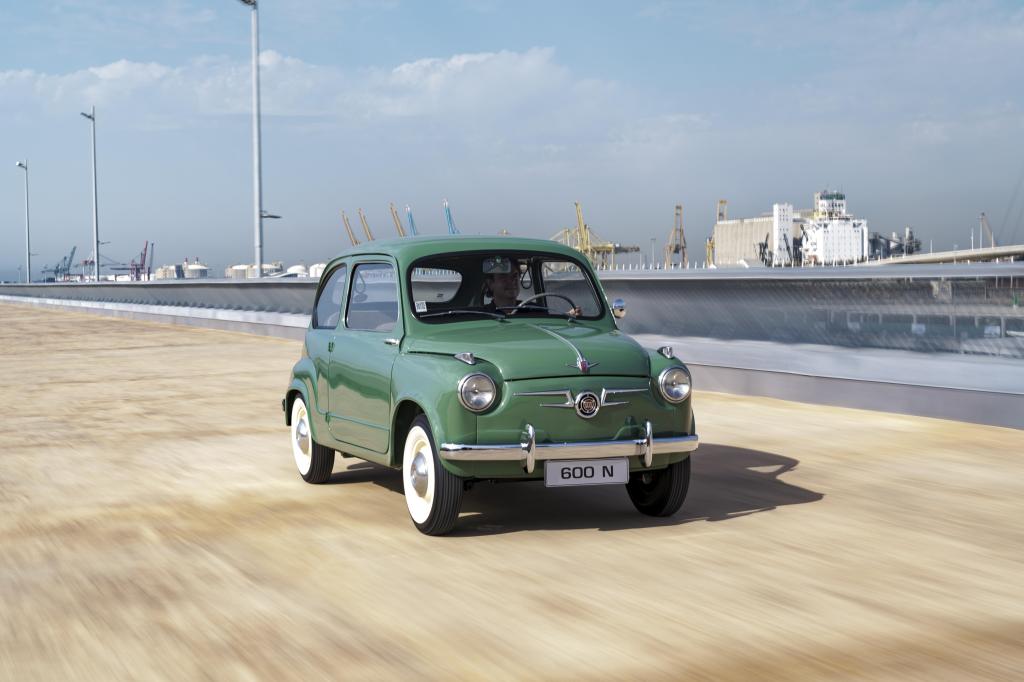
SEAT 600: One Cute Car

The fact that SEAT celebrated its 70th anniversary in 2020 was probably not all that notable for people who (a) don’t live or work in Barcelona or (b) aren’t automotive historians.

That said, the company was able to show off some of the vehicles that the company has launched (it says 75 over this period), including the SEAT 600, which was introduced in 1957.

(Image: SEAT)

And it is clearly one of the cutest cars you’re ever going to see.

According to SEAT, when the SEAT 600 was introduced, it was “the start of motorization in Spain. Back then, a motorcycle sidecar was considered a family vehicle.”

Which probably explains why this diminutive city car was said to be sufficiently sizeable to take mom, dad, four kids and grandmother on a trip, including luggage.

While nowadays, thanks in large part to Elon Musk, when people are now putting down deposits of varying amounts to hold their place in line for the purchase of a vehicle, it turns out the SEAT 600 was ahead of the curve: before the car went into production there was a waiting list two years long.

Admittedly, production rates then weren’t exactly what they are now, because five years into production SEAT had produced 100,000. So that would be an average of 20,000 per year.

Not a huge number.

By the time of the final model, the 600 L, in 1973, the SEAT 600 went out of production. Total build over the years the SEAT 600 was produced: ~800,000 units.

Not many cars. But cute.

Fiat’s Fortunes

Although 2020 sales will be reported next week—numbers that will probably down 10%-ish—a look at Fiat brand sales in the U.S. for the first three quarters of 2020 are such that it would take a proverbial Christmas miracle to have any effect on what is truly a dismal year for the Italian marque.

For the first nine months of the year, there were 3,569 Fiat vehicles sold in the U.S.

That is the total. For nine months. 3,569.

And that number is shared by four vehicles, the 500, 500L, 500X and Spider.

Compared to the same period in 2019, 3,569 is a decrease of 52%.

That’s right: more than half the sales of the brand: poof!

The vehicle that brought the brand back to the U.S. market when the 2012 model year was launched, the 500, is down 74% for the first three quarters. 662 were sold.

That decline is greater than any of the other three, though there wasn’t good news for any of them:

  • 500L:            -35%
  • 500X:           -46%
  • Spider:         -37%

So let’s say you’re in Fiat planning. Which vehicle(s) do you keep?

(Image: FCA)

Based on the fact that the company has released pricing for just one of the four, odds are there is one that will remain.

Because you are clever, you’ve seen the picture and know the answer: the 500X.

Presumably the logic is:

  • The decline in 500 sales is absolutely unrecoverable
  • The 500L is essentially a compact sedan that isn’t at all class competitive
  • The Spider is a sports car that doesn’t tend to move the needle for mainstream brands (although it is interesting to note that the Spider shares a platform with the Mazda MX-5 Miata and for the first three quarters of 2020 there were 7,503 Miatas sold—more than double the number of all Fiats sold in the same period)
  • The 500X is considered a crossover

Yes, that’s what matters.

Crossovers, presumably, have a future. Too bad there isn’t a 500 pickup.

In bocca al lupo. (Good luck)

Car Gigs Chuck Palahniuk Didn’t Take

Chuck Palahniuk, earlier this year, published Consider This: Moments in My Writing Life After Which Everything Was Different. In some ways, it is a book that writers who hope to be as successful as Palahniuk is can read so as to get some insights into the way Palahniuk went about getting to where he is.

Arguably, Palahniuk’s star went nova with the release of Fight Club in 1999, directed by David Fincher and starring Brad Pitt and some other guys.

And as everybody—particularly those who have perhaps not (a) read the book or (b) seen the movie knows—the first rule of Fight Club is “You don’t talk about fight club.” (What these people may not realize is that they also know the second rule of Fight Club, which is essentially see Rule 1.)

Anyway, in the world of freelance writing, one could imagine a rule that says, “You don’t tell people about jobs you didn’t get/take.”

However, Palahniuk reveals in Consider This a number of OEMs who wanted to take advantage of his celebrity to do advertising:

  • “First there was Volvo.” He relates that they’d wanted him to write a series of stories “about an obscure hamlet in Sweden where an enormous number of Volvos were being sold.” (Fun fact: the population density of Sweden is 64 people per square mile. The population in Germany is 623 people per square mile. “Obscure hamlet” is relative.) Palahniuk: “They were offering. . .tens of thousands of dollars.” He didn’t take it.
  • “After Volvo came BMW.” The Bavarian builder wanted him to write a series of short stories that would be turned into an audiobook, loaded onto a CD and provided to those who bought Bimmers. Given BMW’s approach toward audio entertainment, such as CarPlay, one imagines had he taken them up on the idea there would have been a line item on the Monroney for the disc. Fortunately for consumers, he didn’t accept the offer.
  • Here is a case of (1) the tentativeness of memory of (2) an indication that some people don’t quite care as much about cars than others. “In the year 2000 or 2001, Chevrolet offered me five thousand dollars for the right to mention Fight Club in a television commercial for the Ram pickup truck.” Ah, right.
  • And an example of artistic purity or insanity: Jaguar Land Rover “offered me a half million dollars to write a story that could be made into a film that would feature a Land Rover in some crucial, high-profile way.” Palahniuk notes, “And maybe I was stupid, but I still said no.” What can be said about that?
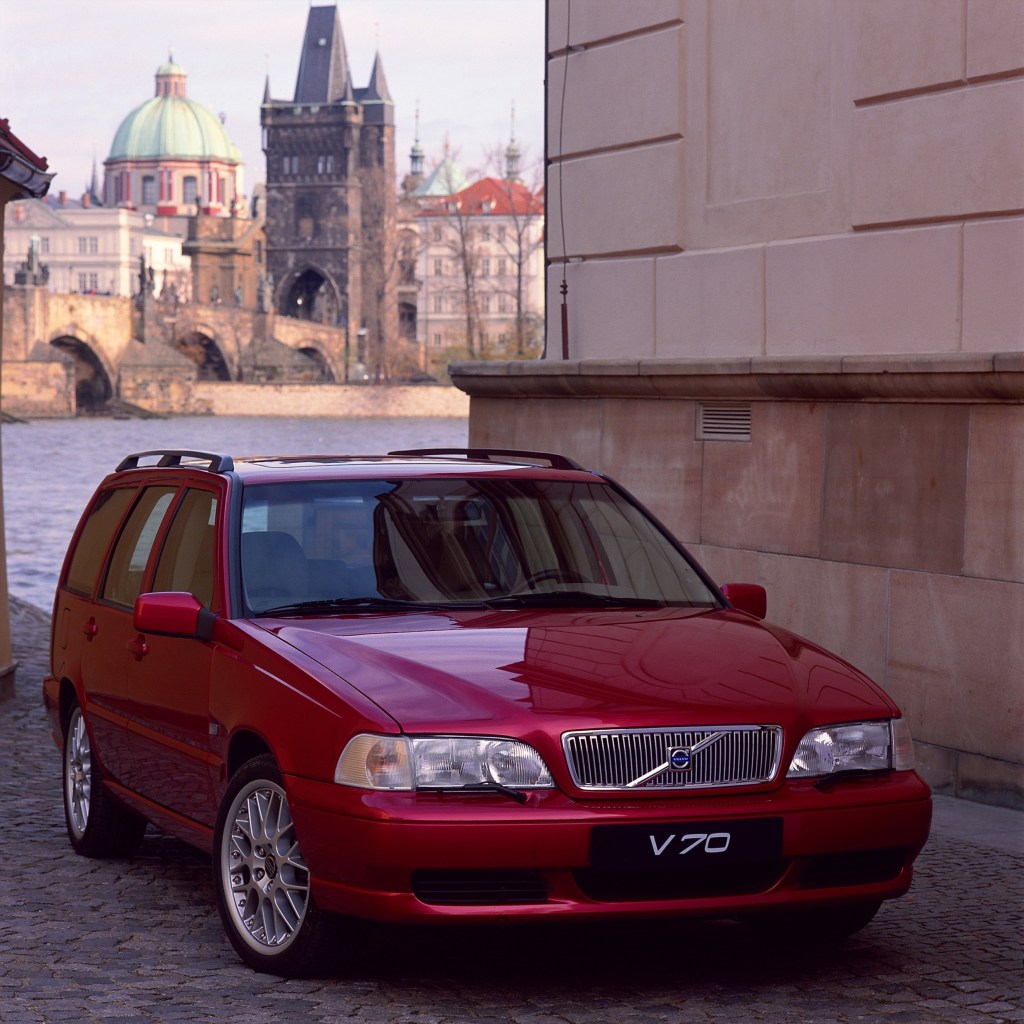
The Volvo 70 Series had a run from 1996 to 2016, so possibly this would have been featured in the stories about the obscure Swedish hamlet. (Image: Volvo)

2020 Sales Expectations: Not Bad. But Not Good.

12,386,000. That’s the number of new vehicles that J.D. Power and LMC Automotive estimate will be sold in the U.S. in 2020.

All in, this is a decline of 9.5% compared with 2019 sales.

Given COVID-19, surprisingly good.

What’s more, the average transaction price—that is, the price that people actually pay, taking cash back, incentives and other means to persuade people to buy—is expected to be $38,077, up 9% from 2019.

According to the researchers, because of the higher transaction prices, the vehicle manufacturers are not going to take quite as big a hit as the 9.5% decline in sales might lead one to expect: It is estimated that the total value of new vehicles purchased will be off just 4%.

December sales provide a bit of a boost because this is when luxury sales tend to make an upswing.

And for this particular December, J.D. Power and LMC calculate that trucks and SUVs—which generally have a higher sticker price than sedans—will account for 79% of all retail sales, up 4% from December 2019.

But here’s a question: is this a sustainable situation given the number of people in the U.S. who are currently unemployed?

According to the most recent figures from the Bureau of Labor Statistics:

“Among the unemployed, the number of persons on temporary layoff decreased by 441,000 in November to 2.8 million. This measure is down considerably from the high of 18.1 million in April”—good—“but is 2.0 million higher than its February level.” Not good.

“The number of permanent job losers, at 3.7 million, was about unchanged in November but is 2.5 million higher than in February.” Think of this: those people aren’t getting their jobs back.

“In November, the number of persons who usually work full time rose by 752,000 to 124.3 million”—good—“while the number of persons who usually work part time decreased by 779,000 to 25.4 million.” Not good.

Given the number of unemployed people, is it not likely that there were some people who, after the lockdowns were lifted, went out and bought a new pickup because they figured that they might as well?

While sales in 2021 will undoubtedly be better than 2020 (yes, a not particularly high bar), one wonders: How many people are going to find that their vehicle payments and their income just aren’t getting along very well?

Will Apple Get into the Automobile Business?

Although it is no secret that Apple had been operating a secret “Project Titan,” which was imagined to be its electric—and probably (at least semi-) autonomous—vehicle program, although it was said to have been disbanded, although it was said to be restarted after Doug Field was rehired, a Reuters’ report has gotten legions of Apple fanboys—to say nothing of the investment community—giddier than they already are when it comes to all things Apple.

The vehicle is back, it seems. Launch date: 2024.

Could this happen?

Apple CEO Tim Cook. (Image: Apple)

If so, they’d better start rethinking the Genius Bar and figure out how to install hydraulic lifts in the back of the stores.

As Elon Musk discovered—and it should be pointed out that he has Tweeted that he once wanted to sell out to Apple but couldn’t get a meeting with Apple CEO Tim Cook—building cars is hard.

And this is a challenge whether you’re a long-time manufacturer or someone who has just started within the past few years, trying to take advantage of the “simpler” production requirements of an electric vehicle, compared to one that has an internal combustion engine.

However, as Darren Palmer, global director, Battery Electric Vehicles, a Ford recently told me, “80% of a car is not the drivetrain.” Meaning that it is a challenge to make sures the doors fit, the plastic materials on the inside have consistent coloring, the fascias don’t fall off. And on and on.

Yes, hard.

Apple doesn’t manufacture its products. That is done for it by companies including Hon Hai Precision Industry (a.k.a., Foxconn), Wistron, Pegatron and so on.

So the likelihood of it building its own vehicles is non-existent.

It would have to work with a company that knows how to make things.

In the auto industry there are companies like Magna, which produces vehicles for companies including BMW, Mercedes, Toyota and Jaguar—and for Jaguar it manufacturers the electric i-Pace. Magna has recently entered into an agreement with Fisker. It is working on the engineering of the Fisker Ocean right now and will be performing the manufacturing when it is ready to go.

What’s interesting about Magna is that most people have no idea that it has manufactured so many vehicles.

That is the kind of company that Apple would need to work with.

It knows that building cars is hard (you can see an interview with Magna’s just-retired CEO Don Walker here, where he talks about how tough the task is). It knows how to build them with the highest levels of quality. And it does so while remaining discrete.

Let’s face it: It is one thing if someone has a problem with an iPhone that bends as it shouldn’t or a battery that doesn’t have the life it should and it would be something else entirely were that to be a full-size car or SUV.

Will Project Titan come to fruition?

If it does, Tim Cook will have his hands full. Just ask Elon.