According to the British trade association the Society of Motor Manufacturers and Traders (SMMT), through the first half of 2024 the car brand MG had 4.38% of the UK market.
While that may seem, at first blush, somewhat trivial, it should be noted that MINI was a 2.11%, Land Rover 3.26%, and Ford at 5.64%–and as for that last-named, I’ve been told by people who live there that Ford has been on the scene so long that it is considered indigenous to the U.K., and that Ford’s U.K. showroom has a breadth of offerings that dwarfs MG’s.
MINI is owned by BMW. Land Rover by Tata Motors. And MG SAIC Motor.
MG was established in Oxford in 1930 and had a run until 1972, when its then-owner British Leyland, which itself no longer exists, stopped using the marque.
SAIC has owned the brand since 2005. (It was purchased by Nanjing Automobile Group that year, then SAIC acquired Nanjing in 2007.)
Presently MG offers 11 models in the U.K. of which only four are pure ICE vehicles, with the remainder hybrids or EVs.
But next month a British company, Frontline Cars, is going to be bringing its MGB-based LE60 to Monterey.
The Frontline LE60. An MGB brought up to date with a V8. (Image: Frontline Cars)
Interestingly, this restomod is powered by a 375 bhp 4.8-liter V8. Frontline points out that this is “almost quadruple the power of the original MGB.”
But one wonders: while the company now selling vehicles carrying the MG badge are mainly non-ICE, doesn’t a V8-powered sportscar that is returned and updated from the past seem like some sort of curio?
Cadillac, in 2003, decided to really strut its stuff on the world stage.
It looked at competitors—BMW with its M line, Mercedes with AMG—and decided it needed a performance line.
So it created “V.”
“Take that!” it said, while offering additional engineering in models to make them perform at higher levels.
Then it upped things when it introduced the CT6-V Blackwing in 2018, a vehicle deploying the twin-turbocharged V8 engine that was designated “Blackwing.” Those vehicles also came with various aero and suspension mods.
And now. . .
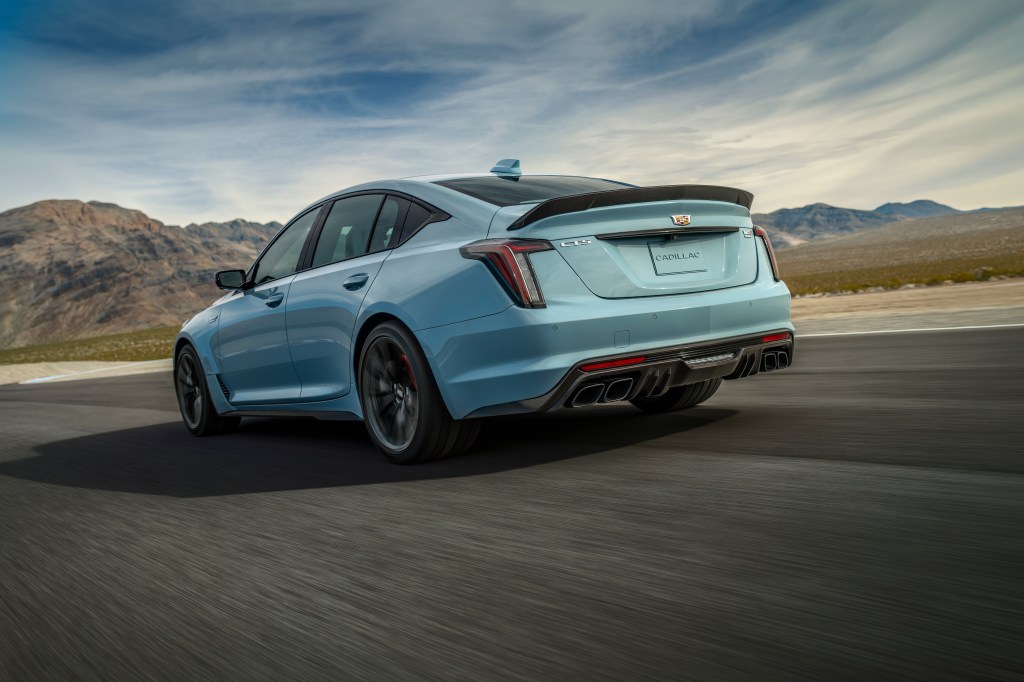
Earlier this year Cadillac introduced the 2025 CT5-V Blackwing.
Yes, it has a 6.2-liter supercharged V8 that pumps out 668 hp and 659 lb-ft torque.
Oh, and it’s a midsize four-door sedan.
Yes, you can drive it to Kroger.
One of the things that has happened in the U.S. in the era of V has been an increase in the number of private race tracks.
Rather than golf country clubs with lockers, these are special racetracks with garages.
Which probably goes a long way to explaining the 2025 CT5-V Blackwing Precision Package.
You could take it for a Sunday drive in the park—especially if it’s a private motorsports park: CT5-V Blackwing Precision Package. (Image: Cadillac)
“This new Precision Package will enable the CT5-V Blackwing to be incredibly light on its feet at all speeds — both on road and track.”
Odds are, this is not oriented for those who are going to get groceries.
This package is largely predicated on changes to the chassis including: increased spring rates. . .larger front stabilizer bar. . .new front steering knuckles and rear suspension toe links. . .recalibrated MagneRide dampers. . .carbon ceramic brakes. . . .
Yes, elements that make a difference when showing your stuff at the track on a Saturday afternoon.
But you’ll have to wait.
Production for the CT5-V Blackwing Precision Package will begin in early 2025.
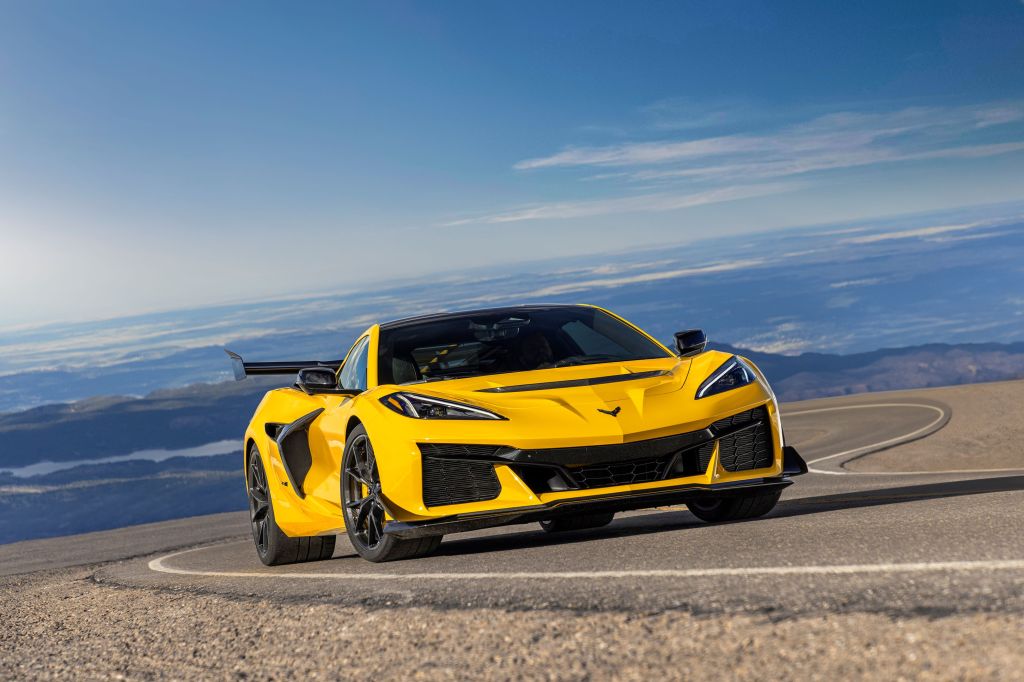
And while it won’t be launched until next year—and “launched” is a good word for this vehicle, the ’25 Corvette ZR1, while undoubtedly something that will be produced in limited numbers, will likely drive interest in the more readily available Corvettes.
The ZR1 is a special model, with its 1,064-hp 5.5-liter, twin turbocharged, DOHC flat-plane crank V8.
The car will have a top speed of over 215 mph.
And while it looks and certainly is fast, it won’t launch to the sky as there is a carbon fiber aero package that produces in excess of 1,200 pounds of downforce when the ZR1 hits top speed.
Now there are electric vehicles that have higher top speeds, though not many, and not readily accessible as at a Chevy dealer.
And the instant torque of an EV may be more impressive than the impressive 828 lb-ft that the ZR1 LT7 generates—at 6,000 rpm.
But the ZR1 will provide a visceral experience as well as the one predicated purely on acceleration.
This sensory suite of sound and vibration is simply something that cannot be as genuinely obtained in an electric vehicle.
At some point, after a sufficient number of enthusiasts, the type of people who would consider paying what is estimated to be on the order of >$180,000 for a car, haven’t driven combustion-powered vehicles, things like the ZR1 will fall out of fashion, undoubtedly being perceived as having insufficient refinement because of the very characteristics that make it so exhilarating to drive.
One of the issues related to things like roboshuttles, small bus-like vehicles that can operate autonomously, carrying, say, about a dozen passengers, vehicles that are often described as providing “last mile” transportation, is that for most people who need something for that last mile, as they’ve been needing it for a while they have undoubtedly figured out a method of accomplishing it.
It may not be the most efficient way, but it (a) works and (b) old habits die hard.
That chart shows roboshuttle companies going in the wrong direction. (Image: IDTechEx)
This could be one reason why research organization IDTechEx has found that between 2020 and 2024 the number of companies globally involved in the roboshuttle market went from 25 to 12.
A fairly sharp drop.
IDTechEX points out:
Navya, which was a leader in the space, had some issues that led it to be acquired by two companies, one of which is likely to acquire the company that they’d relaunched from the Navya acquisition
ZF has shifted from developing and building shuttles to producing hardware and software for autonomous operation; its shuttle business has been taken over by two other companies, Oceaneering and Beep
May Mobility, which had been operating compact bus-like vehicles from Polaris GEM, is shifting to using Toyota Sienna minivans, just like the ones you can pick up from a local dealer (albeit without the autonomous capability that May adds)
As IDTechEX puts it, “The primary challenge facing the roboshuttle industry lies in the difficulty of finding practical commercial applications.”
Practicality and financial viability are two elements that cannot be underestimated.
A midsize SUV with something of a rational but curious difference. . .
By Gary S. Vasilash
According to the U.S. Census Bureau, in 2023 the mean family size in the average household was 3.15 members. While it is not clear what constitutes the other 0.85, it is clear that there are fewer than four whole family members.
And according to the 2022 American Community Survey, conducted by the Census Bureau, in 2022 68.7 workers aged 16 and above drove to work alone, which is an increase over 2021’s 67.8%, but well below 2019’s 75.9%.
One more data point: while this is constantly changing, according to the U.S. Bureau of Labor Statistics, in August 2023, 19.5% of workers worked from home. Presumably that had an effect on the number of people who drove to work alone.
Mazda CX-70. Long enough for three, but with just two rows. (Image: Mazda)
All of this is to perhaps provide a rationalization for the interior configuration of the Mazda CX-70, a large-ish midsize SUV: 200.8 inches long, 78.5 inches wide, 68.2 inches high; as a reference, the Ford Explorer is 198.7 inches long, 78.9 inches wide and 69.6 inches high.
You look at those numbers and figure that we’re talking about the same proverbial ballpark in terms of size. And you’re right.
But what’s different about the CX-70 compared to the Explorer and many other SUVs in this large-ish midsize segment is that it has two rows of seats, not three.
Given all of the data about the number of people and vehicle use, seating for five is probably pretty much all one would need on a regular basis. Or an irregular basis there is that need for a third row, a space that is generally not particularly accommodating, especially for those who have moved on from elementary school.
Still, there is a tendency to opt for the “just in case,” so plenty of people buy three-row SUVs, even if that third row is always folded flat.
And Mazda offers the CX-90, which is the dimensional twin of the CX-70, though with the third row.
This additional complexity in the lineup is curious. As is the fact that when I visited the Mazda shopping site, the starting MSRP for a 2024 CX-90 was $37,845 and for a 2025 CX-70 $40,445, and while there are undoubtedly some content differences, it seems, well, odd.
But in terms of passenger roominess it is worth noting that the two vehicles have the same passenger volume: 141.6 cubic feet, which goes to the point of the third row inhabitants not being particularly happy.
Back to the vehicle at hand.
Like all the CX-70 trims, it is AWD.
It is powered by a 3.3-liter, turbocharged in-line six cylinder engine that produces 340 hp and 369 lb-ft of torque (with premium fuel). There is an eight-speed automatic transmission.
While Mazda has been known for the past few years of providing exterior designs for its lineup of vehicles that put it in a very small category of OEMs that are consistently innovating, the CX-70’s exterior design is certainly handsome, but it is not as distinctive as Mazdas have been.
It seems as though for the CX-70 they decided they’d put the focus on the interior design. In this Premium Plus package there are the 12.3-inch Mazda Connect center infotainment display, seven-inch TFT LCD instrument panel display, head-up display, Bose 12-speaker audio, Mazda Online Navigation with over-the-air update capability, wireless phone charging, keyless entry, and more.
What is surprising is not the Nappa leather for the seats or the two-tone leather-wrapped steering wheel. But the fact that there are suede inserts on the dash.
There is a wide range of driver assistance tech, ranging from traffic sign recognition to cruise control with stop-and-go capability.
Fitted with “Mazda Genuine Towing Accessories” it can tow up to 5,000 pounds.
The starting MSRP for the vehicle is $55,950.
While that is certainly understandable given what is listed on the sticker and in the general overall performance of the vehicle (though I did experience some turbo lag on occasion), what will probably make it difficult for people to opt for it is that seat delete.
One is making money. One is making progress. Slight progress.
By Gary S. Vasilash
In her Q2 2024 earnings letter to shareholders released yesterday, GM CEO listed the “four key drivers” of the company’s performance—and that performance includes record revenue in both Q1 and Q2—and it is interesting what the first item on the list of four is:
In North America, we have a consistently high performing portfolio of ICE trucks and SUVs on a volume, share and margin basis.
Now because the company is in the process of spending billions of dollars on EV technology, the second point on the list goes to EVs, although it doesn’t exactly sound robust:
Our EV portfolio is scaling well, and we’re encouraged by the early sales results, including record second-quarter deliveries and improving market share.
To put some data to that “scaling well,” in Q2 the company delivered:
7,294 Cadillac LYRIQs
6,634 Blazer EVs
1,374 Bolt EV/Bolt EUVs
1,013 Equinox EVs
2,196 Silverado EVs
2,926 HUMMER EVs
and to throw in for good measure a commercial product:
490 BrightDrop Zevo 400/600s
That is a total of 21,927 EVs sold in Q2.
Yes, there are increases in numbers.
The GMC HUMMER EV SUV (Image: GMC)
The LYRIQ was at 1,348 units in Q2 2023. And the HUMMER was at a mere 47 in Q2 2023.
But to put things into some context: the Chevrolet Malibu, which is going out of production later this year, had Q2 2024 deliveries of 36,360 units, or 14,433 more than all the EVs combined.
And isn’t the accepted wisdom that “Nobody buys sedans anymore?”
If we look at ICE truck or SUV numbers. . . well at this point it isn’t even a fair comparison.
But Barra goes on to write:
“To unleash the next cycle of EV growth, we’re scaling production of the Chevrolet Equinox EV. . . . Then over the next several months, GMC will launch the Sierra EV and the Cadillac LYRIQ will be joined by the OPTIQ, Escalade IQ and CELESTIQ.”
On the one hand, this is completely understandable for at least a couple reasons.
For one, there are those billions spent on getting capacity, so they need to use it.
For another, regulations are going to require the sale of more EVs, especially to offset the sales of things like trucks and large SUVs (e.g., in Q2 there were 151,112 Silverados sold).
That said, one wonders: Given the increasing popularity of hybrids, why is there no discussion of that in the forthcoming product portfolio?
Those associated with paint shops in this case. . .
By Gary S Vasilash
While there is a considerable—and justified—amount of attention paid to tailpipe emissions, there is also plenty of spew associated with the production processes that create those cars and trucks.
Like when the vehicles are painted.
You know how fresh paint has a pungent fragrance?
That is generally the result of things like volatile organic compounds that are not particularly good for the environment.
So in automotive paint shops there are measures taken to clean the exhaust before sending it out the smoke stacks (a.k.a, chimneys).
This includes running the exhaust through a bed of ceramic media that is at very high temperatures—as in 1,000 degrees Celsius.
To get those temps natural gas is usually deployed for the ovens.
BMW has completed testing on a method that uses electricity from renewable sources to achieve these temperatures.
It’s called eRTO—for “electric regenerative thermal oxidation).
BMW is installing paint shop equipment that will help clean exhaust using electricity from renewable sources rather than natural gas. (Image: BMW)
Says Michele Melchiorre, head of Production System, Planning, Tool Shop, Plant Construction at BMW Group:
“For other energy-intensive paint shop processes, such as vehicle drying and water heating, solutions already exist for working without natural gas. So, electric exhaust purification is the final steppingstone for the BMW Group to run its paint shops on regenerative energy in the future.”
And that future is pretty much now in BMW plants in Germany and China, where eRTO is working along side the natural gas process.
Next year, a new BMW Group plant in Debrecen, Hungary, will have eRTO only.
When someone refers to the “Motor City,” it is typically thought of in terms of cars.
But Detroit is (1) on the Detroit River and (2) located in the “Great Lakes State.”
Which brings us to Sharrow Engineering, a Detroit-based advanced engineering and design firm.
And within Sharrow Engineering there’s Sharrow Marine, which produces propellers for outboard motors.
The company has just launched the Sharrow X10 for Mercury V10, 350- and 400-hp engines.
Sharrow X10 propeller provides operational advantages in the water. (Image: Sharrow Marine)
The propeller, which is CNC machined from a stainless-steel alloy, “offers superior performance, greater fuel efficiency, and a significantly quieter ride,” according to Greg Sharrow, the founder and CEO of the company.
Here’s an interesting thing: Greg Sharrow invented the propeller design not while pursuing advances for outboard motors. Rather, he was working in video production and worked to develop a quieter drone.
It was determined that by reducing or eliminating tip vortices there is significant noise-reduction—as well as the other benefits that are achieved for the propellers used in water.
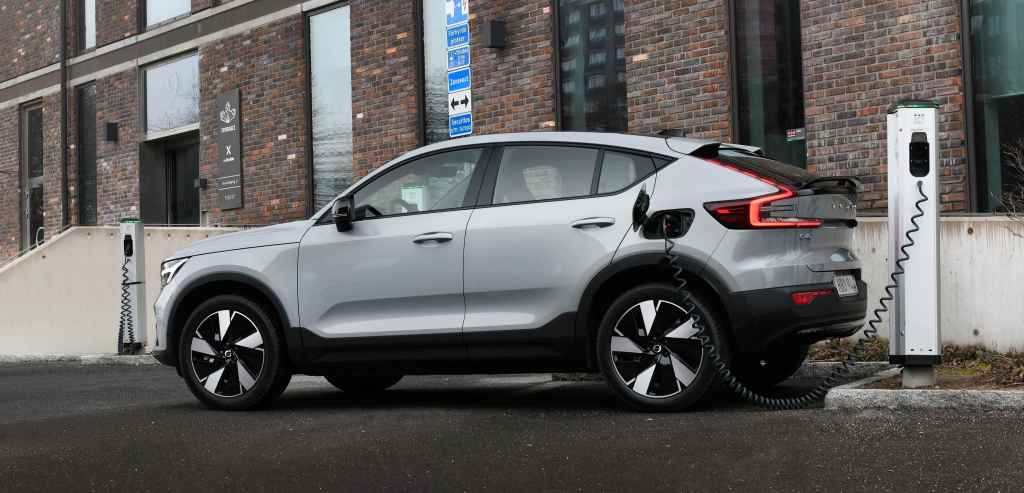
The Volvo C40 Recharge is, as its name implies, a vehicle that needs recharging because it is an electric vehicle. A small SUV. But a stylish small SUV, as it has what is, for SUVs, a coupe-like roofline, sloping back. In fact, arguably it is the most stylish among the Volvo SUVs, of which there are numerous (XC90, XC90 Recharge, XC60, XC60 Recharge, XC40, EX90, XC40 Recharge, and the forthcoming EX30.)*
The XC40 Recharge is the C40 Recharge with a different top on it. It is what is historically the more Volvoesque of the two, meaning it is boxier. And style comes with a bit of a price, and not just in terms of MSRP, although there is that, too (C40 Recharge starts at $53,600; XC40 Recharge starts at $52,450).
Dimensionally the two vehicles are the same with the exception of one thing.
They are both 174.8 inches long and have a 106.4-inch wheelbase. They are both 80.1 inches wide.
But the C40 Recharge is 62.6 inches high and the XC40 Recharge is 64.8 inches high.
A consequence of that difference is that the C40 Recharge has a cargo capacity of 49 cubic feet and the XC40 Recharge has 57.5 cubic feet back there, so it is a non-trivial difference.
Volvo C40 Recharge: Charge and go. (Image: Volvo)
Still, it is not like the C40 Recharge is lacking in capacity. And sometimes you just have to sacrifice a bit to standout with more style.
And speaking of styling, the vehicle has great-looking 20-inch wheels, which add presence to the exterior. I must confess that I am not wholly engaged yet with the replacement of a grille with a solid slab with the badge affixed in the middle.
One of the interesting things about this vehicle is that it comes with a four-year subscription to the Digital Services Package. While some OEMs want to have their own digital setup, Volvo is working with Google so that this vehicle has Google built-in, as it were, so that there are native Google Maps, Google Play Store and Google Assistant. And that four-year package provides all these.
(And perhaps not entirely coincidentally, there is 48-month/50,000-mile limited warranty coverage (48 months = 4 years), and complementary factory scheduled maintenance for the first four years or 40,000 miles. Four years evidently is a key metric vis-à-vis the C40 Recharge.)
The C40 Recharge is Volvo’s first leather-free vehicle. One of the available material options is a wool blend seating fabric that is an exceedingly nice alternative even were leather to be available. In fact, it speaks to the style of the vehicle: A man’s suit in leather looks, well, goofy (or creepy) in most wearings (sure, some guys can get away with it, but they are few and far between); a good wool suit is stylish and classic regardless of the person inside.
Of course, as this is an electric vehicle, we’ve got to get to the battery-related things.
The “Extended Range” in the name of the vehicle goes to the 82-kWh battery that provides an estimated range of 297 miles on a single charge. And on the subject of charging, on a Level 2 (11 kW) charger, such as you might get installed in your garage, it can be charged from 10% to 90% in eight hours; with a DC fast charger, 20 minutes will take the battery from 10% to 80%.
This vehicle has a single 248-hp motor driving the rear wheels. Although people talk about a benefit of EVs is their ability to go quickly quickly, there is another characteristic that is beneficial for driving: their comparatively sizable mass provides a sense of solidity, which combined with the power means a feeling of improved control.
Having said plenty of positive things about the style I do need to point out something that I found understandable but unusual.
Because the rear glass (a.k.a., backlight) is at a somewhat fast angle, the view from the rearview mirror is truncated. Yes, there are 360-degree cameras when maneuvering, say, out of a garage, and there are highly noticeable blind-spot detector warnings in the side mirrors. But still, a glance in the mirror to see what’s going on back there is not fully informative.
The usual part is that the C40 Recharge has a “panoramic” roof—essentially, with the exception of what amounts to a frame, the whole roof provides a fulsome view of, well, the sky. Not exactly handy, of course, when you’re driving.
A remarkable EV gets some remarkable performance. But if efficiency, range and economy are of interest. . .
By Gary S. Vasilash
Credit to Lucid Group for what it says is “the most efficient and thus most sustainable vehicle made,” the 2025 Lucid Air Pure.
5.0 miles per kWh of energy? Huh? (Image: Lucid Motors)
The vehicle achieves a 146 MPGe EPA rating. This means it achieves “a landmark 5.0 miles per kilowatt hour of energy.”
More to the point of people without a slide rule handy, this means the Lucid Air Pure can travel an estimate 420 miles before requiring recharging.
According to the EPA, the Lucid Air Pure is in the Large Car Category. For those who are looking for something a bit more economical than the $69,900 starting MSRP, there’s the 2024 Hyundai Ioniq 6, which provides an MPGe of 140.
It also starts at $42,450.
But back to the Lucid Air Pure.
It is interesting that suddenly things like range and efficiency become important metrics for vehicles.
According to the EPA, the 2024 Honda Accord Hybrid has the best fuel efficiency among non-full-EV vehicles in the Large Car Category: a combined 48 mpg.
This means than on its 12.8-gallon tank of gas, it can travel 614 miles, or 194 miles further than the Lucid Air Pure.
And while no one is likely to cross shop an Accord Hybrid with a Lucid Air Pure, the former has a starting MSRP of $32,895, which means that compared to the Lucid , you could buy two and have money left for gas.








 shinymetalboxes