Lots and Lots of Tacomas

By Gary S. Vasilash

As John McElroy points out at the top of this edition of “Autoline After Hours,” in 2023 Chevy sold 71,081 Colorados, GMC 22,458 Canyons, Ford 32,334 Rangers, and Nissan 58,135 Frontiers.*

That is a total of 184,008 midsize trucks.

And another number: 234,768.

That’s the number of Toyota Tacomas sold in 2023.

There were 50,760 more Tacomas sold than all of the others on the market combined.

Clearly a popular truck.

Now there is a new generation Tacoma, one designed, engineered and manufactured in the North American market because that’s where the preponderance—and it is clearly quite a preponderance—of vehicles sold.

2024 Tacoma. Badass. (Image: Toyota)

During the development of the ’24 Tacoma an objective was to create a “Badass adventure machine.”

It was configured to be capable.

It was configured with several trims—SR, SR5, TRD Off-Road, TRD PreRunner, TRD Sport, Limited—so there would be a bandwidth available for buyers.

Because Toyota is committed to providing electrified variants of all of its vehicles, the Tacoma was fitted with an optional hybrid powertrain, a propulsion system that provides 326 hp and 465 lb-ft of torque.

Because Toyota is still interested in providing something for those off-road enthusiasts (and to the economy buyers) who are interested in a third pedal, there is a six-speed manual available.

Sheldon Brown, chief engineer for the new Tacoma, talks with McElroy, Richard Truett of Automotive News, and me on this show for an entire hour.

If you’re interested in Tacomas specifically or trucks in general, it is worth your time.

==

*Who would have thought that Nissan outsold Ford in trucks?

Volvo, Polestar & Geely: Adjustments Being Made

By Gary S. Vasilash

Volvo Cars CEO Jim Rowan said on CNBC this morning about Polestar, the EV brand that it has some 44% of the shares of:

“They’ve have got a very exciting future ahead of them, they’ve moved from being a one-car company to a three-car company, they’ve got two brand-new cars coming out very shortly, in fact in the first half of this year, and that’s going to take them to a new growth trajectory.”

Sounds good, right?

But then there’s the fact that the reason Rowan was interviewed on CNBC is because Volvo Cars has announced it is going to reduce its holdings in Polestar.

Volvo Cars and Geely Holding essentially own Polestar.

In a press release from Polestar it says, in part,

“Volvo Cars is evaluating a potential adjustment to its shareholding in Polestar including a distribution of shares to its shareholders, with Geely Sweden Holding being the primary recipient. Volvo Cars will remain a strategic partner in areas across R&D, manufacturing, after sales and commercial.”

Which one could read as:

Geely China and Geely Sweden are going to own the majority of Polestar. So it is Geely, pure and straightforward.

Given that Geely owns Volvo Cars, there are probably just some bookkeeping adjustments being performed in Hangzhou. In Gothenburg the books are getting some line items removed so there can be an increased focus on its vehicles.

One wonders: Is this a further sign that the EV slowdown is having some consequences, especially on new OEMs trying to grow up?

Making MINIs

By Gary S. Vasilash

MINI, a quintessentially British brand, is owned by BMW, a company with a German state in its name.

Last fall BMW announced an investment of more than £600 million in the MINI factories at Oxford—yes, as in the place that also has the university—and Swindon—the place where the Wernham Hogg office that merged with the Slough branch in “The Office” was located.

About the investment Milan Nedeljković, Member of the Board of Management of BMW AG responsible for production, said, “With this new investment we will develop the Oxford plant for production of the new generation of electric MINIs and set the path for purely electric car manufacturing in the future.”

MINI Aceman. No, that isn’t the production paint. It is undergoing final tests–evidently in Arizona, given that license plate–before production starts for the EV in a plant in China. (Image: MINI)

The MINI Cooper 3-door and the MINI Aceman, both EVs, will go into production in the U.K. in 2026.

Going back to the owner of the brand’s HQ country, it isn’t entirely surprising that the MINI Countryman is made in Leipzig.

What may be a bit of a surprise, however, is where the Aceman will soon start production: at a plant in Zhangjiagang, Jiangsu Province, China.

About the Aceman, Stefanie Wurst, head of MINI said, “The all-electric MINI Aceman opens new opportunities for customers who want a smaller crossover than our successful MINI Countryman. The consistent electrification of our product portfolio makes a clear statement about the future of the MINI brand.”

The Aceman is based on a new EV platform developed by BMW and Great Wall Motor.

U.K. . . .Germany. . .China.

Mr. Bean couldn’t have imagined this.

Fisker: They’re Dealin’. They Hope.

By Gary S. Vasilash

Today Fisker is holding a meeting at its HQ in Manhattan Beach, California, for prospective dealers.

Sort of like someone going into a dealership thinking about buying a given vehicle. Kicking the tires, as it were.

Fisker has had a direct sales approach, which seems to be de rigueur for new energy vehicle companies.

But it has decided that it might be more efficient—or effective—to go the old-school route and sign up some dealers.

However, as part of its “Dealer Partnership” model, it will ask that its dealers offer no-haggle pricing, where that is permitted. And it will allow dealers to have larger chunks of geography than is typically the case with dealerships, particularly in urban areas.

The first element is presumably good for customers—as in customers who don’t want to treat their buying experience as some sort of swap-meet event.

The second element provides a dealer with greater odds of moving some metal without having to compete with the dealer down the street.

According to Fisker chairman and CEO Henrik Fisker, “Over 120 dealers in North America and Europe have expressed interest in our new Dealer Partnership model.”

Of course, there is interest and there is signing on the bottom line.

So far, Fisker has gotten one dealer to sign on. It is in Europe.

GM EVs: Let a Smile Be Your Umbrella

By Gary S. Vasilash

In GM CEO Mary Barra’s letter to shareholders for the Q4 2023 results it reads, in part:

“In our EV business, we expect our U.S. portfolio will become variable profit positive in the second half of the year based on our current expectations for EV demand and production growth, strong interest in our vehicles, lower commodity prices and other factors.

“It’s true the pace of EV growth has slowed, which has created some uncertainty. But many third-party forecasts have U.S. EV deliveries rising from about 7% of the industry in 2023 to at least 10% in 2024, which would mean another year of record EV sales. 

“We believe our competitive position will improve throughout the year, based on higher production of the Cadillac LYRIQ, GMC HUMMER EV, Chevrolet Blazer EV and Silverado EV Work Truck. We’re also excited to have the Chevrolet Equinox EV and Silverado EV RST, the GMC Sierra EV Denali and the Cadillac Escalade IQ arriving in showrooms over the course of the year.”

There is something to be said for optimism. And given that GM is investing billions in EV development and production, optimism is better than the alternative.

In her Q4 2022 letter to shareholders Barra wrote:

“By leveraging U.S.-made battery cells produced by our Ultium Cells joint venture and the scalability and flexibility of the Ultium Platform, we are accelerating production of the Cadillac LYRIQ, GMC HUMMER EV and BrightDrop Zevo 600, and we will launch exciting vehicles like the Chevrolet Silverado EV, Blazer EV and Equinox EV. This keeps us on track to produce 400,000 EVs in North America from 2022 through the first half of next year.”

For the full year of 2023, rather than just the first half, GM sold 75,883 EVs. About 19% of that 400,000. Even if we add in the 2022 EV sales, 39,096, to the full year ’23 sales, that is 114,979, or about 29% of that 400,000.

Yes, GM will sell more EVs in 2024 than it did in 2023.

And it will be a good thing if the EVs it sells are “variable profit positive” by the second half of the year.

But consider: in 2023 GM’s total U.S. sales were 2,594,698 units. That means the 75,883 EVs represented about 3% of total sales.

If industry sales of EVs this year are “at least 10%,” what is the likelihood that GM will come close to reaching that number?

The Return of the Minivan?

By Gary S. Vasilash

Since the start of the contemporary minivan with the Chrysler Voyager, Dodge Caravan and the Plymouth Voyager in November 1983, that type of vehicle has had its ups and downs in the market. Mainly downs after the notion that it was a vehicle for “soccer moms.” One can imagine that when that meme was established Landon Donovan’s or Mia Hamm’s mothers probably didn’t want to be seen in one.

But from a packaging point of view, it is hard to think of anything better than the configuration of the minivan.

Perhaps the forthcoming VW ID.Buzz electric minivan will change the perceptions of what a minivan is.

In other parts of the world, there is nothing diminutive (i.e., “mini”) about the boxy vehicles (no matter what aero effects are deployed, let’s admit it: these are shaped more like shoeboxes than Stingrays).

Elsewhere they are called “MPVs,” or “multi-purpose vehicles.”

The purposes seem to be carrying people and stuff, so there isn’t a whole lot of multi about them.

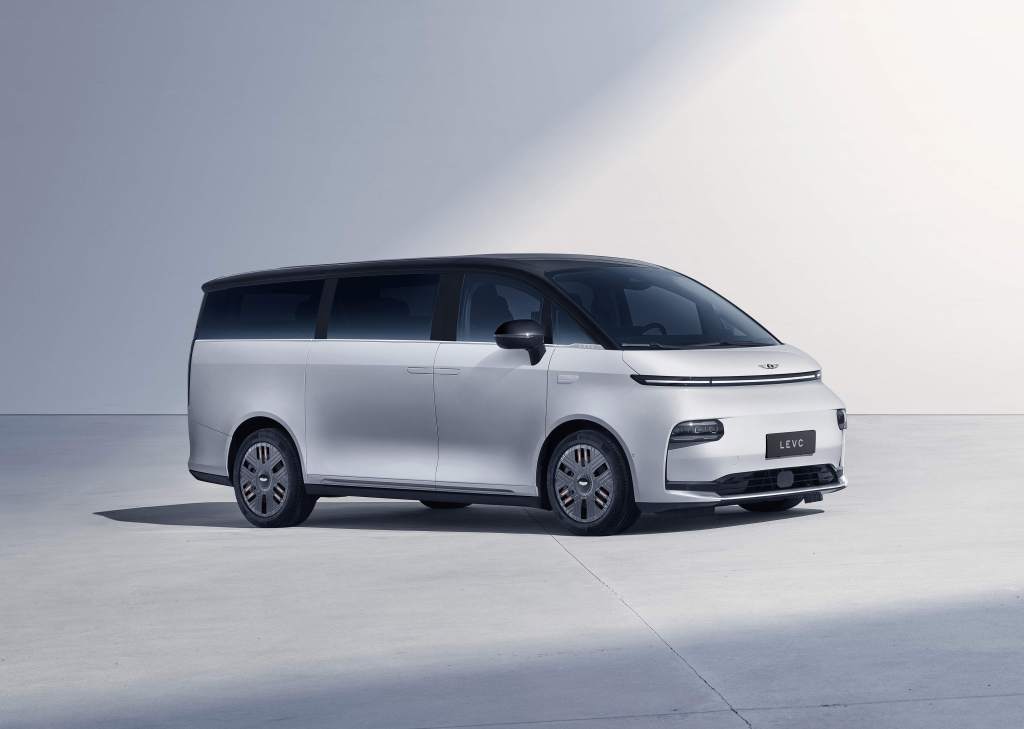
The L380, electric MPV. (Image: LEVC)

LEVC—the London Electric Vehicle Company, the firm that produces the TX, the hybrid-electric (it has a range extender) black cab that is rolling through the streets of London and elsewhere—is extending its transport offerings by putting into pilot production in a plant in Yiwu, China, the L380, a fully electric MPV.

Alex Nan, LEVC CEO, described the vehicle as “the next step forward in the company’s globalization strategy, as we rapidly accelerate our transition from manufacturing the world’s most advanced and iconic taxi, to becoming a leading e-mobility technology company.”

LEVC is a Geely Holding Group company. Which means it is related to Volvo and Polestar, Lotus and Lynk & Co., and others.

The L380 is based on the Geely Space Oriented Architecture (SOA), which is an underpinning that can be deployed for lots of vehicles, including those that aren’t vans.

The L380 will initially launch in China and then is expected to be delivered into the U.K. in about two years.

After that. . . ?

What’s the Real EV Demand?

(A Look at Western Europe)

By Gary S. Vasilash

Although Western European vehicle buyers have consistently been more bullish on buying electric vehicles, even there things are beginning to shift according to analysis by Schmidt Automotive Research.

According to its “European Electric Car Study,” there were 1.96 million battery electric vehicles sold in the West Europe region in 2023, a 28% year-over-year improvement, which means 16.9% of the total automotive market.

But it could it have better, as there was a 25% decline in December 2023 compared with the final month of 2022, which resulted in a decline for 5% for Q4 ’23 compared with ’22.

One of the reasons for the decline: “various purchase subsidies and lower tax incentives being stripped away.”

Looking ahead into 2024, Schmidt Automotive predicts:

“Auto executives will need to wrap up and buckle up as the market begins to see a chill easterly wind arrive, with discounting expected to be the keyword of the year, accompanied by protectionism to defend against an increasingly aggressive attack from Chinese manufacturers, as states hope to buy some time for key regional employers giving them space to restructure their business and become more competitive in the new e-mobility age.”

So let’s break this down:

  1. EV demand fell as consumer subsidies and tax incentives declined
  2. Discounting will be the condition this year, which means an advantage for the consumer and bad news for the manufacturers

The Chinese manufacturers are providing inexpensive products. Yes, they happen to be EVs, but would low-cost ICE vehicles be any less appealing?

At some point the “free money” for EVs is no longer going to be available.

Which leads to a question of what the real demand for the vehicles is.

Perhaps not as much as some OEM execs would like to think.

Useful Info for Those Going Fast

By Gary S. Vasilash

Cadillac, undoubtedly having a cadre of people on staff who know that there is still a whole lot of interest in the market for luxury sport sedans with internal combustion engines (even if there aren’t necessarily a whole lot of buyers), have given the CT5-V and CT5-V Blackwing a bit of refreshing, although keeping the 360-hp 3-liter twin-turbo under the hood of the CT5-V and the 668-hp 6.2-liter V8 in the Blackwing.

One of the primary mods is the deployment of a 33-inch diagonal LED color touchscreen.

2025 Cadillac CT5-V Blackwing showing its 33-inch-diagonal LED color touchscreen display can provide some useful information for those who are driving their car on the track really, really fast. (Image: Cadillac)

Some implementations of large screens seem rather gratuitous, as though there isn’t certainty of what ought to be on the screens (e.g., does there really need to be pictures of things like album covers?), but seeming absolute certainty that the screen needs to be there, as large as possible.

But in the case of the CT-5 Vs, they are offering a Performance Data Recorder that provides a wealth of info for those who take their cars racing, with everything from a Lap Analyzer tool—which Cadillac claims is something that heretofore was the sort of thing that one would need a laptop to process—to a live data screen in the center stack, which isn’t so much for the driver, but for the passenger who can provide real-time coaching for the driver.

Clever, those folks at Cadillac.

Skip the May Pole. Grab a Banner Instead. (Really?)

By Gary S. Vasilash

A country’s GDP—gross domestic product—is a measure of the value of goods and services produced for sale. A higher GDP is generally a reflection of comparatively higher economic health for a given country compared with others.

According to the United Nations, the top 10 countries measured on GDP per capita are:

  1. Luxemburg
  2. Ireland
  3. Norway
  4. Switzerland
  5. United States
  6. Demark
  7. Netherlands
  8. Sweden
  9. San Marino
  10. Belgium

What do all of these countries have in common?

They are not generally associated with wide-spread labor actions (a.k.a., massive strikes).

The U.S. Bureau of Labor Statistics has released information about union membership rage in the U.S.: 10%, or 14.4 million workers. That 10% is flat compared with 2022.

The BLS started tracking these numbers in 1983. Back then there were 17.7 million union workers. That represented 20.1% of the workforce.

And while many people (likely you, as you are reading something about the auto industry) might think that the auto industry is where there is the greatest number of represented workers, turns out that in the private sector the number-one industry for union workers is utilities, at 19.9%. Then the BLS buckets transportation and warehousing at 15.9%, followed by educational services (12.9%) and motion picture and sound recording (12.9%).

If people are interested in money first and foremost, then union membership is certainly a positive, as the median weekly earnings for a union worker in 2023 was $1,263 compared with $1,090 for a non-union worker.

Which brings us back to the list.

On Monday, speaking at the UAW national political conference in Washington, DC, UAW president Sean Fain said that he wants an organized strike, a general strike, a mass strike across the board, to occur on May 1, 2028.

“We want everybody walking out just like they do in other countries.”

If GDP is important, then one wonders about the wisdom of emulating the labor practices or activities of other countries where it isn’t particularly high.

People deserve good pay, benefits and working conditions. But somehow a scheduled across-the-board strike doesn’t seem to articulate the needs of a utility worker, which are probably different than those of a barista, which are coincidental at most with a university teaching assistant, which are undoubtedly not the same as someone working the line in a Chevy plant.

Buick: Wouldn’t You Rather Have One?

By Gary S. Vasilash

If there is someone who is quintessentially American, that person has to be Dale Earnhart, Jr. It is hard to imagine how difficult it would be to live up to the legend that his father was, but Dale Jr. was able to make his own way into the annals that is NASCAR.

Like many former drivers, Earnhart owns car dealerships. One of them is Dale Earnhardt Jr. Buick GMC in Tallahassee, Florida.

Like many dealer websites, there is an array of vehicles for sale presented and an immediate pop-up that shows they are willing to engage pronto with prospective customers.

But there is something that is different than is the case on many dealer websites, which is a Q&A section.

And one of the questions that is presented and answered is:

“Is Buick American?

And the answer begins:

“If you’re considering a new Buick vehicle as your next Thomasville, GA car or SUV, you may be wondering, is Buick American? The answer is yes.”

And it laudably goes on to acknowledge that the brand builds vehicles in places that aren’t within the U.S., like Bupyeong, South Korea (Encore GX), and Shanghai, China (Envision).

Yes, you read that right: the Buick Envision is built in China. Which is something to think about when the rhetorical question is raised: “Will Americans buy Chinese vehicles?,” as though this is some sort of question about the future. It isn’t. And the answer is yes.

The Buick Envista is also made in South Korea.

This leaves the Buick Enclave, which is made in the U.S., at the Lansing Delta Township plant in Michigan.

GM has been building vehicles in Lansing for a long time. Ransom E. Olds built a plant there in 1901. (Olds, unfortunately, ceased to exist in 2004.)

While some people wondered about the viability of Buick, here’s Duncan Aldred, vice president, Buick and GMC:

“As the fastest growing mainstream brand in the industry in the U.S.last year, 2024 promises more big things for Buick, spearheaded by the launch of the next-generation Enclave.”

Sketch of the 2025 Buick Enclave. No, it won’t have square wheels. (Image: Buick)

Last year Enclave sales, 39,411 units, were up 29.1% compared to 2022.

But Envision sales, 44,281 units, were up 71.2% and Encore GX, 64,149 units, were up 92.4%.

Which seems to indicate that at least so far as 2023 goes, they were busier in Bupyeong and Shanghai than they were in Lansing.

Perhaps the forthcoming version of the stylish Enclave will help boost things in Lansing.

And probably at Dale Jr.’s dealership in Florida, too.