Cadillac Back at Le Mans

Will the participation move the metal?.

By Gary S. Vasilash

The old line has it: “Win on Sunday, sell on Monday.”

Which basically goes to a point of why OEMs participate, particularly, in NASCAR.

This is a bit of a problem, however, for Chevrolet, as it races the Camaro in NASCAR and that vehicle has been out of production for a while, so fans of William Byron, Chase Elliott, etc. would be out of luck at their local Chevy dealers.

But another brand has hopes that seem somewhat quizzical because the relationship between what is available for sale and what is on the track is largely a logo.

“We’re thrilled to have Cadillac Racing return to the 24 Hours of Le Mans with four cars competing for the overall win in the Hypercar class,” said John Roth, vice president, global Cadillac.

Hypercars are to showroom Cadillacs what Wagyu beef is to dusty gas station beef jerky.

Roth continued: “After scoring our first podium finish at this iconic endurance race in 2023 and securing a top 10 finish last year, we look to build on that success and showcase the Cadillac V-Series.R’s technology, performance, and innovation with our 2025 entries.”

In 2023 Cadillac finished third and fourth.

In 2024 it qualified second and third in the Hypercar category and its best finish that year was seventh.

The cars have a special Cadillac 5.5-liter V8 developed by GM’s Performance and Racing Propulsion team that operated in Pontiac, Michigan.

The cars, designed and developed by Cadillac Design and Cadillac Racing, are constructed by Dallara.

Cadillac first went to Le Mans in 1950. Then skipped it until 2000. It raced in 2001 and 2002, too, before giving it a pass for a few years.

The 24-hour race will be contested June 14 and 15. The 15th is a Sunday.

What is the likelihood Cadillac dealerships will see a bump in buyers on the 16th?

This is actually one of the two Cadillacs the company campaigned at Le Mans in 1950. It was nicknamed “Le Monstre.” (Image: Cadillac

2025 Volkswagen Taos SE Black

A study in competency—which is mainly why people want to get a vehicle

By Gary S. Vasilash

(Images: VW)

One of the things that is probably going to happen in the market given the high prices of vehicles—high prices that people are having a difficult time affording (sure, they might be able to get a low(ish) monthly car payment, except that by the time they pay off the loan, were they to have given birth to a child the day they bought the car, the kid would be old enough to get a driver’s license by the time it was paid off).

While it once was that ±$20,000 was the point people considered to be where “economy” resided for vehicles, it is now ± $30,000.

As is the case with age, 30 is the new 20.

Which brings me to the 2025 Taos SE Black, which has a base MSRP of $30,145.

About Black

It should be noted that the “Black” is a trim level for the vehicle that includes, well, features like two-tone paint that includes. . .black on the roof as well as black 18-inch wheels (for the FWD version or 19 for the AWD) and black mirror caps and a black illuminated grille. One feature that it brings that isn’t black is the panoramic sunroof, but it provides more illumination of the extensive use of piano black plastic on the instrument panel.

However, the 2025 Taos in S trim starts at $24,995, so while it is closer to that $20K of days gone by, that’s still about a 25% bump, which is a non-trivial thing.

This is a subcompact SUV, which might lead some people to hear alarm bells, in that they think “compact” is “small” so “sub” must be “mirco.”

Sizeable

It is not particularly small.

It has a wheelbase of 105.5 inches, length of 175.9, width of 72.5 and height of 64 inches. It offers 99.5 cubic feet of passenger space and there is bona-fide utility, as there is  27.9 cubic feet of cargo space with the seats in place and 65.9 cu ft with the second row folded down (again, for the FWD version; packing for that 4Motion system takes away a bit of that capacity: 24.9 cubic feet behind the second row and 60.2 cubic feet with it down, so if stuff handling is a bigger concern than, say, driving in the snow, that decrease in capacity is something to keep in mind).

Inside

Circling back to the black theme, the interior, in addition to the aforementioned piano black, is mainly gray-on-gray, with differences in hues, but still gray so far as the seats, door cards and other surfaces on the vehicle driven. There is nice white stitching on the seats which adds a perceptible bump in visual aspects. The upholstery material in the SE Black are a combination of cloth and what VW calls “CloudTex,” which has a suede leather-like appearance, although it is not made from animals. The material is used on the IP and door panels for trim, too. On the surfaces that people are not likely to touch (e.g., top of the IP) there is a hard(ish) plastic that is grained so it looks appropriate but doesn’t include padding that is otherwise not going to bring anything to the party beyond price.

The 8-inch infotainment screen is centrally located (it is described as being “semi-floating,” which simply means that it is ahead of the main IP surface) and easy-to-use. The higher trim level (SEL) includes navigation, but in the case of the SE Black I used Waze through Apple CarPlay; wirelessly pairing the phone with the vehicle was simply simple. And in addition to two USB-C points with 45-w fast charging below the screen in a bin, there is a wireless charging pad in that space.

Power

The Taos is powered by a 1.5-liter four-cylinder engine that produces 174 hp and 184 lb-ft of torque. It is mated to an eight-speed automatic.

The fuel economy numbers are 28 city, 36 highway and 31 mpg combined, and I got 31 mpg during my city and highway driving. Imagine.

The thing that strikes me about the Taos is that things like the Atlas SUV notwithstanding, VW has a depth of knowledge when it comes to the execution of smaller vehicles.  The Taos does what it is supposed to do, and that matters a lot.

The Shift in Gearbox Preference in the U.K.

No, not everyone drives a manual in the U.K.—a lot do, but the number is declining

By Gary S. Vasilash

One of the things that isn’t often taken into account when looking at the number of vehicles sold in a given time period is that that number is additive to what exists on the road at that time.

Last year S&P Global Mobility calculated the average age of light vehicles in the U.S. was 12.6 years old.

From the standpoint of vehicles in operation (VIO) last January there were 286 million vehicles rolling around in the U.S.

So making a change (e.g., percentage of overall EVs in operation) will take a considerably longer time than might be thought.

An example of this are numbers from a British automotive data company, cap hpi, on types of transmissions in vehicles on the U.K. roads.

It found that at the end of 2024 automatic transmissions are in 29.3% of the U.K. car parc.

Which means more than two thirds of the vehicles are still manuals.

Yes, they found there is a considerable uptake in the number of automatics and a decrease in those buying vehicles with manuals: over 1.5 million new vehicles with automatics registered in 2024; 274,000 with manuals registered.

And the trend toward automatics is seemingly going to continue.

Unlike in the U.S. where a driver’s license is a driver’s license, in the U.K. there are differences in terms of the gearbox.

Stacey Ward, senior data director at cap hip, noted, “Additionally, more new drivers are opting for automatic-only driving licenses. In 2012, there were just 550,000 drivers with automatic licenses. In 2022, there were over 1.1 million, with this figure expected to continue to increase. Estimates suggest that by next year, a quarter of learners will qualify with a license limited to automatic cars only.”

The proverbial die has been cast.

EU Powertrain Picture

Seems that gasoline is still reasonably popular. . .

By Gary S. Vasilash

The good news for companies in the European Union that make things like con rods and pistons is that according to the most recent vehicle registration figures from the European Automobile Manufacturers’ Association (ACEA) people are still buying vehicles that use internal combustion engines.

Its figures for January 2025 show that 29.4% of EU new vehicle registrations in January were for “petrol” powertrains.

The number in January 2024 was 35.4% petrol power, so clearly things are moving in the wrong direction for those in the business of making engines and the components thereof.

However, looking at the numbers for hybrids, things appear in a different way.

In January 2024 hybrids represented 28.7% of the new registrations in the EU.

But in January 2025 hybrids are at 34.9%.

So while there was a 6% decline in petrol registrations between the two months, there was a 6.2% increase in hybrid registrations.

And hybrids, of course, use internal combustion engines, too.

So if we sum the figures, 64.3% of the new vehicle registrations in the EU in January have internal combustion engines.

If the plug-in hybrids are added (7.4%), that gets to 71.7% of the market.

Electric vehicles?

They’re 15% of the January 2025 new vehicle registrations, which is a move toward the upside compared to January 2024, when EVs were at 10.9%.

However, EU regulations regarding CO2 emissions are such that 20% of the vehicles sold by automakers must be zero emissions.

If the ~37% increase from January 2024 to January 2025 for EVs holds, there is not going to be a problem reaching that figure.

Still, presumably when the 20% rule was written it was a stretch goal but not one thought to be wholly unattainable.

At the end of the day, the Market will decide on what powers its vehicles.

Screen Gem

LG Display’s big display goes into production for Sony Honda Mobility. . .

By Gary S. Vasilash

The AFEELA 1 from Sony Honda Mobility is expected to have initial deliveries in mid-2026.

According to the company, the AFEELA 1 “pursues an interactive relationship between people and vehicles through the integration of advanced software and high-performance hardware, resulting in intelligent mobility.”

Presumably part of that “interactive relationship” is based on the screen that goes from A-pillar to A-pillar.

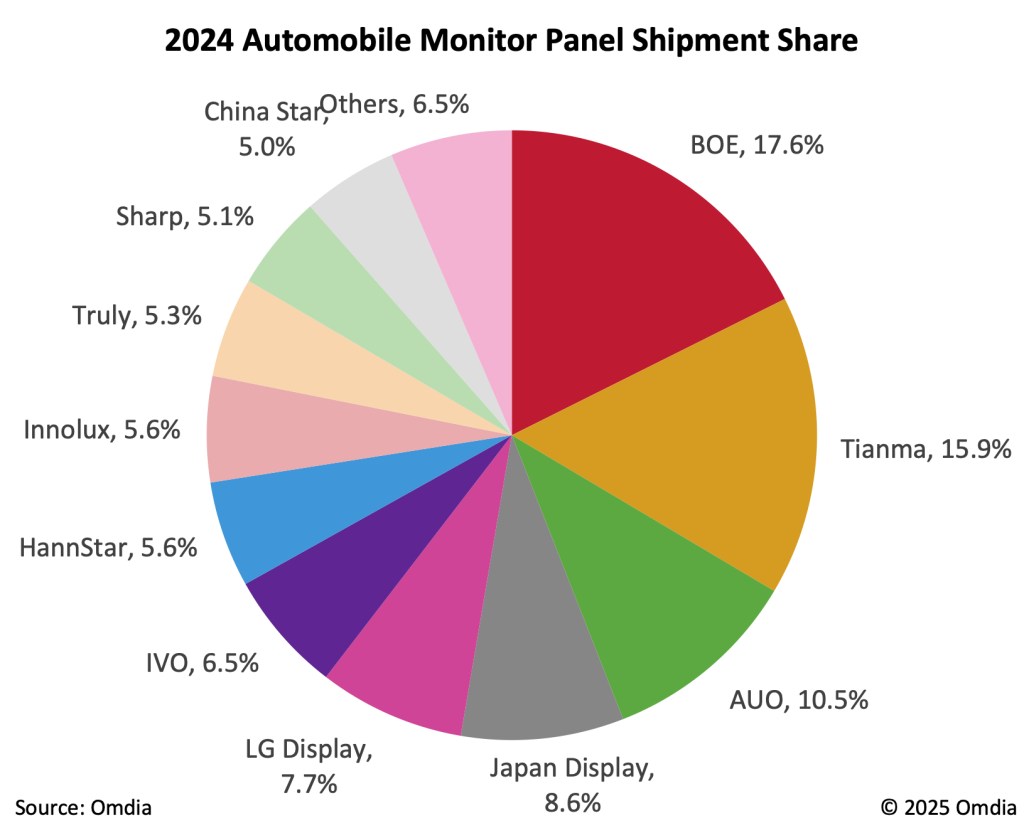
LG Display announced that it has started mass production of the 40-inch screen, which it says is the first of its type.

That’s a lot of screen. (Image: Sony Honda Mobility)

According to the company the screen “raises user convenience by allowing the simultaneous display of advanced infotainment functions, from a digital dashboard and navigation to climate control, movies, music, and even games – all without screen transitions.”

Of course, having a driver watch a movie while driving certainly isn’t ideal (and illegal). The screen features something called “Switchable Privacy Mode” that uses “viewing angle control technology.” This means the driver can’t see what’s visible on the screen to the front passenger.

And because energy conservation is something that is important for electric vehicles, the screen has “local dimming technology,” which reduces both heat generation and power consumption.

Who would have thought a screen in a car would generate heat?

Of course, who thought a screen in a car would be 40 inches long?

2024 Toyota Prius Prime SE

The Prius just keeps going. . . .

By Gary S. Vasilash

I suspect there is really nothing that “sells itself.” Sure, there are things that someone might need and go out and buy because of current conditions—like the people who make a run on snowblowers at Home Depot both before and after storms: no one needs to sell that equipment to the buyers.

But when it comes to things like automobiles, the number of people who have a sudden need and are capable of dropping a few grand to accommodate that need is probably quite small.

As is often pointed out, a vehicle is generally the second biggest purchase that someone makes, so consideration is involved in the process.

Still, if there is any type of vehicle that “sells itself” today, it is a hybrid.

Even though there is massive attention paid to electric vehicles, in 2024 hybrids (including the plug-in versions) had 11.9% of the total US light-duty market while EVs accounted for 8.1%.

And when is the last time you heard anything about a new hybrid? And compare that with the paid-for advertising or earned media (coverage in various outlets, including this one, often predicated on the loan of a vehicle by an OEM for assessment) for electric vehicles.

If not “selling themselves,” then people are becoming more interested in going hybrid.

The first Prius was available in the US market in July 2000. Which means it is coming up on its 25th anniversary.

Through the years the Prius has been both lauded and chastised. And it seems more the latter than the former.

There has always been the claim that because there are two powertrains (the internal combustion engine and the electric motor(s)) in a hybrid, it is too expensive for regular consumers—and the knock is often made by companies that were rolling out with electric vehicles that were significantly expensive, far more than the price of a Prius.

Consistently, Prius sales have been by mass manufacturing metrics “meh.”

Last year 44,711 were sold, and 38,052 the year before.

But it should be noted that in 2024 Toyota brand sold 546,738 hybrid vehicles in the US as the company now offers vehicles ranging from the Corolla to the Sienna to the Tundra with a hybrid powertrain.

Toyota seriously has the hybrid power and the consumers have a lot of choice.

The Prius, while having styling that has ranged from the dowdy to the bizarre, currently has an appealing look.

Looks good and you can drive and drive and drive before you need a fill-up. (Image: Toyota)

When the current body style was launched in 2023 in the US it was so striking that it was named the 2024 North American Car of the Year by the jury of the North American Car, Truck and Utility of the Year Awards, besting both the Honda Accord and the Hyundai Ioniq 6.

The last time the Prius won was in 2004, besting the Mazda RX-8 and Cadillac XLR, neither of which exist in contemporary production.

People have consistently wanted to get a Prius, and Toyota has consistently provided them.

The vehicle driven here is a plug-in hybrid. (The “Prime” moniker goes away for MY 2025 vehicles, at which point it simply is Prius Plug-in.)

If you’re not familiar with what that means, know that in the case of the Prius, on the rear quarter panel on the driver’s side you pop the door to fill the car with gas and on the opposite side there is an outlet to plug the car in either at home or at a Level 2 charging station.

This means there is full-electric range for the vehicle—up to 44 miles (based on ideal conditions).

It should be noted, however, that if you’re plugging it in on a standard 120-V outlet at home, it is going to take 11 hours to fully charge the battery. If you stop at a commercial Level 2 charger, then it will take about four hours.

When you go to the gas station, it will take you about five minutes to fill the tank.  The Monroney sticker says you’ll get 52 mpg city/highway combined, so with about 11 gallons in the tank that means over 500 miles from the liquid fuel.

But perhaps (1) you have a daily commute that is 40 miles or under and you don’t like visiting gas stations and you do have an outlet in your garage or (2) you are exceedingly environmentally conscious and don’t like combusting gasoline if you don’t have to. Which would make the plug-in version right for you.

The Prius (powertrain notwithstanding) now has a sporty look on the outside and a low seating position signifying sportiness on the inside. While this is appealing to some people, it will probably turn off others. But Toyota has more than a dozen other hybrids to choose from, so that’s covered.

There is a Prius with FWD, a Prius with AWD and the plug-in with FWD.

The first provides system (i.e., engine and motor(s)) horsepower of 194. The AWD version delivers 196 hp. And the plug-in has 220 hp.

There is a discernable difference with the +20 hp for those who are so inclined.

The SE is the base model. Cloth. Eight-inch screen. Manual seats. But a sticker under $33K.

But were you to go for the less powerful but base non-plug-in FWD Prius, you’d get 5 mpg more and spend a few grand less.

While the increased horsepower is nice, I think the 57 mpg is nicer.

However, some people want an EV but don’t have the money to buy one.

The Prius plug-in could be the answer. If the average American drives 40 miles per day and the plug-in provides approximately that range, there you go.

What’s more, when you need to drive from, say, Detroit to Chicago, you can do that, too, without having to think about making a long stop along the way for recharging because the gasoline engine will get the job done—in fact, you could drive there and more than three quarters of the way back without needing to stop for any kind of fuel.

Bugatti: From W16 to the V16

Yes, the company is going hybrid. . .

By Gary S. Vasilash

The Bugatti W16 Mistral, said to be the world’s fastest-ever roadster (453.91 km/h; 282 mph), is the last hurrah for the W16 engine, and the first of the last Mistrals has just been built at the Bugatti Atelier in Molesheim, France.

As the car produces 1,577 hp and has a starting price of about $5-million, most people on planet Earth won’t notice its absence.

This is what the W16 engine looks like:

You might want to bookmark this because it is a Bugatti W16 engine, which will soon be a memory for most but otherwise housed in the garages of a handful of really rich people. (Image: Bugatti)

You might think that something with 16 cylinders and four turbochargers would be enormous, it is because of the W configuration—think of two Vs (as in V8s) side-by-side, but with the Vs having a very narrow angle. But in point of fact the engine is comparatively compact.

It has to be, given that the two-seater is 179 inches long, 80 inches wide, 47.6 inches high and has a 106.7-inch wheelbase.

So what follows the W16?

The Bugatti Tourbillon with a normally aspirated V16.

The output of that car is 1,800 hp.

It is a hybrid.

There are two 250-kW motors on the front axle and another 250-kW on the rear.

According to Bugatti it will accelerate from 0 to 62 mph in two seconds.

How fast is that?

Well, it is estimated that reading speed is 250 words per minute.

This sentence has been read in approximately two seconds.

Maybe Software Isn’t Their Strong Suit

Things don’t necessarily get better with time. . .

By Gary S. Vasilash

In the J.D. Power 2022 Initial Quality Study, which looks at how owners feel about vehicles they’ve had for 90 days, things had gone south compared to the study performed for 2021.

The research organization has released figures for the 2025 U.S. Vehicle Dependability study, which is based on how owners feel about their vehicles three years later.

Not so good at the start. Not so good now.

That is, J.D. Power uses a metric called “problems per 100 vehicles” (PP 100).

The 2025 study finds that the industry average is 202 PP 100, which is a 6% increase (or 12 PP 100) compared to people who had owned their vehicles three years last year.

The primary problem is software.

Connecting Android Auto and Apple CarPlay to the vehicle is the top problem. Odds are, this is a problem with the OEMs, not the folks in Cupertino or Mountain View.

J.D. Power says that half of the top 10 problems are related to smartphone integration, usage or connectivity.

Now one of the features that is being boasted about by vehicle manufacturers is “over-the-air” (OTA) update capability. This means just like for your smartphone software can be sent to your OTA-capable vehicle and functions can improved or fixed.

Of those surveyed for the 2025 study, 36% said they’ve performed an OTA during their time with their vehicle.

Then the proverbial shoe drops. . .

• 30% of those owners said there was an improvement after the OTAs. Or 70% evidently didn’t see much in the way of a change.
• 56% said there was no noticeable improvement. Which presumably means that if that 70% perceived hints, this 56% saw nothing.

OEMs are busy working on “software-defined vehicles.” Which means, in part, there can be improvements to a vehicle over its lifetime by the addition of new functions and features. . .through OTAs.

Given what J.D. Power is finding there are probably a lot of people who are not going to speed to their local dealerships when the software-defined vehicles become available.

And it leads to the question of whether the OEMs are really any good at software.

To be sure, things have gotten better between now and then, but odds are if you own a three-year old iPhone or Samsung Galaxy, it was good when you got it and is good today. And there are new features to your phone between then and now, and odds are they work as expected.

Some companies are just better in some areas than they are in others, even if they don’t want to admit it.

2025 Hyundai Sonata Limited Hybrid

The future is now. . .

By Gary S. Vasilash

As the Grand Transformation to Electric Vehicles seems to be somewhat less transformative than we might have been led to believe by industry executives who were “all in” with varying levels of commitment (e.g., “We will be all electric by ____,” a date that is no longer uttered), there is a move back to hybrids.*

The knock on hybrids, since the Toyota Prius showed up on American roads in 2000, was that there are two powertrains (the regular engine and electric motor(s)), so that wasn’t going to be acceptable.

Except they were accepted.

And that two powertrain quibble gave rise to the “too expensive” mantra.

Now there is a move by some of the hybrid-skeptical companies to say, “Hey, we’ve got them, too! We’ve been behind them all along!”

(Insert polite coughing sound here.)

Hyundai has been offering a Sonata Hybrid since model year 2011.

Consistently.

But if there’s anything to know about Hyundai, the company is consistently producing vehicles that are stylistically and functionally advanced.

Although the 2025 Sonata Hybrid is a carryover from model year 2024, it still looks 10 years more innovative than anything out there.

Looks sensational and sips gas. (Image: Hyundai)

And it should be pointed out that the Limited trim driven here is the top-of-the-line (there is also the entry SEL trim).

So, going back to that “hybrids are too expensive,” know that this hybrid has a starting MSRP of $37,450. The one driven had a single option: $210 for floor mats.

Before looking at the Monroney for the car I guesstimated it would cost $50,000.

Not because of the “two powertrains are too expensive” schtick.

But because (1) it looks lux and (2) it is loaded.

Let’s roll through just some of the features on the vehicle:

  • Blind-spot and surround-view monitors
  • Parking collision-avoidance assist (for example: you can see on the 12.3-inch screen where the vehicle is in real space when you are backing out of a parking space, which is incredibly handy in lots that are designed to maximize the number of spaces and minimize the amount of space between them)
  • Panoramic sunroof
  • Leather seats
  • Heated and ventilated front seats
  • LED interior lights (this is something that needs to be seen because the difference between the illumination from them and the traditional incandescent lights is remarkable)
  • Bose premium audio
  • Power closing trunk (which really seems a bit too much, but when you look at how the trunk hinges, something that most people pay approximately zero attention to, are designed and integrated, you know that this is something that is conceivably beyond my $50K estimate to lux space)
  • And this list could go on to the extent that your eyes will glaze over, so as there are a few more things to say, I’ll stop

The vehicle has a 2.0-liter four-cylinder engine that is mated to a permanent magnet synchronous motor. The engine provides 150 hp. The motor 51 hp. And the way these things work, the sum of the two is not 201 hp but a combined 192 hp. The whole hybrid give-and-take is a tricky business.

Now this is a large-ish four-door sedan. It is 193.3 inches long, 73.2 inches wide, 56.9 inches high, and has an 111.8-inch wheelbase. It has a passenger volume of 104.4 cubic feet (i.e., it is roomy) and the aforementioned trunk has a 15.6-cubic foot capacity.

Its curb weight is 3,687 pounds.

All of which is to say that given the capacity of the engine and the size and weight of the vehicle, it is capable of propelling you when you drive—surface streets or freeways—as you probably normally drive. No head-snapping when you stand on the throttle, because 99.9% of the time—give or take a 0.1%–you are not feeling that you have to prove something when you are in a four-door midsize sedan, type of powertrain notwithstanding.

The reason people drive hybrids is not to sate their need for speed but because they don’t have a need to spend a whole lot of time at a gas station. The EPA numbers for the Sonata Limited Hybrid are 44 mpg city, 51 mpg highway, for a combined 47 mpg.

Hard to quibble with what it is or how it delivers the kind of fuel economy people are looking for.

==

*It should be noted that Hyundai does have EVs, including the Kona Electric, the Ioniq 5 and the Ioniq 6. But it also offers hybrids in the Elantra, Santa Fe and Tucson.