
2026 Lexus LX 700h Overtrail

Yes, you can take it off the beaten path. But would you? (I wouldn’t)

By Gary S. Vasilash

I will admit that I am sometimes—not all the times, but some—mystified by some vehicles that are engineered to be taken off-road.

Now let’s say that someone can afford more than one vehicle. One is for fun and the other function. The fun one could be an off-road vehicle.

But a question becomes how much that fun is going to cost relative to the amount of fun experienced through the use of that product.

That is: Say you buy a ticket for Cedar Point or Kings Island or some other place predicated on excitement and rather than going on a roller coaster you spend your time in the snack bar. The price of that ticket is largely based on the use of the rides. (You certainly don’t want anyone to skimp on the maintenance.) And there are plenty of snack bars on the other side of the turnstiles that don’t charge a fee to get in.
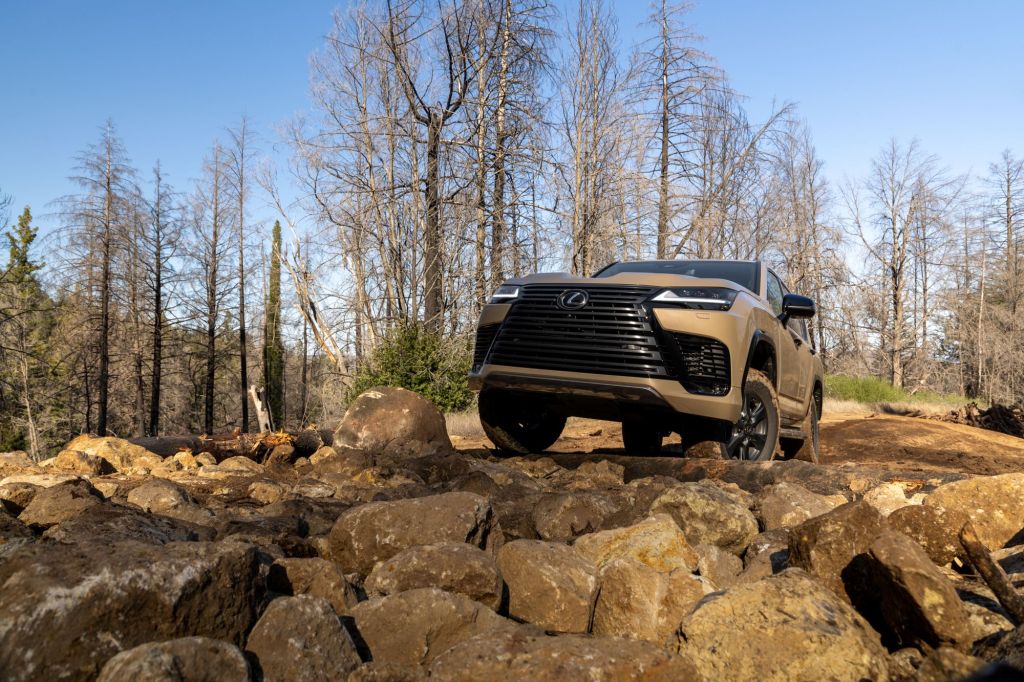
This may be the only time you see a Lexus on rocks like these. (Images: Lexus)

So if you buy the ticket but don’t take the ride you’re not going to have the thrill of someone who takes advantage of the venue.

Similarly, I suspect, someone who buys an off-road-capable vehicle could think “I can go anywhere and do anything” or “This will show Henry next door that I’ve really made it with my new set wheels” and that is enough to justify the buy. Apparently.

While the percentage of people who actually take off-road-capable vehicles off road is fairly small—I’ve found no numbers above 5%–that’s still a market for the OEMs to address.

Certainly some off-road vehicles are simply quintessential, like, say, the Jeep Wrangler or Ford Bronco. These are vehicles that almost beg to be taken off the tarmac—in part because when they are on the tarmac the ride experience isn’t particularly good (and even if an argument is made that the suspension setups can be adjusted for a non-rock-strewn surface, there’s no getting away from the semi-defining sound of the large, chunky tires and little in the way of noise-attenuating countermeasures).

But then there’s something like this, the Lexus LX700h Overtrail.

This is a large (200.59 inches long; 78.35 inches wide; 74.61 inches high; a 112.2-inch wheelbase; 8.07 inches of ground clearance—all of which is to say that (1) the various sensors and cameras are key for things like maneuvering in parking lots and (2) you’d probably pull a muscle were you to try to climb into the cabin without a running board) magnificent beast—with the word beast, of course, in the context of the Disney version of The Beauty and the Beast, with the Beast reverting back to an elegant prince).
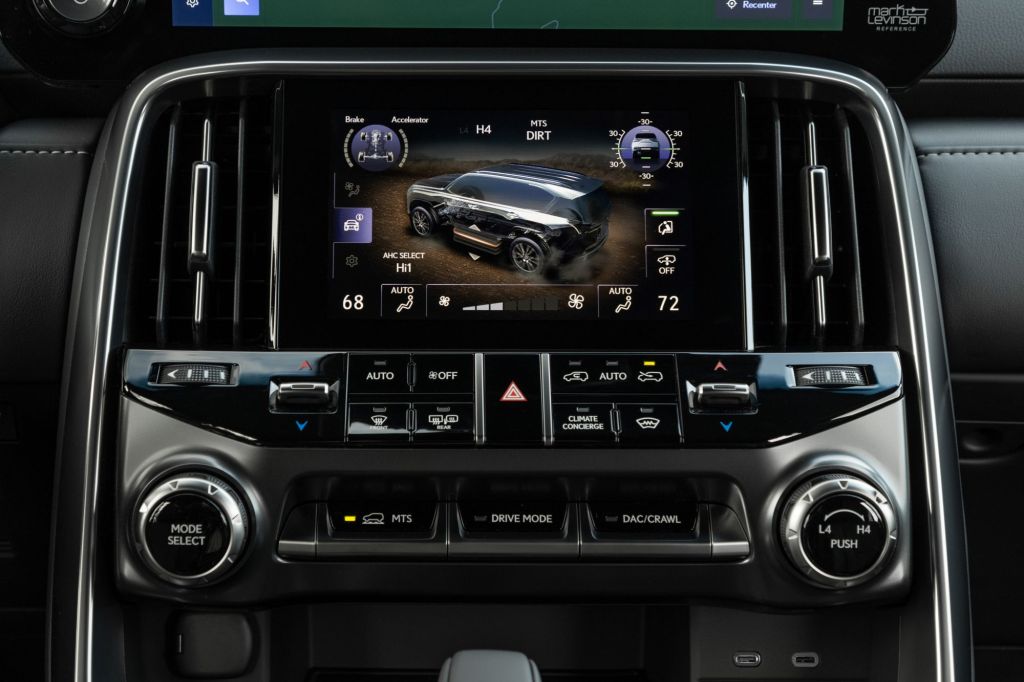
That is the smaller of the two screens, primarily focused on the various off-road settings and parameters. Odds are it will be like the additional software people never use on their laptops.

The LX700h is based on the TNGA-F platform, which is also used for the Toyota Tundra pickup truck, a vehicle that is engineered anticipating that it will have the stuffings knocked out of it (and I suspect more pickup owners use the capabilities of their pickups than the owners of off-road vehicles do of their machines).

You may have noticed the “h” in the name of the SUV. Yes, that stands for hybrid. Which might lead you to think that the vehicle might be Prius-like in its performance. Which is not the case.

Rather, this hybrid setup, which supplements the V6 engine with a 48-hp electric motor so there are 457 hp produced as well as 583 lb-ft of torque at 2,400 rpm. A key point of the hybrid setup is to help generate that high torque at comparatively low rpms. Also, it aid the gasoline engine when the vehicle is towing (with an integrated tow hitch it has an 8,000-pound towing capacity) or going up a hill or the like.

The LX 700h Overtrail has front and rear locking differentials, 18-inch wheels and 33-inch all-terrain tires.
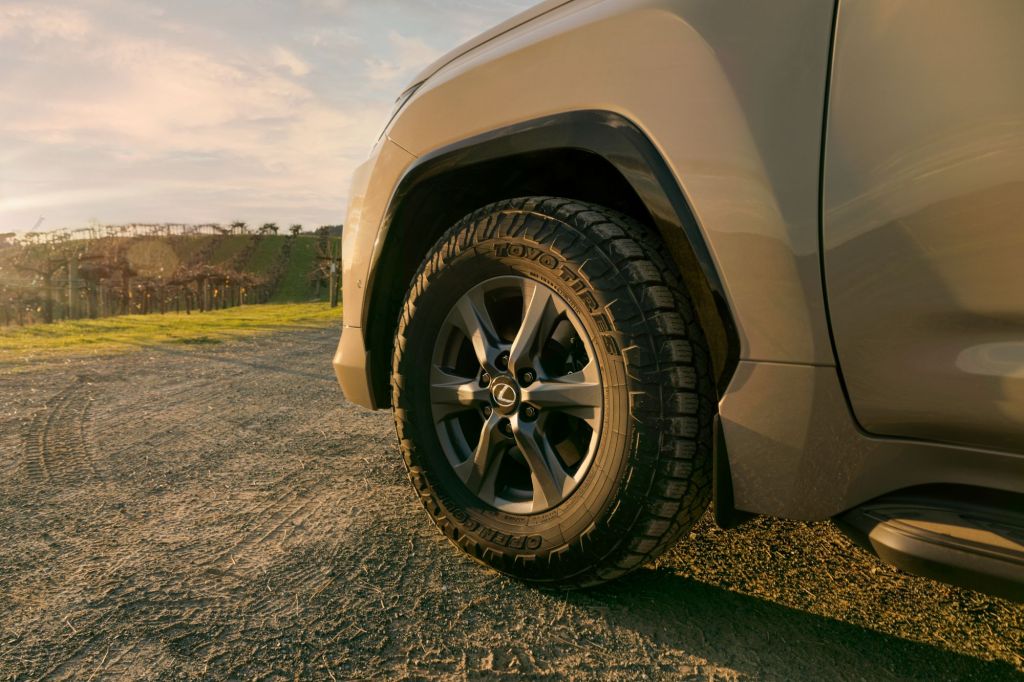
Ready to roll over the tough terrain.

But it is a Lexus first and foremost.

As such it has semi-aniline leather seating, which is probably nicer than any furniture in your house. Plus, the front seats are heated and ventilated, which is likely not the case with any at-home furniture. It has open-pore wood trim. It is, in a word, luxe.

Yes, there are things like a 12.3-inch infotainment display and a 7-inch lower touchscreen because evidently more info is what’s needed. The audio system is sweet sounding.

The point is, this is a wonderful package that has a base MSRP of $119,550.

I don’t know about you, but I would worry about scratching the paint during an off-road excursion. So I guess the point is lost on me.

However, the people at Lexus are clever, so there are other variants of this vehicle: the LX 700h Luxury and the LX 700h Ultra Luxury.

And those, I think, are the sweet spot for a Lexus.

2025 Lexus LX 700h Overtrail

Yes, it is built to take it. But how many are going to take it to places where that matters?

By Gary S. Vasilash

One of the consequences of the COVID pandemic, when people didn’t get on airplanes and go places and pretty much avoided people to the extent the could, was the “overlanding” phenomenon. The point of this was to climb into one’s vehicle and drive someplace where the odds of encountering other people up close was minimal at most. And if you did encounter them, you were outside, which meant wind was your friend, blowing the stuff away.

This gave the rise to more people buying vehicles that could take them places where their conventional SUVs wouldn’t take them because their SUVs were based on platforms that also underpinned cars, so they were insufficiently robust.

Solid Base

The Lexus LX 700h (as well as the other LX variants in the lineup) is based on the global Toyota GA-F platform. It has frame. It isn’t a unibody like those aforementioned SUVs.

The GA-F platform is also used for the Toyota Land Cruiser 300, Tundra, Sequoia, Tacoma, and 4Runner.

Those vehicles—especially the Tacoma and 4Runner—are often used in driving situations where even trails are left behind. And they take it.

Off-Road Enablers

So the LX has some fundamental bona fides when it comes to the ability to drive on surfaces that aren’t leading to the valet stand at the country club.

It has some 8.07 inches of ground clearance, an approach angle of 23 degrees and a departure angle of 21 degrees.

There are front and rear locking differentials.

There are Active Height Control and Adaptive Variable Suspension. Multi-Terrain Select (four modes when driving in four low (Auto, Sand, Mud, Rock) and five modes in four high (Deep Snow in addition to the others). There are Crawl Control—which is essentially like Cruise Control but when in four low—and Turn Assist, which facilitates a reduction in the turning circle of the vehicle when Crawl Control is on (though the driver does the turning).

There is a clever Multi-Terrain Monitor, that uses four cameras, the images from which are stitched together so that there is an image on the 12.3-inch display in the center console that allows the driver to “see” beneath the front of the vehicle, which is very handy when traversing terrain that is tough.

The vehicle rides on 33-inch tires and 18-inch wheels.

Hybrid Setup

The “h” in the nomenclature of the vehicle signifies that it is a hybrid.

There the powertrain uses a twin-turbocharged 3.4-liter V6 supplemented by motors so the system output is a stalwart 459 hp and 583 lb-ft of torque.

One of the benefits of the hybrid system for those doing overlanding (in addition to the stickered 19 mpg city/22 mpg highway/20 mpg combined) is that when Multi-Terrain Select is engaged the vehicle can be powered by the electric motors alone, sans engine, for more precise control of speed.

The nickel-metal hydride battery is packaged in a waterproof container that allows water fording of up to 27.5 inches.

What’s more, in the event that there is something awry with the hybrid system, the LX, unlike other Lexus hybrids, features an alternator and starter so the V6 can be operated on its own.

And they even addressed the Shore hardness of the foam used for the seats for the Overtrail, making it easier on the occupants when traversing trying terrain.

All of which is to say it is engineered to be considerably capable.

Design Cues

Arguably the exterior design of the vehicle was executed during the pandemic, taking into account the seeking of vehicles that have a stout appearance.

A special color, Earth, was developed for the Overtrail.

On the interior there are either Black or Stone Brown leather trim and Black open-pore wood accents.

All of that said. . .in this execution, the LX 700h Overtrail doesn’t seem like a Lexus.

There is something about the brand, with its vehicles generally combining luxury, technology and style. In this case it seems to be more about the mechanical from a technical point of view. The luxury is overwhelmed (sure the materials are first-rate on the inside) by what I found to be oppressive darkness.

The style of the exterior seems too much like a truck and the style of the interior seems somewhat pedestrian.

On the one hand, this is probably a means by which Lexus can garner a few more global customers for something with off-road credentials.

But on the other, Toyota has things like the Land Cruiser which is meant for those circumstances.

Sometimes extensions aren’t a good idea, but as they have the makings on hand, it probably won’t matter much, either way.

Lexus LX 700h Overtrail: You can play in the dirt with it. But would you? (Image: Lexus)