It could cripple auto manufacturing in North America. . .
“Much international trade is the result of long-term planning. To create something like the modern North American auto industry, a deeply integrated system in which various components of a finished car may be manufactured in all three countries, with parts sometimes crossing the border seven or eight times, businesses needed to make a lot of cross-border investments and carefully restructure the geography of their production.
“They were only willing to make those investments and engage in that kind of long-term planning because NAFTA gave them confidence that more or less free trade in North America was a settled issue. Now, suddenly, it seems that this confidence was misplaced.”
Yes, it is about “Vorsprung durch Technik” (Advantage through Technology), but. . . .
By Gary S. Vasilash
While portal axles are usually used in things that are used by military vehicles or vehicles that go way off road, there are some like the Mercedes G500 that use them, too.
A key difference between a portal axle and a conventional one is that the portal axle is offset above the center of the wheel hub. There is a gear mechanism on the hub that transfers the power to drive the wheels.
The reason for the portal axle is to provide increased ground clearance.
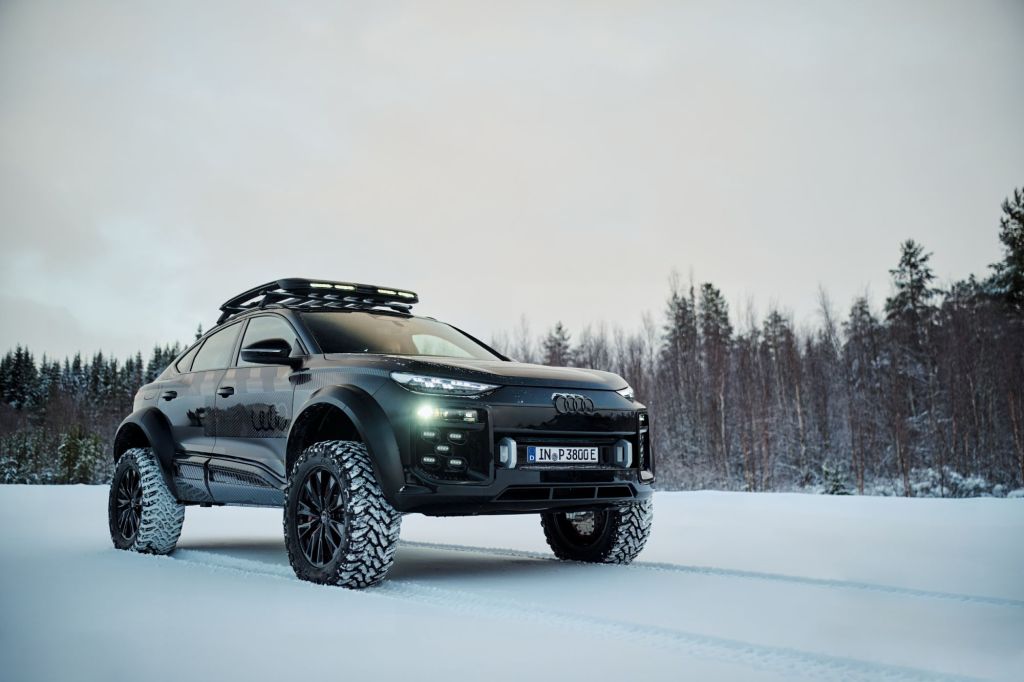
Remember when Audi concept vehicles were sexy? (Image: Audi)
Audi says it has developed new portal axles that it is using on a prototype Q6 e-tron offroad vehicle.
The prototype is based on the automaker’s Premium Platform Electric (PPE).
According to the company while conventional portal axles can increase torque from 20 to 30% at the wheels, Audi’s increases it by 50%.
Audi CEO Gernot Döllner said of the vehicle: “The model shows the potential that our platform for all electric vehicles already has today. This vehicle can claim new ground. We look forward to seeing our customers’ reactions to this highly emotive car.”
Presumably more than a few customers are going to think it looks like something that has undergone massive suspension tuning for display at a venue like SEMA, not as something that is, well, an Audi.
Somehow the “Premium” part is overwhelmed by the engineering of the axles.
Why this model deserves serious consideration. . .
By Gary S. Vasilash
Genesis was launched as a stand-alone brand in the U.S. in 2015.
In 2008 Hyundai started selling large, lux models in the U.S. that were labeled “Genesis.” Like the “Hyundai Genesis” model.
The thing is, Hyundai was largely recognized back then as a purveyor of economical vehicles, whether it was the entry-level Accent or the sporty Tiburon.
The design revolution that was launched by the Hyundai Sonata didn’t happen until the sixth generation, starting with the model year 2011 car.
The success of that car led to a transformation of the perception of the brand from frumpy to forward.
But still, there was the association of value with Hyundai. Certainly not a bad characteristic, but most luxury buyers probably aren’t worried about whether the vehicle they buy have “America’s Best Warranty.”
The situation was not unlike that experienced at U.S. Volkswagen dealerships from 2004 to 2006, when the $70,000 Phaeton was available.
Imagine taking that car into the service department and seeing a 1978 Beetle (the last year the original was available in the U.S.) covered with Deadhead stickers up on a lift.
Somehow the exclusivity just wasn’t there.
A similar situation would be between an Accent and a Genesis
So the decision was made to make Genesis a brand onto itself.
The first two models offered in the U.S. in 2016 were the G80 and the G90.
Both sedans.
As you may recall, 10 years ago there was a real upswing in demand for lux SUVs.
But Genesis didn’t have one.
And it followed the G80 and G90 with the G70 in 2018—another sedan.
The GV80, an SUV, was launched in the U.S. in 2020.
Dealers must have sighed with considerable relief.
But the company continues to produce sedans. Including the G80.
The thing is: when the first G80 was brought on the U.S. market it was received with a “How are they able to do that?” with the “that” being producing a vehicle with features and amenities that were then primarily associated with the German marques, yet with a sticker price that the Germans had only on their entry-level vehicles.
Genesis designers and engineers have kept at it. They have made improvement after improvement to the interiors and exteriors, to the tech and to the powertrains.
2025 Genesis G80: Style and substance. (Image: Genesis)
The 2025 G80 3.5T Sport Prestige AWD starts at $77,000.
You climb inside it, sit on the quilted Nappa leather seats, look at the actual carbon fiber surfaces, assess the information on the 27-inch OLED instrument cluster and infotainment system, and you know this is something special.
You depress the Start button and the 375-hp turbocharged V6 makes a subdued rumble.
You turn the rotary shift knob located on the center console to put the car into gear, and the car moves with alacrity.
You smile.
Genesis now has a full suite of SUVs. The GV60, GV70, Electrified GV70, GV80, GV80 Coupe.
Yet it still has sedans, like this one.
At some point, I think, people are going to go into a dealership planning to get an SUV, take a sedan like the GV80 for a spin, and forget about that SUV.
Although not available in the U.S.—and not likely to be anytime soon—there is an array of vehicles coming from China-based brands that have some purported capabilities that are rather astonishing.
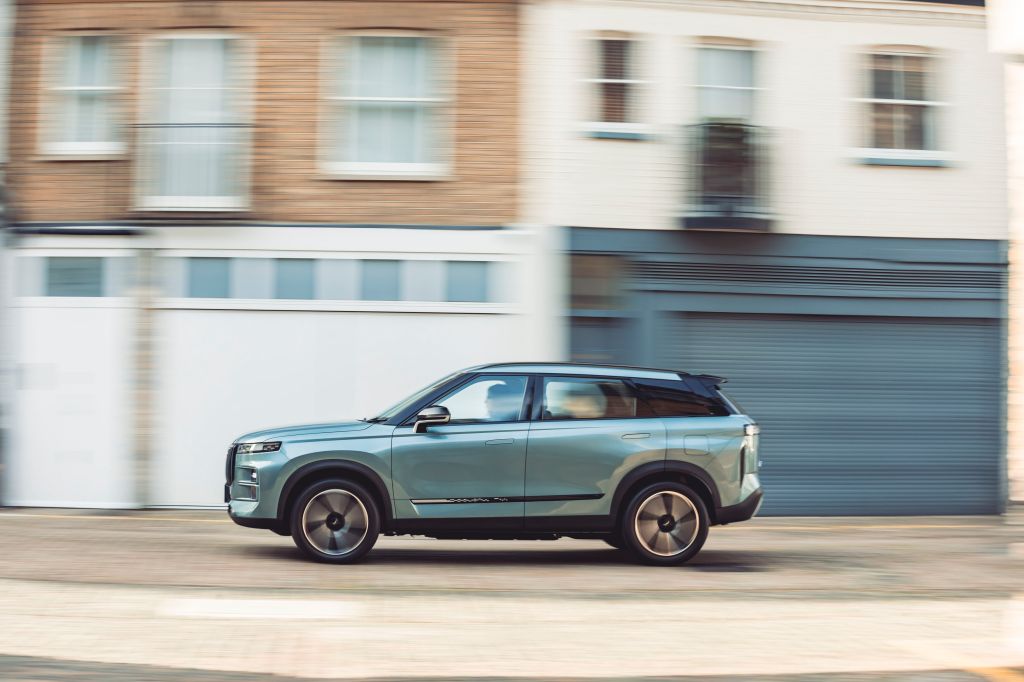
Take, for example, the forthcoming JAECOO 7 SHS, an SUV that is going on sale in the U.K. market.
This vehicle, a plug-in hybrid, is claimed by the company, which is part of the Chery Group, to deliver, on the WLTP test procedure, a fuel efficiency of. . .
403 mpg
The “SHS” in the name comes from “Super Hybrid System.”
If it gets 403 mpg, it really must be super.
Brits might forget what petrol stations look like they’ll be there so infrequently. (Image: JAECOO)
The range is stated at 745 miles.
The vehicle has a 1.5-liter engine that produces 143 bhp. The engine has six technologies the company says contributes to its efficiency.
They are: Deep Miller cycle; i-HEC internal combustion; i-HTM intelligent thermal management system; HTC efficient turbocharging; i-LS intelligent lubrication and HiDS high dilution.
I don’t know what they are, either.
Then there’s a transmission that has four technologies:
Quad-core dual electronic control MCU; IGBT double-sided water cooling; a high-efficiency dual motor; hydraulic split cooling.
Which is slightly more understandable.
And then there’s a 18.3-kW lithium iron phosphate battery pack.
It provides, according to the company, the ability to drive 58 miles on electricity alone.
The JAECOO 7 SHS has a starting price in the U.K. of £35,065 (~$43,000).
Here’s something that seems a bit mysterious, though.
It has a 60-liter fuel tank. That’s 15.68 gallons.
If it is rated at 403 mpg, then shouldn’t the 15.68 gallons of gas be good for 6,319 miles?
The OEM is contributing to the generation of plenty of green electricity. . .
By Gary S. Vasilash
Although Volkswagen is going through all manner of issues in Europe predicated on things like declining sales in China which has a knock-on effect that reverberates through the entire system, the company is still working hard on the renewable energy front.
“We plan to step up our commitment in the filed of renewable energies each year in line with the development in sales of ID. models,” said Andreas Walingen, CSO and Head of Strategy of the Volkswagen Passenger Cars brand.
He explained: “Through the large-scale development of European wind and solar farms, we intend to support our customers in the region in their efforts to always use their ID. vehicles in a net carbon-neutral way. This shows that our commitment to sustainability goes far beyond the electrification of vehicles.”
Volkswagen ID.4: charging it with green electricity reduces carbon emssions by a lot. (Image: VW)
Or, VW is investing in the generation of “green power” that can then be used by drivers of their electric vehicles.
Of course, given that VW is part of the generation of some three terawatt-hours of green energy on an annual basis.
The company performed a life cycle analysis of an ID. model compared with a comparable diesel model. (Yes, there are still diesel vehicles being sold by VW in Europe.) The objective was to determine the carbon footprint of both.
The analysis looked at a period of 200,000 km (or 124,274 miles).
It was determined that an ID.4 Pro has about 25% lower emissions over the life cycle than a diesel vehicle.
“But wait!” you think. “EVs don’t have tailpipes.”
True, but in a life cycle analysis, everything is taken into account, from the creation of the battery to the manufacturing operations to build the vehicle.
Another determination is that if the ID.4 Pro is consistently charged with green electricity, it achieves a lower carbon footprint than a diesel model after some 66,000 km (41,010 miles).
Even if the conventional European Union grid electricity is used the ID.4 becomes lower at 97,000 km (60,273 miles).
So those who are looking to reduce their carbon footprints can know that by rolling in an ID. model they are helping.
Of course, one would imagine that those driving diesels probably aren’t quite as environmentally oriented.
If car companies want to convince consumers they are cool, the site is a place to start
By Gary S. Vasilash
Auto manufacturers are seemingly hell bent on making sure everyone understands that they are not just purveyors of transportation equipment but tech wizards, as well.
After all, they don’t want to be seen as digital luddites compared to, say, Tesla.
But the recent J.D. Power 2025 U.S. Manufacturer Website Evaluation Study—Winter indicates that consumers aren’t seeing them as particularly advanced so far as the OEM websites go.
“The auto industry is falling short on modernization and organization of their websites. Consumer expectations are high and having an updated, organized and aesthetically pleasing site is one of the most important things manufacturers can do to drive site satisfaction,” says Kristen Coffin, analyst of digital solutions at J.D. Power.
Guess what OEM website in the Premium category is the most satisfying?
Tesla.
On a 1,000-point scale it scored 752 among the surveyed.*
The average for the segment is 708.
The companies below the line are Cadillac (704), Jaguar (702), Porsche (700), Genesis (699), Volvo (688), and Alfa Romeo (641).
Over on the Mass Manufacturer side of things, the numbers across the board are lower, with the segment average at 692.
Ford has the highest ranking, at 719.
Mitsubishi, which needs all the help it can get in the market, ranks lowest at 661.
Arguably it is harder to convince people that the vehicles on offer by an OEM are as up to date as they can possibly be if they see better websites for home improvement tools or running shoes. // *11,406 people who indicated they’d be in the market during the next 12 months. The study was conducted in October-November 2024.
The Volvo XC60 is a compact luxury SUV, although some characterizations have it as a midsize.
I’d opt for the latter. (The EPA is the arbiter of what goes where. On the Monroney for the vehicle driven it is described as a “Small Sport Utility.”)
Think of it as something that competes with the Cadillac XT5 and the Lincoln Nautilus—or maybe that would be the Lincoln Corsair, as the former is the midsize and the Corsair compact.
Moving on.
The XC60 did rather well in 2024 in terms of garnering awards from consumer outlets.
There were the “2024 Newsweek Auto Awards.”
The XC60 was “Best” for both “Suburbanites” and “Single, Powerful Women.”
It was “Top Pick” for “Empty Nesters.”
While a single, powerful woman could live in a suburb, the “Suburbanites” category was actually for people who have families that need to be transported. Or people who at some point will become “Empty Nesters.”
The XC60 seats five. Which is likely a sufficient number for any of those categories.
Good Housekeeping, in its “2024 Best New Family Cars Awards,” picked the XC60 as its “Best Luxury Compact Crossover SUV” (which brings us back to that category question).
Whether you simply eyeball it or follow the documented categorization, know that the XC60 has lots of competition. Not only the aforementioned Cadillac and Lincolns, but the BMW X3 and the Mercedes GLC, among others.
What is truly a distinctive difference is found in the interior.
If you go to a furniture store there is likely a section that is dedicated to and labeled as “Scandinavian.”
There is likely not one that says “American” and really not likely “German.”
And when you enter the cabin of the XC60 you know from the execution of the leather, wood and metal on the instrument panel (well, keep in mind this is the Ultra, top-of-the-line model) and from the comfort and support of the seats that this is a Scandinavian product.
(For those wondering: Yes, this vehicle was built at the Volvo plant in Torslanda, Sweden.)
The vehicle has a Bowers & Wilkins audio system that features 15 speakers and 1,400-W output, such that you might want to just sit in the leather-covered seat for a while after your trip is complete simply to listen
Volvo has a commitment to electrification. The XC60 is part of it. Albeit a small one.
The XC60 is powered by a 2.0-liter turbocharged four. And supplementing it is a 48-Volt hybrid system. This is a “mild hybrid” system. It permits regenerative braking to recharge the battery and provides a boost when accelerating. It also adds 13 hp to the output so the total horsepower is 247.
It is a more-than ample amount. When first driving the XC60 I was pleasantly surprised by the throttle response.
The vehicle is stickered at 26 mpg combined. In my experience that was, um, optimistic as I generally got more toward the city number of 23 mpg rather than the highway 30 mpg—even though I had a mixed drive.
If we go back to the “Suburbanites” or simply “Family,” odds are that cargo is a key consideration when selecting a vehicle. So to that end know that with the rear seat I place there is 22.4 cubic feet of space and with the seatback folded 63.3 cubic feet.
Volvo uses Google for its maps and the Google Assistant. There is a 9-inch infotainment touchscreen. (The Assistant is accessed via voice.) Even though this is Google-centric, there is Apple CarPlay and, no surprise, Android Auto.
The vehicle driven was not only Ultra, but it was loaded with other things—like that audio system, which adds $3,200 to the sticker. The Ultra alone has an MSRP of $57,000. The add-ons for the model driven—like the 22-inch five-double spoke matte black diamond cut alloy wheels—and other things, as well as the $1,295 for destination, kicked the bottom line up to $68,245.
But for a lux vehicle in whichever category you consider it, that really is reasonable.
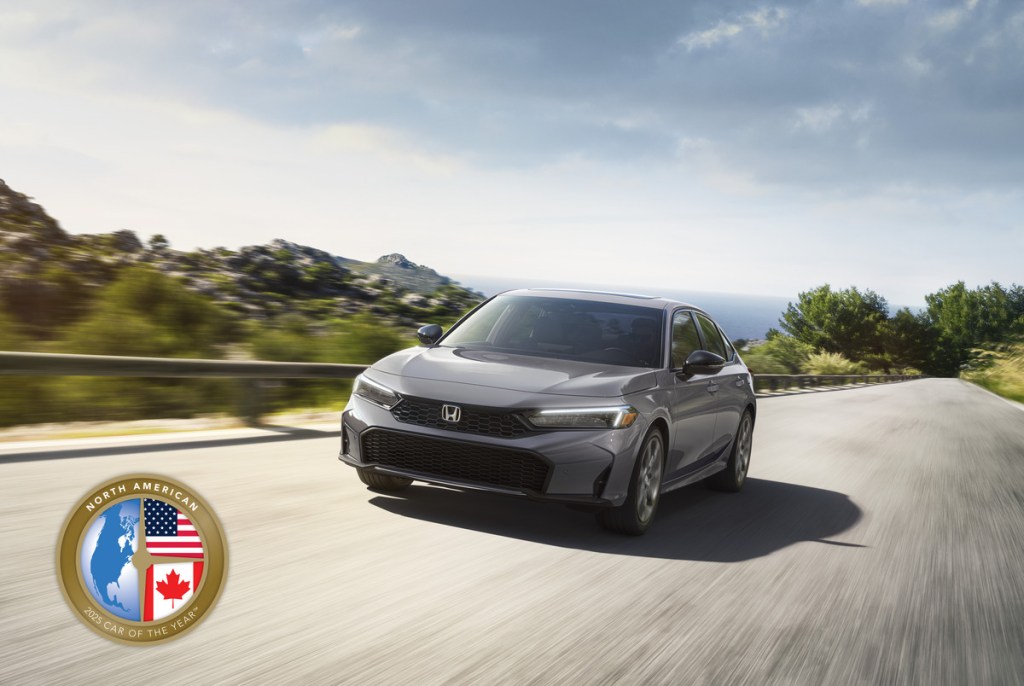
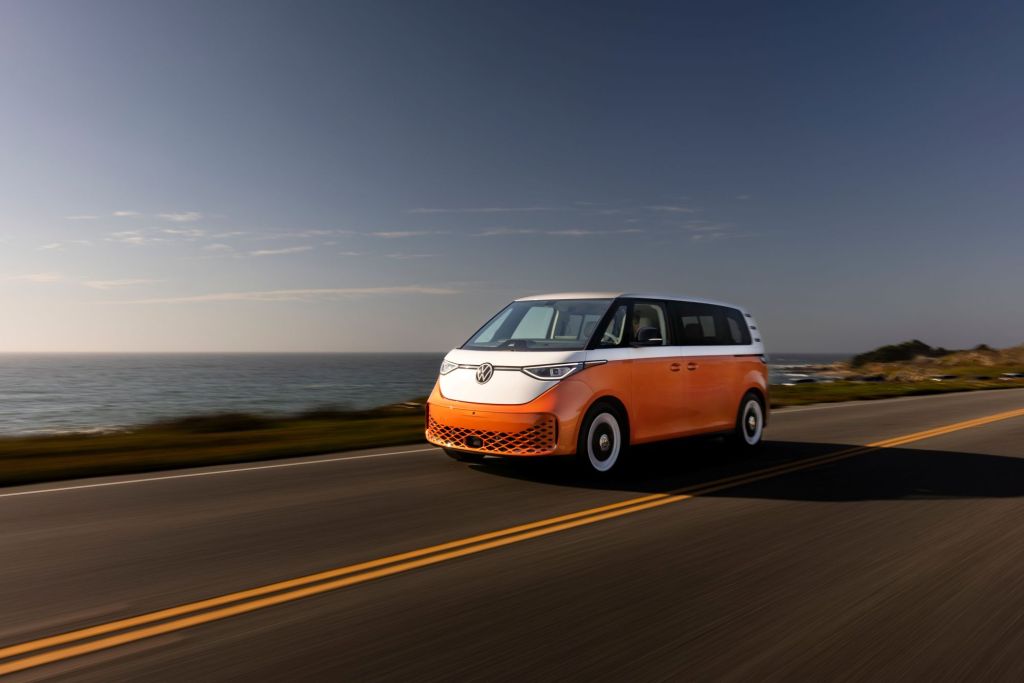
The winners of the 2025 North American Car, Truck and Utility of the Year (NACTOY) were announced this morning at the Detroit Auto Show.
They are:
Car: Honda Civic Hybrid
Truck: Ford Ranger
Utility: Volkswagen ID.Buzz
The three vehicles were selected by a jury consisting of 50 journalists*, so there was a diverse number of people and associated opinions. That is, it isn’t like they all work for the same outlet, so there was no “house opinion.”
The selections are made based on metrics including innovation, design, safety, performance, and value.
Consumers can use the winners as a good rule of thumb should they be in the market for new sheet metal.
The NACTOY awards have been presented since 1994.
It is worth noting the vehicles were up against in the finalist round:
Car: Kia K4, Toyota Camry
Truck: Ram 1500, Toyota Tacoma
Utility: Chevrolet Equinox EV, Hyundai Santa Fe
In other words, the nine vehicles are all notable but three of the nine are even more notable.
A couple of fun facts:
The Honda Civic is no stranger to NACTOY trophies. It also won in 2022. 2016 and 2006.
When you think “Ford” and “truck” immediately thereafter, you’re not wrong. The Ranger win is the fifth victory in a row for Ford trucks. The Super Duty won in 2024, the F-150 Lightning in ’23, Maverick in ’22, and F-150 in ’21. The F-150 also won in 2015, 2009, 2004, 1996. The Transit Connect won in 2010.
It is showing at CES in Las Vegas a production-intent model with aero validation performed in Italy. Huh?
By Gary S. Vasilash
Aptera is a vehicle company that seems to have been around a lot longer than it actually has, probably because the vehicle that it has been promoting is pretty much unlike anything else out there: a three-wheeled, two-person vehicle that has a shape more akin to a teardrop than what is ordinarily thought of during this age of Large Rectangular Vehicles That Can Accommodate More People Than They Typically Ever Do.
It was founded in 2019.
The Aptera model is an electric vehicle that gets supplemental power via built-in solar charging. It is said to be able to provide 40 miles of range on a daily basis through the solar panels alone.
(Image: Pininfarina)
In association with the vehicle being at CES 2025, Pininfarina has announced that the vehicle underwent aerodynamic validation at the design house’s wind tunnel in Turin, Italy.
(According to Aptera the vehicle has a low coefficient of drag of 0.13, compared with the 0.23 figure for a Tesla Model 3.)
Said Chris Anthony, Co-CEO of Aptera Motors of the model at CES: “Our production-intent vehicle is not only a testament to years of innovation and engineering but also a tangible solution to reducing carbon emissions and redefining how we think about energy-efficient mobility. We’re excited to show the world that Aptera is ready to hit the road and deliver a cleaner, more sustainable future.”
The company says it has $1.7-billion in pre-orders.
It had previously announced that it would go into production in 2024, which obviously hasn’t happened.
One curious thing: Why did the company, based in Carlsbad, California, determine it was necessary to go some 6,000 miles to do wind tunnel testing?
After all, there are some that are closer, like the A2 Wind Tunnel in Mooresville, North Carolina, which is used by motorsports teams and offers general pricing of $595 per hour.
Yes, I understand that there is a difference between Turin and Mooresville, but were I one of the claimed nearly 50,000 people waiting for my car, closer would be quicker and consequently better.
ZF is supplying a system that uses hydraulic-fluid-free braking
By Gary S. Vasilash
One of the things (among many) that most drivers probably don’t think much about is brake fluid, a glycol- or silicone-based hydraulic fluid that is pressurized when the brake pedal is depressed (roughly: the pedal initiates a vacuum booster that activates the master cylinder which pushes brake fluid through the brake lines so that it goes to the wheel caliper and then forces a set of pistons that apply the brake pads so the vehicle will slow or stop).
Which is probably something most don’t think about, either.
Or that it is generally recommended that brake fluid be changed every two years or 30,000 miles.
Who knew?
Some lucky drivers of vehicles produced by an unnamed “global manufacturer” will be getting vehicles that at least have a reduced amount of brake fluid on board, as those vehicles will be equipped with an electro-mechanical braking system (EMB) from supplier ZF.
Rather than brake fluid, this ZF system uses electric motors for brake actuation. (Image: ZF)
The EMB is a “dry brake-by-wire” system.
That is, when pressure is applied to the brake pedal a signal travels to electric motors that generate the pressure needed to provide braking.
No fluids are involved.
However, in this particular application the EMB is being used for the rear brakes with hydraulics at the front, so the entire braking system isn’t entirely dry.
According to ZF the EMB system is a contributor to software-defined vehicles.
That is, there can be adjustments made to the performance parameters EMB made via code, something that is not going to happen on a purely hydraulic setup (which would require adjustments with a wrench).
Of course, drivers are still going to have to be aware of that need to replace brake fluid in those vehicles. . . .







 shinymetalboxes