U.K. Facts About EVs

They’re concerned that people don’t know what they should about EVs. . .

By Gary S. Vasilash

In order to keep U.K. customers interested in the possibility of buying an electric vehicle, Auto Trader (a vehicle purchase platform), ChargeUK (an organization consisting of EV charging companies), and the Society of Motor Manufacturers and Traders (a trade association representing OEMs and suppliers) have gotten together to combat misinformation about EVs.

This past February the House of Lords’ Environment and Climate Change Committee came out with a report that indicated there was a need for “clear and balanced information” regarding EVs for consumers.

And Auto Trader discovered that the number of retailers offering EVs on its site was at 35% for both 2023 and 2024. It had been 57% in 2022.

So this is what the three groups have come up with:

One of the interesting points is the 71,459 available chargers.

In the U.S., as of late August, there were over 192,000 publicly available chargers, according to the U.S. Federal Highway Administration.

To put that into context, the U.S. is 40 times larger than the U.K.; it has five times as many people, and nine times as many automobiles. Yet it has just 120,500 more public chargers.

According to the U.K. group there is one charger per four miles of road in the U.K.

The U.S. federal infrastructure plan is building out one charging station on the Interstate Highway System—per every 50 miles.

If there is concern about the lack of a significant uptake of EVs it should be in the U.S. far more than in the U.K.

NACTOY 2025 Finalists Announced

When you consider what they were up against, these nine vehicles all deserve respect

By Gary S. Vasilash

Earlier this fall, the North American Car, Truck and Utility of the Year (NACTOY) Awards announced what it called the “Best of 2025.”

Or said another way: the semi-finalists for the awards that will be presented January 10, 2025 at the Detroit Auto Show.

The vehicles are:

Car

• BMW 3 Series
• BMW M5
• Cadillac Celestiq
• Dodge Charger EV
• Fiat 500e
• Honda Civic Hybrid
• Kia K4
• Mercedes-AMG E-Class
• Porsche Panamera
• Toyota Camry

Truck

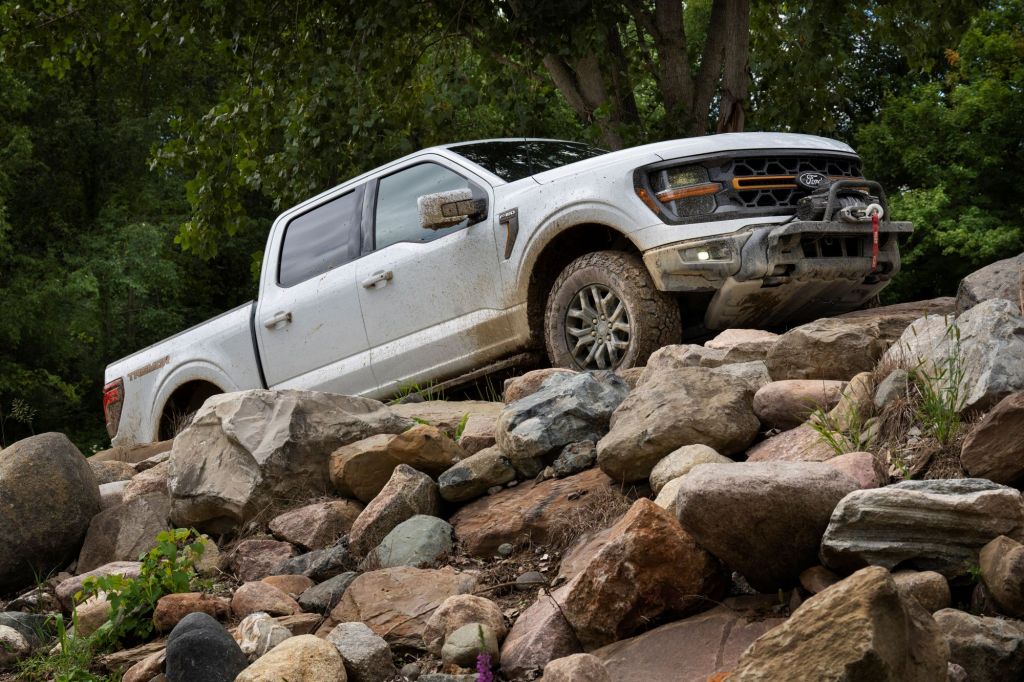
• Ford Ranger
• GMC Sierra EV
• Ram 1500
• Rivian R1T
• Toyota Tacoma

Utility

• Chevrolet Equinox EV
• Honda Prologue
• Volvo EX90
• Hyundai Ioniq 5 N
• Hyundai Santa Fe
• Jeep Wagoneer S
• Lincoln Nautilus
• Porsche Macan EV
• Toyota Land Cruiser
• Volkswagen ID. Buzz

So with that as prologue, this morning the finalists—three in each category–were announced at the LA Auto Show.

They are:

Car

• Honda Civic Hybrid
• Kia K4
• Toyota Camry

Truck

• Ford Ranger
• Ram 1500
• Toyota Tacoma

Utility

• Chevrolet Equinox EV
• Hyundai Santa Fe
• Volkswagen ID. Buzz

The 50 automotive journalists who serve as jurors (including me) now have the challenge of trying to sort out which of the vehicles represents best in class for consumers.

For those who might be wondering how things have gone recently, here are the winners for the past five years:

2020

• Car: Chevrolet Corvette
• Truck: Jeep Gladiator
• Utility: Kia Telluride


2021

• Car: Hyundai Elantra
• Truck: Ford F-150
• Utility: Ford Mustang Mach-E

2022

• Car: Honda Civic
• Truck: Ford Maverick
• Utility: Ford Bronco

2023

• Car: Acura Integra
• Truck: Ford F-150 Lightning
• Utility: Kia EV6

2024

• Car: Toyota Prius
• Truck: Ford Super Duty
• Utility: Kia EV9

Based on that, it is clear that Ford is solid in trucks.

The Civic has gotten a trophy.

Kia is strong in utilities—but the K4 is a car.

All of which is to say that at this point it is anyone’s guess.

VW 2025 ID. Buzz Pro S Plus

This is a vehicle that more people than you might imagine have been waiting for—even if they didn’t know it. . .

By Gary S. Vasilash

GeekWire is unique among technology and business news sites, in that we look at the world through the lens of Seattle and the Pacific Northwest, where we’re based.” So the outlet describes itself.

The site has an “intense global interest in technology, ideas and innovation emerging from our backyard. Our motto is, ‘What happens here matters everywhere.’ Microsoft and Amazon are classic examples, but countless startups, research organizations, educational institutions and others based in the Seattle region also have an outsized impact on the world.”

So while the coverage is generally about the tech and the people related to Microsoft, Amazon and an array of outfits and organizations that you’re likely not to have heard of unless you are deep in the digital tech space, it also covers other things on occasion.

Like the Seattle Auto Show.

And its story on the event opens:

“As I pulled away from the Seattle International Auto Show on Thursday during a test drive of the highly anticipated Volkswagen ‘ID. Buzz’ electric van, a driver in a Tesla Cybertruck offered a thumbs up.

“It was all the confirmation I needed that the Buzz was going to be the buzzworthy vehicle at the annual show at Lumen Field Event Center.”

Yes, it is the type of vehicle that gets love whether it is in Seattle or Detroit.

Cost Consideration?

Which is absolutely appropriate for the rebirth of the VW Microbus: while in its heyday in the 1960s the Microbus was largely associated San Francisco scene, this new EV is somehow more appropriate for places like Seattle than Silicon Valley, south of San Francisco. That is, there is an income-based accessibility to the ID. Buzz, with a starting MSRP of $59,995, which is more in line with the median household income in Seattle ($129,715) than Silicon Valley ($146,143): the former probably is more concerned with sticker prices than the latter.

However, given that the median household income in the U.S. is more along the lines of $78,046, the ID. Buzz may not be for every household budget—but that won’t matter. Those who can probably will.

VW Germany Builds. U.S. Will Buy

At least for the first couple years every ID. Buzz available in the U.S. (it is built in a VW plant in Hannover and has been available in the Europe market since the latter half of 2022) will be purchased. People are drawn to the vehicle in a way few other vehicles of any configuration command.

And not just the type of people who read GeekWire.

It looks familiar. And fresh. Quite a feat. (Image: VW)

Of all of the vehicles I have driven in the past few years the ID. Buzz has had considerably more attention than any other.

Lots of Love

A 20-something HVAC technician who came to check my furnace, who says he’s thinking about buying an Accord: “That is really a cool vehicle.”

My 30-something Alfa Giulia Quadrifoglio-driving next-door neighbor: “I LOVE it!”

A 60-something man who walked over to the ID. Buzz when I was in a Barnes & Noble parking lot: “I remember the Microbus from when I was young. This is quite nice.”

And there were many others who were walking by who stopped and stared and drivers giving me a thumb’s up when I cruised by.

The thing is, none of the people that I talked with about the ID. Buzz brought up the fact that it is an electric vehicle. They didn’t care whether it was based on the MEB platform, which is meaningless to them. They didn’t know if it was a rear-drive vehicle (the one in question is) or whether there is a low center of gravity by having the 91-kWh lithium-ion battery located beneath the floor.

They weren’t overthinking it.

They simply thought it looks great.

And evidently VW found that design is the #1 reason why people are interested in it.

The Definition of “Capacious”

Of course, if you’re going to buy something like the ID. Buzz, you’re probably going to be interested in its cargo capacity, whether that’s in the context of having three rows of seats for people (depending on the types of seats selected, it handles six or seven people, and there is considerable third row legroom: 42 inches, which is 10 inches more than that offered in the roomy Kia EV9) or a whopping 146 cubic-feet of cargo capacity—and I use the word “whopping” advisedly: its capacity bests the Chevy Suburban—which is 2.6 feet longer (the ID. Buzz is 195 inches; the Suburban 226 inches)—by one cubic foot, and on more of an apples-to-apples comparison, it bests the Chrysler Pacifica PHEV minivan by five cubic feet (about the size of an average microwave oven).

(However, a word about cargo capacity. The aforementioned 282-hp electric motor that provides rear-wheel drive isn’t located in the front of the vehicle with a drive shaft traveling back to the rear axle, as would be the case of a vehicle with an internal combustion engine up front, but it is in the rear of the vehicle, below the location of the third row. So while other minivans provide more manipulation of the third row because they’re not restricted by a motor, to get the maximum cargo capacity from the ID. Buzz the third row needs to be removed, not exactly the sort of thing you’d want to do on a regular basis. Still, the second and third rows do fold flat. It is just that the third row can’t go into the floor, like the “Magic Seat” in the Honda Odyssey.)

Because this is an EV, the range must be stated: the rear-drive ID. Buzz provides a range of an estimated 234 miles. And to put that into context, according to the EPA, the 2025 Kia EV9 Standard Range RWD has a range of 230 miles, so the ID. Buzz is certainly in the mix.

Final Thought

The VW ID. Buzz has something most vehicles nowadays lack: Character.

That’s what its predecessor had, which explains why there is a resonance—even for those who may not be aware of it—that carries on in this reimagining.

Audi Becoming AUDI in China

No, that’s not a problem with the caps-lock on the keyboard

By Gary S. Vasilash

Like many Western brands, Audi is having a bit of a struggle in China, a market it has been in since 1988.

After all, not only are native Chinese brands offering an array of compelling vehicles at all price points, including the upper end where Audi resides, but there is probably something of a bit of nationalism, as Chinese consumers are turning toward Chinese brands.

Consequently Audi is making a shift in its strategy in China and has developed the “Advanced Digitized Platform” with Chinese company SAIC.

AUDI E concept introduced at the Shanghai Motor Show. All caps. No rings. Is it going to shift perceptions of the brand in China? (Image: Audi. Or maybe AUDI)

According to Audi CEO Gernot Döllner: “The joint platform will be the basis for a new generation of state-of-the-art intelligent connected vehicles exclusive to China. The upcoming models are aimed at a promising and simultaneously demanding new customer segment. The cooperation will further expand the Audi portfolio of battery electric vehicles in China and accelerate the company’s transformation in the world’s largest market.”

The platform will be used to develop three models that fall within the midsize and full-size segments, with the first model becoming available next year.

Audi says the collaboration with SAIC allows a >30% decrease in the time required to get a model in market.

In addition to which, Audi has created a new brand for the China market:

AUDI

That’s right: an all-cap version of the existing name.

Also, the famous four-right logo is jettisoned.

Döllner:

“By launching this new brand for electric and intelligent models in China, Audi is breaking new ground to tap into new and more tech-savvy customer segments.”

Seems like Audi in China becoming AUDI is China is the sort of change that a company that is afraid of making a major change would do.

Too little too late?

The So-So Sales Experience

You may be surprised at brands that aren’t making new-vehicle buyers all that chuffed. . . .

By Gary S. Vasilash

Maybe it has something to do with comparatively low numbers.

The J.D. Power 2024 U.S. Sales Satisfaction Index (SSI) Study ranks Porsche, for the second year in a row, as having the most satisfying sales experience. It has a score of 851 out of 1,000.

Industry average is 818.

In the first nine months of 2024 Porsche delivered 61,471 vehicles in North America (so this is the U.S. and Canada and Mexico).

The brand that arguably built itself on customer satisfaction, Lexus, is below average in SSI, at 812 (putting it in a tie with Mercedes, and putting those two above only Alfa Romeo at 810 and Genesis at 781).

In the first nine months of 2024 Lexus delivered 248,200 vehicles in the U.S. (just U.S.)

(And Mercedes sold 264,600 in North America.)

There are 202 Porsche dealers in the U.S.

There are 244 Lexus dealers in the U.S.

So, assuming (unrealistically, of course) that each dealership sold the same number of vehicles during the first nine months:

• Porsche dealer: 304 vehicles
• Lexus dealer: 1,017 vehicles

Needless to say, the people working at the Lexus dealership is a whole lot busier.

According to J.D. Power: “Buyer satisfaction is based on six factors (in order of importance): delivery process; dealer personnel; working out the deal; paperwork completion; dealership facility; and dealership website.”

You know: the regular routine of going in to buy a car, which is often not unlike going to an endodontist for some serious work.

Now certainly there probably isn’t a tremendous amount of cross-shopping between a Lexus store and a Porsche facility: the least expensive Lexus is a UX, which starts at $37,515 and the least expensive Porsche is a Macan, starting at $62,900.

But the SSI puts Lexus behind (in order): Infiniti, Jaguar, Acura, Land Rover, Lincoln, Volvo, Cadillac, BMW, and Audi, which are cross-shoppable.

What is also surprising is that Toyota brand, which competes in the “Mass Market” SSI category, is also third from the bottom, above only Mitsubishi and Chrysler—and with 777 points, it is well below the segment average of 798 and remarkably below the leading marque, MINI at 829.

Of course, MINI had sales of just 17,552 in the first nine months of 2024, which is a fraction of Toyota’s 1,481,319. Still, that puts Toyota well behind other mass market brands like Ford (805 points), which sold 1,473,642 vehicles through Q3.

Product, which Lexus and Toyota certainly have, is one thing.

Getting people to buy those products while feeling good about the experience is another thing entirely.

Seems like the folks in the sales department of Toyota Motor North America have some work on their hands.

2025 Toyota Crown Signia Limited

Crown is taking the place of other Toyota nameplates and is doing a good job at doing so. . .


By Gary S. Vasilash


There are probably more people who are familiar with the Roxy Music album of the same name than the Avalon, Toyota’s former top-of-the-line sedan in the U.S. market.


Which is a shame because the Avalon, which was introduced in model year 1995 and had a five-generation run until it became unavailable in the U.S. market, was, year in and year out, generation after generation, a fine automobile.


Perhaps a problem for the flagship that it was simply eclipsed by the Toyota Camry which, year in and year out, generation after generation (it is now the ninth), simply sold in tremendous numbers.


Someone would walk into a Toyota dealership and likely drive out in a Camry because it probably took little in the way of convincing. But for another car that cost a few thousand more, nice as it was, the persuasion would have been more challenging. So if you were a commissioned salesperson, wouldn’t you take the path of least resistance? (It has been the best-selling sedan in the U.S. for 22 years running, and this year it will likely notch 23.)


The product planners at Toyota know they need to have something at the top of the line. Something that isn’t the Camry XSE AWD (the highest trim level of the eight available).


For model year 2023 Toyota introduced the Crown to the U.S. market, the top-of-the-line that was the Avalon replacement.


Initially the Crown was positioned as a sort-of hybrid crossover, with the “sort-of” predicated on what it called a “lift-up” design.


As Toyota put it: “Crown has a raised overall height that’s nearly four inches higher than Camry. The unique height of this sedan offers increased road visibility, along with easy entry and exit.”


But sort-of isn’t enough.


So for model year 2025 Toyota is adding the Crown Signia to it lineup. This vehicle is categorized as an SUV.


And just as the Crown replaced the Avalon, the Signia Crown replaces the second-generation (the all-hybrid one that had a run from model years 2021 to 2024) Venza.
Clearly the “Crown” moniker, which has been a fixture in the Toyota Japan lineup since it went into production in 1955, is taking its place in the U.S. market in a notable way.
The Crown Signia is quite an impressive vehicle.

If there is any problem that the Crown Signia may have (though not for me) it is that the roofline resembles a small wagon more than an SUV. (Image: Toyota)


No, this is not because its hybrid powertrain’s 240 combined net horsepower (188 hp from the four-cylinder engines and the balance from its 134 kW front and 40 kW rear permanent magnet synchronous electric motors) or from its standard electronic on-demand all-wheel drive (it works when it needs to; the driver need not engage buttons or knobs or tap a selection of the 12.3-inch infotainment screen).


It’s not because it has the capability of towing 2,700 pounds or, with the second row seats folded, a 6.5-foot long cargo area.


It is because it is clear that the level of attention to detail executed in both the exterior and interior designs bring to mind the style and sophistication that had been characteristic of the Avalon.


For example, the leather-trimmed seats that are in the Limited grade have double-stitching, quilting and fillet piping. While leather seats can provoke a shrug, it is the fact that there is the double-stitching, quilting and fillet piping that takes them to a level that is not characteristic of an offering from a mass-market brand.


The vehicle as-driven has an MSRP of $51,799. That’s $47,990 for the vehicle and the remainder for the options. (There is also an addition of $1,450 on top of the $51,799 for delivery and handling.)


The options include things like premium paint ($425) and mudguards ($155). The biggest one if the advanced technology package ($1,865), which includes things like various sensors and monitors and associated functions.


So it comes to $53,249, certainly a reasonable sticker for what is a premium hybrid.

Cadillac VISTIQ: Architectural Lesson

Maybe they got their styles wrong. . .


By Gary S. Vasilash


Cadillac has announced the VISTIQ, a three-row electric SUV.


It has a dual-motor system, which means all-wheel drive is standard. The motors provide 615 hp and 650 lb-ft of torque, which, according to the company, will provide a 0 to 60 time of 3.7 seconds when the Velocity Max performance mode is engaged.


The 102-kWh battery is expected to provide a range of 300 miles.


As Jeff MacDonald, North American chief engineer, for the vehicle puts it:


“From the start, it was our team’s goal to deliver a three-row SUV that provides exhilarating performance and intuitive technology, wrapped in the brand’s iconic design language.”

2026 Cadillac VISTIQ, three-row EV SUV. Jeff MacDonald, North American chief engineer, for the vehicle: “Bold, yet refined, the VISTIQ provides a comfortable ride while handling like a much smaller vehicle, delivering a sense of isolated precision.” (Images: Cadillac)


And of that design language, Brian Nesbitt, executive director, Global Cadillac Design, says:


“VISTIQ continues the Cadillac EV identity, including our signature vertical lamps front and rear, the illuminated pinstripe grille, a 33-inch diagonal high-resolution LED screen, and available 23-inch wheels, rendered in a proportionally stately and functional three-row SUV.”


But there is one odd thing in Cadillac’s announcement of the EV, which will have a starting MSRP of $78,790:


““The spacious interior seamlessly integrates with the elegant design, inspired by modern architectural contours and structure framework. The vertical banding is reflective of robust features in Brutalist architecture and helps frame elements in the interior, creating more refined lines and offering a balance of sophistication and practicality for modern luxury living.”

Inside the VISTIQ. Real wood. Recycled yarn. Carbon fiber. Authentic. Not Brutal.


Brutalist?


Writing in Architectural Digest, a place where they know a thing or ten about architectural styles modern and otherwise, Katherine McLaughlin explains:


“The style is often associated with socialist utopian ideas, which were regularly promoted by the buildings’ architects. Many early Brutalist buildings were affordable housing projects that sought to reimagine architecture to address modern needs.”


Brutalism got its start in post-World War II Britain where, McLaughlin writes,


“Spinning off the heels of the modernist movement of the day, architects were presented with a new set of challenges, namely limited resources, when designing in the post-war era.”

So they had to design buildings that were concrete-intensive and decoratively absent.


McLaughlin quotes Geddes, Ulinskas, principal of Geddes Ulinskas Architects:


“If modernism is about architecture being honest, Brutalist design is about architecture being brutally honest.”


Ulinskas goes on:


“Forms are as simple as can be and materials are stripped to be as bare and raw as possible.”


There is something to be said for honesty in materials in vehicles—if you’re going to have something that looks like wood, it should be wood, not plastic or an applique; the same goes for metal and carbon fiber. And this is what they’re doing inside the VISTIQ.


Yes, the materials are authentic inside. But they are undoubtedly not “as bare and raw as possible.”


Somehow Brutalism just doesn’t seem particularly “Cadillac.”

Some Thanksgiving Driving Stats

Don’t worry, the turkey can wait. . . .


Who knew that Thanksgiving was a period during which so many drivers were in such a hurry?


According to Verra Mobility, a company that provides things like red-light camera systems so it has first-hand knowledge of this, during the 2023 Thanksgiving weekend (Wednesday through Sunday) there were more than 57,000 red-light violations.


(This is based on information from 21 states.)


Most of these violations occurred on Wednesday between 12 pm and 4 pm.


What’s more, Verra Mobility, which also has traffic cameras in its portfolio, found that during the 2023 Thanksgiving weekend there were more than 150,000 speeding violations.


In this case, the majority of the violations occurred on Thanksgiving, between 10 am and 12 pm. (Leaving the parade and getting to grandma’s house for turkey?)


This finding is curious: while red-light violations have increased annually since 2020, the number of speeding violations has been going down since 2021.


A little forward planning can help avoid an average penalty of $150.

2025 INFINITI QX80 Autograph

This is what “flagship” means. . .


By Gary S. Vasilash


Craig Keeys, group vice president, INFINITI Americas, was recently a guest on “Autoline After Hours.”


One of the topics discussed is the 2025 INFINITI QX80, which really gives meaning to the term “flagship.”


That is, the three-row SUV is 211.2 inches long and has a 121-inch wheelbase. It is 83.3 inches wide and depending on the suspension setup (there is an independent, double wishbone fore and aft, but there is an available as high as 77.9 inches. In three (Luxe, Sensory, Autograph) of the four (Pure is the other) trims it rides on 22s. (Pure gets 20s.) The ground clearance is (again, suspension-dependent) from 9.6 to 10 inches, which means that the standard body-colored running board is not something that’s merely “nice” to have. The cargo capacities are 22 cubic feet with the third row upright; 59 cubic feet with the third row folded; and 101 cubic feet with the second and third rows folded: with the leather seating throughout and the 14.3-inch infotainment and 9-inch screen below that one for control of HVAC and seating, this capacious vehicle provides a sense that you are in something like a well-appointed cruise ship cabin, not something that is going to take you on your next trip, be it to work or to the lake (there is 8,500-pound—said to be best-in-class—towing capacity, facilitated by the 450-hp twin-turbo V6 that produces 516 lb-ft of torque).


When introducing the vehicle, Alfonso Albaisa, senior vice president for Global Design for Nissan Motor Co., said the new QX80 is “Powerful, practical and provocative.”


While the boxes for the powerful and practical have been checked in that lengthy paragraph above, the provocative nature of the QX80 is evident here:


Which brings me back to Craig Keeys.


He said that he’d been talking to one of his acquaintances who was looking for a full-size SUV. Not surprisingly, Keeys recommended that the QX80 get a look. No surprise.


And also no surprise (after all, Keeys told the story), the QX80 was purchased.


And here’s the thing: People who are in the market for a large, lux SUV would probably opt more frequently for the INFINITI if they were aware of it.


Through the third quarter of 2024 INFINITI sold 7,410 QX80s, or 67% of the number of Lincoln Navigators delivered during the same period.


Over at Cadillac, things were far more robust than was the case for either of those vehicles: 27,992 Escalades.


The QX80 certainly deserves more than it is getting.

Bentley’s Credible Claim

There’s luxury. And then there’s luxury. . .


Given that the average price of a Bentley is on the order of $300,000, when the company announces that it is going to “create an entirely new segment, the world’s first true Luxury Urban SUV,” you’ve got to give it to them.


After all, while we may think of “luxury” in the context of something from Mercedes—which, of course, has SUVs—it is that rarefied air that Bentley is in that Mercedes—even with its Maybach brand—is without.


The new SUV, which is to launch in 2026, is a battery electric vehicle. Presumably that explains the “Urban” part, as in the company figures this will not be a vehicle to take on some sort of grand tour.


Bentley plans to be fully EV by 2035.


Presently its Continental GT coupe, convertible and Flying Spur models are plug-in hybrids; the V8-based propulsion system replaces the W12 engine that had once been under the bonnets of the cars coming out of Crewe.