
This is what “continuous improvement” means. . .
By Gary S. Vasilash
The Lexus RX has been exceedingly popular since it launched in the US in March 1998. Arguably it created the luxury crossover segment. It was followed in time by vehicles including the BMW X5 (1999), the Acura MDX (2000), and Volvo XC90 (2002).
But year after year, the Lexus has been the top seller among all Lexus models, as well as having greater sales than those other crossover models.
This seems to have led some critics to maintain that the RX is somehow boring, perhaps because of its success.
Which is somewhat bizarre logic: Because it has such great appeal, it must not be as good as vehicles with less appeal.
Yes, those other models may have better performance or more capacity or something, but it is the package that people buy, and evidently the RX package has, from the first generation, been one with the greatest appeal.
It is now on its fifth generation. It is still settling the pace.
US sales through the first half of 2026:
- RX: 59,904
- X5: 41,554
- MDX: 24,102
- XC90: 22,538
“Oh, but it is too this, that or the other thing.”
Maybe.
But it is also clearly successful. All the more so when you realize that this generation RX was introduced in the market in the fall of 2022 and here we are four years later and it still has considerable appeal.
///
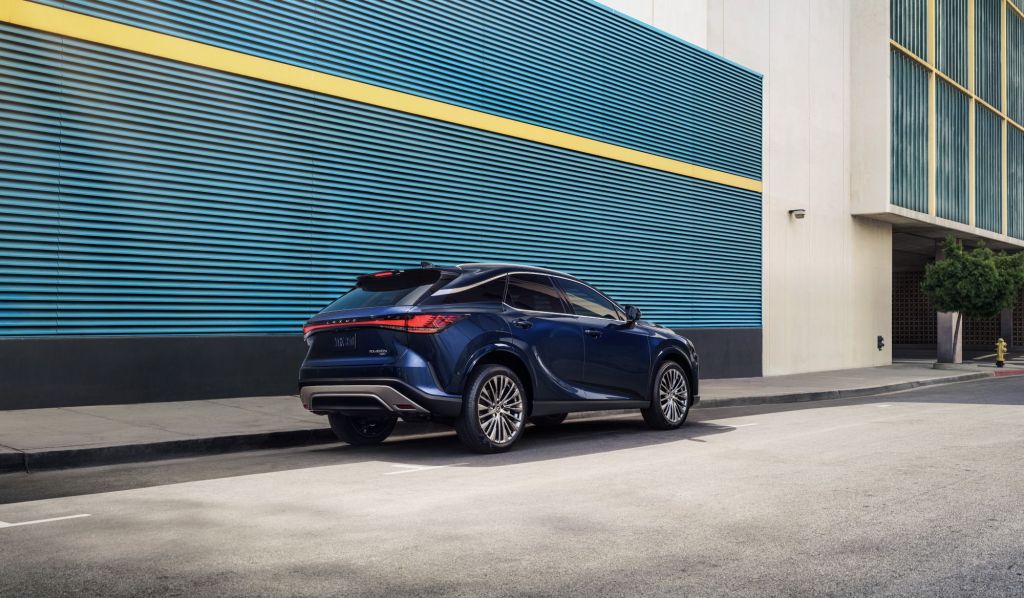
The RX 450h+ is a plug-in hybrid.
Said simply, it is a gas-electric hybrid. It is an AWD vehicle. So there is a permanent magnet synchronous motor in the front, a permanent magnet synchronous motor in the rear, and a gasoline-powered 2.5-liter four cylinder engine under the hood. All-in the system produces 304 hp.
But the “plug-in” part goes to the fact that, yes, there is a plug, which can be used to charge the lithium-ion battery. Note the “can.” It isn’t a requirement, though not taking advantage of this would be silly (you can use a regular home outlet, though there are other, more powerful options for charging).
What that fully charged battery means is that the RX 450h+ operates like a full-on electric vehicle for as many as 38 miles.
And when that runs out—and you won’t notice it when it does, unless you keep a keen eye on your gauge cluster—the vehicle operates like a hybrid, which means it is fuel efficient (and lest you think fuel efficiency = sluggishness, Lexus says it goes 0 to 60 mph in an estimated 6.2 seconds, which is probably true because they probably had a lawyer or two assessing the claim).
While the fuel economy measure is 85 MPGe, let’s face it: that’s fairly meaningless.
Know that I was getting 35.7 mpg after the electric miles were long gone.
And realize that this is a vehicle that seats five in comfort. It is a midsize crossover, measuring 192.5 inches long, 75.6 inches wide, 67.3 inches high, and having a 112.2-inch wheelbase.
That “in comfort” part is the essence, I’d argue, of Lexus.
Whether it is feeling the suppleness of the semi-aniline leather on the seats or simply looking at the ash bamboo trim in the cabin, this tells you that this is authentic.
Yes, there is a 14-inch touchscreen display and a 12.3-inch multi-information display (a.k.a., “gauge cluster”), but there are also knobs (e.g., temperature control, volume), so it isn’t all swiping (though you could should you be so inclined).
When the Lexus brand was launched in 1989 it used the tagline “The Relentless Pursuit of Perfection.” That was phased out in 2013. (It is currently “Experience Amazing.”)
Still, it is evident that the designers and engineers at Lexus know that working to achieve the utmost in quality and flawlessness is something they have to work at every day.
Whether or not that results in something “amazing” is certainly something that’s a personal assessment.
But unquestionably, whether predicated on sales or getting behind the wheel, the RX seems to be getting better and better.


