Munich has one in a facility where people take delivery of their cars. . .
By Gary S. Vasilash
While it is not uncommon for an automotive company to send out a news release regarding the retirement of an executive, BMW has sent one headlined:
BMW Welt bids farewell and thank you to star chef Bobby Bräuer
Which is, well, uncommon.
Bräuer is an executive, the executive chef of EssZimmer restaurant.
EssZimmer has achieved two Michelin stars since he took over the restaurant in 2012.
BMW Welt and BMW Group headquarters: notable architecture in Munich. (Image: BMW)
EssZimmer is one of the restaurants at BMW Welt in Munich, a facility that is not only a place where people can receive deliveries of their vehicles, but a public display of BMW Group products (BMW, BMW M, BMW i, MINI, Rolls-Royce, and BMW Motorrad)—since BMW Welt opened in 2007 more than 250,000 people have taken delivery there. There are three other restaurants and a bistro.
There are over three million people who visit BMW Welt each year.
There are displays, conferences, events and other activities that are both put on by BMW Welt (more than 400 people work there) or by organizations that rent space within the facility.
There is car culture and there is car culture.
Seems that BMW checks both boxes with its vehicle and with BMW Welt.
Madison, Alabama, is a city southwest of Huntsville, about 12 miles away, a quick trip on the I-565. It has a population of some 60,854, a nice bump up from the 56,933 in 2020.
The median household income in Madison is $118,132, compared with the national average of $75,149. Sixty-four percent of the population has a bachelor’s degree or higher, compared with the national average of 34%.
Madison, Alabama, is a place you’ve not heard of, as there are about 200 cities in the U.S. with a population of about 60,000.
But there’s something else about Madison that you may not be aware of:
It is the home of Mazda Toyota Manufacturing, a $2.3-billion factory where some 4,000 people work at producing 300,000 vehicle per year.
The first vehicle produced in the plant was the 2022 Toyota Corolla Cross. Assembly commenced in September 2021. A few months later, the Mazda CX-50 build began.
(Fun fact: Huntsville is the home of the legendary Marshall Space Flight Center. There are two assembly lines in the MTM plant: Apollo and Discovery.)
Timing is everything, so it seems rather propitious for Mazda that it decided to put a hybrid under the hood of the CX-50.
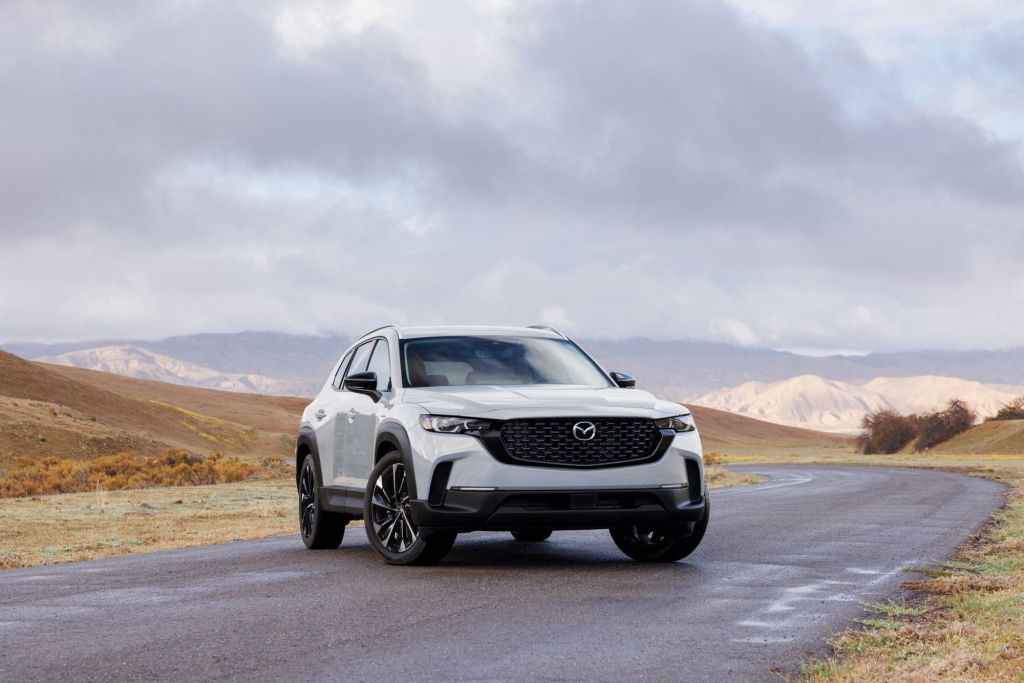
Mazda CX-50 compact crossover with a hybrid powertrain. (Image: Mazda)
And it would hard to believe that it is just a coincidence that the hybrid system—which includes a 176-hp 2.5-liter four-cylinder engine supplemented by three AC motors, so that there is a total system output of 219 hp—is one that is spec-wise just like the hybrid in the Toyota RAV-4.
(Curiously, the Corolla Cross is available as a hybrid, too, yet its system is different than the one that is used in the CX-50. The RAV-4 is built in the Toyota plant in Georgetown, Kentucky. Although one might think that it would be closer to go from Apollo to Discovery (or vice versa), turns out the hybrid system isn’t sourced from Kentucky but is sourced from Japan.)
It has a continuously variable transmission. It is all-wheel drive.
The vehicle is stickered at 39 mpg city, 37 mpg highway and 38 mpg combined.
Style
From the standpoint of the exterior, the compact crossover has the Mazda sheet metal styling that shows skill in creasing sheet metal, but perhaps because Mazda has been using this approach for a while on its range of vehicles, it isn’t as visually striking as it once was. Or maybe it has something to do with the fact that the Hyundai Tucson and Kia Sportage have become more visually striking and so the Mazda doesn’t have the standout looks it once had.
On the inside, especially as this is the top-of-the-line Premium Plus trim, there are things like leather for the seats and steering wheel. The instrumentation is laid out in a stylish and useful manner. There is a 10.25-inch display that is controlled by a large horizontally oriented knob in the center console. I would strongly recommend that if you’re interested in this vehicle and take it out for a test drive that you test drive that setup because some find it to be somewhat unwieldy.
Size
The CX-50 has a 110.8-inch wheelbase. It is 186.1 inches long, 75.6 inches wide and 65.8 inches wide.
So far as cargo: fold the second row and get 56 cubic feet. Behind the second row there are 29 cubic feet. As that is probably hard to visualize, simply know that there is plenty of room back there without folding the seats.
Assessment
The people in Mazda marketing probably cringe when people bring up the old “Zoom-Zoom” line.
If you’re interested in that, this isn’t the place to find it.
But if you want to get an efficient compact crossover, this is something that should be considered.
Everything old isn’t precisely new again—but an increasing number of products are being remanufactured for the good of the environment. . .
By Gary S. Vasilash
One of the ways that the environment can benefit without much in the way of sacrifice for consumers is through the use of remanufactured products rather than new.
While some might thinks that “remanufactured” is simply a euphemism for “used,” and that “used” is typically substandard compared with “new,” a “remanufactured” product doesn’t mean “second-hand,” with all of the questions that go along with that, but reprocessed in a factory so that it is like-“new,” even though it isn’t.
In other words, this isn’t the classic case of “buying someone else’s problem.”
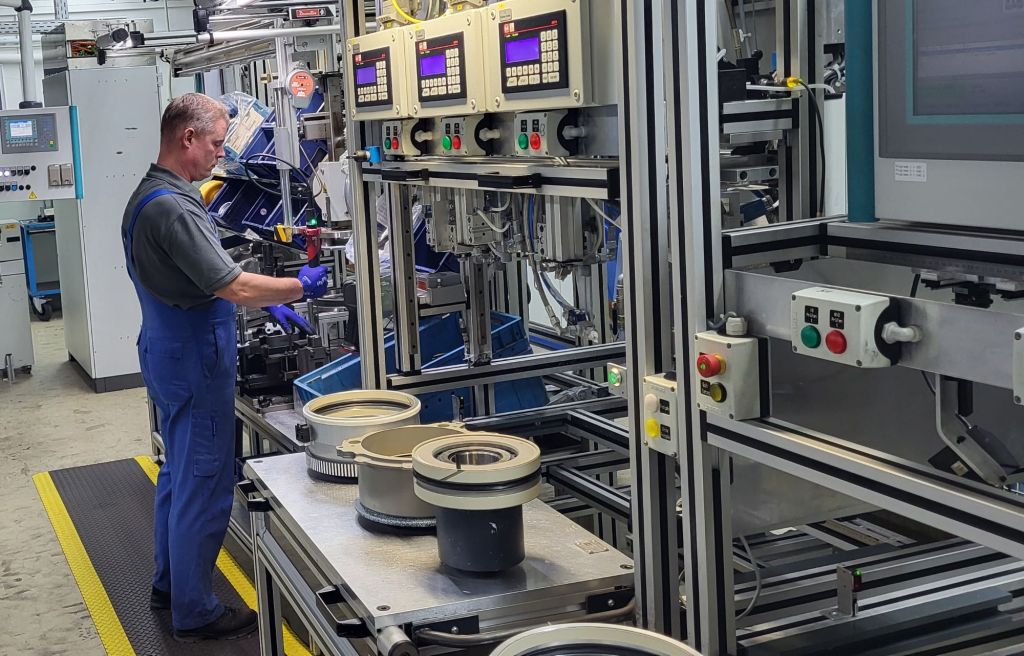
Drivetrain modules being remanufactured at the Bielefeld plant. (Image: ZF)
Auto supplier ZF, which is best known for making new things, like transmissions and chassis systems, is also an evident leader in performing remanufacturing.
It recently received the German Sustainability Award from the Germany Sustainability Award Foundation (obviously a case of the award name being a reuse of the words in the title of the organization).
The award was given in the context of its activities in the “transformation field of resources.”
Or remanufacturing.
ZF operates 25 remanufacturing sites worldwide.
One, in Bielefeld, Germany, has been in operation since 1963.
There products come in and are disassembled, cleaned, tested, refurbished and reassembled.
According to ZF, compared to a new part, the remanufactured part means
On average a reduction in material use of up to 95%
Energy and CO2 savings up to 90%
At the plant there are some 180,000 clutch pressure plates and disks, 10,000 torque converters, and 55,000 clutch release systems that come in used and go out remanufactured.
Presently, up to 35% of the products that were originally manufactured at Bielefeld return to the plant for remanufacturing. An objective is to increase that to 90% over the next five years.
Looking east for potential in-country investment. . . .
By Stephen Macaulay
According to the CIA World Fact Book, the industries in Bulgaria are:
“electricity, gas, water; food, beverages, tobacco; machinery and equipment, automotive parts, base metals, chemical products, coke, refined petroleum, nuclear fuel; outsourcing centers”
Apparently, the automotive parts manufacturing operations in Bulgaria are extensive, with the company having a particular expertise in the production of things like airbag sensors.
But there are no OEM operations in Bulgaria.
So last week H.E. Rumen Radev, president of the Republic of Bulgaria, and his colleagues took a trip of nearly 5,000 east to the VinFast Hai Phong Manufacturing Complex in Vietnam.
Radev met with Vice Chairman and CEO of Vingroup, Mr. Nguyễn Việt Quang, who noted that the company is looking to expand its electric vehicle production operations around the world.
So Radev emphasized that Bulgaria might be a good place for the Vietnamese company to not only sell its EVs and produce components for them, but to even manufacture in the country.
The point: While the European auto industry is undergoing some severe pressures that will result in massive changes, people like Radev recognize that auto still represents a net positive for one’s GDP.
With the 2024 Tacoma, the reengineering of what has long been the most popular—by a lot—truck in its midsize segment* Toyota product planners decided to make the market for the pickup as broad as possible by providing versions of the truck that cover the terrain in terms of price point and in terms of the way the truck is fitted out, be it someone who is looking for something they can drive to the supermarket or someone whose drive to the supermarket takes them over the valley and through the woods.
There are 11 variants, six with a 2.4-liter, four-cylinder turbocharged engine and five with the 2.4-liter supplemented with a hybrid system. The non-hybrid versions have either up to 228 hp and 243 lb-ft of torque or 278 hp and 317 lb-ft of torque. The hybrid version adds a 48-hp electric motor so that the combined horsepower in 326 and 465 lb-ft of torque. There are models with an eight-speed automatic transmission and models with a six-speed manual.
There are the SR, SR5, TRD PreRunner, TRD Sport, TRD Off-Road, Limited, TRD Sport i-FORCE MAX, TRD Off-Road i-FORCE MAX, Limited i-FORCE MAX, Trailhunter, and TRD Pro.
Sheldon Brown, Tacoma chief engineer, on these variants: “Each one has a distinct focus on the core purpose of the grade and uses hardware-, spec- and performance-based turning to deliver that unique experience more so than in the past.”
Common Elements
Having visited the Toyota Technical Center in Michigan during the development of the vehicle I can testify to the extent to which the development team did benchmarking and performed careful consideration of making each of the variants more than some trim modifications here and there.
What is consistent across the board is that the truck uses a boxed, steel-ladder frame. The Tacoma is based on the Toyota TNGA-F global truck platform, which means that it has the same underpinnings as the Land Cruiser, Sequoia, and Tundra, and forthcoming 4Runner.
Styled at the Toyota CALTY Design Research studio in California, Kevin Hunter, who heads that facility, said the design theme for the truck is “badass adventure machine.”
Again, yes, you can use it to pick up some cereal, yes, you can use it to traverse some rocks and logs, and either way, regardless of what model you pick, this is still something that looks like a truck, not something styled to be soft and silky.
The Trailhunter
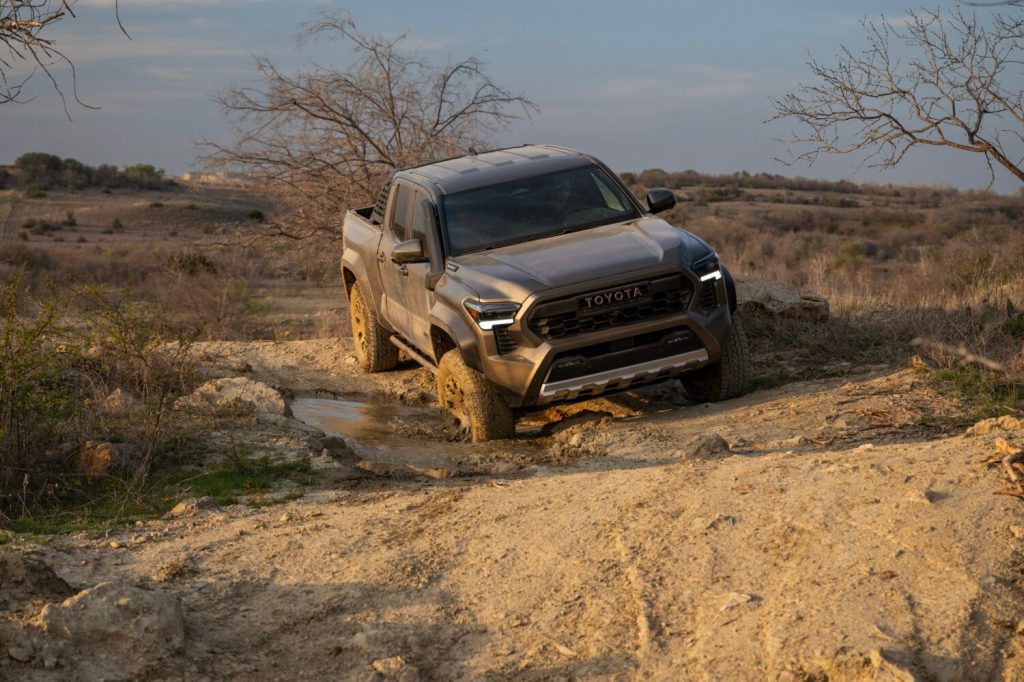
2024 Toyota Tacoma Trailhunter: Engineered to get dirty. (Image: Toyota)
Of the lineup, the Trailhunter is certainly one that not only has the style but the stuff for, well, trail hunting, assuming that that activity requires driving places that are otherwise places were people don’t usually find themselves.
This model is a double cab configuration with a five-foot, aluminum reinforced composite bed.
ARB & Toyota
The vehicle comes with ARB high-performance Old Man Emu 2.5-inch forged monotube shocks. (Evidently the shocks are named after the large, flightless, Australian bird that can traverse difficult terrain at considerable speed. No, I don’t get it.)
Those shocks aren’t the only thing that ARB and Toyota collaborated on for the Trailhunter. The rear bumper is another, constructed with 2.5-mm thick steel that’s powder coated for durability. There are two red recovery points, two jack points for an off-road jack, and non-slip step pads.
Also, there are MOLLE sail panels that are attached to the truck so that there can be a variety of overlanding gear can be attached to them.
There are 33-inch Goodyear Territory Rugged Terrain tires wrapped around 18-inch bronze-finished alloy wheels. The bronze theme is also picked up on the heritage-style grille, although the integrated LED light bar is certainly not vintage, nor are the RIGID Industries LED fog lamps.
Also on the exterior are rock rails and, should you look under the truck, high-strength steel skid plates.
Selectable Settings
The Trailhunter has a push-button Stabilizer Disconnect Mechanism that increases the suspension articulation front and back.
There is also Multi-Terrain Selection which operates in 4WD High and 4WD Low. Depending on terrain selection (mud, dirt, sand) the system helps control wheel spin. There is an electronically activated locking read differential.
The Trailhunter also offers CRAWL Control: set a (slow) speed and it works as a cruise control system so you can concentrate of maneuvering the vehicle. And on the subject of maneuvering, there is the Multi-Terrain Monitor that shows what’s ahead of the truck on a 14-inch touchscreen.
One of the most-striking things about the interior design of the Trailhunter is found on the dashboard and center console. Yes, this is a completely technologically up-to-date vehicle.
But rather than having the driver needing to select things on the screen or via what seem to be rather paltry buttons, the knobs, switches and buttons in the Trailhunter are rugged and robust: You know that you are in a highly capable machine.
Which, presumably, is the point.
One More Thing
The Trailhunter is a hybrid. And only a hybrid. Toyota knows it can get the job done.
==
*In 2023 in the U.S. Ford sold 39,364 Rangers, Chevy 45,562 Colorados, GMC 14,831 Canyons, and Toyota 234,768 Tacomas.
Well, Spain is the second-largest auto manufacturing country in Europe. . .
By Gary S. Vasilash
From Audi to Volkswagen—and a whole lot in between—automotive brands are not something in short supply in the U.S. market.
So it should come as no surprise that still another European brand wants to make its way to the U.S. by the end of the decade (yes, tongue is firmly planted in cheek).
CUPRA, established in 2018, is a subset of Barcelona-based SEAT. SEAT is a subset of Volkswagen Group.
CUPRA CEO Wayne Griffiths:
“CUPRA’s ambition is to be a truly global brand and expanding into the United States represents one of the greatest milestones on our journey.”
Current CUPRA lineup. (Image: CUPRA)
The company intends to sell ICE, PHEV and EVs in “key states that are aligned with the brand” (whatever that means: the company describes itself as a “disruptor” and an “unconventional challenger brand,” and when a company says that about itself rather than having it said of it, there is the distinct whiff of a marketing team coming up with buzzy descriptors).
Because it recognizes the importance of having good distribution, it is in talks with the Penske Automotive Group, one of the largest automotive dealership groups in the country, with more than 200 stores in the U.S.
Questionably a smart move.
And speaking of smart moves, in 2008 Penske Automotive Group started exclusive distribution of the smart auto brand in the U.S.
That ran until 2011, when Mercedes took in the brand.
Smart ceased to be available in the U.S. after model year 2019.
They’re concerned that people don’t know what they should about EVs. . .
By Gary S. Vasilash
In order to keep U.K. customers interested in the possibility of buying an electric vehicle, Auto Trader (a vehicle purchase platform), ChargeUK (an organization consisting of EV charging companies), and the Society of Motor Manufacturers and Traders (a trade association representing OEMs and suppliers) have gotten together to combat misinformation about EVs.
This past February the House of Lords’ Environment and Climate Change Committee came out with a report that indicated there was a need for “clear and balanced information” regarding EVs for consumers.
And Auto Trader discovered that the number of retailers offering EVs on its site was at 35% for both 2023 and 2024. It had been 57% in 2022.
So this is what the three groups have come up with:
One of the interesting points is the 71,459 available chargers.
In the U.S., as of late August, there were over 192,000 publicly available chargers, according to the U.S. Federal Highway Administration.
To put that into context, the U.S. is 40 times larger than the U.K.; it has five times as many people, and nine times as many automobiles. Yet it has just 120,500 more public chargers.
According to the U.K. group there is one charger per four miles of road in the U.K.
The U.S. federal infrastructure plan is building out one charging station on the Interstate Highway System—per every 50 miles.
If there is concern about the lack of a significant uptake of EVs it should be in the U.S. far more than in the U.K.
When you consider what they were up against, these nine vehicles all deserve respect
By Gary S. Vasilash
Earlier this fall, the North American Car, Truck and Utility of the Year (NACTOY) Awards announced what it called the “Best of 2025.”
Or said another way: the semi-finalists for the awards that will be presented January 10, 2025 at the Detroit Auto Show.
The vehicles are:
Car
• BMW 3 Series • BMW M5 • Cadillac Celestiq • Dodge Charger EV • Fiat 500e • Honda Civic Hybrid • Kia K4 • Mercedes-AMG E-Class • Porsche Panamera • Toyota Camry
Truck
• Ford Ranger • GMC Sierra EV • Ram 1500 • Rivian R1T • Toyota Tacoma
Utility
• Chevrolet Equinox EV • Honda Prologue • Volvo EX90 • Hyundai Ioniq 5 N • Hyundai Santa Fe • Jeep Wagoneer S • Lincoln Nautilus • Porsche Macan EV • Toyota Land Cruiser • Volkswagen ID. Buzz
So with that as prologue, this morning the finalists—three in each category–were announced at the LA Auto Show.
They are:
Car
• Honda Civic Hybrid • Kia K4 • Toyota Camry
Truck
• Ford Ranger • Ram 1500 • Toyota Tacoma
Utility
• Chevrolet Equinox EV • Hyundai Santa Fe • Volkswagen ID. Buzz
The 50 automotive journalists who serve as jurors (including me) now have the challenge of trying to sort out which of the vehicles represents best in class for consumers.
For those who might be wondering how things have gone recently, here are the winners for the past five years:
2020
• Car: Chevrolet Corvette • Truck: Jeep Gladiator • Utility: Kia Telluride
2021
• Car: Hyundai Elantra • Truck: Ford F-150 • Utility: Ford Mustang Mach-E
2022
• Car: Honda Civic • Truck: Ford Maverick • Utility: Ford Bronco
2023
• Car: Acura Integra • Truck: Ford F-150 Lightning • Utility: Kia EV6
2024
• Car: Toyota Prius • Truck: Ford Super Duty • Utility: Kia EV9
Based on that, it is clear that Ford is solid in trucks.
The Civic has gotten a trophy.
Kia is strong in utilities—but the K4 is a car.
All of which is to say that at this point it is anyone’s guess.
This is a vehicle that more people than you might imagine have been waiting for—even if they didn’t know it. . .
By Gary S. Vasilash
“GeekWire is unique among technology and business news sites, in that we look at the world through the lens of Seattle and the Pacific Northwest, where we’re based.” So the outlet describes itself.
The site has an “intense global interest in technology, ideas and innovation emerging from our backyard. Our motto is, ‘What happens here matters everywhere.’ Microsoft and Amazon are classic examples, but countless startups, research organizations, educational institutions and others based in the Seattle region also have an outsized impact on the world.”
So while the coverage is generally about the tech and the people related to Microsoft, Amazon and an array of outfits and organizations that you’re likely not to have heard of unless you are deep in the digital tech space, it also covers other things on occasion.
“As I pulled away from the Seattle International Auto Show on Thursday during a test drive of the highly anticipated Volkswagen ‘ID. Buzz’ electric van, a driver in a Tesla Cybertruck offered a thumbs up.
“It was all the confirmation I needed that the Buzz was going to be the buzzworthy vehicle at the annual show at Lumen Field Event Center.”
Yes, it is the type of vehicle that gets love whether it is in Seattle or Detroit.
Cost Consideration?
Which is absolutely appropriate for the rebirth of the VW Microbus: while in its heyday in the 1960s the Microbus was largely associated San Francisco scene, this new EV is somehow more appropriate for places like Seattle than Silicon Valley, south of San Francisco. That is, there is an income-based accessibility to the ID. Buzz, with a starting MSRP of $59,995, which is more in line with the median household income in Seattle ($129,715) than Silicon Valley ($146,143): the former probably is more concerned with sticker prices than the latter.
However, given that the median household income in the U.S. is more along the lines of $78,046, the ID. Buzz may not be for every household budget—but that won’t matter. Those who can probably will.
VW Germany Builds. U.S. Will Buy
At least for the first couple years every ID. Buzz available in the U.S. (it is built in a VW plant in Hannover and has been available in the Europe market since the latter half of 2022) will be purchased. People are drawn to the vehicle in a way few other vehicles of any configuration command.
And not just the type of people who read GeekWire.
It looks familiar. And fresh. Quite a feat. (Image: VW)
Of all of the vehicles I have driven in the past few years the ID. Buzz has had considerably more attention than any other.
Lots of Love
A 20-something HVAC technician who came to check my furnace, who says he’s thinking about buying an Accord: “That is really a cool vehicle.”
My 30-something Alfa Giulia Quadrifoglio-driving next-door neighbor: “I LOVE it!”
A 60-something man who walked over to the ID. Buzz when I was in a Barnes & Noble parking lot: “I remember the Microbus from when I was young. This is quite nice.”
And there were many others who were walking by who stopped and stared and drivers giving me a thumb’s up when I cruised by.
The thing is, none of the people that I talked with about the ID. Buzz brought up the fact that it is an electric vehicle. They didn’t care whether it was based on the MEB platform, which is meaningless to them. They didn’t know if it was a rear-drive vehicle (the one in question is) or whether there is a low center of gravity by having the 91-kWh lithium-ion battery located beneath the floor.
They weren’t overthinking it.
They simply thought it looks great.
And evidently VW found that design is the #1 reason why people are interested in it.
The Definition of “Capacious”
Of course, if you’re going to buy something like the ID. Buzz, you’re probably going to be interested in its cargo capacity, whether that’s in the context of having three rows of seats for people (depending on the types of seats selected, it handles six or seven people, and there is considerable third row legroom: 42 inches, which is 10 inches more than that offered in the roomy Kia EV9) or a whopping 146 cubic-feet of cargo capacity—and I use the word “whopping” advisedly: its capacity bests the Chevy Suburban—which is 2.6 feet longer (the ID. Buzz is 195 inches; the Suburban 226 inches)—by one cubic foot, and on more of an apples-to-apples comparison, it bests the Chrysler Pacifica PHEV minivan by five cubic feet (about the size of an average microwave oven).
(However, a word about cargo capacity. The aforementioned 282-hp electric motor that provides rear-wheel drive isn’t located in the front of the vehicle with a drive shaft traveling back to the rear axle, as would be the case of a vehicle with an internal combustion engine up front, but it is in the rear of the vehicle, below the location of the third row. So while other minivans provide more manipulation of the third row because they’re not restricted by a motor, to get the maximum cargo capacity from the ID. Buzz the third row needs to be removed, not exactly the sort of thing you’d want to do on a regular basis. Still, the second and third rows do fold flat. It is just that the third row can’t go into the floor, like the “Magic Seat” in the Honda Odyssey.)
Because this is an EV, the range must be stated: the rear-drive ID. Buzz provides a range of an estimated 234 miles. And to put that into context, according to the EPA, the 2025 Kia EV9 Standard Range RWD has a range of 230 miles, so the ID. Buzz is certainly in the mix.
Final Thought
The VW ID. Buzz has something most vehicles nowadays lack: Character.
That’s what its predecessor had, which explains why there is a resonance—even for those who may not be aware of it—that carries on in this reimagining.
No, that’s not a problem with the caps-lock on the keyboard…
By Gary S. Vasilash
Like many Western brands, Audi is having a bit of a struggle in China, a market it has been in since 1988.
After all, not only are native Chinese brands offering an array of compelling vehicles at all price points, including the upper end where Audi resides, but there is probably something of a bit of nationalism, as Chinese consumers are turning toward Chinese brands.
Consequently Audi is making a shift in its strategy in China and has developed the “Advanced Digitized Platform” with Chinese company SAIC.
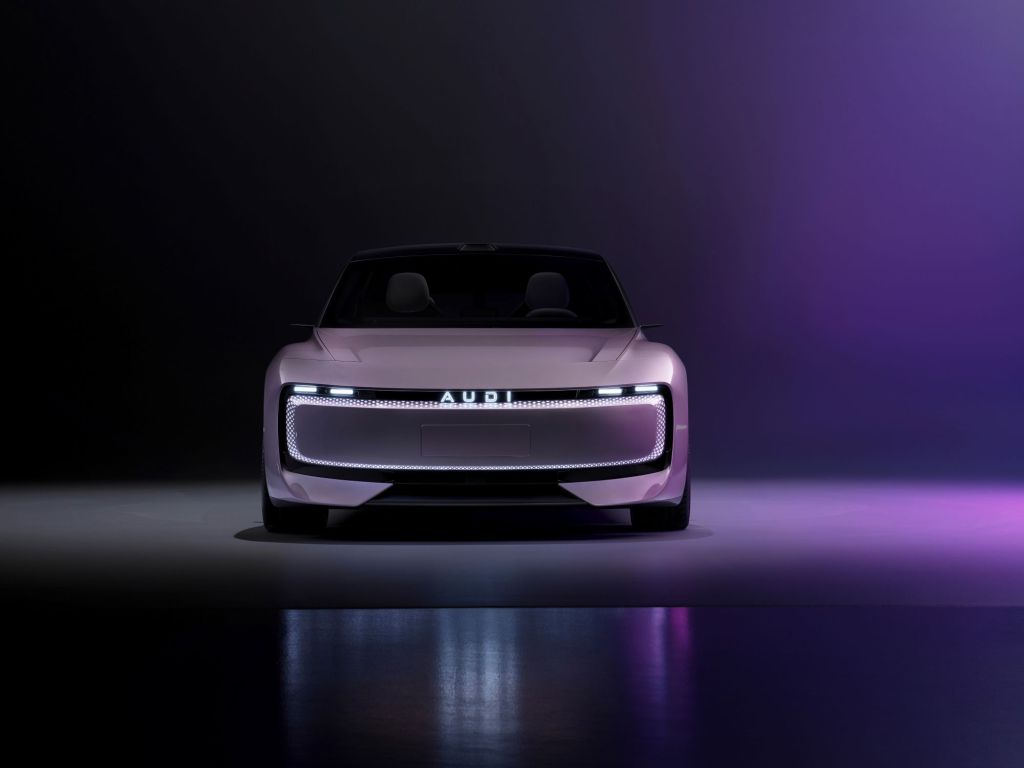
AUDI E concept introduced at the Shanghai Motor Show. All caps. No rings. Is it going to shift perceptions of the brand in China? (Image: Audi. Or maybe AUDI)
According to Audi CEO Gernot Döllner: “The joint platform will be the basis for a new generation of state-of-the-art intelligent connected vehicles exclusive to China. The upcoming models are aimed at a promising and simultaneously demanding new customer segment. The cooperation will further expand the Audi portfolio of battery electric vehicles in China and accelerate the company’s transformation in the world’s largest market.”
The platform will be used to develop three models that fall within the midsize and full-size segments, with the first model becoming available next year.
Audi says the collaboration with SAIC allows a >30% decrease in the time required to get a model in market.
In addition to which, Audi has created a new brand for the China market:
AUDI
That’s right: an all-cap version of the existing name.
Also, the famous four-right logo is jettisoned.
Döllner:
“By launching this new brand for electric and intelligent models in China, Audi is breaking new ground to tap into new and more tech-savvy customer segments.”
Seems like Audi in China becoming AUDI is China is the sort of change that a company that is afraid of making a major change would do.




 shinymetalboxes