Ford: Hybrids Should Be the Story

By Gary S. Vasilash

Much of the attention given to Ford’s Q4 2023 earnings call last week has been focused on CEO Jim Farley’s comment:

“[W]e made a bet in silence two years ago. We developed a super-talented skunk works team to create a low-cost EV platform. It was a small group, small team, some of the best EV engineers in the world, and it was separate from the Ford mothership. It was a start-up.

“And they’ve developed a flexible platform that will not only deploy to several types of vehicles but will be a large installed base for software and services that we’re now seeing at Pro.”

Somehow the inherent mystery of a “skunk works” has gotten people all excited.

Would they be so excited to know that the skunkworks methodology goes back to 1943 in the aircraft industry?

Yes, an 80-year-old approach.

Well, You’ve Got to Build It. . .

The other thing about this is that it is one thing for an R&D team operating independently to develop something and a whole other thing for that development to be engineered for and launched in production.

Launches have been something that Ford has been finding a bit troubling, so there’s that.

And it should be noted that the company also announced last week that its Ford e operation—as in the electric vehicles—lost $4.7 billion last year and the company anticipates losing $5 to 5.5 billion this year on Ford e.

The excitement of the skunk works project was certainly helpful from diverting some attention to that red ink.

What About This?

But what was largely overlooked was Farley’s comments on hybrids.

As in,

“Our global hybrid sales were up 20% last year, and we expect them to be up 40% this year.”

And:

“We now have the No. 1 and No. 2 best-selling hybrid trucks in the U.S. Maverick is No. 1. And we’re the No. 3 hybrid brand in the U.S. behind Toyota and Honda. But unlike them, our hybrids really sell best on trucks for our side.”

Given that Farley said “And margins on hybrids are closer to ICE, much higher than EV margins,” you’d think hybrids would be the headline going forward if for no other reason than the company can make money on them, something that it is not going to see on the EV side of the business until. . . . Well, that remains to be seen.

Maverick hybrid: Fuel efficiency and the energy to bust out the beats. (Image: Ford)

Not Exactly a Strong Third

While it is nice that Farley is so bullish about the company’s hybrid performance, it is worth really putting that into context.

Of course its hybrids “really sell best on trucks” because with the only hybrid Ford has without a box on the back is the Escape.

And as for it being number three, know that these are the number of hybrid sales for the three companies in 2023:

  1. Toyota:         523,664
  2. Honda:         293,640
  3. Ford:            133,748

In other words, it sold less than half of what Honda did and about a quarter of what Toyota did.*

So while the claim is factually true, one should perhaps not be too chuffed about the Ford hybrid performance.

About a quarter of Toyota and Honda sales are hybrids.

About 7% of Ford’s sales are hybrids.

Did I mention the skunk works. . .?

==

*It is worth noting that until recently Toyota was treated like some technological troglodyte for its continued support of hybrids and its not all-in approach to EVs. Not only do we see that Ford is reconsidering its positioning vis-à-vis hybrids and full EVs, but General Motors, which doesn’t have much of a record in the hybrid space, has announced that it, too, is going to bring hybrids to the U.S. market. Farley pointed out on the earnings call that consumers can quickly do the math on the fuel efficiency benefits of hybrids and, perhaps the most important factor: “they don’t have to change their behaviors.” It is surprising that there seems to be so many auto execs who ignore the long public charging time required for EVs compared with pumping gas: perhaps this is a case that when they get behind the wheel of their company vehicles someone else has done the charging.

Fuel Cell Market to Expand, But. . .

Fuel cells are having their moment again for various vehicle applications, from light-duty to big rigs.

How big a moment?

Seems not trivial according to a report by MarketsandMarkets, which products the automotive fuel cell market will grow from $200 million this year to $2.1 billion by 2030. It will have a compound annual growth rate of 48%.

Where will the largest market be?

Asia Oceana.

Given that the geographies covered in the firm’s report also includes Europe, North America and Rest of the World, presumably that Asia Oceana includes China, which could explain the biggest market.

(Image: Toyota)

That said, with companies including Toyota, Honda and Hyundai continuing their hydrogen fuel cell development efforts, Japan and South Korea can’t be counted out as players, and consumers, in this field.

However. . .the global battery electric vehicle market size right now is on the order of $500 billion and it is estimated to be about $1.5 trillion by 2030, so even with the impressive growth of fuel cells, they’re still approximately the size of a dandelion in a redwood forest.

Building Cars Is Hard

“The market is under-investing now, as a reaction to over-investing. There were a lot of bullshit ideas that got funded during that speculative boom around new ways to manufacture vehicles, forgetting the last 100 years of lessons on how hard it is to build a car company. People will look at Tesla, forget how hard it was for them, and assume everybody else can also do this really quickly.”– Olaf Sakkers – Partner and Co-Founder at mobility venture investment firm RedBlue Capital in Zag Daily

Yes, creating a new automotive company—advanced battery chemistry, digital twins, asset-light approaches, and other advantages that legacy  OEMs didn’t start with—is difficult.

To understate the case by a magnitude of scale.

Brazilian School Buses Making a Shift by Not Having to Shift

By Gary S. Vasilash

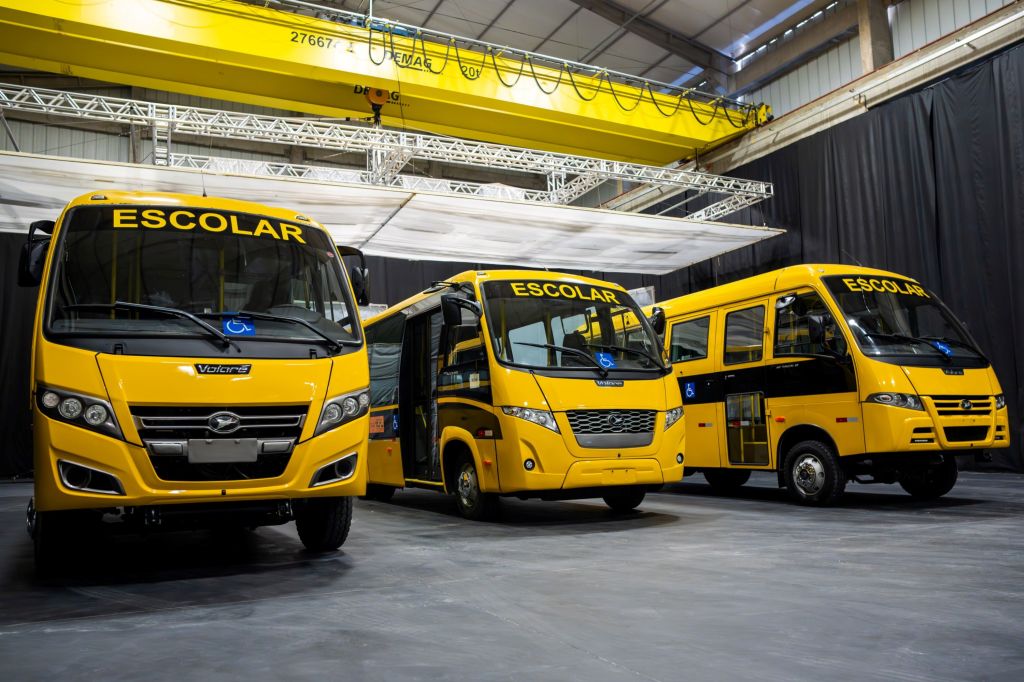
While it is easy to take for granted things like automatic transmissions in vehicles of all types, Allison Transmission has announced it is working with Volare, the leading manufacturer of minibuses in Brazil, to equip “South America’s first school buses with fully automatic transmissions.”

Brazilian busess to be fitted with Allison automatics. (Image: Allison)

Sidnei Vargas da Silva, Volare’s Domestic Market Business Manager:

“The introduction of Allison’s fully automatic transmissions in school buses in Brazil will be revolutionary in the progress of school transportation.”

Who would have thought that in 2024 a step-gear transmission could be considered “revolutionary”?

Puts things in perspective.

The 320 new buses, which will be fitted with Alllison Torqmatic transmissions and which are being financed by Brazil’s National Fund for Educational Development, are said to be more efficient to operate on roads that are characterized by mud, gravel or sand, which apparently is characteristic of the roads in the rural areas of northern and northeastern Brazil.

While it might be thought that all school buses in the U.S. are equipped with automatics, according to Schoolbusfleet.com, the transmissions are “prevalent in most school buses” and while manuals are “less common,” they are not nonexistent.

The Growing Cyber Risk

By Gary S. Vasilash

“This is not Charlie Miller anymore. We’re in a different era.”

That’s Shira Sarid-Hausirer, vp marketing, for Israeli automotive cybersecurity firm Upstream Security.

Sarid-Hausler is referring to the man who, with Chris Valasek, remotely hacked a 2014 Jeep Cherokee. As Andy Greenberg wrote in Wired of his adventures being behind the wheel of a Jeep that the two hacked from a distance:

“Though I hadn’t touched the dashboard, the vents in the Jeep Cherokee started blasting cold air at the maximum setting. . . .Next the radio switched to the local hip hop station and began blaring Skee-lo at full volume. . . . Then the windshield wipers turned on, and wiper fluid blurred the glass.”

Nothing he did could allow him to regain control of these systems. On the one hand, those things would be annoying. On the other, it would be highly disturbing that the knobs, buttons, or screen interface didn’t work.

Greenberg, driving on I-64:

“my accelerator stopped working.”

Yes, on an interstate with the traffic one would expect. With unhappy motorists behind him.

He couldn’t get the accelerator to start working. Miller and Valasek, sitting in a house several miles away here in charge.

Welcome to cybersecurity issues.

Sarid-Hausirer reports, based on finding from the 6th annual report that Upstream has conducted on cybersecurity, that things are going beyond hacks like that, that in terms of attacks on automotive companies we’re at “an inflection point.”

Swell.

A couple of data points that substantiate that inflection point:

  1. Based on its analysis of publicly reported cyber incidents, as well as those that Upscale personnel have found on the Deep and Dark Web, they’ve calculated that between 2010 and 2023 there were 1,468 incidents—and of that number, 295 occurred in 2023—that’s 20% of the entire number.
  2. While there are researchers and other helpful hackers, so-called “White Hats,” they accounted for 36% of the incidents, with the Black Hats accounting for the rest. And whereas for the past few years the number of attacks that would affect thousands or millions of “mobility assets”—which range from vehicles to EV charging stations were under 23%, in 2023 the number was 49%.

And as we more frequently hear of the wonders of “the Cloud” doing all manner of compute and control and communicate functions for us, turns out that of all attack vectors, telematics and the Cloud are far and away the biggest target: 43% of the attacks are focused there.

Infotainment, the other thing that OEMs are always pointing out their newest vehicles have to the utmost and then some, is the second-highest attack vector, at 15%.

And speaking of talked about tech, Upstream has discovered that AI is going to amp up the cyberattacks on mobility assets. (The good news on this front is that AI can also be used to counteract it.)

While some might think that there are state actors behind much of this activity, Sarid-Hausirer says that for the most part those doing the hacking are groups and individuals that are interested in money more than political activities.

Somehow all of this makes that 1978 Chevy Impala with an AM/FM radio seem all the more appealing.

You can get a copy of the 138-page report that is likely to make you wonder about all of that tech being offered in new vehicles here.

The Least-Surprising Finding About Bike Riding

By Gary S. Vasilash

Back when many of us were kids, before there were even articulated concepts about “multi-modal mobility,” a bike was something that, well, we just rode around with friends.

I’m not talking about serious riding that required special outfits and equipment.

I’m not talking about mission-oriented transport.

I’m talking about, “Hey, Mom, I’m going to go ride my bike.”

The U.S. Department of Transportation, Federal Highway Administration, did a study of bike trips in the U.S. during 2022.

It found that of the “Total person-trips made by bike”—some 2.2 billion of them—52% were in the “Social/Recreational” category.

Presumably some of those rides were of the dedicated variety. And odds are more than a small number were just “going riding.”

The second-highest category is “School/Church,” which came in at 20%.

The lowest category, tied with “Other” at 1%, is “Work-Related Business.”

Sure, cargo bikes may be a growing category, and while there have long been bike messengers and now bike-based food deliverers in urban areas, let’s face it: At least in the U.S. bikes are more associated with fun than generating finance.

Lincoln Freshens the Aviator

By Gary S. Vasilash

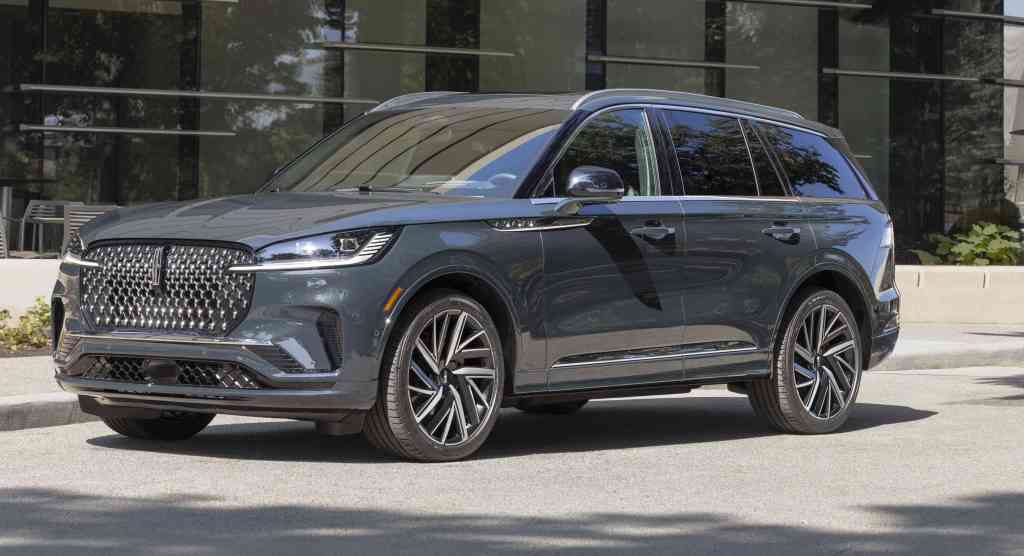
The biggest surprise about the Lincoln Aviator—and as a three-row vehicle that offers 140.6 cubic feet of passenger room or a maximum 78.6 cubic feet of cargo capacity (with the second and third rows folded) it is itself fairly big—is that there aren’t more of them sold.

That is, in all of 2023 there were just 15,551 Aviators sold in the U.S., putting it in last place in the four SUV Lincoln lineup.

Actually, that goes to an even bigger point, which is that Lincoln, for some reason, has become one of the best-kept secrets in the luxury market.

Lincoln, which positioned itself using the design philosophy “Quiet Flight” over the past several years and which uses the term “sanctuary” to describe the interior experience of its cabins, perhaps did too good a job of being stealthy.

Perhaps they should have made more noise.

The exterior designs of the Lincoln vehicles are sophisticated and unostentatious; the interior executions—particularly in the higher trim Black Label variants—are absolutely first rate. Anyone who sits in a vehicle from its crosstown rival and then gets into a Lincoln will be surprised at how well done the Lincoln interior is.

It is nothing short of striking.

Lincoln has done a refresh for the 2025 Aviator.

Fresher for MY 25: the Lincoln Aviator. (Image: Lincoln)

While there are some exterior modifications—

“The new Aviator looks more planted with a more dynamic presence than ever before. The changes we made to our signature grille shows our laser-focus on details and design that pulls you in. And with our new lighting features which we call ‘jewelry,’ the Lincoln star comes to life and immediately catches your attention.” – Kemal Curic, design director, Lincoln

–the real story for this model is upping the ante on the interior tech—

“With the new Aviator, technology takes an even larger role in helping create a relaxing, luxurious space that our clients have come to appreciate and expect from Lincoln. With advanced, connected features like the Lincoln Digital Experience and BlueCruise hands-free driving technology, we are creating a new, digital sanctuary on the road.” – Heidi Shaffer, director, Lincoln

The Lincoln Digital Experience is accessed through a 13.2-inch touchscreen or via voice, using Google Assistance or Alexa. For those who are part of the Apple ecosystem, there is CarPlay, as well. (An available Revel Ultima 3D audio system, with 28 speakers, makes the SiriusXM or Spotify or other music sound all the better.)

There is a leaning towards Google, however, as there is the ability to download apps from the Google Play store.

The BlueCruise feature, standard, allows hands-free driving on some 130,000 miles of roads in North America. There is Lane Change Assist—which allows the Aviator to switch lanes when safe to do so by simply using the turn signal indicator—and In-Lane Repositioning—which determines where the SUV is in relation to vehicles on either side of it and makes steering adjustments to provide the most room.

The midsize lux SUV category has a number of competitors, many of which (e.g., Genesis, Lexus, BMW) have solid options.

But sit in a Lincoln with a 30-position driver’s seat and then think about what your daily drive will be like.

Even if it is a two-year lease, you’re going to be spending a considerable amount of time in an interior, so it is best to get the one that you’ll be most comfortable with–and it could very likely be in a Lincoln.

Lots and Lots of Tacomas

By Gary S. Vasilash

As John McElroy points out at the top of this edition of “Autoline After Hours,” in 2023 Chevy sold 71,081 Colorados, GMC 22,458 Canyons, Ford 32,334 Rangers, and Nissan 58,135 Frontiers.*

That is a total of 184,008 midsize trucks.

And another number: 234,768.

That’s the number of Toyota Tacomas sold in 2023.

There were 50,760 more Tacomas sold than all of the others on the market combined.

Clearly a popular truck.

Now there is a new generation Tacoma, one designed, engineered and manufactured in the North American market because that’s where the preponderance—and it is clearly quite a preponderance—of vehicles sold.

2024 Tacoma. Badass. (Image: Toyota)

During the development of the ’24 Tacoma an objective was to create a “Badass adventure machine.”

It was configured to be capable.

It was configured with several trims—SR, SR5, TRD Off-Road, TRD PreRunner, TRD Sport, Limited—so there would be a bandwidth available for buyers.

Because Toyota is committed to providing electrified variants of all of its vehicles, the Tacoma was fitted with an optional hybrid powertrain, a propulsion system that provides 326 hp and 465 lb-ft of torque.

Because Toyota is still interested in providing something for those off-road enthusiasts (and to the economy buyers) who are interested in a third pedal, there is a six-speed manual available.

Sheldon Brown, chief engineer for the new Tacoma, talks with McElroy, Richard Truett of Automotive News, and me on this show for an entire hour.

If you’re interested in Tacomas specifically or trucks in general, it is worth your time.

==

*Who would have thought that Nissan outsold Ford in trucks?

Volvo, Polestar & Geely: Adjustments Being Made

By Gary S. Vasilash

Volvo Cars CEO Jim Rowan said on CNBC this morning about Polestar, the EV brand that it has some 44% of the shares of:

“They’ve have got a very exciting future ahead of them, they’ve moved from being a one-car company to a three-car company, they’ve got two brand-new cars coming out very shortly, in fact in the first half of this year, and that’s going to take them to a new growth trajectory.”

Sounds good, right?

But then there’s the fact that the reason Rowan was interviewed on CNBC is because Volvo Cars has announced it is going to reduce its holdings in Polestar.

Volvo Cars and Geely Holding essentially own Polestar.

In a press release from Polestar it says, in part,

“Volvo Cars is evaluating a potential adjustment to its shareholding in Polestar including a distribution of shares to its shareholders, with Geely Sweden Holding being the primary recipient. Volvo Cars will remain a strategic partner in areas across R&D, manufacturing, after sales and commercial.”

Which one could read as:

Geely China and Geely Sweden are going to own the majority of Polestar. So it is Geely, pure and straightforward.

Given that Geely owns Volvo Cars, there are probably just some bookkeeping adjustments being performed in Hangzhou. In Gothenburg the books are getting some line items removed so there can be an increased focus on its vehicles.

One wonders: Is this a further sign that the EV slowdown is having some consequences, especially on new OEMs trying to grow up?

Making MINIs

By Gary S. Vasilash

MINI, a quintessentially British brand, is owned by BMW, a company with a German state in its name.

Last fall BMW announced an investment of more than £600 million in the MINI factories at Oxford—yes, as in the place that also has the university—and Swindon—the place where the Wernham Hogg office that merged with the Slough branch in “The Office” was located.

About the investment Milan Nedeljković, Member of the Board of Management of BMW AG responsible for production, said, “With this new investment we will develop the Oxford plant for production of the new generation of electric MINIs and set the path for purely electric car manufacturing in the future.”

MINI Aceman. No, that isn’t the production paint. It is undergoing final tests–evidently in Arizona, given that license plate–before production starts for the EV in a plant in China. (Image: MINI)

The MINI Cooper 3-door and the MINI Aceman, both EVs, will go into production in the U.K. in 2026.

Going back to the owner of the brand’s HQ country, it isn’t entirely surprising that the MINI Countryman is made in Leipzig.

What may be a bit of a surprise, however, is where the Aceman will soon start production: at a plant in Zhangjiagang, Jiangsu Province, China.

About the Aceman, Stefanie Wurst, head of MINI said, “The all-electric MINI Aceman opens new opportunities for customers who want a smaller crossover than our successful MINI Countryman. The consistent electrification of our product portfolio makes a clear statement about the future of the MINI brand.”

The Aceman is based on a new EV platform developed by BMW and Great Wall Motor.

U.K. . . .Germany. . .China.

Mr. Bean couldn’t have imagined this.