AV in the UK

This makes more sense than Tesla in Austin

By Gary S. Vasilash

While there is a lot of attention being paid to Tesla’s rollout of some 10 vehicles in Austin that are operating autonomously—with a safety driver on board and apparently people back in Tesla HQ monitoring the fleet, ready to kick in with teleoperation help if needed—there is virtually no attention being paid to what is happening in Cambridge, UK.

This week an autonomous Mellor Orion E electric midi bus—a low-floor transporter that can be configured to accommodate a maximum 16 passengers—equipped with a CAVStar Automated Drive System started rolling through the streets of the university town.

Bus is operating autonomously in the streets of Cambridge, England. (Image: Fusion Processing)

The CAVStar system is engineered by Fusion Processing. It comprises an AI processing unit, radar, LIDAR, optical cameras, and ultrasonic sensors.

The Cambridge vehicle is said to meet the requirements of SAE Level 4 autonomy.

The bus is running as part of the Connector project, which is led by the Greater Cambridge Partnership, which is supported by Innovate UK and the Centre for Connected & Autonomous Vehicles.

The bus initially ran though the areas in Cambridge where it is now operating without passengers to determine fitness for use.

Dan Clarke, head of Innovation and Technology at the Greater Cambridge Partnership:

“People may have already seen the bus going around Eddington and Cambridge West from Madingley Park & Ride recently, as, after the extensive on-track training with the drivers, we’ve been running the bus on the road without passengers to learn more about how other road-users people interact with the technology. We’re now moving gradually to the next stage of this trial by inviting passengers to use Connector.

“As with all new things, our aim is to introduce this new technology in a phased way that balances the trialling of these new systems with safety and the passenger experience. This will ensure we can learn more about this technology and showcase the potential for self-driving vehicles to support sustainable, reliable public transport across Cambridge.”

Somehow this seems more substantial than the reports out of Austin about the performance of some of those Tesla vehicles.

In addition to which: if, as Musk has proclaimed in his various “Master Plans,” his goal is to reduce overall energy use (yes, targeting fossil fuels, but even renewable energy systems are far from being zero-emissions), then doesn’t a mass transit vehicle that can transport plenty of people make more sense than autonomous passenger cars?

2025 Toyota 4Runner TRD Pro

Built to take it. . . .

By Gary S. Vasilash

Consider these elements:

  • Fox Racing QS3 internal-bypass shocks, front and rear, with rear piggyback-style remote reservoirs
  • Independent double-wishbone front suspension with coil springs and stabilizer bar
  • Multi-link rear suspension with coil springs and stabilizer bar
  • 33-inch Toyo Open Country III tires
  • 18-in. matte-black alloy wheels with 33-in. Toyo all-terrain tires
  • Stabilizer Disconnect Mechanism (SDM)
  • Multi-Terrain Select (MTS) and Crawl Control (CRAWL)
  • Electronic locking rear differential
  • TRD Pro aluminum front skid plate with underbody transfer case and fuel tank protection
  • Part-time 4-Wheel Drive (4WD)
  • Electronically controlled 2-speed transfer case (high/low range) and Active Traction Control (A-TRAC)
  • Rigid Industries LED fog lights

If those things make you shrug, as in “I don’t exactly know why these things are of particular importance,” then the 4Runner TRD Pro is not for you.

Which is not exactly the sort of thing you ordinarily see this early in a description of a given vehicle.

2025 Toyota 4Runner TRD Pro: Who needs pavement? (Image: Toyota)

But the point is, the 2025 4Runner TRD Pro, a mid-size SUV, is engineered to drive on terrain and in ways that if you aren’t an enthusiast of the great outdoors you are likely never to appreciate.

Here’s another thing to know about this model—as well as the other 4Runner variants: It has body-on-frame construction.

Again, if you shrug, then maybe there should be the consideration of something like a Grand Highlander.

The TNGA-F platform the 4Runner is built on is also used for things like the Toyota Tundra and Tacoma—both pickup trucks. (It is also found on the Toyota Land Cruiser.)

This is a fully boxed ladder frame that is constructed to provide high levels of torsional rigidity. Another thing Toyota has done is use tailor welded blanks, which means there is additional strength in areas that need it so the structure is ready to handle the hard stuff, like when crawling over rocks.

The vehicle is powered by an i-FORCE MAX 2.4-liter, turbocharged (twin-scroll turbocharger) 4 cylinder hybrid engine.

Yes, that’s right: this is a hybrid, a parallel hybrid system with a permanent magnet synchronous motor/generator. The system—as in the combustion engine and the electric motor—produces 326 hp @ 6,000 rpm and 465 lb-ft of torque @ 1,700 rpm.

There is an eight-speed automatic.

And if you’re curious: it is rated at 23 mpg city, 24 mpg highway, 23 mpg combined.

The TRD Pro offers seating for five on SofTex-covered seats: this is material that resembles leather, but which is formulated to be able to handle serious wear and tear. It also cleans up nicely, because if you’re going to have a vehicle that you may take literally off-the-grid on weekends (which goes back to the point of the TRD Pro), odds are you’re going to want to get rid of the mud and muck that may be brought unintentionally back into the cabin. (Leather is used for the heated steering wheel and on the shift knob.)

The 4Runner offers beefy knobs, dials and buttons that make making adjustments far easier than is the case of vehicles that have switched to digital interfaces for changing things. But this is not to say that the vehicle is in any way behind when it comes to tech, as there are a 12.3-inch digital gauge cluster and a 14-inch infotainment screen. There is a 14-speaker JBL audio system. The 4Runner has wireless Apple CarPlay and Android Auto.

The interior is so good that it is a winner in the 2025 Wards 10 Best Interiors & UX competition.

But let’s go back to the list that started this and the claim that if you aren’t impressed, the 4Runner TRD Pro is probably not the one for you.

It is worth knowing there are eight other 4Runner trims. And while there is something of a bias toward the rough and ready (e.g., TRD Off-Road Premium; Trailhunter), there are configurations that are better for those who are unlikely to beat the stuffings out of their vehicle on a somewhat regular basis.

AC Cars Expands Footprint to U.S.

Opening a new operation—in West Palm Beach

If you’re interested in reserving an AC GT Roadster, know that the starting MSRP of the V8-powered, carbon fiber-skinned two-seater is $276,792.

You will not, however, have the problem of seeing a whole lot of other people driving around in “your” car. The company, founded in 1901 (heritage matters, right?), which has operations in both the UK (where it is headquartered) and Germany, will build 250 of the vehicles annually—for the global market.

Classic design for a car with a specialized price. (Image: AC Cars)

It is worth noting, however, that for customers in the U.S. things have gotten a bit easier as AC Cars has announced the launch of AC Cars America.

David Conza, CEO of AC Cars England:

“AC Cars America is poised to play a critical role in the next chapter of our global journey. The US is AC Cars biggest single market, and establishing a dedicated company ensures that clients will receive the best possible care while we continue to reach a greater audience for our exclusive models.”

The American outpost is headquartered in West Palm Beach, Floridia. Of course it is.

Arguably it is a good thing that the whole tariff regime between the U.S. and the UK—the “Economic Prosperity Deal”—has been worked out.

It includes a provision that has it that the first 100,000 cars manufactured in the UK will face merely a 10% tariff.

On that AC GT Roadster would be a mere $27,679.20—which is a whole lot better than the $69,198 that the original “Liberation Day” 25% tariff on cars imported from the U.K.

Even the denizens of West Palm Beach would notice that.

2025 Acura ADX A-Spec AWD Advance

By Gary S. Vasilash

Acura, the premium division of Honda, had its start in 1986 in the U.S.

That was before Toyota launched Lexus and Nissan Infiniti.

Both of those arrived in 1989.

When Acura started, there were two vehicles on the showroom floor:

  • The Legend. This sedan, with a rather ostentatious name (c’mon: somebodies else decide whether something is a legend or not), was actually developed by Honda and the now-non-existent Austin Rover Group.
  • The Integra. This was something of a polar opposite of the Legend. It was a sporty three- or five-door. A more affordable vehicle.

The Legend went into the history books after the 1995 model year. In 2001 the Integra was replaced by the RSX. The RSX had a short run: until model year 2006. There was a bit of a hiatus in this car space: the ILX replaced the RSX in 2012. It had a run until model year 2022, when it was replaced by the current-generation Integra.

The point of this is that Acura has consistently maintained what can be considered an affordable, entry-way vehicle in its lineup. Of late it has been the Integra. That car has a starting price of $33,000.

And Now This

But the interest in cars has cooled*, and Acura has stocked the showroom floor with an array of SUVs. Until lately, the least-expensive Acura SUV was the RDX, with a starting price of $44,700. (In case you’re wondering; the starting price of the most-expensive is the ZDX, an electric vehicle, that begins at $64,500.)

So in order to, in part, get people into an affordable SUV Acura, the company has launched the ADX.

Acura’s new entry: the ADX. (Image: Acura)

It has an entry price of $35,000.

The top-of-the-line ADX A-Spec Advance AWD takes the MSRP to $44,000.

But the ADX has a bit of a problem. The problem is a good one for American Honda (the overall company). But not a good one if your job is moving Acuras.

Too Good for Its Own Good

The problem is the Honda CR-V.

The 2026 CR-V LX FWD starts at $30,920. The top-of-the-line CR-V AWD Sport Touring Hybrid starts at $42,250.

Yes, there is a difference between a “Honda” and an “Acura” badge.

But there are some similarities between the two models.

Like in the ADX there is a 1.5-liter, turbocharged four that produces 190 hp. In that CR-V LX there is a 1.5-liter, turbocharged four that produces 190 hp.

Whether it is the entry ADX or the top model, there’s the same engine.

In the top-of-the-line CR-V AWD Sport Touring the powertrain produces 204 hp.  And not only is it more powerful than the ADX powertrain, it gets better fuel efficiency (40 mpg city/34 mpg highway/37 mpg combined vs. 25 mpg city/30 mpg highway/27 mpg combined).

But one might point out that when it comes to that powertrain, there’s less mass to move: the AWD ADX has a mass of 3,611 pounds and the AWD hybrid CR-V is at 3,926 pounds. But there is that additional horsepower in the CR-V, so at the very least it is a wash.

Sized Right

It should also be pointed out that dimensionally the two vehicles are fairly similar, with the ADX being 185.8 inches long and the CR-V at 184.8 inches; the ADX 72.5 inches wide and the CR-V at 73.5 inches wide. The big difference is in the height, with the ADX at 63.8 inches and the CR-V at 66.5 inches, which I suppose goes to the point of the ADX being a sport utility vehicle and the CR-V a sport utility vehicle. (And on the subject of utility, the ADX A-Spec Advance offers 23.2 cubic feet behind the second row and 53.9 cubic feet with the second row folded; the CR-V Sport Touring has 34.7 cubic feet behind the second row and 76.5 cubic feet with it folded.)

Of course, comparisons are not typically made of vehicles from the same company so perhaps the above is inappropriate (though not if you’re in the market for a new vehicle).

So just to look at the ADX A-Spec Advance driven here, it provides:

  • A 10.2-inch digital gauge cluster
  • 9-inch touchscreen
  • A 15-W wireless charger
  • 15-speaker Bang & Olufsen audio system
  • Built-in Google and Alexa
  • Adaptive cruise control
  • Ventilated front seats (i.e., cooled as well as heated)
  • Leather for seating surfaces and wrapping the steering wheel
  • Sport pedals (i.e., metal)
  • Powered liftgate
  • 19-inch alloy wheels
  • Panoramic moonroof
  • And more

And it has that stylized “A” on the Diamond Pentagon grille.

But still, even if there wasn’t economic uncertainty in the world at large at the moment due to everything from tariffs to roiling in the Middle East, anyone who is looking to get the most for their money would be hard pressed not to consider the Honda rather than the Acura.

The company that encompasses Acura and Honda simply makes great products.

==

*In addition to the Integra, Acura still offers the TLX. It seems as though that model may not be long for this world.

The Trials of Remodeling

If you had an NVIDIA-powered system you could pull off that basement remodel without a hitch. . .

By Gary S. Vasilash

If you are, say, redoing your basement, you might think you’ve got everything planned out to the final light fixture but discover along the way that there happens to be something that isn’t going to allow it to happen as anticipated, such as a support pole being in the “wrong” place. (It, of course, is in the right place. Your plans are off.)

You might think that this is something that couldn’t happen during professional projects.

Like when modifying an existing factory to accommodate a new vehicle or to add capacity.

Turns out, factories can be just like basements.

While half of those robots are where they need to be, the question is whether the other half will be able to do what needs to be done. So simulation lets BMW engineers know. (Image: BMW)

Only the consequences can be greater when it turns out the support beam is the way.

BMW plans to launch more than 40 new or updated vehicles between now and 2027.

It has more than 30 production sites to prepare.

To do this with as minimal a hitch as possible it is using its “Virtual Factory.”

That’s a simulation system that’s based on the NVIDIA Omniverse.

Inputs to the simulation include everything from building data to vehicle metrics, equipment information to manual work operations.

Simulations are run in real time.

Potential collisions (e.g., banging into a column) are automatically determined.

What’s surprising is that pre- this digital twin approach it was sometimes necessary to manually move a vehicle through the plant to make sure everything fit.

And in some cases it was necessary to drain the dip tanks in the paint shop, which is not only time-consuming, but expensive.

And speaking of costs: BMW says the Virtual Factory approach will save as much as 30% in production planning.

2025 Volkswagen Tiguan SE

This one is really in the game. . .

By Gary S. Vasilash

VW Tiguan: “drive like Somebody.” (Image: VW)

Back in 1959 advertising agency Doyle Dane Bernbach initiated a series of ads for a then largely unknown automotive company, a series of ads that are now legendary.

It was the “Think Small” campaign for Volkswagen. In a time when cars were both enormous and ostentatious a diminutive, rounded vehicle was certainly something that was itself out of the ordinary.

Arguably that “Think Small” campaign did more to establish VW in the minds of Americans more than any campaign for any car line, period.

Although this is something that occurred some 60 years ago, arguably it is a two-edged sword for Volkswagen in America.

That is, the New Beetle hasn’t been available in the U.S. market since 2019. While enthusiasts might say “GTI” when asked to name a Volkswagen model, the average person would likely answer “Bug.”

VW = SUV

But the thing is: Volkswagen in America is largely an SUV brand. In 2024 the company sold 290,824 SUVs and 88,353 cars. (The GTI, incidentally, had total sales of 11,072.)

The Volkswagen Tiguan, a compact SUV, has been available in the U.S. since 2008.

Early on the sales were nothing to write to Wolfsburg about.

And that was the case for several years.

Perhaps one reason was that people “Thought Small” when they thought “Volkswagen,” so even though during the first decade you could get in Tiguan in the U.S. there was also the sizable VW Touareg SUV in the showroom. (It stopped being available in 2018.)

Tough Crowd

But there has been a bigger issue for the Tiguan.

Even though it was VW’s best-selling vehicle in the U.S. last year (94,372 units; the Atlas came in second at 75,516), it faces a phalanx of redoubtable competitors.

As in the Toyota RAV4, the Honda CR-V, the Ford Escape, and many more.

One fairly contemporary model with the Tiguan in the U.S. is the Hyundai Tucson, which first became available in late 2004.

The Tucson will be on its fifth generation later this year.

The third-generation Tiguan has just launched.

The point of this comparison is simply that Hyundai has been aggressively improving the Tucson in order to catch up with some of its competitors in that space.

And with the 2025 Tiguan, Volkswagen has really gotten into the race because this third-generation model is really quite competitive.

It is not like the second generation was bad. But it was the case that the competitive set were generally better.

Gamer

But now the Tiguan is really in this game.

The exterior design is more substantial without being truck-like. The front fascia has a slim lighting signature that sits above a large lower grille that signifies business. There are subtle fender flairs to provide a more-planted stance. Around back the taillamps also have the slim look that is becoming more characteristic of VW design.

Overall, the exterior design is one that doesn’t mimic other vehicles in the class.

Inside the materials seem to be a class-above.

In the late 1980s, early 1990s the craftsmanship of German vehicle interiors were the envy of other OEMs. Either the others got better or the Germans became complacent because the advantage passed.

But with the Tiguan it seems they’re paying attention again.

An issue is that while there is a nice 12.9-inch center infotainment display (it is 15 inches on top-of-range SEL R-Line models), the infotainment interface is less intuitive than in other brands. (Guess this is why you don’t see people walking around with German smartphones.) 

The turbocharged 2.0-liter engine produces 201-hp. It is mated to an eight-speed automatic. The FWD SE model as driven here provides estimated fuel economy numbers of 25 mpg city/32 highway/28 mpg combined. This is a competitive set of numbers as a 2025 FWD Honda CR-V with a turbocharged 1.5-liter engine that produces 190 hp has numbers of 28/34/30 mpg, so a few more horsepower for the VW means a few fewer miles per gallon.

Which brings me back around to positioning.

There is currently a clever TV spot created by agency Johannes Leonardo for the new Tiguan.

The tagline is: “Now anybody can drive like Somebody.”

Which goes to the point that the new Tiguan, which has a starting MSRP of $29,495 (the MSRP for the SE driven here is $32,295) seems much more special yet is accessible.

Which is as true now as “Think Small” was true then.

2026 IONIQ 9: Nine Things to Know

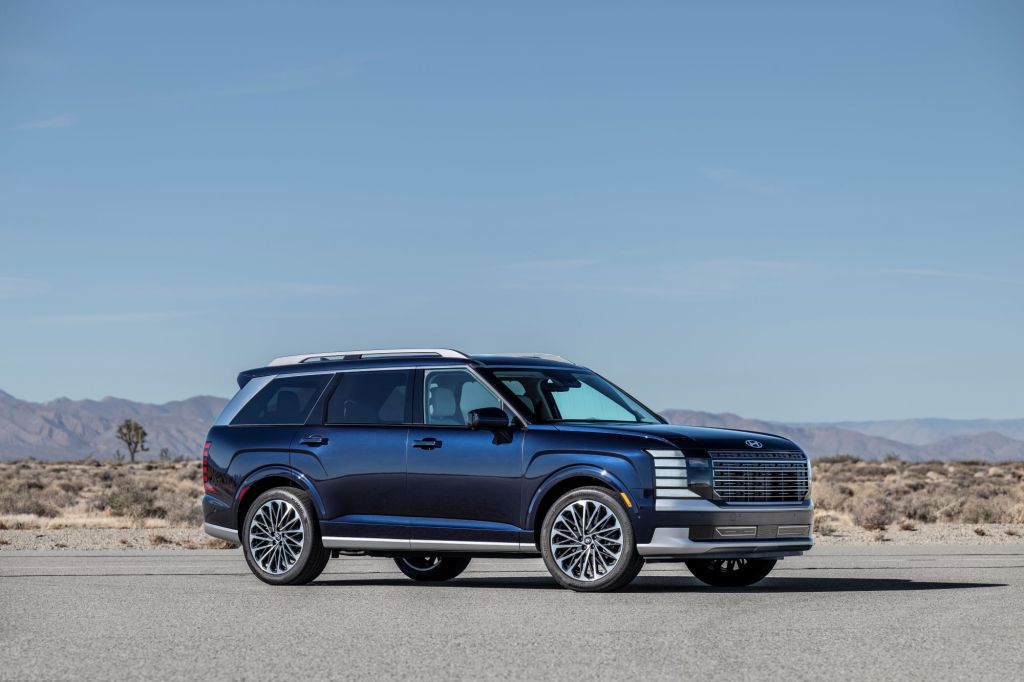
(Image: Hyundai)

Even if it wasn’t an electric vehicle it would be a most-impressive three-row vehicle. . . .

By Gary S. Vasilash

Roomy for Folks

The IONIQ 9 seats ether six or seven people in its three rows. And any way you configure it it is roomy: as in having passenger interior volume of 163.54 cu. ft. in the seven-passenger configuration. But like any vehicle, the third row is not as roomy as it is in the front or second row, but the IONIQ 9 has sufficient roominess in that third row such that the people who are back there won’t feel as though they are being punished, as is the case more often than not.

The seats are comfortable and that interior volume is such that occupants have a sense of space, as though they are in a room, not an SUV.

In fact, Hyundai interior designer Gary Lin uses a neologism to describe the cabin: “Aerosthetic Lounge.”

Speaking of Seats

What Hyundai calls “Relaxation Seats” are available for the first and second rows in the six-seat setup. These are seats that resemble those found in the First Class cabin of a transoceanic aircraft: They offer full recline—including leg rests.

Now here’s the clever part of the Relaxation Seats: People talk about how to kill time when having to recharge their EVs. But let’s face it: there are only so many nonperishable items you’re going to be buying in that Walmart that has a charging area.

So Hyundai is cleverly allowing people in the IONIQ 9 to get a comfortable place to wait it out.

Not a Long Wait

The IONIQ 9 has a 110.3-kWh lithium-ion battery.

According to Hyundai, using a CCS adapter and a 350-kW DC fast charger, the battery can go from 10% of charge to 80% in 24 minutes. If you go to a Tesla Supercharger, the same can be done in 41 minutes. At a 50-kW DC fast charger it is up to 109 minutes.

Presumably the choice might be predicated on how much you want to lounge.

When You’d Need to Recharge/Relax

There are three powertrain setups for the IONIQ 9.

The Long-Range RWD model features a 160-kW motor in the rear.

The Long-Range AWD model adds a 66.1-kW motor in the front. (This is something that EVs do that gasoline-powered vehicles can’t: want AWD, just add a motor. In gas-powered vehicle there are driveshafts and transfer cases or center differentials involved. Much simpler in an EV.)

Finally, there is the Performance AWD model, which has a pair of 157.3-kW motors.

So in that order the ranges are an estimated:

  • 335 miles
  • 320 miles
  • 311 miles

All of which is to say that the driver may not get to enjoy the full recline for a while.

The Utility Factor

Not only do people get big sport utility vehicles (and this vehicle is certainly sizable, measuring 199.2 in. long, 78 in. wide, 70.5 in. high, and having a 123.2-in. wheelbase) to move people, but also to move stuff.

So if all the seats are folded it can swallow 86.9 cu. ft. of stuff. 46.7 cu. ft. if the second row is in use. 21.9 cu. ft. behind the third row. (To provide some perspective: the trunk of a Sonata sedan measures 15.6 cu. ft., and it isn’t stingy on space.)

Yes, there is a frunk. For RWD models it measures 3.1 cu. ft. For AWD it is a diminutive 1.84 cu. ft.

Slippery, Too

One of the surprising things about the IONIQ 9 is that because it is large, you might think of it like pushing a large box through the air.

But, again, design and engineering have achieved a coefficient of drag that is nothing short of incredible.

That is, the coefficient of drag for a 2025 Corvette ZR1—the “fastest, most powerful Corvette ever,” according to Chevy—is widely reported to be 0.279.

The coefficient of drag for the IONIQ 9: 0.269.

Lower is more slippery.

In an Uncrowded Space

Back in 2023 Ford, which knows more than a little about such configurations, announced it planned to build a three-row electric SUV. A year later Ford announced that the vehicle planned to be launched in 2025 would be delayed. 2027, perhaps.

There aren’t a whole lot of EVs in this space.

Hyundai compares the IONIQ 9 to the Rivian R1S, which is reasonable. Except that the starting price for the Hyundai is $58,955 and the Rivian at $75,900. Not a trivial difference.

Hyundai also compares it with the Tesla Model X. Odds are Hyundai intends to sell more than the ~21,000 Model X’s that Tesla sold in the U.S. last year.

There is the Mercedes EQB that can carry seven, assuming that those who are relegated to row three are on the diminutive side.

And then there’s the Kia EV9. It is on the Electric Global Modular Platform (E-GMP). Just like the IONIQ 9.

Hush

Compared with vehicles powered by internal combustion engines, EVs tend to be quiet.

After all, there isn’t that series of explosions that occur as gasoline combusts in the cylinders because there are no cylinders, no gasoline in an EV.

But in some EVs there is a noticeable sound of whirring. And what’s more the case, there are noises from the outside of the vehicle, whether it is caused by the wind or the tires on the tarmac.

Hyundai engineers have addressed those noises in an impressive manner.

For one thing, there is acoustic glass used not only for the front side windows, but for the second row, as well. Many companies just opt for using the acoustic glass (which consists of a sandwich: glass/acoustic film/glass) in the front.

There are pads on the insides of the tires to absorb sound.

There is an array of foams and pads and insulation to mitigate unwanted sounds.

And if that’s not enough there is an active noise control system that uses the audio system to cancel out what you don’t want to hear.

Attainable

Let’s face it: electric vehicles are more expensive than vehicles that have gasoline engines.

According to recent numbers from Kelley Blue Book, the average transaction price for an EV was just shy of $60,000 while it was below $50K for a gas-powered vehicle.

Now make no mistake: the IONIQ 9 is—even if you look at it from the perspectives of size and amenities alone—an above-average vehicle.

Yet the starting MSRP for a RWD model is $58,955. (The vehicle is built at the amazing Metaplant outside of Savannah, Georgia, so it can qualify for the $7,500 tax credit.)

For all that it is and offers—nothing short of impressive.

Toyota’s Significant Collaborative Safety Research

Since its establishment in 2011, the Toyota Collaborative Safety Research Center has been working with an array of North American intuitions on making things better for drivers and pedestrians. And it has just completed its 100th project

By Gary S. Vasilash

 Toyota has a suite of driver-assistance systems and alerts—based on hardware and software—that it calls “Toyota Safety Sense” (TSS). Elements of the system include a pre-collision system, lane departure alert with steering assist, dynamic radar cruise control, and more.

Other OEMs have their TSS-like systems.

But what other OEMs don’t have is the Toyota Collaborative Safety Research Center (CSRC), established in 2011 by Akio Toyoda and funded (through 2026) to the tune of $115 million.

CSRC has collaborated with a number of organizations, from the Children’s Hospital of Philadelphia to Virginia Tech, from The Ohio State University Biomechanics Research Center to the Texas A&M Transportation Institute.

CSRC has announced the competition of its 100th research project, a study with the Massachusetts Institute of Technology AgeLab on the “Non-Driving Related Tasks” (NDRTs) performed by drivers while, ostensibly, driving.

Things like interacting with steering wheel controls, center stack interaction, using a phone (known in the research world as a “PED”: Personal Electronic Device), eating or drinking, interacting with passengers, fixing hair, singing to self. . . .

A whole lot of things that are not directly related to the task at hand (i.e., driving).

The researchers had some 450 hours of driving data—video and digital information—and in it they annotated more than 145 hours of NDRT behavior.

Dr. Bryan Reimer, research scientist at the MIT AgeLab and founder and co-director of the Advanced Vehicle Technology Consortium (of which Toyota is a founding member), explained that an objective is to determine the impact of SAE Level 2 driver assistance technologies on driver behavior when it comes to engaging in NDRTs.

Dr. Bryan Reimer of the MIT AgeLab says he has worked with dozens of OEMs on projects and is impressed with Toyota’s commitment to safety research. (Image: gsv)

Although every driver knows that they are not to do many of the things that are within the NRDT sphere, Reimer says there’s what he calls “the Cheeseburger Equation.”

You are hungry. You stop at a fast-food place and buy a cheeseburger. If you don’t eat inside the restaurant, you take the cheeseburger into your vehicle. And if you don’t remain parked, you drive your vehicle. And eat the cheeseburger.

That’s just going to happen, Reimer says.

Now the objective isn’t to create cheeseburger-facilitating vehicular automation.

Rather, it is to determine the methods to discourage drivers from performing NDRTs, thereby enhancing vehicular safety.

(Reimer says that positive suggestions can help reinforce correct behaviors in a way that telling people what not to do doesn’t do.)

In addition to announcing the completion of the 100th, CSRC announced 10 new projects:

  • “Analysis of Speed Assist Implementations and Context-Aware Improvements.” with Touchstone Evaluations
  • “Driver behavior adaptation to L2 automation,” with MIT AgeLab
  • “Evaluating driving performance and behavior across varying vehicle specifications and driving contexts,” with Virginia Tech Transportation Institute
  • “Safety benefits of in-vehicle alerts and notifications,” with Oregon State University
  • “User Acceptance Factors for In-Vehicle Safety Systems Targeting Impared Driving,” with Impact Research
  • “Comparing applicability of global ADAS testing scenarios in the U.S. context,” with University of Michigan Transportation Research Institute
  • “Skeletal data for anthropometry and posture,” with University of Michigan Transportation Research Institute
  • “Biological sex in ankle bone material properties,” with The Ohio State University Injury Biomechanics Research Center and University of Waterloo
  • “Interacting While Driving: Evaluating Attentional Demands of In-Vehicle Interfaces,” with Auburn University

Much of the information developed has been and is shared with other interested parties throughout the vehicle environment and some have contributed to the development of standards.

At a time when budgets are being not merely cut but chopped, it is laudable that Toyota continues to do safety research.

It doesn’t simply result in better vehicles, but there have been more than 400 students, postdocs, and researchers from collaborating institutions that have worked on CSRC programs, and that experience is proliferated throughout industry for the betterment of all involved parties.

2026 Genesis GV70 3.5T AWD Sport Prestige

Paying attention to the things that matter. . . .

By Gary S. Vasilash

While this is probably not the first thing that anyone who is going to be in the market for a compact luxury SUV like the 2026 Genesis GV70 3.5T AWD Sport Prestige will think about, it strikes me as being a salient point about what the designers and engineers behind this model did and didn’t do.

A comfortable cockpit. Tech is available without being overwhelming or calling attention to itself. Usability matters most. (Images: Genesis)

The vehicle features a 27-inch OLED screen. It stretches across the front of the driver and so has the cluster information necessary for vehicle control. But it also stretches into the area of the center of the instrument panel and so contains navigation, apps and audio control capabilities (AM/FM/HD Radio/Sirus XM (as long as you’re not in Alaska or Hawaii); as there is a Bang & Olufsen audio system you’re probably going to be listening to music, not news because the sound is really good).

The point is: this is as technical a setup as most any going out there.

Now this is a car that offers fingerprint recognition for operation.

It has the Genesis Digital Key 2 system, which means that you can use your phone or smartwatch to unlock/lock and start the GV70.

But rather than messing around with things that really don’t need fixing, it offers wireless Android Auto and Apple CarPlay.

If they thought they could do better they probably would have tried to replace them.

Instead they concentrated on making the drive experience a spirited and pleasant one.

///

As the name of the vehicle indicates, it has a 3.5-liter, 24-valve, DOHC, twin-turbo V6.

The engine produces 375 hp @ 5,800 rpm and 391 lb-ft of torque at 1,300 to 4,500 rpm.

It runs on premium fuel.

It is mated to an eight-speed automatic.

The transmission has paddle shifters.

This GV70 has all-wheel drive. That’s just as germane to the hard acceleration that may happen on occasion as it is to the slippery conditions that may be encountered.

///

2026 GV70: Style meets substance.

And then there’s the ride.

There are multilink suspensions front (MacPherson) and rear.

But there are a couple of other things that make a difference.

While you probably think not at all about the bushings in a suspension system—which are typically made with rubber or polyurethane and work to do such things as isolate vibrations and reduce noise—Genesis chassis engineers think a lot about them.

So for the GV70 they use “hydro bushings.” While the rubber and polyurethane types depend on elasticity of the materials to do their jobs, the Genesis hydro bushings use fluid that flows through an orifice, instead.

The difference? Genesis claims rear-seat passengers experience about 40% fewer vibrations.

Then there’s something more sophisticated.

There is a “preview” function of the electronically controlled suspension. It uses information from both the front camera and the navigation map.

Consequentially, if there’s rough road ahead, the system is ready. Adjustments are made as required. So the ride is smooth.

That’s clever.

///

Inside the seats are Nappa leather.

The front seats offer a four-way power lumbar.

There is an extension bolster that provides additional leg support.

The driver seat has an “Ergo Motion” function (a.k.a., massage).

The front seats are heated and cooled.

The rear seats are heated.

The steering wheel is leather-wrapped. And heated.

The instrument panel has “leatherette” (a.k.a., synthetic leather) wrapping.

The headliner is “microsuede” (a.k.a., synthetic suede that looks every bit like the real thing and is actually better from the standpoint of keeping it clean).

There is an abundance of carbon fiber trim. It is the real thing, not the result of wrapping or hydrodipping, as some OEMs do (a.k.a., synthetic carbon fiber that looks good only at a glance).

///

While the vehicle is technologically advanced, the execution is such that it doesn’t call attention to itself.

The model driven here is the top-of-the-line. It has a starting MSRP of $70,095 and it is so well equipped that adding things isn’t particularly likely.

Beyond That First bZ

Yes, Toyota has been, continues to be, and will be all about getting things better. . . .

By Gary S. Vasilash

When the model year Toyota bZ4X was launched in the U.S. it was roundly reviled for its range and its name. The range ranged from a low of 222 miles for a Limited AWD to a high of 252 for an XLE with FWD. And those, of course, are the EPA estimated numbers, so in the real world they vary—often going in the wrong direction.

And the horsepower wasn’t any great shakes, either: 201 hp for FWD and 214 for AWD.

Guffaws Galore

People scoffed at Toyota for putting out the vehicle. They dusted off the term “compliance car” for the midsize SUV, claiming that Toyota put out what they considered a pathetic attempt at an electric vehicle.

As for the other aspect of low dudgeon: What kind of name is “bZ4X”? It sounds like the name of a ‘droid in a knock-off Star Wars movie.

The explanation was:

  • bZ: Toyota’s “Beyond Zero” initiative for zero-emissions vehicles. (Why it isn’t “BZ” isn’t clear, nor is the whole notion of “beyond zero”: given that positive integers beyond zero are things like 1, 2, 3, etc., might that not indicate positive emissions?)
  • 4: This is reportedly meant to indicate that it is approximately the same size as a RAV4 (although the bZ4X is longer (184.6 in. vs. 180.9 in.), wider (at 73.2 in., up by 0.2 in.), but lower (65 in. vs. 67 in.)).
  • X: Crossover.

When you have to explain something at several levels it is more like hermeneutical analysis than something you’re going to do at your local dealership.

This Is How They Do It

But anyone who knows approximately anything about Toyota knows that the company is all about “continuous improvement,” a philosophy and methodology that is still highly important even though people sometimes claim that Tesla’s nonlinear improvement (i.e., “great leaps forward”) is the name of the game.

2025 Toyota bZ: second time is a charm. (Images: Toyota)

Toyota has introduced the 2026 bZ. Yes, half the nomenclature has been eliminated. Given that the Lexus side of the house has used two letters for names since its start, two is good for the name of this model.

Long(er) Run

But then there’s the ranges offered by the new model.

The least range is 235 miles for the XLE FWD. The top end is 314 miles for the XLE FWD Plus model.

There are horsepower improvements, too: the Limited AWD and XLE AWD are both at 338 miles. On the low end there’s the XLE FWD, with a curiously low 168 miles. The XLE FWD has a 57.7-kWh lithium-ion battery, while the other models have a 74.7-kWh battery, which explains the low range.

While pricing hasn’t been announced yet, I wouldn’t bet against that XLE FWD having an exceedingly economic MSRP. (The vehicle becomes available later this year.)

The Stuff

The 2026 bZ comes with a NACS charging port that allows high-speed charging (e.g., at Tesla Super Chargers). The company estimates that with DC fast charging the battery can go from 10% to 80% in about 30 minutes.

In terms of overall dimensions, there is no change.

While there are some exterior mods—mainly to the fascias—compared to the bZ4X, the major changes are found in the interior.

Inside amenities are improved. All models get that 14-inch screen.

The dashboard is redesigned—which is no trivial change from an engineering perspective. All trims have a 14-in. touchscreen for infotainment. It runs the Toyota Audio Multimedia system, developed by Toyota in Texas, so its functionality is what Americans have come to expect (“Hey Toyota take me home”).

Because this is an “environmental” vehicle, the seating surfaces are either cloth or Toyota’s synthetic leather, SoftTex, which is made with thermoplastic polyurethane, which is actually a good facsimile or the real thing.

Driven

As for driving the bZ: quite honestly, the bZ4X drives well. After all, this is a vehicle that is primarily meant to be appropriate transportation for those who are inclined to reduce their carbon footprint, not a hot vehicle that one is going to put one’s foot to the floor in.

And the bZ, albeit quicker, also drives well. Generally, it drives for a longer period and you’re in more comfort while doing that driving.

Bottom Line

Now the real question comes down to the price. At present the Toyota shopping site has the MSRP for an 2025 XLE $37,070. That model has an estimated range of 252 miles.  The company is going to have to meet or beat that with the 2026 models.