Who doesn’t like a crossover? Almost no one it seems.
Toyota has taken its Corolla and turned it into a crossover. It isn’t even trying to disguise that fact in any way. It is calling the vehicle the “Corolla Cross.”
Front wheel drive. All wheel drive (up to 50% of the power can go to the rear wheels when needed; otherwise there is a disconnection to save fuel). A 169-hp engine and a continuously variable transmission (the “Direct Shift CVT” from the Corolla S—the sportier version of the sedan).
Toyota brings another crossover, the Corolla Cross, based on the TNGA-C architecture (Image: Toyota)
As gas is getting more expensive, know that the combined MPG for the AWD is estimated to be 30 and 32 for the FWD.
Yes, it can tow. Up to 1,500 pounds.
More importantly, perhaps, is that it has Apple CarPlay and Android Auto.
While it has yet to be revealed what the cargo capacity is with the second row folded, behind the second row the FWD can handle 25.5 cubic feet and the AWD 24.3 cubic feet. Good for gear.
The Corolla has been on offer for some 50 years. Its sales numbers, year after year, as a sedan (and hatch), has been impressive.
Seems like it will be racking up some additional numbers, given the popularity of the vehicle in and of itself and the crossover architecture.
The Volkswagen Taos is absolutely new, but because the company knows that it is always good to offer stuff, it has rolled out with “Basecamp” components for the compact SUV.
The components—thus far, at least—aren’t about, well, camping, base or otherwise.
Rather, they are about making the vehicle have a more-rugged appearance.
Through cladding.
“Our goal is to build on the vehicle’s dynamic exterior design and provide customers with an extensive catalog of accessory options that cater directly to their desires for distinctive styling and functionality,” said Hein Schafer, senior vice president of Product Marketing and Strategy at Volkswagen of America.
Specifically, there are things like front and rear fender flares with integrated splash guards, lower door side plates, and a Basecamp badge for the front grille.
VW Basecamp accessory. A serious mat. (Image: VW)
While those elements are clearly show, not go, what is completely functional and then some are the Rubber MuddyBuddy mats.
Yes, that’s the sort of stuff that gets on one’s boots at a basecamp.
A wide-ranging discussion with the man in charge of the look of that venerable marque
By Gary S. Vasilash
Mark Allen is presently the head of Jeep exterior design.
He’s been on the Jeep team since 1994.
Which pretty much means that everything you see in showrooms right now he had his hand in.
And as Jeep owners tend to be hang onto their vehicles—and drive them, drive them in places where few other vehicles can be driven—Allen has probably been involved with them, too.
On this edition of “Autoline After Hours” we spend the entire hour talking to Allen about the how, why, wherefore, who and more of Jeep design.
A good portion of the conversation is dedicated to the vehicles that participated in this the Easter Jeep Safari that occurred this past April in Moab, Utah. This is an annual event that Allen and his colleagues specifically develop vehicles for—bona-fide Jeeps that are able to crawl the rocks with the best of them, but Jeeps that have specific themes or techs that they want to get first-hand feedback about from the people who assemble in Moab with their vehicles.
Among the vehicles Allen describes are:
The Wrangler Magneto. This is a battery-electric vehicle. Allen is particularly interested in the performance of electric motors for Jeeps, not only because they are quiet and so when going on trails it is possible to not scare away the wildlife, but also because they allow the vehicle to be precisely controlled, which can make all the difference when making a difficult ascent or transition.
Jeeps at the 2021 Easter Jeep Safari in Moab, Utah. (Image: Jeep)
The Jeepster Beach. A resto-mod based on a 1968 Jeepster Commando. Allen says they like to do at least one resto-mod per Safari.
Jeep Red Bare. A Gladiator Rubicon-based concept that utilizes a 3.0-liter EcoDiesel. Highly customized, he points to the interior seat material, which resembles a lumberjack’s shirt.
Jeep Orange Peelz. This one was done by the Mopar studios. It brings in the half-doors and features a custom one-piece glass sunroof.
Jeep Farout. A Gladiator tricked out with a AT Overland Equipment Habitant Truck Topper. Allen points out that often tents on vehicles are dark and oppressive. In this case they worked to lighten things up.
Jeep Top Dog. Another execution by the Mopar team. This Gladiator-based concept is developed for mountain bikers, with a bike and gear case built onto the vehicle—as is a rotisserie hot dog cooker. (One imagines that serious mountain bike athletes probably don’t eat a whole lot of hot dogs. . . .)
Jeep Wrangler Rubicon 392. “Wait a minute,” some of you might be thinking. That’s a production vehicle. Yes, but here’s the thing. Allen explains that it was going to be a large part of the 2020 Safari, something of a tease, but then the pandemic got in the way.
Allen also talks to “Autoline’s” John McElroy, freelance writer Mark Williams and me about the forthcoming Grand Cherokee L, the Wagoneer and Grand Wagoneer, and the absolute importance of the Wrangler to what is arguably the phenomenon that is known as “Jeep.”
Well, not exactly something you probably think about
By Gary S. Vasilash
Consider the tires on your vehicle. Even though that car or light truck weighs at least a couple thousand pounds, there is a tube of rubber (and other materials) that is full of air holding it up.
Air.
Think about it: What is a flat tire but the absence of air.
One of the leading tire manufacturers is Firestone.
So it knows a lot about creating automotive air-holding objects for purposes of improved ride and handling.
Turns out that the company holds the first patent in the world for air springs. And it has been producing them for some 75 years.
An air spring doesn’t look like what you think about when you think “spring.” No, it isn’t a rubber spiral full of air.
Rather, it is more like a cylinder.
Air springs provide better control of comfort and vehicle leveling. And to the point of leveling: they’re usually found on trucks due to the heavy loads that they sometimes carry.
Here’s another place where they have applicability: electric vehicles.
Reason: The battery packs are heavy.
In a Tesla Model 3 the battery weighs over 1,000 pounds. And as EVs get bigger, so do the batteries, so does the challenge of ride and handling.
So the folks at Firestone Industrial Products, which make air springs (among other things), are expanding the production capacity of the factory Williamsburg, Kentucky, where the springs are manufactured. It is investing $51 million in the effort.
The rationale: “With the increase in vehicle electrification, Firestone air suspension systems are in high demand among the most innovative and forward-thinking original equipment manufacturers globally “Firestone air suspensions are optimally designed with electric vehicles in mind. Compared to traditional coil spring suspensions, our air suspensions are designed to help improve the handling and comfort of heavier electric vehicles and can even help improve EV range by lowering the vehicle to help improve aerodynamics. Advanced air suspensions are increasingly a ‘must-have’ technology on premium electric vehicles, and Firestone is committed to maintaining its leadership in this exciting and important market.”–Emily Poladian, president, Firestone Industrial Products.
Although the bullishness of Hyundai is something that yesterday’s piece on the XCIENT big-rig noted, we didn’t realize the magnitude of that commitment until we saw this pie chart from a research firm, Information Trends :
(Image: Information Trends)
Yes, that’s right, Hyundai has about 75% of the entire pie.
However, the pie needs to be put into some context:
According to the firm, approximately 8,500 passenger fuel cell vehicles (not big-rigs) were sold in 2020.
To put that into some context: Toyota sells more Camrys in a week in the U.S. than that total number of global fuel cell sales, so there is a way to go. Quite a way.
“With 2021 XCIENT Fuel Cell, Hyundai will contribute to the widespread adoption of commercial vehicles powered by hydrogen.”– Jaehoon (Jay) Chang, CEO and President of Commercial Vehicle Division at Hyundai Motor Company
By Gary S. Vasilash
When people think about “electric vehicles” it tends to be in the context of a car like a Tesla Model 3 or if it is a truck it is the Rivian R1T. These are electric vehicles that are powered by electricity that is stored in a battery.
Fuel cell-powered vehicles are electric vehicles, too. The difference is essentially that instead of batteries there are high-pressure cylinders full of hydrogen that is then transformed on board—through the fuel cell—into electricity.
Using hydrogen to propel big rigs. (Image: Hyundai)
Both the traditional EV and the fuel cell vehicle then have electric motors that are used to propel the vehicle.
While most people, naturally, think of something that they might drive, a big impact both technologically and ecologically is going to be trucks—not F-150 Lightnings, but big rigs.
Batteries are heavy for sedans. They are even more massively heavy to move Class 7 and 8 trucks.
So hydrogen becomes a good alternative, especially as the amount of fuel that can be stored on board provides sufficient range, and the hydrogen tanks can be refilled within minutes, not hours as can be the case for battery recharging.
Hyundai has announced that it will begin production of its 2021 XCIENT Fuel Cell heavy-duty truck in August.
The vehicle has a 180-kW hydrogen fuel cell system and two 90-kW fuel cell stacks. There are seven hydrogen storage tanks that hold about 31 kg of fuel. That goes to power a 350-kW e-motor. The range is estimated to be about 400 km. Refueling time is from 8 to 20 minutes.
At present there are 46 XCIENTs rolling around Switzerland right now and Hyundai plans to ship an additional 140 to the country by the end of the year. It intends to have some 1,600 heavy-duty fuel cell electric trucks in Europe by 2025.
Yes, Hyundai is going to bring the model to the U.S. this year.
Ford is transforming what it going on in what was once a traditional transmission plant
By Gary S. Vasilash
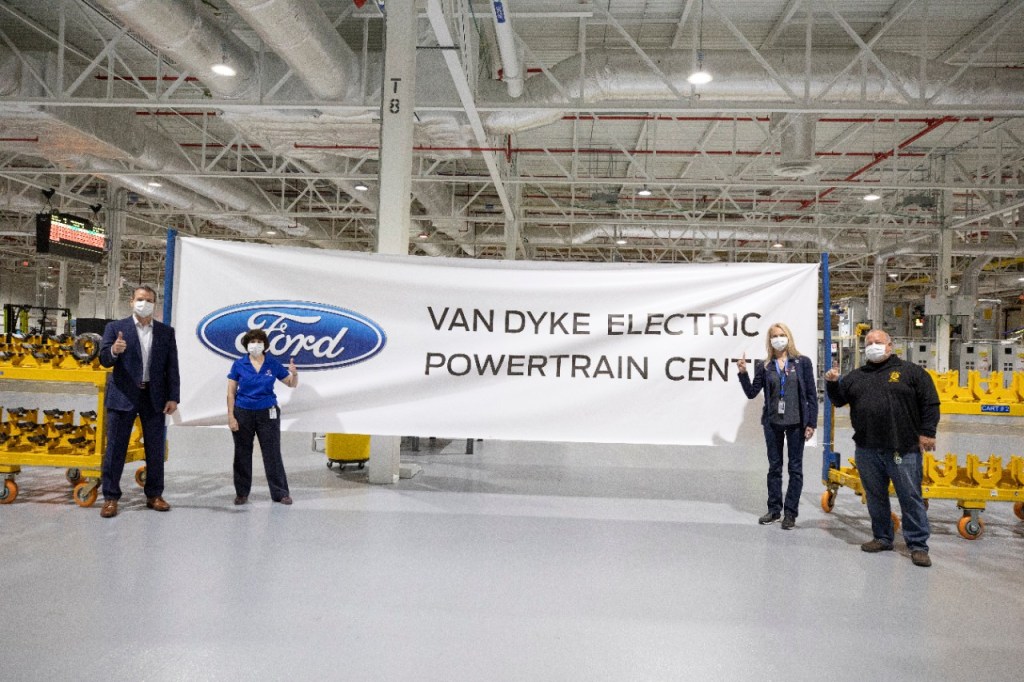
While what has long been known as the “Ford Van Dyke Transmission Plant,” a 2-million square-foot factory in suburban Detroit, didn’t make a transmission until 1993, even though it had been established in 1968 (when it was a suspension components plant), the sign visible on Van Dyke Avenue, after a generation is undergoing a change.
Now it is the “Van Dyke Electric Powertrain Center.”
Sign of change. (Image: Ford)
Inside they are going from just making the classic step-gear (a.k.a., “automatic”) transmission to electric motors and electric transaxles for full electric and hybrid vehicles.
Production of the Ford eMotor will begin at the plant this summer. Early next year the electric transmission (“eTrans”) manufacture will commence.
Ford spent $150-million in the plant to prepare it for its new role.
A lively discussion of things from why Americans don’t buy small, cheap cars and why OEMs aren’t likely to get a big revenue stream from sending data to vehicle head-units
By Gary S. Vasilash
Although there is a whole lot of development going on in the electric vehicle (EV) space, as OEMs announce products and plans with what seems to border on giddiness, maybe things aren’t what they seem.
Consider, for one example, the F-150 Lightning reveal. While it might seem as though every person on your street is likely to replace their gasoline-powered F-150 with an electric one as soon as is practical (even though there is a starting MSRP of $40,000, and even though $40,000 is pretty much the average cost of a vehicle, it is still $40,000), even though people are touting the frunk that will allow them to fill it up with ice and beverages and the power outlets that will permit the audio equipment to be plugged in for parties and picnics, when you listen to Eric Noble, founder and president of The Car Lab, what seems to be the case may not be the case.
The F-150 Lightning in what is a natural environment: a work site. (Image: Ford)
That is, Noble points out that largely because of EV batteries—“They are expensive, huge, very heavy and don’t store very much energy”—especially the cost part, OEMs don’t make money on EVs unless these EVs are priced so highly that the cost of the battery can be buried in the MSRP.
Noble argues that because of the zero-emissions mandate of California and the other states that follow California’s lead in emissions regulations, OEMs that want to sell vehicles in those states—including vehicles with a 5.0-liter V8 under the hood—need to sell zero-emissions vehicles: EVs.
What is the number on the sales forecasts that OEMs have for EVs, he rhetorically asks.
Pretty much what the number of EVs required by the ZEV states are for that particular OEM.
However, he points out that there could be some real business for OEMs when it comes to selling to fleets. (“Ford is good at fleets,” Noble says.)
In other words, Teslas and Mustang Mach Es notwithstanding (and I don’t know whether the champagne need be busted out for the Mach E quite yet because in April Ford sold 1,951 Mach Es and 8,000 regular Mustangs), things like the Lightning are likely to be more oriented toward places where they can do the OEM the most good, which very well may be in fleet applications.
Noble talks about this on this edition of “Autoline After Hours.” And many of his arguments are bolstered by observations by Sam Fiorani, vice president of Global Vehicle Forecasting, AutoForecast Solutions.
Also on the table are other subjects of the moment, like over-the-air updates (not likely to be a revenue stream for OEMs because customers don’t want to have a monthly charge to their credit cards, why tech companies won’t become auto companies and vice versa, and a whole lot more.
Per usual, “Autoline’s” John McElroy and I are engaged in the conversation with these guests, and it is one of the livelier discussions you are like to see about the state of the industry—the reality versus the proclamations.
Toyota leads in SUV sales in the U.S.–by a non-trivial amount
By Gary S. Vasilash
Although it might seem that when it comes to trucks and SUVs, “trucky” things, that Ford, General Motors and the company formerly known as FCA which was formerly known as Chrysler, would be dominant.
When it comes to pickups, yes. The numbers of F-150s, Silverados and Rams is truly extraordinary. Who knew that so many people were in need of boxes on the back of their vehicles? (Yes, people who actually do work with their trucks, do, but somehow that guy down the street who uses the bed to carry mulch once a year. . . .)
According to analysis firm Inovev, SUVs represented 53.5% of the U.S. market during the first quarter.
Toyota RAV4: best selling SUV in the U.S. (Image: Toyota)
And of them, most carried the Toyota “T.”
Inovev notes that Toyota has outsold both Chevy and Ford by about 50,000 units, with Toyota sales being just shy of 250,000 units and the other two slightly below 200,000 for Q1.
Inovev points out that Toyota also leads the Big Three in the sedan category (Camry, Corolla).
So if there are three big categories–trucks, SUVs and cars–the Big Three is now only dominant in one.
Turns out that EVs are significantly less expensive to power
By Gary S. Vasilash
Although electric vehicles tend to be more costly than comparable gasoline-powered vehicles, when it comes to “refueling,” EVs can save a whole lot of money compared with gasoline-powered vehicles, according to the U.S. Department of Energy.
As much as about 60%.
The agency developed what it calls an “eGallon.”
That is a comparison of what it would cost to buy equivalent energy to power an EV the same amount as it would cost a gasoline powered vehicle to travel on one gallon of gas.
So, based on the national average of $2.85 for a gallon of gas (as of March 31) and the equivalent price of electricity at a national average of $1.16 for an eGallon, this means the average fuel savings of approximately 60%.
In Washington state the difference was much larger: the cost of a gallon of regular was $3.13 and the cost of an eGallon was $0.89, so the fuel cost savings was about 72%.
So for those who pay attention to what they’re paying for their miles per gallon, it appears that EVs may be advantageous.
Of course, it takes longer to recharge an EV than it does to fill up a tank with liquid fuel.





 shinymetalboxes