
McLaren, 3D Printing and. . .LEGO

From advanced manufacturing tech to a really complex model. . .

By Gary S. Vasilash

McLaren Automotive, builder of an array of composite-intensive supercars, recently announced that it is partnering with Divergent Technologies, which has developed an additive manufacturing system it calls the “Divergent Adaptive Production System” (DAPS) which allows the creation of lightweight chassis components that otherwise couldn’t be created with traditional manufacturing methods.

As Michael Leiters, CEO of McLaren, put it, “This technology will help us to further reduce weight in our complex structures, which will ultimately benefit the driving experience of our customers and support McLaren’s mission to push the boundaries of performance.”

One of the interesting things related to McLaren and Divergent is that the DAPS was developed to produce the Czinger 21C supercar (i.e., it is a 1250-hp hybrid–certainly not a Prius (yes, even though the current gen Prius is rather cool, you know what I mean)).

But clever tech is clever tech, so the use by McLaren is in keeping with its drive toward even more innovation in its vehicles.
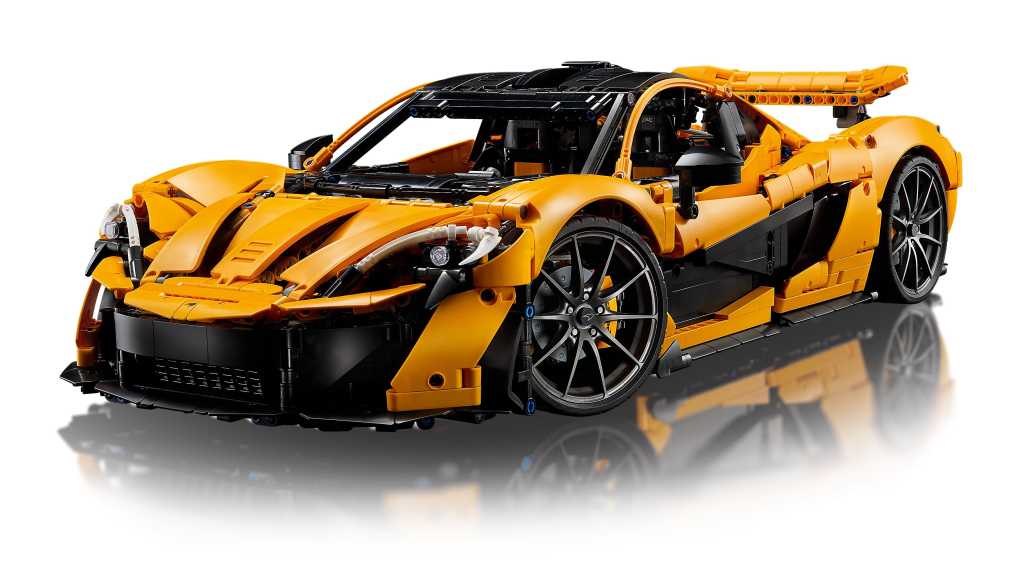
This is the LEGO Technic McLaren P1—all 3,893 elements assembled. (Image: McLaren Automotive)

But what will probably draw more attention than the organic chassis components in a future car is the LEGO Technic McLaren P1.

Yes, a 3,893-piece LEGO set.

And it is rather technical, as the model includes a seven-speed gearbox, V8 piston engine, adjustable rear wing, dihedral doors, and a suspension (undoubtedly injection molded, not 3D printed).

Tobias Sühlmann Chief Design Officer, McLaren Automotive:

“It’s amazing to see so many of the elements from the original P1 brought to life by the LEGO team for the LEGO Technic McLaren P1. I hope this collaboration inspires the next generation of designers and engineers to push the boundaries of automotive innovation.”

I’m guessing that the DAPS will be more influential for next-gen designers—but then I’m not the chief design officer of a supercar company.

Incidentally, the McLaren P1 LEGO Technic model can be purchased starting August 1 here for an MSRP of $449.99.

Additive Aids at BMW

This is where 3D printing really gets the job done. . .

By Gary S. Vasilash

Although every now and then there is an announcement about a “3D-printed car,” it is pretty much that: a 3D-printed car. Or maybe a few of them. In any case, these are objects that are exceedingly expensive and take a comparatively long time to produce.

BMW has been using additive manufacturing (the more technical name for the process) for more than 30 years. In fact the company has established an “Additive Manufacturing Campus” in Oberschleißheim.

Last year in excess of 300,000 parts were printed there. And another 100,000 parts were printed at other BMW facilities.

One of the categories where the technology is used to great effect is in the manufacture of “production aids.”

Getting a Grip

Things like grippers for robots.

Explains Jens Ertel, Head of BMW Additive Manufacturing, by using additive, “We can individually adapt to specific requirements at any time, as well as being able to optimize their weight.”

Why does that matter?

“Less weight allows higher speeds on the production line, shorter cycle times and reduced costs.”

A key reason why they are able to reduce the weight of the grippers is because the process allows the creation of shapes that can’t otherwise be efficiently produced.

Try to make that blue shape–a robotic gripper–with something other than additive manufacturing. (Image: BMW)

That is, just as a stamping press can produce a body panel in a matter of seconds while a 3D printer would take hours, a 3D printer can produce an intricate organic shape generated by topology optimization in a fraction of the time it could be produced—if at all (reasonably speaking) by conventional manufacturing processes.

One of the organic robot grippers, produced in 22 hours, is being used to handle composite-reinforced plastic (CFRP) roofs for BMW M GmbH models.

Although this gripper weighs about 264 pounds, that’s 20%, or some 50 pounds, lighter than a gripper made with conventional manufacturing processes.

Another gripper that was made with additive is being used to handle the entire floor assembly of a BMW i4.

Making Molds

If you’ve ever seen additive manufacturing in action (IRL or on YouTube), chances are this is something where there is a laser beam running over a liquid or powder surface at speed and voila! a part emerges.

But there is another way that 3D printing is being used in manufacturing to great effect, which is using it to produce sand casting molds (essentially, the laser is used to melt the resin on sand particles or there is another process that uses a machine that is like an office ink-jet printer but what it uses in place of ink is an adhesive to bind the particles of sand together).

The finished mold—which allows things like curved internal holes that can’t be made by drilling (after all, drills are straight)—is then filled with liquid aluminum.

The gripper produced with this process is 30% lighter than the one conventionally made.

Sure, making production aides with 3D printing may not be as sexy as producing an entire car.

But it is a whole lot more effective and useful.