McLaren Racing & McLaren Automotive Get a New Look

Both companies share heritage, but no longer common ownership

By Gary S. Vasilash

Although this is a bit tricky in terms of names and history, McLaren was founded in 1963 by Bruce McLaren as an F1 racing team, Bruce McLaren Motor Racing. It had a name change in 1981 to simply McLaren Racing.

McLaren Cars was established in 1985. It had a name change to McLaren Automotive in 2010.

McLaren Group, an umbrella organization, was established in 1985, encompassing both operations.

However. . .

In March 2024 McLaren Group was acquired by Baharain’s sovereign wealth fund, Mumtalakat Holding Company.

In December 2024 CYVN Holdings, based in Abu Dhabi, purchased McLaren Automotive. So it is out of the Group but the racing team is still in the Group.

All of that said, McLaren has revealed a new brand identity that encompasses both McLaren Automotive and McLaren Racing.

There continues to be the boomerang like Speedmark:

But there is a new wordmark, which is based on a sign that was used at Bruce McLaren’s parent’s service station in Remuera, Aukland, New Zealand:

In announcing the new visual identity both firms made statements:

“There is something uniquely special about McLaren. Throughout our history, we’ve never been content to follow established paths. We’ve always looked ahead, driven by a restless desire to innovate, create and push beyond expectations. This evolution of our visual identity captures that spirit. It’s a reflection of the journey we are on as a company. It marks the beginning of a new chapter for McLaren, giving a physical expression to the ambition, creativity and forward momentum that is shaping our future.”
David Woodhouse, Chief Creative Officer, McLaren Automotive

“McLaren has evolved enormously over the years, but looking back through our shared history across Racing and Automotive, it’s poignant how much of Bruce’s original vision and spirit still runs through the business today. This evolved identity perfectly bridges that proud heritage with our future ambition. It celebrates the symbols and stories our fans, partners and team mates already know and love, while giving us a more connected expression of where we’re heading next. It feels unmistakably McLaren.”
Lou McEwen, Chief Marketing Officer, McLaren Racing

It is interesting how the two companies, owned by different companies, apparently continue to share a notion of what they are about.

Bruce McLaren, incidentally, died in 1970 while testing his team’s new McLaren M8D Can-Am car at the Goodwood Circuit.

He was 32.

McLaren Brings the Horsepower

Yes, electrified, but not fully electric. . .

By Gary S. Vasilash

Mike Austin, executive editor of Road & Track, so he knows things like this, recently told me that a number of supercar manufacturers are developing vehicles with internal combustion engines rather than with full battery electric propulsion systems because people like the visceral sensation of the thrum of an engine. He acknowledges that there is no doubt that EVs can go really, really fast. But that speed is achieved accompanied with the sound of a whine characteristic of something from the Star Wars universe, not Le Mans or Nürburgring.

McLaren W1: mid-engined hybrid. Yes, there’s a V8 in there. (Image: McLaren)

Case in point is the McLaren W1 supercar, which is based on a V8 hybrid powertrain that produces 1250 hp—915 hp from the engine and 342 hp from the “E-module” (a combination of electric motor and control unit).

Quick? 0 to 62 mph in 2.7 seconds.

Of course, a powerful engine like the MHP-8 twin-turbo V8 itself can’t make a vehicle go fast if the structure it needs to propel is too bulky.

So McLaren, per usual, has constructed a carbon-fiber “Aerocell” monocoque and even uses things like 3D-printed suspension components.

Of course, this comes with a price.

Starting MSRP: £2-million—a.k.a., $2.6 million.

McLaren Automotive & Atlas Copco

Yes, even supercars must be assembled. . . .

By Gary S. Vasilash

When you think of McLaren Automotive, you probably think of supercars like the Artura Spider shown here:

It’s a hybrid that combines a 3.0-liter twin-turbocharged V6 and an axial flux electric motor to produce 690 hp.

Or thought of in action: 0 to 60 mph in three seconds.

A convertible.

When you think of McLaren Automotive, you probably don’t think of nut-runners and other assembly tools.

But at the McLaren HQ in Woking, Surrey, England there is the McLaren Production Centre, where the cars are built.

Of course, they’re built more like a fine mechanical watch than a run-of-the-road motorcar.

But they are still manufactured.

The McLaren announced that Atlas Copco is the company’s “Official Smart Tooling Supplier.”

The builder is deploying Atlas Copco battery-powered, digitally enabled nut-runners and other tools throughout its manufacturing operation. It is leveraging the Atlas Copco Smart Integrated Assembly tools and system for machine learning to improve production operations.

Matt Walton, Chief Manufacturing Officer, McLaren Automotive:

“In addition to our commitment to embracing cutting-edge technologies, we remain dedicated to preserving the essence of our hand-built approach.”

Maybe its from the racing ethos where you get as many suppliers and even tangentially related companies to become sponsors.

Still, an “Official Smart Tooling Supplier” for a manufacturing operation certainly seems like a novel approach.

Wonder if the line workers have Atlas Copco patches on their shirts. . . .

McLaren, 3D Printing and. . .LEGO

From advanced manufacturing tech to a really complex model. . .

By Gary S. Vasilash

McLaren Automotive, builder of an array of composite-intensive supercars, recently announced that it is partnering with Divergent Technologies, which has developed an additive manufacturing system it calls the “Divergent Adaptive Production System” (DAPS) which allows the creation of lightweight chassis components that otherwise couldn’t be created with traditional manufacturing methods.

As Michael Leiters, CEO of McLaren, put it, “This technology will help us to further reduce weight in our complex structures, which will ultimately benefit the driving experience of our customers and support McLaren’s mission to push the boundaries of performance.”

One of the interesting things related to McLaren and Divergent is that the DAPS was developed to produce the Czinger 21C supercar (i.e., it is a 1250-hp hybrid–certainly not a Prius (yes, even though the current gen Prius is rather cool, you know what I mean)).

But clever tech is clever tech, so the use by McLaren is in keeping with its drive toward even more innovation in its vehicles.

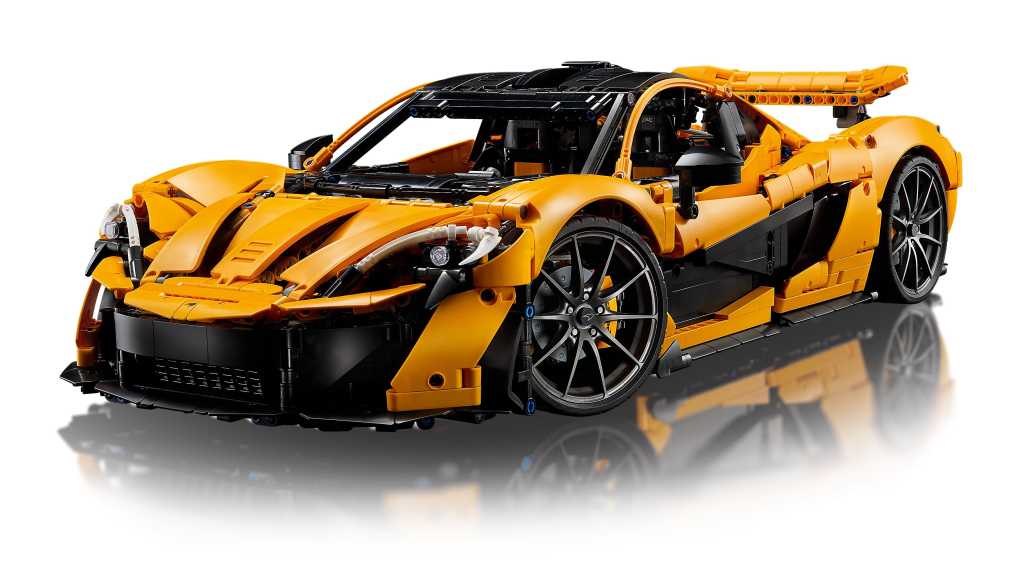
This is the LEGO Technic McLaren P1—all 3,893 elements assembled. (Image: McLaren Automotive)

But what will probably draw more attention than the organic chassis components in a future car is the LEGO Technic McLaren P1.

Yes, a 3,893-piece LEGO set.

And it is rather technical, as the model includes a seven-speed gearbox, V8 piston engine, adjustable rear wing, dihedral doors, and a suspension (undoubtedly injection molded, not 3D printed).

Tobias Sühlmann Chief Design Officer, McLaren Automotive:

“It’s amazing to see so many of the elements from the original P1 brought to life by the LEGO team for the LEGO Technic McLaren P1. I hope this collaboration inspires the next generation of designers and engineers to push the boundaries of automotive innovation.”

I’m guessing that the DAPS will be more influential for next-gen designers—but then I’m not the chief design officer of a supercar company.

Incidentally, the McLaren P1 LEGO Technic model can be purchased starting August 1 here for an MSRP of $449.99.