Audi Engineers Portal Axles

Yes, it is about “Vorsprung durch Technik” (Advantage through Technology), but. . . .

By Gary S. Vasilash

While portal axles are usually used in things that are used by military vehicles or vehicles that go way off road, there are some like the Mercedes G500 that use them, too.

A key difference between a portal axle and a conventional one is that the portal axle is offset above the center of the wheel hub. There is a gear mechanism on the hub that transfers the power to drive the wheels.

The reason for the portal axle is to provide increased ground clearance.
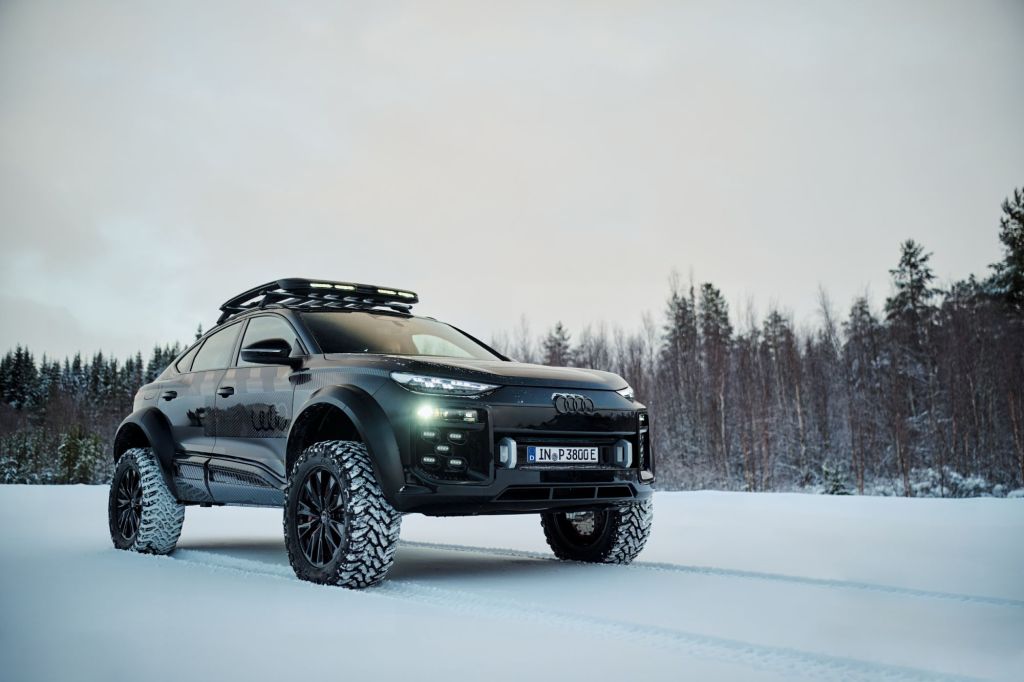
Remember when Audi concept vehicles were sexy? (Image: Audi)

Audi says it has developed new portal axles that it is using on a prototype Q6 e-tron offroad vehicle.

The prototype is based on the automaker’s Premium Platform Electric (PPE).

 According to the company while conventional portal axles can increase torque from 20 to 30% at the wheels, Audi’s increases it by 50%.

Audi CEO Gernot Döllner said of the vehicle: “The model shows the potential that our platform for all electric vehicles already has today. This vehicle can claim new ground. We look forward to seeing our customers’ reactions to this highly emotive car.”

Presumably more than a few customers are going to think it looks like something that has undergone massive suspension tuning for display at a venue like SEMA, not as something that is, well, an Audi.

Somehow the “Premium” part is overwhelmed by the engineering of the axles.
Audi Becoming AUDI in China

No, that’s not a problem with the caps-lock on the keyboard

By Gary S. Vasilash

Like many Western brands, Audi is having a bit of a struggle in China, a market it has been in since 1988.

After all, not only are native Chinese brands offering an array of compelling vehicles at all price points, including the upper end where Audi resides, but there is probably something of a bit of nationalism, as Chinese consumers are turning toward Chinese brands.

Consequently Audi is making a shift in its strategy in China and has developed the “Advanced Digitized Platform” with Chinese company SAIC.

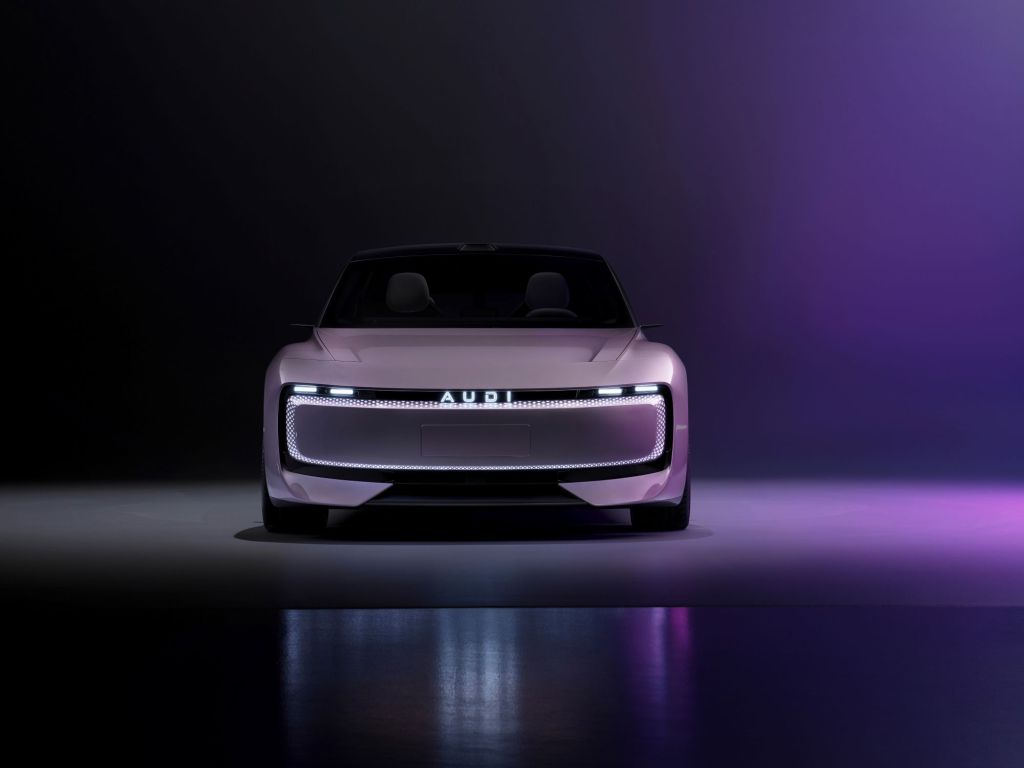
AUDI E concept introduced at the Shanghai Motor Show. All caps. No rings. Is it going to shift perceptions of the brand in China? (Image: Audi. Or maybe AUDI)

According to Audi CEO Gernot Döllner: “The joint platform will be the basis for a new generation of state-of-the-art intelligent connected vehicles exclusive to China. The upcoming models are aimed at a promising and simultaneously demanding new customer segment. The cooperation will further expand the Audi portfolio of battery electric vehicles in China and accelerate the company’s transformation in the world’s largest market.”

The platform will be used to develop three models that fall within the midsize and full-size segments, with the first model becoming available next year.

Audi says the collaboration with SAIC allows a >30% decrease in the time required to get a model in market.

In addition to which, Audi has created a new brand for the China market:

AUDI

That’s right: an all-cap version of the existing name.

Also, the famous four-right logo is jettisoned.

Döllner:

“By launching this new brand for electric and intelligent models in China, Audi is breaking new ground to tap into new and more tech-savvy customer segments.”

Seems like Audi in China becoming AUDI is China is the sort of change that a company that is afraid of making a major change would do.

Too little too late?

New Design Head at Polestar

Römers understands the importance of first impressions. . .

By Gary S. Vasilash

“Polestar is the role model of a design-driven automotive company and it’s a great honor to take on the responsibility for the Design department. I’m looking forward to working with the creative team to design the next generation of Polestar cars,” said Philipp Römers, who is taking the Head of Design position at the electric vehicle company, succeeding Maximilian Missoni.

Römers is moving to the company from AUDI AG. He has been with the Volkswagen Group for the better part of his career. (He had had a stint at Ford.)

Born in Cologne in 1979, Römers studied transportation design at Pforzheim University.

He started at Volkswagen in 2005, where he designed exteriors for models including the Golf 7 and the Passat B8.

Philipp Römers, new head of Design at Polestar. (Image: Audi).

Then he moved from Wolfsburg to Ingolstadt in 2014, where he led teams developing the Audi A3, A6 and Q8.

And undoubtedly his work in the Audi e-tron and the e-tron GT, both electric, will serve him well in his position at Polestar.

While at Audi Römers  said:

“The very first thing that people who are interested come into contact with is still the exterior. It has to arise desire. Ultimately, the first impression is decisive with respect to whether someone stays or just walks away, zooms in on their screen or quickly keeps browsing. Ideally, aesthetic form and function are combined.”

That approach should serve him well at Polestar.

Another Electric Audi

This time, it requires a little more effort from the driver. . .

By Gary S. Vasilash

The bicycle industry is in some ways like the auto industry in the context of electrification.

On the one hand, there are the traditional human-powered bicycles, which are analogous to vehicles with internal combustion engine.

On the other, there are electric bikes, just as there are electric cars.

In both bikes and autos the traditional dominates by a considerable amount.

And in both there is growth in the sales of electrified versions.

But what seems to be a bit of a difference is that electric bikes are still moving upwards on the sales charts while in autos there is a considerable moderation.

Audi EVs in Q1

Audi, like any good European luxury brand, has a full suite of EVs.

Audi of America announced that its Q1 2024 sales were down 16% year over year, but its EV sales were up 29%.

However, the combined sales of the e-tron GT, Q4 e-tron, Q4 Sportback e-tron, Q8 e-tron, and Q8 Sportback e-tron is 5,714 vehicles.

While sales of the Q5 were down 33% year-over-year, it still sold 11,473 of them, considerably more than the five EV models.

Two-Wheelin’

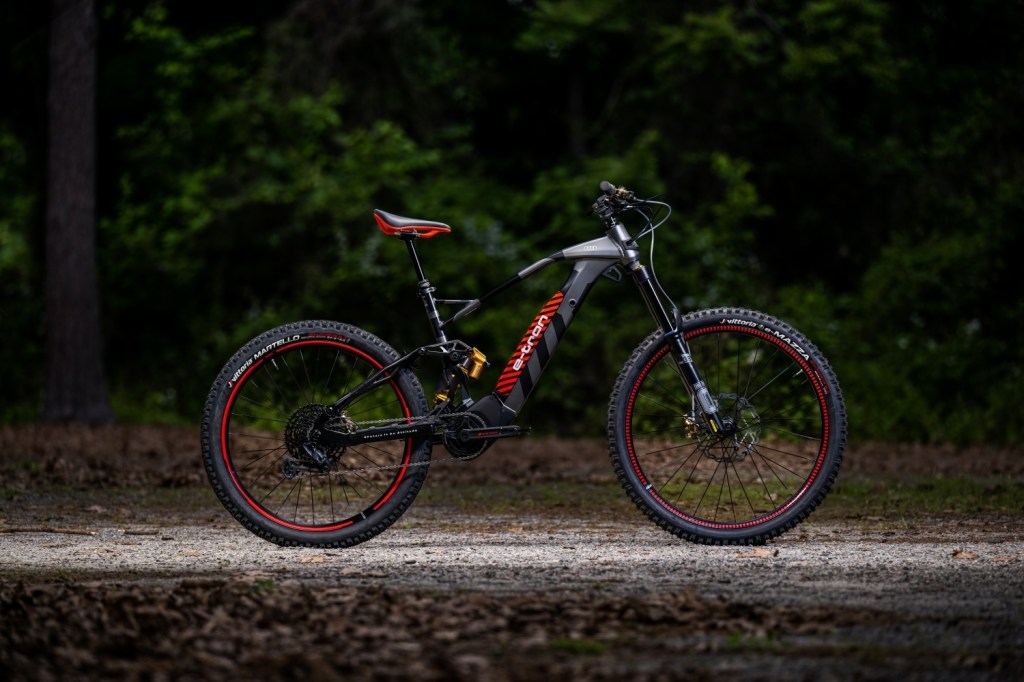
Ride electric with Audi. (Image: Audi of America)

Audi has added a new model to its lineup: the Audi eMTB.

It is an electric mountain bike.

Audi worked with Italian motorcycle and e-bike manufacturer Fantic on the bike, which features an aluminum frame, full suspension (Öhlins shocks in the back and fork up front), off-road tires, Sunstar Braking’s F.I.R.S.T. calipers and S3 Batfly rotors, and other elements.

There is a 720-Wh, 36-volt lithium-ion battery pack that powers a Brose S-MAG 250-watt motor, which delivers up to 90 Nm of torque.

The electrical setup provides four levels of assistance at speeds up to 20 mph.

The battery range is between 12 and 90 miles. Yes, quite a spread there, but how far one will go depends on such things as the terrain, amount of assistance used and rider weight.

Like an Audi with four tires, the engineering comes at a price: MSRP for the eMTB is $9,795.

The bike is being sold through Audi Genuine Accessories.

Maybe if the EVs aren’t moving at the dealership the eMTB will.

Speed of Change in the Global Industry: Blink and You May Miss It

By Gary S. Vasilash

The first thing to acknowledge is that the auto industry today is characterized by various forms of partnerships and alliances, whether they are codified like the Renault Nissan Mitsubishi Alliance or looser-but-still actionable work being done on things from entire vehicles to propulsion systems by General Motors and Honda.

Last week Volkswagen brand and XPENG and Audi and SAIC announced that there will be “strategic co-operations” for, initially, products for China that will carry the badges of the German companies, with XPENG supporting VW and SAIC Audi.

The cooperation isn’t particularly surprising. That’s just happening.

What is:

VW will build electric vehicles on an XPENG platform. Yes, there is still the VW MEB platform. But somehow it seems that’s not getting it done in China.

Audi will work with SAIC on developing electric vehicles for the China market in categories that it currently doesn’t have offerings. You’d imagine that the people in Ingolstadt would be up to the challenge, but evidently there is something that needs to be supplemented.

It wasn’t all that long ago that Chinese OEMs had partnerships with Western OEMs with the latter having the engineering and development chops and the former the production resources.

In the current case, it seems that the Chinese companies have the tech and know-how being sought by the German brands. And undoubtedly the production facilities to build the vehicles to be developed, too.

Things are moving far more rapidly than might have been expected even 10 years ago.

Audi’s Identity Issue

By Gary S. Vasilash

2018 saw the launch of the Audi e-tron, the German’s first production EV. Even then knowing where the interest was developing (things like the Tesla Model S notwithstanding), the folks in Ingolstadt determined that an SUV was the body style to launch.

Since then, Audi has sold about 150,000 of the vehicles.

Audi Q8 e-tron. (Image: Audi)

Maybe they figured that what the heck an “e-tron” was was something that kept it from gaining significantly more traction in the market.

So for the new model the name has been changed to “Q8 e-tron.”

The company had some equity in the Q8 name for its SUV. So it has appended it to the electric variants (there is also the Q8 Sportback e-tron).

Audi puts it: “By renaming this model the Q8, Audi is making a clear statement that the Audi Q8 e-tron is the flagship model among its electric SUVs and Coupe SUVs.”

Perhaps that will resolve what is arguably an identity crisis in the market.

However, the company goes on to maintain, “The Audi Q8 e-tron and Q8 Sportback e-tron are immediately identifiable as fully electric models, marked out by the new front and rear designs that carry Audi’s electric design language forward.”

There it may be a bit misled. The whole “immediately identifiable as fully electric models” is more than a slight exaggeration.

It was probably that sort of thinking that led Audi marketers to think back in 2018 that prospective customers would immediately know that the e-tron was an electric Q8 by another name.

Seems that that didn’t work out particularly well sales-wise.

Audi 80: Not a Throwback

Audi A80 (Image: Audi)

This is the Audi 80, which came out 50 years ago. Were something like this to come out now with an electric powertrain it would probably be a massive hit, the fact that it is designed and engineered to be a family sedan notwithstanding.

The vehicle, which was internally known as the “B1,” had a run through four generations, until the mid-90s, when it was replaced by the A4.

The A4, incidentally, is in its fifth iteration.

Sunk Anticipation

By Gary S. Vasilash

One of the things that hasn’t been mentioned about the burning then sinking of the Felicity Ace cargo ship, the vehicle carrier that caught fire on February 17, then sank this week in the Atlantic, is that there are now some 4,000 customers who are not going to be getting their Bentleys, Audis, Porsches, Lamborghinis, and Volkswagens anytime soon.

While there isn’t a specific brand or model delineation, Porsche has acknowledged that about 25% of the vehicles that are now sunk (possibly the charred husks of said vehicles), let’s face it: When it comes to Bentleys and Lambos, there is an inverse relation between their volume and their MSRP, so even if there are but a few, that is undoubtedly a big chunk of the estimated $438-million worth of cargo on board.

Audis, of course, are not inexpensive, but compared to the other three, not nearly as much. And Volkswagens, of course, are the everyman accessible brand among the group.

But those brands (all, incidentally, under the umbrella of the Volkswagen Group) are, like any right now, be it Ford or Toyota or Kia, still facing the chip shortage. Which means the ability to make vehicles is still restricted.

Which means there are some order-holders who will find their wait has just gotten that much longer.

Premium Vehicle Perspective: Depends Where You Look

When looking at charts developed by French auto analyst firm Inovev of the sales of premium vehicles in the U.S., China and Europe for the first 11 months of 2021, there are a few surprises.

As in sales of 2 million in the U.S., 3 million in China and 2.5 million in Europe.

It’s not surprising that the number is higher in China than in the other two regions. After all, it has a population of 1.4 billion.

It is a little surprising that the numbers break as they do, given that the population in Europe is 748 million, which is about half of that in China and slightly more than twice the population in the U.S. The 500K increments seem strange given that.

Clearly wealth is not evenly distributed, with the U.S. having a higher proportion of its population capable of affording a premium vehicle.

But the surprising thing is the relative sales of the premium brands in the three markets.

The five three brands in the U.S. during this period are BMW, Lexus, Tesla, Mercedes and Audi. Then there is a slight falloff in numbers.

The top five brands in China are BMW, Mercedes, Audi, then a big decline (Audi is at over 600,000 units) to Tesla (at 240,000) and Cadillac.

In Europe it is BMW, Mercedes, Audi, then a big drop to Volvo (Audi: >500K; Volvo: 245K) and Tesla.

While there is consistency with BMW, Mercedes and Audi, and while Tesla is certainly on a roll, Lexus is something of an outlier. It doesn’t show up at all in the listing of sales in China and in Europe it is in ninth position, behind Lancia and just ahead of Jaguar, all of which are well below 100,000 units.

Lancia doesn’t show up at all in the sales tracking for the U.S. and China, and in the U.S. Jag is in last place and it is third from last in China.

Seems as though the German brands are consistently solid around the world while for everyone else it is somewhat random.

Audi TT RS on Its Way Out in U.S.

But if you act quickly, you might get one of 50 special editions

By Gary S. Vasilash

In the first three quarters of this year Audi has sold 825 TT models. Which in the context of, say, the Audi R8 is good (496 through the first three quarters) but as all other Audi models (with the exception of the e-tron GT, which had sales of 462, but know that it didn’t go on sale in the U.S. until July, so that number is completely understandable) are in at least the four figures, the 825 isn’t all that robust.

Model year 22 is the last for the Audi TT RS in the U.S. market, so Audi of America is offering a limited edition—the Audi TT RS Heritage Edition—of which 50 will be on offer.

There will be 50 TT RS models available, 10 each in those five colors. (Image: Audi of America)

They are emphasizing the five-cylinder engine in the vehicle, although in a way that might not be apparent to anyone other than someone buying one, as they have a selection of five color combinations–Alpine White with Ocean Blue leather and Diamond Silver stitch; Helios Blue metallic Diamond Silver leather and Ocean Blue stitch; Stone Gray metallic with Crimson Red leather and Jet Gray stitch; Tizian Red metallic with Havanna Brown leather and Jet Gray stitch; Malachite Green metallic with Cognac Brown leather and Black stitch—and they are producing 10 each.

Two numbers of interest related to the TT RS Heritage Edition:

  1. It has a 174 mph top speed limiter
  2. The MSRP is $81,450

This doesn’t mean the end of the TT in the U.S. The TT and TTS models will continue to be available.