How the Automotive Supply Base Is Being Transformed

Yes, there is still a need for some of yesterday’s tech in the auto industry today. But there is a greater need for tomorrow’s tech right now. And here’s what suppliers are doing to realize that

By Gary S. Vasilash

When people say that the auto industry is “undergoing the biggest transformation since its very beginnings,” they generally mean that the OEMs are having to vigorously change the product offerings that they are producing, putting plugs where they once had fuel filler ports, putting in drive motors where they once had engines, putting batteries in a place where there were once fuel tanks.

And that is just for the electric vehicle part of the change.

There are a variety of other factors that are driving change in automotive, such as the addition of automated driving capabilities and the need to address heightened expectations on the interiors of vehicles, whether this takes the form of things like comfort or infotainment.

By and large, the changes seem to be challenges for the OEMs.

Which is not entirely the case.

Let’s face it: most of what is assembled into a given vehicle is not produced by the OEM. It comes from suppliers.

So the transformation of the auto industry is having arguably a greater impact on the supply base as not only must it provide OEMs with what they want now, but what they will want in the future.

ZF ProAI automotive-grade supercomputer. (Image: ZF)

On this special edition of “Autoline After Hours” my colleague John McElroy and I talk with Martin Fischer, member of the Board of Management of ZF and president of ZF North America, and Phil Eyler, president and CEO of Gentherm.

ZF is one of the world’s largest automotive suppliers, and while historically—and currently—known for such products as its nine-speed transmissions, the company is undergoing a change as it focuses on domains including autonomous driving, electromobility, integrated safety, motion control, and digitalization and software.

Yes, the company has even developed an automotive supercomputer, the ProAI.

Then there’s Gentherm, which is a specialist in thermal electric devices. In 1996 the company launched its first heated and cooled car seat and in the subsequent years has taken a strong position in that market area.

Yet recently it has invested in technology for thermal management of electric vehicle batteries.

McElroy and I talk with Fischer and Eyler about how their companies are working through—and ahead of—demands—today’s and tomorrow’s—they are addressing as automotive suppliers.

Their approaches range from organizing skunkworks to create new products to taking existing technologies from other market segments, like medical, to apply to automotive applications.

You can see it all here.

Will Buying a Car Change?

Does Gen Z really want to kick tires?

By Gary S. Vasilash

On April 14, 2021, an “Open Letter by Academics in Favor of Direct EV Sales and Service” was published, with the signatories being current or emeritus professors at U.S. universities who “specialize in economics, competition policy, market regulation, industrial organization” and other disciplines.

The primary point:

“We write to argue that any state laws still prohibiting car companies from selling their cars directly to consumers, or opening service centers for those vehicles, be amended to permit direct sales and service of electric vehicles (‘EVs’).”

There is an acknowledgement that this has largely been a case of Tesla hitting up against franchise laws. But they go on to note: “it is equally important to a new crop of American EV start-up companies including Rivian, Lordstown, Lucid, Bollinger, and others about to enter the market. It is also important to the legacy automobile companies like General Motors, Ford, and Chrysler, which should be allowed to compete with the start-ups on a level playing field.”

The academics argue the dealer franchise laws generally go back to the mid-20th century when “car dealers were mostly ‘mom and pop’ sole proprietorships. By contrast, the ‘Big Three’ auto companies were hegemonic firms that faced relatively little domestic or foreign competition.”

So, in effect, to protect the little guy, the franchise laws were put in place. This meant that OEMs couldn’t sell (or service) vehicles directly to the consumer, as it was thought that were they able to, they would be able to undercut the small proprietorships that were selling vehicles.

The letter points out that today there are massive dealership groups responsible for moving a whole lot of vehicles, not one’s next-door neighbor who operates a dealership down the street. They write: “there are at least 15-20 major manufacturer groups selling cars in the U.S.”—which account for, they say, billions of dollars in revenue. You can buy a whole lot of jerseys for the local softball team with that kind of money.

The academics put forth a number of reasons why direct sales should be permitted for EVs (one suspects that were it permissible for EVs it would be difficult to stop this happening for vehicles with other propulsion systems). One of the salient points is: “Traditional dealerships earn low profit margins on new car sales, and make it up on service. EVs have a much smaller service component since they don’t have service needs like oil changes or engine tune-ups. Traditional dealerships therefore lack much of an incentive to sell EVs.”

In addition to arguments like that, there is the simple fact that since the franchise laws were enacted there have been an array of developments that allow people to obtain goods and services that were not even imagined back then.

Like the Internet.

Which facilitates things like Amazon.

Which has created a generation of consumers who want to get things on their schedules.

Which has given rise to things like Carvana.

And on it goes.

Dave Zuchowski is the chief strategy officer at Unite Digital. The mission of Unite Digital is “To drive significant growth for our customers by creating seamless customer experiences that Unite and differentiate a manufacturer and their distribution network.” The “customers” in that sentence are “automotive, powersports, automotive groups and other franchised industries.”

Zuchowski, who is a former president and CEO of Hyundai Motor America and senior vice president of Dealer Operations at Mazda North America, has seen the business from several perspectives.

He thinks that what will be the case going forward will be more of a “hybrid” than a case where in order for someone to get a new vehicle—EV or otherwise—they will have to go to a dealership. Rather, it will be a blend of digital and personal interactions, something more seamless than obstreperous.

On this edition of “Autoline After Hours” Zuchowski provides his insights on not only the changing face of automotive retail, but overall changes that are facing various aspects of the industry. He talks with “Autoline’s” John McElroy, automotive writer Steve Findlay, and me.

And you can see it here.

What Makes a Jeep a Jeep

A wide-ranging discussion with the man in charge of the look of that venerable marque

By Gary S. Vasilash

Mark Allen is presently the head of Jeep exterior design.

He’s been on the Jeep team since 1994.

Which pretty much means that everything you see in showrooms right now he had his hand in.

And as Jeep owners tend to be hang onto their vehicles—and drive them, drive them in places where few other vehicles can be driven—Allen has probably been involved with them, too.

On this edition of “Autoline After Hours” we spend the entire hour talking to Allen about the how, why, wherefore, who and more of Jeep design.

A good portion of the conversation is dedicated to the vehicles that participated in this the Easter Jeep Safari that occurred this past April in Moab, Utah. This is an annual event that Allen and his colleagues specifically develop vehicles for—bona-fide Jeeps that are able to crawl the rocks with the best of them, but Jeeps that have specific themes or techs that they want to get first-hand feedback about from the people who assemble in Moab with their vehicles.

Among the vehicles Allen describes are:

The Wrangler Magneto. This is a battery-electric vehicle. Allen is particularly interested in the performance of electric motors for Jeeps, not only because they are quiet and so when going on trails it is possible to not scare away the wildlife, but also because they allow the vehicle to be precisely controlled, which can make all the difference when making a difficult ascent or transition.

Jeeps at the 2021 Easter Jeep Safari in Moab, Utah. (Image: Jeep)

The Jeepster Beach. A resto-mod based on a 1968 Jeepster Commando. Allen says they like to do at least one resto-mod per Safari.

Jeep Red Bare. A Gladiator Rubicon-based concept that utilizes a 3.0-liter EcoDiesel. Highly customized, he points to the interior seat material, which resembles a lumberjack’s shirt.

Jeep Orange Peelz. This one was done by the Mopar studios. It brings in the half-doors and features a custom one-piece glass sunroof.

Jeep Farout. A Gladiator tricked out with a AT Overland Equipment Habitant Truck Topper. Allen points out that often tents on vehicles are dark and oppressive. In this case they worked to lighten things up.

Jeep Top Dog. Another execution by the Mopar team. This Gladiator-based concept is developed for mountain bikers, with a bike and gear case built onto the vehicle—as is a rotisserie hot dog cooker. (One imagines that serious mountain bike athletes probably don’t eat a whole lot of hot dogs. . . .)

Jeep Wrangler Rubicon 392. “Wait a minute,” some of you might be thinking. That’s a production vehicle. Yes, but here’s the thing. Allen explains that it was going to be a large part of the 2020 Safari, something of a tease, but then the pandemic got in the way.

Allen also talks to “Autoline’s” John McElroy, freelance writer Mark Williams and me about the forthcoming Grand Cherokee L, the Wagoneer and Grand Wagoneer, and the absolute importance of the Wrangler to what is arguably the phenomenon that is known as “Jeep.”

And you can see it all here.

Why OEMs Build EVs and Other Things You Think You Know That Probably Aren’t the Case

A lively discussion of things from why Americans don’t buy small, cheap cars and why OEMs aren’t likely to get a big revenue stream from sending data to vehicle head-units

By Gary S. Vasilash

Although there is a whole lot of development going on in the electric vehicle (EV) space, as OEMs announce products and plans with what seems to border on giddiness, maybe things aren’t what they seem.

Consider, for one example, the F-150 Lightning reveal. While it might seem as though every person on your street is likely to replace their gasoline-powered F-150 with an electric one as soon as is practical (even though there is a starting MSRP of $40,000, and even though $40,000 is pretty much the average cost of a vehicle, it is still $40,000), even though people are touting the frunk that will allow them to fill it up with ice and beverages and the power outlets that will permit the audio equipment to be plugged in for parties and picnics, when you listen to Eric Noble, founder and president of The Car Lab, what seems to be the case may not be the case.

The F-150 Lightning in what is a natural environment: a work site. (Image: Ford)

That is, Noble points out that largely because of EV batteries—“They are expensive, huge, very heavy and don’t store very much energy”—especially the cost part, OEMs don’t make money on EVs unless these EVs are priced so highly that the cost of the battery can be buried in the MSRP.

Noble argues that because of the zero-emissions mandate of California and the other states that follow California’s lead in emissions regulations, OEMs that want to sell vehicles in those states—including vehicles with a 5.0-liter V8 under the hood—need to sell zero-emissions vehicles: EVs.

What is the number on the sales forecasts that OEMs have for EVs, he rhetorically asks.

Pretty much what the number of EVs required by the ZEV states are for that particular OEM.

However, he points out that there could be some real business for OEMs when it comes to selling to fleets. (“Ford is good at fleets,” Noble says.)

In other words, Teslas and Mustang Mach Es notwithstanding (and I don’t know whether the champagne need be busted out for the Mach E quite yet because in April Ford sold 1,951 Mach Es and 8,000 regular Mustangs), things like the Lightning are likely to be more oriented toward places where they can do the OEM the most good, which very well may be in fleet applications.

Noble talks about this on this edition of “Autoline After Hours.” And many of his arguments are bolstered by observations by Sam Fiorani, vice president of Global Vehicle Forecasting, AutoForecast Solutions.

Also on the table are other subjects of the moment, like over-the-air updates (not likely to be a revenue stream for OEMs because customers don’t want to have a monthly charge to their credit cards, why tech companies won’t become auto companies and vice versa, and a whole lot more.

Per usual, “Autoline’s” John McElroy and I are engaged in the conversation with these guests, and it is one of the livelier discussions you are like to see about the state of the industry—the reality versus the proclamations.

And you can see it here.

A Look at the Class of 2021

Vehicles, not college grads, that is.

By Gary S. Vasilash

There are lots of new vehicles that have been or will be introduced this year. So on this edition of “Autoline After Hours” we dedicate the show to talking about some of them.

And the “we” includes “Autoline’s” John McElroy; Jennifer Newman, editor-in-chief of Cars.com; Gary Witzenburg, president of the North American Car, Truck and Utility of the Year Awards and freelance journalist, and me.

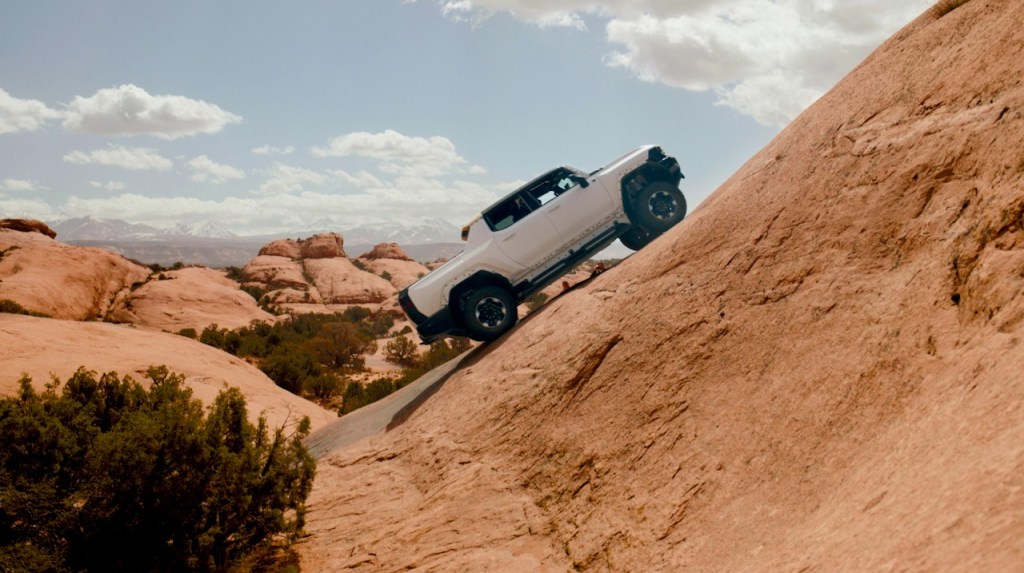
The GMC HUMMER EV Pickup (Image: GMC)

Among the vehicles discussed:

  • Acura MDX: Fourth generation of the utility. Three rows. Edgier styling. Solid suspension. What’s not to like? Apparently the True Touchpad Interface.
  • Buick Envision: A crossover with meticulous attention to detail, inside and out. Does the fact that it is made in China have anything to do with that?
  • Cadillac CT5-V Blackwing and CT4-V Blackwing: A lesser bat-out-of-hell (the 4 has a 472-hp engine) and a full-blown one (the 5 has a 668-hp engine).
  • Chevy Bolt EUV: The second electric vehicle (EV) in the lineup that looks more like an SUV, presumably to appeal to those who can’t get enough of that body style.
  • Ford Bronco: A hard-core off-road vehicle, coming soon to a driveway near you. Get the Sasquatch Package and get extra ground clearance and the approach and departure angles that make climbing rocks not an issue. Get the optional Honda
  • GMC HUMMER EV Pickup. 1,000 hp 11,500 lb-ft of torque. 0 to 60 mph in 3 seconds. 350+ miles of driving range. Fast charge up to 100 miles in 10 minutes. You can’t get a reservation for Edition 1, which is coming out this fall and has an MSRP of $112,595. In the fall of 22 there will be more available with a reduced price: $99,995.
  • Honda Civic Sedan: The 11th generation appears to be what will bring Honda back to being Honda. Which should make sedan enthusiasts every enthusiastic.
  • Hyundai Santa Cruz and Tucson and IONIQ 5: whether it is a little truck-like vehicle, a compact sport ute that comes with two flavors of hybrid as well as a conventional ICE powertrain, or a fully electric crossover, seems that Hyundai is the Overachiever of the Year.
  • Kia Carnival: Don’t call this a “minivan.” Don’t.
  • Nissan Frontier: It has been a while since Nissan has brought out a new version of its pickup (e.g., the one that is out now appeared in. . . 1998), so they’ve clearly had time to get this one right.
  • Rivian R1T: Will this electric pickup from a startup be a success in the market?

And much, much more.

Which you can see right here.

Lidar Explained

You’ve probably heard reference to “lidar.” Here’s where you can get a quick tutorial

By Gary S. Vasilash

Elon Musk once famously said, “Lidar is a fool’s errand.”

And it went downhill from there.

What was he talking about?

A sensor that uses laser beams.

The sensor sends out pulsed light waves from as many as 128 individual lasers (at an eye-safe frequency, so you need not worry about being blinded by a vehicle coming at you with lidar engaged). The waves hit something and bounce back. The time is calculated (send, hit, return). And the information is used to generate a 3D map of the environment. Realize that there is a lot going on here: this beam bouncing is taking place at a rate of millions of times per second.

Using lasers for sensing. (Image: Velodyne Lidar)

The whole purpose of this is to enhance a vehicle’s ability to be able to provide safer driving—for the people within the vehicle as well as others, be they in other vehicles or on foot. And it can also contribute to self-driving vehicles, with the sensor or sensors (there are some lidar devices that have a 360° view so conceivably only one would be needed on the roof of a vehicle to “see” what’s going on; there are some devices that have more limited view, say 120°, so there would be multiples installed) providing input so that the vehicle can perform accordingly.

3D lidar was invented by David Hall in 2005. He had established a company in 1983 to produce audio subwoofers. What was then Velodyne Acoustics has become Velodyne Lidar.

And on this edition of “Autoline After Hours” Mircea Gradu, Velodyne senior vice president of Product and Quality, provides an explanation of lidar—the how, why, where and when of the technology.

One of the things that he really emphasizes in his comments is the importance of lidar when it comes to safety.

He points out, for example, that most vehicle-pedestrian accidents occur after dark. In 2018 76% of pedestrian crash fatalities in the U.S. occurred at night.

Lidar can “see” in the dark. Camera-radar based system don’t have the same level of capabilities. So so far as Velodyne is concerned, any advanced driver assistance system (ADAS) really needs to have lidar sensors as part of its sensing suite. Assuming that the vehicles are going to travel at night.

While Gradu is, not surprisingly, a bit proponent of lidar, he also acknowledges that there needs to be sensor fusion–the use more than just one or two types of sensors. After all, the subject is safety, and who wants to stint?

Gradu talks with Alexa St. John of Automotive News, “Autoline’s” John McElroy and me.

Then during the second half of the show the three of us discuss a number of topics, including the semiconductor shortage and potential solutions, whether companies like GM are putting billions of dollars at risk when they invest heavily in electric vehicles and more.

And you can watch the show right here.

Arrival: The Cleverest EV Company on the Planet?

Making electric commercial vehicles seems to be what several companies are doing. But the approach of this U.K.-based company is unlike what those other companies are doing.

By Gary S. Vasilash

One of the more interesting companies in the electric vehicle space is Arrival, a firm that was founded in London in 2015, where it has its HQ, and which has also established a North American HQ in Charlotte, North Carolina.

Arrival is in the business of developing electric vehicles.

Arrival Automotive CEO Mike Ableson. (Image: Arrival)

Initially a bus (start of production: Q4, 2021). Then a commercial van with a payload up to 4,400 pounds (start of production: Q3, 2022). Then a larger van with a payload up to 8,800 pounds (start of production: Q3, 2022). And eventually a small consumer vehicle (start of production: Q3, 2023).

Here’s one thing that makes these vehicles notable: There is a modular structure so the vehicles can be tailored to the specific user and application. While “special builds” generally drive costs, starting with this design approach helps minimize that.

Here’s one thing that makes the Arrival approach notable: Rather than building these vehicles in conventional automotive assembly facilities that have a stamping plant and paint shop, as Mike Ableson, CEO of Arrival Automotive (and 35-year vet of GM, where his last position was vice president of EV Infrastructure, with a variety of advanced technology, strategy and engineering positions before that), points out on this edition of “Autoline After Hours,” the Arrival approach, known as “microfactories,” is predicated on establishing a manufacturing facility within what would ordinarily be considered a warehouse.

This is low-volume, regional manufacturing.

It will put its first U.S. microfactory, which will start producing buses later this year, in York County, South Carolina. There will be a second in West Charlotte, North Carolina, where as many as 10,000 electric delivery vans will be built, with production starting in the third quarter of 2022. It has another microfactory in Bicester, UK.

The vehicles have proprietary composite body panels so there is no stamping plant needed. The colors are molded in the material so there is no paint shop. The factory utilizes robotic transport vehicles that move from cell to cell so there are no traditional assembly lines. The assembly is done with mechanical fasteners and adhesives so welding equipment isn’t required.

Ableson points out that batteries are a big cost component of all electric vehicles. He also notes that essentially all OEMs are faced with the same type of battery costs. So, he explains, that the way to keep costs down is not only in establishing production capabilities, but also in designing and engineering the vehicles is such a way that they can minimize overall cost.

The company uses the term “radical impact” in relation to what it is doing.

Arguably, if they pull off what they are undertaking, that won’t just be corporate rhetoric but a true statement.

Ableson talks on the show with Joe White of Reuters, Mike Austin of Hemmings and me.

Then White, Austin and I discuss a variety of other subjects, most of which have to do with vehicle electrification claims and efforts being undertaken by companies including Honda, Volkswagen, Ford and General Motors.

And you can see it all here.

Henry Ford’s Soybean Suit and Other Material Marvels

You’d be surprised at what can be done with what might otherwise seem to be organic waste. Like using it to create car parts

By Gary S. Vasilash

Dr. Deborah Mielewski is a Technical Fellow at the Ford Motor Company.

Two things to know about that: (1) Ford employs about 87,000 people in the United States (more if the people from elsewhere are added, but she works in Dearborn, so we’ll use that number). (2) There are 16 Technical Fellows at Ford.

Yes, she is a rare individual.

She obtained her PhD in Chemical Engineering.

You might be thinking: “Technical Fellow. . .one of 16. . .chemical engineering. . .snooze.”

And were you to be, you’d be wrong.

Mielewski, whose focus is on sustainability, is one of the most enthusiastic and engaging individuals who talks about the environment and recycling and closed-loop processes who isn’t on the Discovery Channel or some outlet like that.

In fact, she probably ought to be.

But for the Earth Day episode of “Autoline After Hours” we have Debbie Mielewski talking about what she and her colleagues are doing in the lab to help make the crossovers, trucks and cars that Ford produces more environmentally sound—and doing so in ways that are not, well, what you might imagine.

One of her earlier undertakings was to develop seat foam using soybean oil. Unbeknownst to her at the time, Henry Ford had been a big proponent in using soybean oil for a number of applications, such as in paint and for body panels.

Ford was once so big on soybean that it built a processing plant on the grounds of the Rouge Complex in Dearborn. (Image: Ford)

The foam that they were creating in the lab took a while to come to a usable form (to say nothing of finding a way to attenuate the rather unpleasant fragrance emitted), but they worked at it and the material debuted on the 2008 Mustang.

Then they’ve had a variety of other atypical materials that they’re using.

She says—at least partially in jest—that while driving home from work one Friday night she thought about having a margarita when she got home. And that she would get in touch with Jose Cuervo on Monday to find out whether there might be some materials they could source (other than tequila, that is).

To obtain the juice that turns into the beverage the heart of the agave plant is roasted, ground and compressed. And then there is a whole lot of plant matter, fibrous, left over. While the Jose Cuervo company uses some of it, as do local artisans, there is still a large quantity left over.

The Ford scientists determined that the fibers are good for plastic reinforcement.

She says she likes coffee. Thinking about that led to the discovery that when coffee beans are roasted, their skin, chaff, comes off. Millions of pounds of the stuff. Ford and McDonald’s are working together to use the chaff as a composite reinforcement material instead of the traditional talc. It is lighter. Better. And is otherwise waste.

Wheat straw. Dandelions. Shredded paper currency. These and a whole lot more are being used and investigated by Mielewski and her team.

She tells a story about telling one of her colleagues to go collect some of the post-processed hemp at a Detroit medical marijuana distributor. (He was a bit reticent. . . .) Another fiber that may have application in automotive component production.

This is a fascinating look at a subject that will become only more important explained by someone who has spent more than 30 years of her career working on it.

Mielewski recalls that early on, when some of her other colleagues from the more traditional product engineering teams looked askance at her presentations, Bill Ford, known for his environmental leadership, had her back. Now the whole approach is becoming more pervasive. And not just on April 22.

“Autoline’s” John McElroy, Christie Truett from Wards Intelligence, Lindsay Brooke of Automotive Engineering and I talk with her.

And you can see it here.

Audi’s Approach to Electric Vehicles

The Audi RS e-tron GT produces 590 hp, net. Just sayin’. . .

By Gary S. Vasilash

There are 14 vehicles in the Audi of America lineup. The best-selling model during Q1 was the Q5 crossover, with 14,731 units delivered. The vehicle that had the least amount of sales is the R8 sports car, at 148 units. This gives you a sense of the spread from top to bottom, as Audi sold 54,840 vehicles.

What is surprising is how well the e-tron and e-tron Sportback—electric vehicles—did for the brand, with the former accounting for 3,474 units and the latter 850.

Put another way, electric vehicles are a solid contributor to Audi’s overall sales.

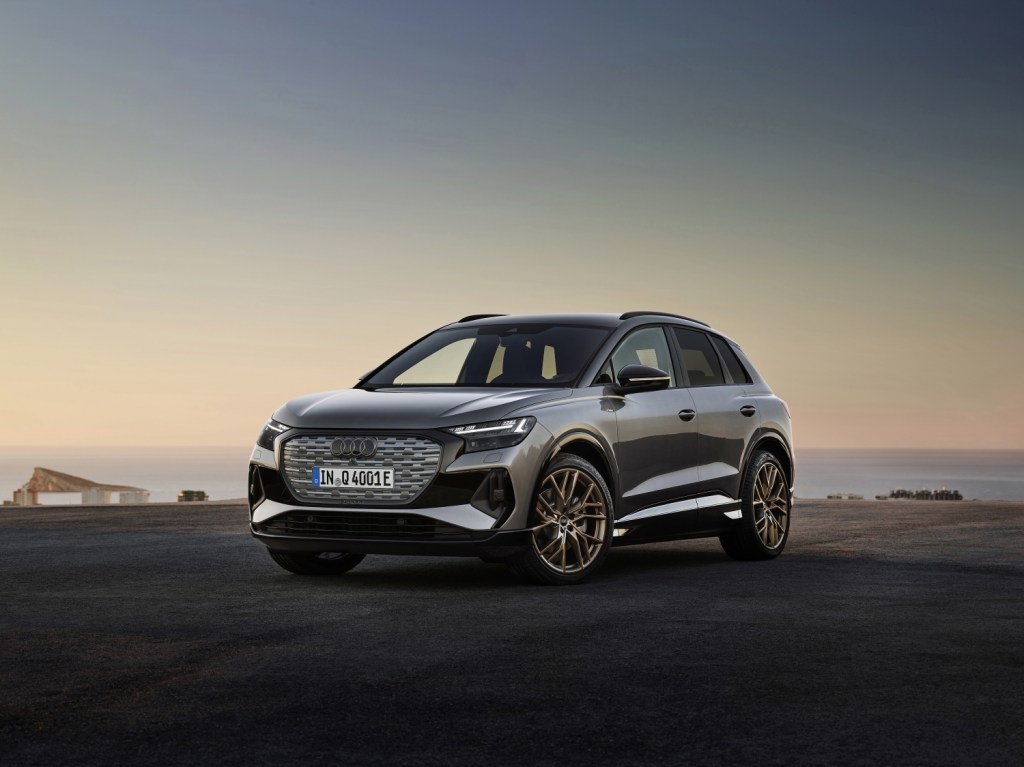
The Audi Q4 e-tron. Part of the company’s electric offensive. It plans to have more EV models for sale in the U.S. by the end of 2021 than any other OEM. (Image: Audi)

And that number is likely to do nothing but increase. This summer the e-tron GT electric sports sedan will launch. With a starting priced of $99,990, odds are the numbers will be low. But there will be numbers.

But before the year is out, there will be two more models added to the electric Audi lineup, the Q4 e-tron and the Q4 Sportback e-tron.

Notably, the Q4 e-tron, a compact crossover, will have a starting price of under $45,000. And then there could be incentives and credits that could put people in an electric Audi for much less.

To learn about what Audi is doing in the EV space, on this edition of “Autoline After Hours” we talk with Matt Mostafaei, the Audi e-tron product manager. (The “we” consists of “Autoline’s” John McElroy, Stephanie Brinley of IHS Markit, and me.)

Mostafaei explains that one of the biggest challenges that they face with regard to getting more people to buy an e-tron is a lack of familiarity that they have with EVs. He suggests that once they’ve an understanding of the advantages that can be realized—like plugging in one’s vehicle at night, analogously to plugging in a phone, so as to have a full charge every morning—as well as the driving dynamics that are provided by an EV*, this will change.

While Tesla is certainly the dominant player in the category, and while Mostafaei says that they’d be glad to have Tesla owners or intenders come into Audi dealerships, he maintains that there is a far greater number of potential customers than just those who have gone the Tesla route.

Just think of all of the people who fuel their vehicles with gasoline. That’s a market.

Audi isn’t adding all of those EVs to its lineup just to be au courant.

As Mostafaei puts it, they see where the market is going and they’re going to help drive it forward.

In addition to which, McElroy, Brinley and I discuss a number of other vehicles, electric and otherwise, as well as the benefits OEMs—and consumers—can realize from tech like Ford’s just-introduced BlueCruise hands-free driving technology, and autonomous driving tech that will be shuttling people in Dubai—and which is shuttling pizzas in suburban Houston.

And you can see it all here.

Creating a Micromobility Company

A surprising story about the use case for electric mopeds

By Gary S. Vasilash

Matt Brueggeman says that when he was growing up in suburban Chicago, his family had three Chevy Tahoes. He acknowledges that they were good vehicles. But he also admits that it occurred to him that the Tahoe wasn’t the most efficient vehicle to transport a single person to, say, go visit a nearby friend or to go pickup a carton of milk.

After graduating from the University of Wisconsin, where he studied Chinese, he moved to Beijing for six years.

While there the absurdity of the Tahoe really became evident to him, as he watched people riding on electric mopeds.

The Flux EM1: It won’t replace a car. But it offers an alternative for those quick trips. (Image: Flux Mopeds)

When he returned to Madison he and his colleagues decided to start a company to allow people to sensibly take local trips. Brueggeman is the co-founder and CEO of Flux Mopeds.

With time, research and development they came up with the Flux EM1. It is an electric moped that has a limited range—50 miles on two batteries. A limited top speed—38 mph. A limited capacity—300 pounds.

It also has a comparatively limited MSRP: $2,400.

And on this edition of “Autoline After Hours” Brueggeman talks about how the vehicle came to be and how it is doing in the market. He talks with “Autoline’s” John McElroy, John Beltz Snyder of Autoblog Green and me.

Brueggeman explains that while the mopeds are produced in China there was extensive engineering developed in the U.S. He says that while the owner of a moped in China can get a broken part fixed by a corner repair shop, that’s not the case in the U.S., so they’ve engineered the units to be as robust and reliable as possible.

He says that the company is keeping its costs down by not selling through dealerships and not carrying inventory: it is build to order.

And while you might think that this is a vehicle that would be on college campuses or being ridden in downtowns by urban hipsters, Brueggeman says that the big market for the company is. . .RV owners. (Why tow a car when you can stick an EM1 on the back?)

If you’re interested in micromobility, you’ve got to watch this show. Right here.