Automotive Encyclopedias

A historian and a design strategist walk into a virtual studio. . . .

By Gary S. Vasilash

If a person who was interested in a career in the auto industry did just one of the things that Karl Ludvigson has done in his time on the scene, that would be a notable accomplishment.

Ludvigson has been a:

  • Designer at General Motors
  • PR guy at GM
  • VP of Corporate Affairs at Fiat Motors of North America
  • Technical editor of Auto Age and Sports Car Illustrated
  • Editor-in-Chief of Car and Driver
  • VP of Ford of Europe

And there are more items on his resume.

In addition to which he has been deeply involved in motor sports, which has given rise to a book shelf worth of tomes on racers including Jackie Stewart, Juan Manuel Fangio, Emerson Fittipaldi and more.

He has written another shelf’s-worth on companies including Porsche and Ferrari, on specific vehicle, and even on vehicle components.

His knowledge of the auto industry is, in a word, breathtaking.

Ostensibly, Ludvigson came on this edition of “Autoline After Hours” to promote his most-recent volume, Fast Friends, in which he writes about an array of people who he had the opportunity to know. But functionally, Ludvigson shares a portion of his wealth of knowledge not only about people he has known, but about the design and development of a number of important vehicles.

Joining him on the show—in addition to “Autoline’s” John McElroy and me—is Jim Hall, a walking Wikipedia of automotive knowledge and recent GM retiree, who was working on strategic design before he departed the automaker.

This is a show where the depth of discussion of, primarily, the recent past of the auto industry is discussed, although how those developments have come to affect what is on the road today is revealed, with a particular emphasis on automotive design, which Ludvigson and Hall are particularly well-versed in.

And while this may sound as though it may be a dry recitation of what once was with a glance at what is, know that it is anything but.

And you can see the show in its entirety here.

Inside the Volkswagen ID.4

A look at the vehicle and the strategy that Volkswagen has for this important electric vehicle

By Gary S. Vasilash

Even though the Volkswagen ID.4 is only now beginning to roll out on American roads (as well as on German autobahns, which one would have imagined would have happened sooner, as the vehicles are built in a plant in Zwickau), people at Volkswagen were evidently certain of the likely success of the electric vehicle as on November 19, 2019, there was a ground breaking for a $800-million, 564,000-sq. ft. facility at the company’s Chattanooga, Tennessee, complex that will be used, in large part, to build EVs, with the ID.4 being the first.

What’s more, they’re in the process of building a plant for assembling battery packs.

Volkswagen ID.4 (Image: Volkswagen)

So to say VW has a lot riding on EVs is not a hackneyed phrase.

What’s interesting about Volkswagen in America is that it has made a decided focus on crossovers.

While there were once the Touareg and Tiguan Limited, it wasn’t as though either of them made much of a dent in the ute market. The Touareg was described as being “the people’s premium SUV” and the Tiguan Limited was, well, limited in its appeal. MY 2017 was the final for both of the vehicles in the U.S.

But VW has subsequently come out with a new Tiguan, the Atlas, the Atlas Cross Sport and the soon-to-arrive Taos. And the ID.4 is also positioned in the utility space.

In 2020 VW sold 325,784 vehicles in the U.S. While it is down 10% from 2019, arguably because of the pandemic, even 2019’s 363,322 units was nothing to necessarily celebrate, especially when you consider, for example, that in 2020 Toyota delivered 430,387 RAV4s. In other words, one vehicle sold nearly 105,000 more units than the entire Volkswagen lineup.

Be that as it may, the SUV lineup is fundamental to the success of VW in the U.S. market as it accounted for 58% of all VW sales in the market. The Tiguan is the only model that had 100,000+ sales in the U.S. in 2020.

So on the one hand, VW wants to sell more SUVs. On the other hand, it wants to sell more EVs. And while the ID.4 is an EV SUV, it still presents a bit of an issue for VW in that it is close to the Tiguan in terms of passenger volume, which is a metric that people pay attention to more than, say, slight differences in wheelbase (the ID.4 has a 108.9-inch wheelbase, which is 0.9 inches shorter than the Tiguan).

A man who has to deal with all of these issues is Hein Schafer, Volkswagen of America senior vice president, Product Market and Strategy.

And he explains what the company is doing regarding the ID.4 in the context of the company’s other offerings on this edition of “Autoline After Hours.”

Schafer also gives insights into features of the electric vehicle and why they are the way they are (e.g., when you climb into an ID.4 with the keyfob, you don’t need to push a button to start the vehicle: you engage the gear selector and just go; Schafer says they took that approach to make the vehicle simple to use, recognizing that people unfamiliar with EVs might have a preconceived notion that driving one is akin to an algebra class or science experiment).

Schafer talks with “Autoline’s” John McElroy, freelance journalist Sebastian Blanco, and me on the show.

Additionally, McElroy, Blanco and I discuss a variety of other subjects, including the focus other OEMs have on luxury EVs rather than something that is more mainstream like the ID.4, whether sales practices are likely to change as a result of the massive increase in on-line shopping for seemingly everything during the past year, and a whole lot more.

You can watch the show by clicking here.

Developing the 2022 Bolt EUV

If you have any doubt that EVs have a future in an arena mainly populated by things with pistons, watch this show

Rob Mantinan was a self-described “gearhead” growing up in metro Detroit. He had a Camaro when he was in high school. His dad was a UAW worker at a GM facility in Warren. He went to Kettering University. And started right out of school at GM. He has a mechanical engineering degree from the school with a specialization in automotive powertrain. Which is arguably what a gearhead would get.

But then, while working at GM, he pursued a graduate degree and obtained a master’s in energy systems engineering. He was working on things like the Chevy Volt and his focus began to shift.

The Bolt is quick. But probably not faster than an X-Wing. (Image: Chevrolet)

Which makes a whole lot of sense for what he is doing now: Mantinan is the program engineering manager for the Chevrolet Bolt EV and the Bolt EUV.

On the subject of going from one propulsion system to another, he admits, “I got converted pretty quickly,” adding, “I’ve turned from a piston guy to an EV guy. And I can’t see going back—other than as a toy.”

It is certainly good to be a strong believer in what you are doing. It makes doing it all the better and satisfying. And arguably results in a better outcome.

On this edition of “Autoline After Hours” Mantinan talks about the development and characteristics of the Bolt EUV, which is based on the Bolt EV platform, but stretched in terms of overall length (it is 169.5 inches long vs. 163.2 inches) and wheelbase (105.3 inches vs. 102.4 inches), with most of the addition space being used for rear passenger legroom (39.1 inches vs. 36 inches).

From a styling point of view, Mantinan says that the Bolt EUV is moving the Bolt “to the mainstream”: it resembles more of a crossover than a five-door hatch.

And the Bolt EUV is being offered with tech that is only otherwise available on. . .Cadillacs.

That’s right. On a vehicle that starts under $40,000 Super Cruise Level 2+ tech can be obtained.

One of the topics—which seems to come up whenever EVs are discussed—is the range. The Bolt EUV range is an estimated 250 miles. When asked whether they considered providing enough battery to allow a greater range, Mantinan notes (1) for existing Bolt customers, the range has not been a problem and (2) they wanted to assure that the Bolt EUV was accessibly priced for the buyer who isn’t interested in making the hefty payments that are associated with some other brands: This is a Chevy. (In addition to which, GM will be bringing out an array of EVs—including some with the bowtie on the front—that will be using its Ultium battery technology, but that’s in the future and the Bolts are now.)

Mantinan talks with “Autoline’s” John McElroy, Jeff Gilbert of WWJ-950, and me.

Then the three of us discuss a variety of subjects, including VW’s Power Day, Cruise Automation buying Voyage, Foxconn’s reported EV plant plans, and a whole lot more.

You can see it all here.

The Transformation of the North American International Auto Show

Even before COVID this was going to be different. Now it will be really different

When the 2019 North American International Auto Show (NAIAS) closed its doors at what was then still known as “Cobo Center,” Rod Alberts, executive director of the Detroit Auto Dealers Association (DADA), the organization that puts on NAIAS, and his team had a idea for what they would do the following year, something that would be significantly different from the cars-on-carpet approach that had long been characteristic of not only the Detroit Show, but auto shows in general.

For one thing, the date would change to June, which is certainly a much more climatically hospitable time of year.

For another, rather than just staging an event at an expo center, the expo center would be an element of something that would take advantage of a wider footprint in downtown Detroit.

Rod Alberts (Image: DADA)

It wouldn’t just be a matter of people looking at vehicles, but having the opportunity to experience them—including autonomous vehicles.

While a map of NAIAS was historically one with the boundaries being formed by the walls of a single building, the new map was one that stretched far beyond Jefferson and Washington Blvd.

But then there was COVID.

On March 28, 2020, NAIAS put out a statement that included a statement from Rod Alberts: “With the more than 100 convention centers and facilities around the country being considered to potentially serve as temporary hospitals, it became clear to us that TCF Center”—the rebranded Cobo Center—”would be an inevitable option to serve as a care facility to satisfy our community’s urgent health needs. 

“One of the hallmarks of NAIAS since the very beginning has been our commitment to being socially responsible. Our thoughts continue to be with those whose lives have been impacted by this devastating virus.  And we support the city and state’s mission to help preserve life in the face of this challenging situation.”

The 2020 NAIAS was canceled.

So Alberts and his team flipped the pages of the calendar to June 2020.

January 11, 2021, with COVID-19 getting worse than it had been in March 2020, Rod Alberts and his colleagues canceled the 2021 NAIAS.

But they announce a new event, one that will be held September 21-26, not at TCF Center and its environs, but at the M1 Concourse in Pontiac, Michigan, which is 87 acres dedicated to motorsports, including a 1.5-mile track.

While the reimagined NAIAS that was going to be held in Detroit would have offered some rides, the nature of those rides would have been nothing like what Alberts says is going to happen at what is named “Motor Bella.”

He’s talking fast.

And not only does the M1 allow fast, there is also an off-road facility, so he’s talking dirty, too.

Fast cars, rock-crawlers and a whole bunch of new sheet metal in a whole different venue.

Alberts talks all about Motor Bella on this edition of “Autoline After Hours” with “Autoline’s” John McElroy, Detroit Free Press car critic Mark Phelan, and me.

Alberts, who has probably been to more auto shows in venues around the world than most people have been to auto shows in their home towns, says that the team at NAIAS is completely aware of the what expectations are among especially younger audiences, so they’re going to be staging the Motor Bella event to appeal to not only this younger demographic, but to car enthusiasts of all types.

But while Motor Bella will be an alternative—given that it is outdoors, it can accommodate a COVID environment that, one hopes—will be less onerous—Alberts says the they’ll be back downtown, too.

If you have any interest in the transformation of auto shows, this is something you need to watch.

You can see it here.

Electric Delivery: A Clever Approach to Logistics

This van is compact, capable and electric. And it has a hell of a price-point

This is nothing if not clever.

Even were it not for COVID-19, the success of e-commerce was driving all manner of commercial delivery vehicles into neighborhoods across the U.S. The pandemic has only accelerated that growth, and suddenly even businesses that never imagined that they’d be in the delivery business (e.g., restaurants that aren’t based on pizza) suddenly are if they want to stay in business.

One of the characteristics of electric vehicles is that because they have fewer parts than a vehicle with a combustion engine, there are fewer things that could break. In addition to which, there are fluids, like oil, that need to be changed.

Companies that have fleets of vehicles (even if that fleet consists of, well, one), know that maintenance is both costly and time consuming.

So that’s on the good side of the ledger for an electric delivery vehicle.

So James Taylor, who is the founder and CEO of Electric Last Mile Solutions (and a man who has run operations with names that you might be more familiar with, like Cadillac and Hummer), says that a right-sized delivery vehicle that happens to be electric can be a cost-effective game-changer for many companies.

The vehicle that will be offered by Electric Last Mile Solutions (ELMS) is a Class 1 delivery van. It is based on a model that is on the road in China, the Sokon EC35. It has a cargo capacity of 170 cubic feet and a maximum payload of 2,403 pounds. It is compact, with a 120-inch wheelbase and a length, width and height of 177, 66 and 78 inches, respectively.

The ELMS Class 1 delivery vehicle. (Image: ELMS)

It has a 100 kW electric motor from JJE and a 42-kWh battery from CATL.

It has a range of 150 miles.

Back to that cost of equipment issue.

According to Taylor, the vehicle is going to be priced at about $32,500. When you take the $7,500 federal tax credit off of that, it is at $25,000, a price, he says, that someone can get a combustion-powered Class 1 van for. So because of the reduction in required maintenance and other factors, Taylor says the total cost of ownership is about 35% better than the traditional approach.

The vehicles will be produced in Mishawaka, Indiana, in the 675,000-square-foot factory that used to be the Hummer plant. It has the capacity to build over 100,000 vehicle per year, which is probably a good thing for Taylor because he says that they have more than 30,000 reservations for the vehicle.

The bodies-in-white will be delivered to the plant so there is no stamping, welding or painting involved. It will be all about assembly.

Because there is a vast array of requirements in the commercial space, Taylor says upfitters will actually work within the Mishawaka plant so customers will get their van from the factory.

It is very clever.

Taylor talks about what ELMS is doing on this edition of “Autoline After Hours” with “Autoline’s” John McElroy, Christie Schweinsberg of Wards Intelligence and me.

In addition, McElroy, Schweinsberg and I discuss a variety of other subjects including the need for better and more extensive EV charging infrastructure, the introduction of the Chevrolet Bolt EUV, Jaguar Land Rover’s plans to go electric, Ford of Europe’s electrification plans, and a whole lot more.

All of which you can see right here.

How the 2021 Ford Raptor Came to Be the Beast It Is

One can only wonder how much sand the engineering team had to wash out of their clothes. . .

Although the official name is the “2021 F-150 Raptor,” now in its third generation, the vehicle is more commonly known as, well, “the Raptor.” While it is certainly based on the F-150, it is an extreme execution of a vehicle that is engineered to do the sorts of things that even outlier owners of conventional F-150s would never even think of.

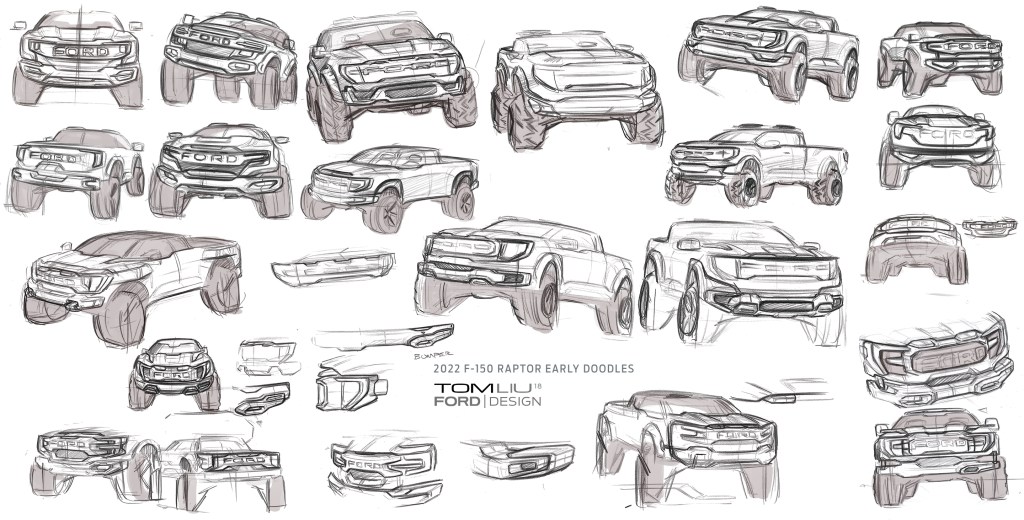
Sketches that led to a Raptor. (Image: Ford)

Notes Tony Greco, Ford Program Manager, F-150 Raptor, “It has never been as differentiated from the F-150” as it is now.

While the team behind the development of the conventional F-150 spent a lot of time with contractors and serious DIY homeowners, and while members of that team certainly own and use trucks on a daily basis, Greco says on this edition of “Autoline After Hours,” “I work with a lot of passionate off-road guys.”

So it is not entirely surprising when Greco is asked to list the top things that he says differentiate the Raptor from other vehicles, he lists:

  1. The suspension
  2. The enhanced steel frame
  3. The 37-inch tires
  4. Fox—the supplier of the internal bypass shocks with SOA electronic control technology, the largest shocks (3.1-inch diameter) ever offered on a Raptor—becoming more than a supplier, working with the team like a partner

You may notice from the list that there is a lot about the suspension, which is what Greco says they spent a lot of time concentrating on. For example, he said that when they were looking at the rear suspension, they went through the considerable parts bins at Ford—including Ford Performance, the real home of the vehicle—and didn’t find what they were looking for. So they developed a five-link suspension with extra-long trailing arms—the better to deal with the toughest terrain.

Then there are those 37-inch tires, which required frame modifications for accommodation. Why not even larger? Simply because they wanted to make sure that a full-size spare tire could be handled under the vehicle, not put in the bed, which would take away from the ability to haul stuff. Remember—while this truck can do Baja, it can also carry things on that weekend Home Depot run.

Greco also notes that the design of the Raptor pushes things to an extreme that speaks to the capability of the truck.

While there is another truck that has come on the scene of late that challenges the Raptor—the Ram 1500 TRX—Greco says with the Raptor, which debuted in MY 2010, they created a segment and are not giving it up—to anyone. He also says that the team knew what they wanted to achieve when they started on the 2021 vehicle, and kept to it, regardless of the introduction of the new competitor.

Greco talks with “Autoline’s” John McElroy, freelance writer (and truck guy) Mark Williams, and me on the show.

In addition McElroy, Williams and I discuss a variety of other subjects, including the MY 2022 Nissan Frontier (the third generation of that midsize pickup); the acceptance of the truck community of new vehicles coming from new companies that happen to have electric motors; the California DMV automated vehicle disengagement performance in 2020 by GM Cruise and Waymo; and a whole lot more.

Watch this edition of “Autoline After Hours” right here.

The Cadillac CT4-V Blackwing & CT5-V Blackwing: Yes, “Cadillac”

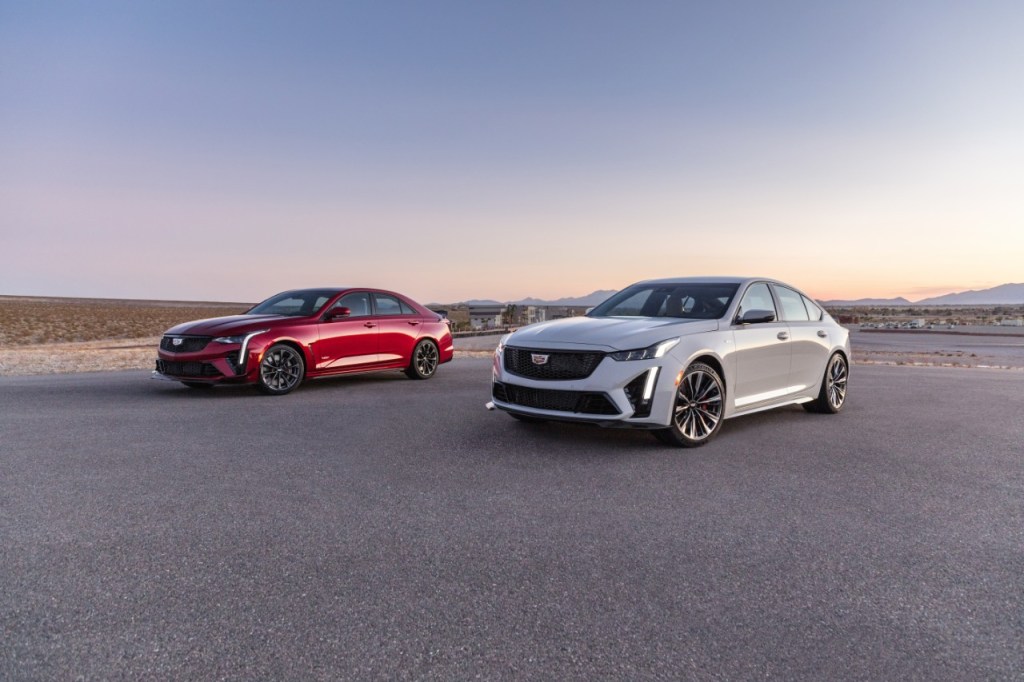
If when you think “Cadillac” you think of something big and lush and lumbering like the Escalade (no offense to the SUV, but it is 211 inches long and weighs up to 6,015 pounds, a.k.a., three tons), then the 2022 V-Series Blackwing vehicles are going to absolutely upend that notion: The CT5-V Blackwing is powered by a hand-built (think about that for a moment) 668-hp. 6.2-liter supercharged V8 mated to a six-speed manual TREMEC transmission; the sedan has a top speed of over 200 mph.

Then there’s the CT4-V Blackwing, which is smaller, a subcompact, and is certainly no slouch, as it is fitted with a 3.6-liter twin-turbo V6 such that it has an estimated top speed of 189 mph. Equipped with the optional 10-speed automatic (which is also available for the other car), it has an estimated 0 to 60 mph in 3.8 seconds.

2022 CT4-V Blackwing (left) and CT5-V Blackwing (right): engineered to perform. (Image: Cadillac)

Of course, when you go fast you also need to, well, stop, so there are serious Brembos deployed, with the CT5-V Blackwing featuring the largest factory-installed brakes in Cadillac history: 15.67 x 1.42-inch front rotors and 14.7 x 1.1-inch rear rotors. (There is also a lightweight carbon-ceramic brake package available, which is helpful in track situations, in particular, as it reduces unsprung mass by 53 pounds and rotating mass by 62 pounds.)

At this point you might be wondering why these vehicles are being named with their full names. That’s because you can go to a Cadillac dealership and buy a CT4 or a CT5. Or you can buy a CT4-V or a CT5-V.

The Blackwing execution is a whole different thing.

And so to that end, on this edition of “Autoline After Hours” Tony Roma, chief engineer of Cadillac V-Series Blackwing, provides a deep dive into the features that they’ve brought to the vehicles in order to make them track-capable vehicles straight out of the dealer’s showroom.

Roma talks with “Autoline’s” John McElroy, Chris Paukert of Roadshow by CNET and me.

Roma says that their objective was to make a vehicle that is “light, nimble and precise.”

Which is arguably what some people might not think about when it comes to Cadillacs.

Then McElroy, Paukert and I discuss a variety of other subjects, including Cadillac’s electric future (Roma is also the chief engineer for the forthcoming, ultra-luxury Celestiq electric vehicle), the agreement between Google and Ford and the whole issue of data monetization, January sales and a whole lot more.

And you can see it all here.–gsv

Does Tueor Technologies Have a Better Idea for Vehicle Control Systems?

Although one of the claimed benefits of the Digital Current System (DCS) developed by Tueor Technologies is that it is “hack-proof,” what is possibly more compelling is that according to Dan Greene, chief operations officer for the company, is that it eliminates from 80 to 90% of the wiring needed for a vehicle’s electrical control system.

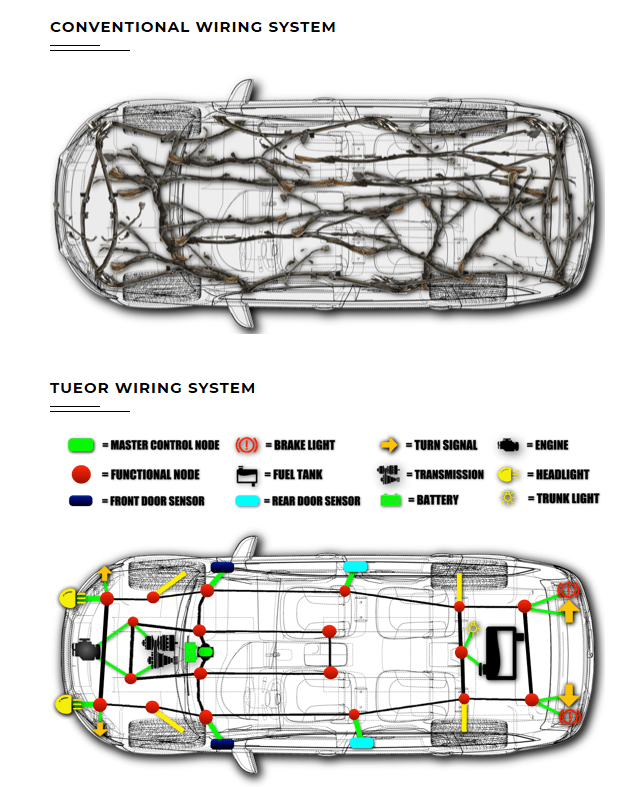
Just one loop of coaxial cable. It carries power. It carries data. It combines grounding and feedback.

There is a master control node running the system. There are sensor nodes, switching nodes and slave nodes. Each of the nodes has a varying level of intelligence, from obtaining information to essentially doing a single task, such as locking and unlocking a door.

Tueor’s simple, safe system. (Image: Tueor Technology)

Should the cable break, the DCS keeps working, Greene says.

The unhackability is predicated on the fact that it is a closed system and should there be an update necessary—over-the-air or otherwise—it cannot be loaded into a vehicle system unless there is explicit permission given by the owner. And to prevent something non-desirable from piggybacking onto a valid update, Greene says a check-sum system can be setup so if something is supposed to be X and it is seen to be X + 1, then it will not be permitted to load into the system.

According to Greene, Tueor began its work on the system to address the ability to hack medical devices like pacemakers and insulin pumps. Then they moved on to satellites. Then to military vehicles, working with AM General on the Stryker armored vehicle.

Auto application?

Not yet.

Seems that OEMs and suppliers are not engaging with the Tueor team.

Greene and his colleague John Dinkel talk about the DCS on “Autoline After Hours” to “Autoline’s” John McElroy; Henry Payne, auto critic for the Detroit News; and me.

Then John, Henry and I discuss a number of subjects, with a particular focus on electric vehicles, as Henry is an enthusiastic owner of a Tesla Model 3 and as on the day of the show GM’s Mary Barra announced that the corporation plans to be carbon-neutral in both its operations and products by 2040. Part of that undertaking includes “an aspiration to eliminate tailpipe emissions from new light-duty vehicles by 2035,” which means an increase in the number of vehicles it puts on the road that don’t have internal combustion engines but possibly frunks under the hoods.

We talk about innovation and corporate cultures. And a whole lot more.

All of which can be seen right here.

Gentex: Mirrors and Much, Much More

That rear-view mirror you have in your vehicle? It was probably made by Gentex Corp., a company on the west side of Michigan that completely dominates the market

And if you have a Homelink button that is fitted within the housing of that mirror (or elsewhere, for that matter), know that Homelink is a Gentex development.

If you’ve been in a Cadillac CT6 and saw that the rear-view mirror was not just a reflective surface but through activation was transformed into a video monitor showing what is behind the car even if there happens to be members of an NBA team sitting in the backseat and consequently obstructing the view, know that that was a Gentex development.

Gentex mirror that is both a typical reflective type as well as a video screen fed by a back-mounted camera. (Image: Gentex)

The company, which started out as a provider of smoke detectors, has become an instrumental part of safe vehicle operation (if you’ve ever tried to drive without your mirrors, you know that it is a dodgy situation—at best).

One of the things that’s interesting about Gentex is that while it has expertise in glass processing (no surpsie), it has extended its range to accommodate capabilities in electronics and microelectronics, software, chemistry, sensors and more.

This, explains Neil Boehm, chief technology officer, is driving the company to develop things that go well beyond what might be expected.

For example, imagine when there are shared autonomous vehicles. Nowadays, although there is a reduced number of people who smoke (and even vaping has taken a bit of a downward turn), let’s say that there is someone in an AV—one that you might be the next in line to get—who lights up a stogie. Boehm says that they’ve taken their knowhow in the smoke detector arena and have developed a system that can be embedded in the HVAC system: Smoke is detected and—remember, there’s that electronics capability (that goes well beyond Homelink)–a message is automatically sent to the AV service provider, which then knows it may have to bring that vehicle back to the depot. And another message—possibility along with the notification of a fine—can be sent to the phone of the cigar smoker.

Boehm talks about these and other developments (e.g., electrochromatic windows; V2I toll and gas pump paying technology; nanofibers that can detect explosives [think of an AV being used as a mobile bomb—an unfortunate thing to have to consider]) on this edition of “Autoline After Hours” with “Autoline’s” John McElroy, Lindsay Brooke, editor-in-chief at SAE International, and me. Gentex is obviously a company that is leveraging its people’s imaginations as well as the developed technologies.

McElroy, Brooke and I also talk about an array of other subjects, including Microsoft’s partnership with General Motors on the Cruise AV program, whether Apple is going to get into the automobile business and what company might manufacture the vehicle, and the implications of the microchip shortage on the auto industry, which has led to the stoppage of production at plants the world over, and something that may have implications going forward for the auto industry.

And you can see the show here. —gsv

Sandy Munro on Tesla, Three-Wheelers and Flying Vehicles

From a functional and executional standpoint, there is probably no one who is more well versed in Tesla than Sandy Munro, who established the lean design, engineering and manufacturing consultancy, Munro & Associates in 1988. The teardowns and analyses that he and his colleagues have performed on Tesla models have become the stuff of grist for the never-stopping mill that is a phenomenon since the vehicles started rolling out of the Fremont, California factory. Has there been an auto company’s products that has garnered more attention? It seems unlikely.

Obviously, once a vehicle has been completely disassembled and assessed, it isn’t the sort of thing in which it is possible to take for a ride.

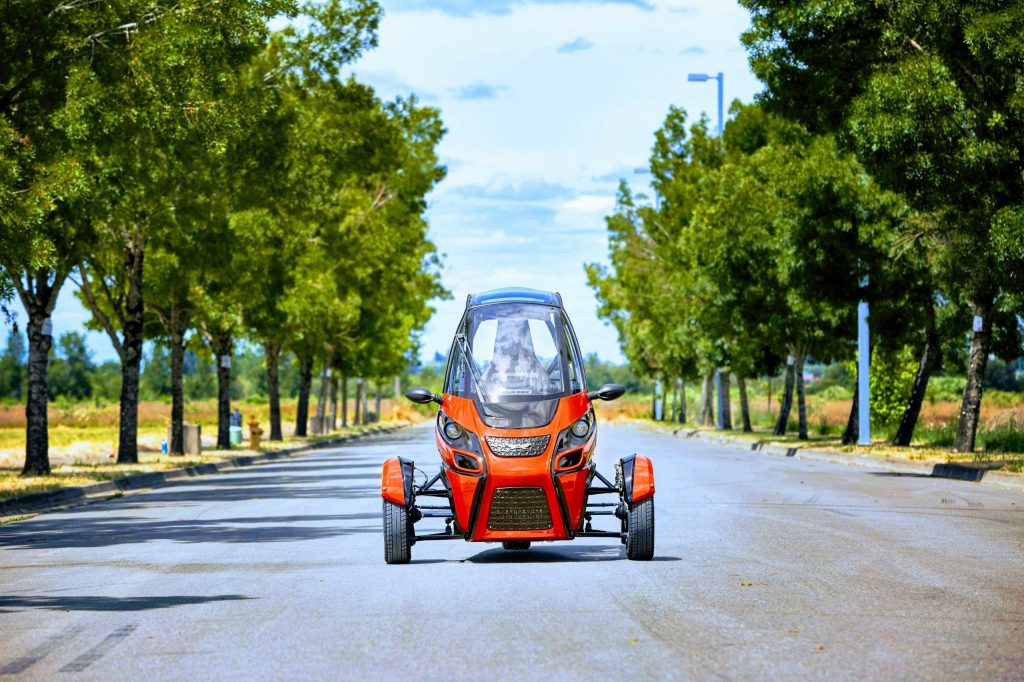
Arcimoto three-wheeler. (Image: Arcimoto)

So on this edition of “Autolline After Hours” Munro talks about how he has acquired another Model 3. . .and this time he and company president Cory Steuben are going to take it on a road trip, where they will make a determination of everything from how the battery works in the winter of the upper Midwest to the heat of the southwest to how hands-off the Tesla FSD (full-self driving computer system) actually is.

In addition to which, Munro talks to “Autoline’s” John McElroy, “Autoline’s” West Coast correspondent Chase Drum and me about what he sees as what is likely to become a growing automotive trend: three-wheel vehicles, like the products developed by Aptera Motors and Arcimoto. Munro explains that these electric vehicles are highly efficient and enjoyable to drive.

What’s more, a couple days before the show GM’s Mary Barra, in a presentation for CES, revealed a concept, the Cadillac Halo, an electric powered, four-rotor VTOL craft. Munro, who has also done extensive work on aircraft, thinks that there is likely to be a proliferation of personal aircraft for commuting.

While this might seem to be something that will be happening in the Jetson’s future, Munro anticipates such transformations in transportation in a matter of years—a few, not many.

And about that Tesla test drive: Munro says that he’ll also take the opportunity to. . .eat a lot of hamburgers.

And you can see it—the show, not the burgers—here.–gsv